John Edward Costigan Art

American, 1888-1972
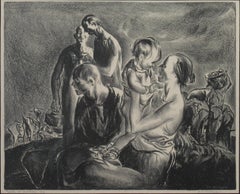
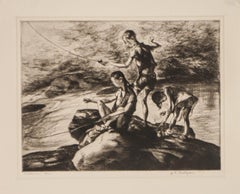
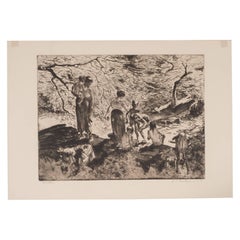
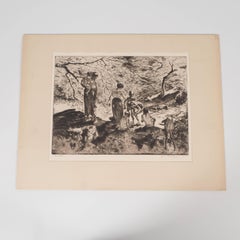
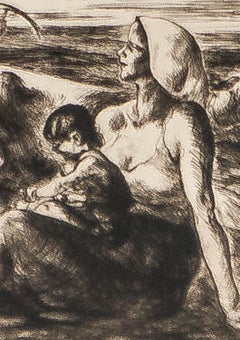
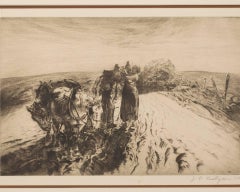
An American Painter Compositional painter of figures and country animals; watercolor painter Costigan was a largely self-taught artist. He moved from Providence, Rhode Island to New York City as an orphaned teenager in 1904 to work for a commercial poster company. It was here that he learned the rudiments of drawing and painting, skills he furthered with informal study at New York's Kit Kat Club, a popular artists' hangout. Costigan achieved national fame as a painter and printmaker in the1920s and 30s. He won numerous prestigious awards and, despite his lack of formal artistic training, was elected a full member of the National Academy of Design. In 1937 the Smithsonian Institution held a one-person exhibition of his graphic works. Famed American printmaker John Taylor Arms praised Costigan as "a brilliant etcher, particularly noted for his interpretation of life on the American farmstead." Today prints by Costigan can be found in private and public collections around the nation, including the Prints and Photographs Division of the Library of Congress in Washington, which owns twenty-two. The Swope exhibition is the largest devoted to Costigan's work since the late 1960s. Many of the forty-five prints in the exhibition are from the Swope's own extensive holdings of Costigan's works. Other are being lent by private collectors from around the country.
to
11
11
10
3
1
1
1
1
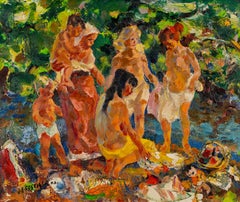
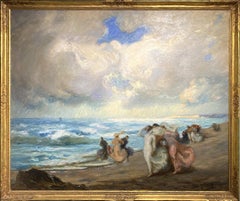
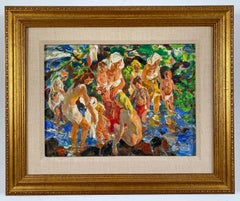
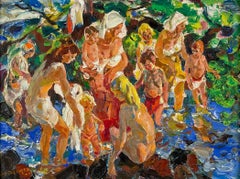
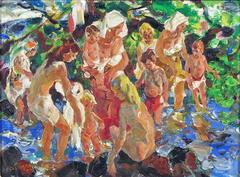
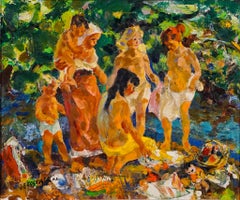
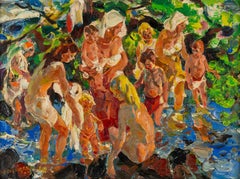
Bathing Group
Bathing Group

Bathing Group

By John Edward Costigan

Located in Sheffield, MA

John Edward Costigan American, 1888-1972 Bathing Group Oil on canvas board 12 by 16 in, w/ frame 19 by 23 in Signed ‘J.E. Costigan N.A.’ lower left John Costigan was born of Irish-...

Category

Mid-20th Century Modern John Edward Costigan Art

Materials

Oil

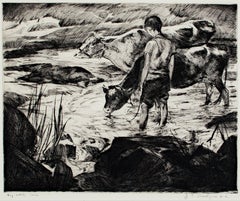
Fisherman Three  1939 original signed etching by John E. Costigan

Fisherman Three 1939 original signed etching by John E. Costigan

By John Edward Costigan

Located in Paonia, CO

Fisherman Three is an original 1939 signed etching by the American artist John E. Costigan ( 1888-1972 ) a self-taught painter and printmaker. The locale for Costigan...

Category

Mid-20th Century Other Art Style John Edward Costigan Art

Materials

Etching

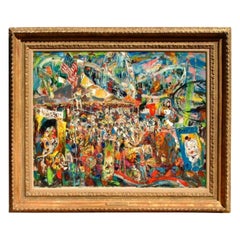
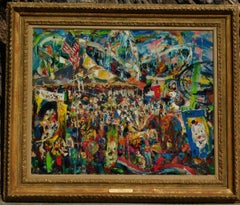
John Edward Costigan Painting, circa 1950's - Carnival

John Edward Costigan Painting, circa 1950's - Carnival

By John Edward Costigan

Located in Phoenix, AZ

John Costigan (1888-1972) oil on canvas, circa: 1950s. In excellent condition. Exciting Expressionist Painting of a lively Carnival Scene. Signed lower right: ''J.E. Costigan", Title...

Category

Mid-20th Century John Edward Costigan Art

Materials

Paint

Woman and Child
Woman and Child

Woman and Child

By John Edward Costigan

Located in Sheffield, MA

John Edward Costigan, N.A. American, 1888-1972 Woman and Child Oil on canvas Signed ‘J.E. Costigan N.A.’ lower left 24 by 30 in. W/frame 32 by 38 in. John Costigan was born of Irish-American parents in Providence, Rhode Island, February 29, 1888. He was a cousin of the noted American showman, George M. Cohan, whose parents brought the young Costigan to New York City and was instrumental in starting him on a career in the visual arts. They were less successful in encouraging him to pursue formal studies at the Art Students League (where, however, he later taught) than in exposing him to the commercial art world through the job they had gotten him with the New York lithographing firm that made their theatrical posters. At the H. C. Miner Lithographing Company, Costigan worked his way up from his entry job as a pressroom helper, through various apprenticeships, to the position of sketch artist. In the latter capacity he was an uncredited designer of posters for the Ziegfeld Follies and for numerous silent films. Meanwhile, he had supplemented his very meager formal studies in the fine arts with a self-teaching discipline that led to his first professional recognition in 1920 with the receipt of prizes for an oil painting and watercolor in separate New York exhibitions. A year earlier, Costigan had wed professional model Ida Blessin, with whom he established residence and began raising a family in the sleepy little rural New York hamlet of Orangeburg, the setting for the many idyllic farm landscapes and wood interiors with which he was to become identified in a career that would span half a century. John Costigan’s first national recognition came in 1922 with his winning of the coveted Peterson Purchase prize of the Art Institute of Chicago for an oil on canvas, “Sheep at the Brook.” It marked the start of an unbroken winning streak that would gain him at least one important prize per year for the remainder of the decade. The nation’s art journalists and critics began to take notice, making him the recurring subject of newspaper features and magazine articles. The eminent author and critic Edgar Holger Cahill was just a fledgling reporter when he wrote his first feature, “John Costigan Carries the Flame,” for Shadowland Magazine in 1922. Costigan had his first one-man show of paintings at the Rehn Gallery on New York’s 5th Avenue in November, 1924, to be followed less than three years later by another at the Art Institute of Chicago. In addition, Costigan’s work has been—and continues to be included, side-by-side with that of some of America’s most high-profile artists, in museum and gallery exhibitions throughout the country. His renown had peaked in the early 1930s, by which time his work had been honored with nearly every major award then being bestowed in the fine arts and had been acquired for the permanent collections of several prestigious American museums, including New York’s Metropolitan (which only recently, in 1997, deaccessioned his “Wood Interior,” acquired in 1934). Although Costigan’s celebrity had ebbed by the late 1930s, the Smithsonian Institution saw fit in 1937 to host an exhibition exclusively of his etchings. And, in 1941, the Corcoran Gallery (also Washington, D.C.) similarly honored him for his watercolors. (Another Washington institution, the Library of Congress, today includes 22 Costigan etchings and lithographs in its permanent print collection.) During World War II, Costigan returned briefly to illustrating, mainly for Bluebook, a men’s pulp adventure magazine. A gradual revival of interest in his more serious work began at the end of the war, culminating in 1968 with the mounting of a 50-year Costigan retrospective at the Paine Art Center and Arboretum in Oshkosh, Wisconsin. Oils, watercolors and prints were borrowed from museums and private collections throughout the country, and the exhibition was subsequently toured nationally by the Smithsonian Institution. John Costigan died of pneumonia in Nyack, NY, August 5, 1972, just months after receiving his final prestigious award —the Benjamin West Clinedinst Medal of the Artist’s Fellowship, Inc., presented in general recognition of his “...achievement of exceptional artistic merit...” in the various media he had mastered in the course of his career. This painting depicts one of the artist's favorite themes --the farm family bathing...

Category

1940s Post-Impressionist John Edward Costigan Art
Materials

Oil

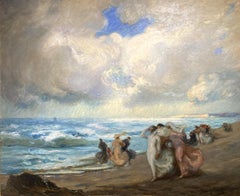
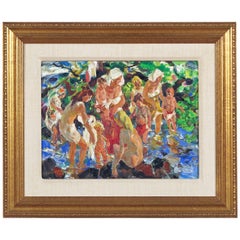
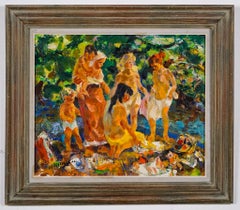
Bathing Group
Bathing Group

Bathing Group

By John Edward Costigan

Located in Sheffield, MA

John Edward Costigan American, 1888-1972 Bathers Oil on canvas 20 by 24 in, w/ frame 26 by 30 in Signed "J.E. Costigan N.A." lower left John Costigan was born of Irish-American par...

Category

Mid-20th Century Impressionist John Edward Costigan Art
Materials

Canvas, Oil

Bathers
Bathers

Bathers

By John Edward Costigan

Located in Sheffield, MA

John Edward Costigan, N.A. American, 1888-1972 Bathers Oil on canvas Signed ‘J.E. Costigan N.A.’ lower left 20 by 24 in. W/frame 26 by 30 in. John Costigan was born of Irish-American parents in Providence, Rhode Island, February 29, 1888. He was a cousin of the noted American showman, George M. Cohan, whose parents brought the young Costigan to New York City and was instrumental in starting him on a career in the visual arts. They were less successful in encouraging him to pursue formal studies at the Art Students League (where, however, he later taught) than in exposing him to the commercial art world through the job they had gotten him with the New York lithographing firm that made their theatrical posters. At the H. C. Miner Lithographing Company, Costigan worked his way up from his entry job as a pressroom helper, through various apprenticeships, to the position of sketch artist. In the latter capacity he was an uncredited designer of posters for the Ziegfeld Follies and for numerous silent films. Meanwhile, he had supplemented his very meager formal studies in the fine arts with a self-teaching discipline that led to his first professional recognition in 1920 with the receipt of prizes for an oil painting and watercolor in separate New York exhibitions. A year earlier, Costigan had wed professional model Ida Blessin, with whom he established residence and began raising a family in the sleepy little rural New York hamlet of Orangeburg, the setting for the many idyllic farm landscapes and wood interiors with which he was to become identified in a career that would span half a century. John Costigan’s first national recognition came in 1922 with his winning of the coveted Peterson Purchase prize of the Art Institute of Chicago for an oil on canvas, “Sheep at the Brook.” It marked the start of an unbroken winning streak that would gain him at least one important prize per year for the remainder of the decade. The nation’s art journalists and critics began to take notice, making him the recurring subject of newspaper features and magazine articles. The eminent author and critic Edgar Holger Cahill was just a fledgling reporter when he wrote his first feature, “John Costigan Carries the Flame,” for Shadowland Magazine in 1922. Costigan had his first one-man show of paintings at the Rehn Gallery on New York’s 5th Avenue in November, 1924, to be followed less than three years later by another at the Art Institute of Chicago. In addition, Costigan’s work has been—and continues to be included, side-by-side with that of some of America’s most high-profile artists, in museum and gallery exhibitions throughout the country. His renown had peaked in the early 1930s, by which time his work had been honored with nearly every major award then being bestowed in the fine arts and had been acquired for the permanent collections of several prestigious American museums, including New York’s Metropolitan (which only recently, in 1997, deaccessioned his “Wood Interior,” acquired in 1934). Although Costigan’s celebrity had ebbed by the late 1930s, the Smithsonian Institution saw fit in 1937 to host an exhibition exclusively of his etchings. And, in 1941, the Corcoran Gallery (also Washington, D.C.) similarly honored him for his watercolors. (Another Washington institution, the Library of Congress, today includes 22 Costigan etchings and lithographs in its permanent print collection.) During World War II, Costigan returned briefly to illustrating, mainly for Bluebook, a men’s pulp adventure magazine. A gradual revival of interest in his more serious work began at the end of the war, culminating in 1968 with the mounting of a 50-year Costigan retrospective at the Paine Art Center and Arboretum in Oshkosh, Wisconsin. Oils, watercolors and prints were borrowed from museums and private collections throughout the country, and the exhibition was subsequently toured nationally by the Smithsonian Institution. John Costigan died of pneumonia in Nyack, NY, August 5, 1972, just months after receiving his final prestigious award —the Benjamin West Clinedinst Medal of the Artist’s Fellowship, Inc., presented in general recognition of his “...achievement of exceptional artistic merit...” in the various media he had mastered in the course of his career. This painting depicts one of the artist's favorite themes --the farm family bathing...

Category

1950s Post-Impressionist John Edward Costigan Art
Materials

Oil

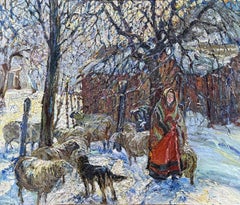
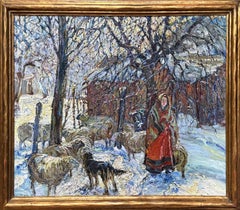
"Barnyard Winter" John Edward Costigan, Snowy Landscape, American Artist

"Barnyard Winter" John Edward Costigan, Snowy Landscape, American Artist

By John Edward Costigan

Located in New York, NY

John Edward Costigan Barnyard Winter, 1922 Signed dated lower right Oil on canvas 25 x 30 inches John Costigan was a self-taught painter and trained printer distinguished by his im...

Category

1920s American Impressionist John Edward Costigan Art
Materials

Canvas, Oil

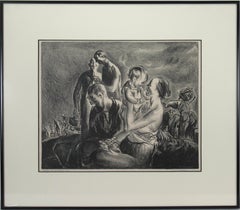
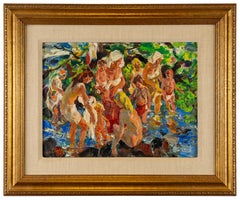
"Bathers" by John E. Costigan, Original Limited Edition Signed Etching

"Bathers" by John E. Costigan, Original Limited Edition Signed Etching

By John Edward Costigan

Located in New York, NY

This original, limited edition etching, was realized by the esteemed American artist John E. Costigan, circa 1930. He is represented in the collections of the Metropolitan Museum, th...

Category

1930s American Art Deco Vintage John Edward Costigan Art

Materials

Paper

Group of Workers
Group of Workers

Group of Workers

By John Edward Costigan

Located in San Francisco, CA

This artwork titled "Group of Workers" 1943, is an original lithograph on paper by noted American artist John Edward Costigan, 1888-1972. It is hand signed and titled in pencil by th...

Category

Mid-20th Century Realist John Edward Costigan Art

Materials

Lithograph

"When Day is Done, " an Original Etching signed by John Edward Costigan

"When Day is Done, " an Original Etching signed by John Edward Costigan

By John Edward Costigan

Located in Milwaukee, WI

"When Day is Done" is an original etching and aquatint signed lower right in pencil by the artist John Edward Costigan. It depicts a man and a woman with their young child at the end...

Category

1930s Post-Impressionist John Edward Costigan Art
Materials

Etching, Aquatint

Related Items
Behind the Frog - 21st Century Contemporary Landscape Etching

Behind the Frog - 21st Century Contemporary Landscape Etching

By Charles Donker

Located in Nuenen, Noord Brabant

Charles Donker Behind the Frog 20 x 38,5 (Framed included in price, 42 x 59 cm) Etching on paper The etchings of Charles Donker are admired and collected both in the Netherlands and...

Category

2010s Contemporary John Edward Costigan Art

Materials

Etching

Abstract Watercolor N.8 by Dmitry Samygin

Abstract Watercolor N.8 by Dmitry Samygin

By Dmitry Samygin

Located in Paris, FR

Abstract Watercolor N.8 by Dmitry Samygin Minimalist and geometric paintings. Technique: Watercolor Color: Teal blue Size: H. 35.5 x 27.5 x 0.1 cm Dmitry Samygin is a Furniture a...

Category

21st Century and Contemporary Abstract Geometric John Edward Costigan Art

Materials

Watercolor

"Divine Spontaneity II" Acrylic, Oil Pastels, Pencils Abstract Painting 48"x36"

"Divine Spontaneity II" Acrylic, Oil Pastels, Pencils Abstract Painting 48"x36"

By Karina Gentinetta

Located in New York, NY

"Divine Spontaneity II" 2023, 48" H x 36" W. Vertical abstract painting consisting of acrylics, house paint, oil pastels, color pencils, and carbon pencils on canvas by Argentine-bo...

Category

21st Century and Contemporary Abstract Expressionist John Edward Costigan Art
Materials

House Paint, Acrylic, Carbon Pencil, Oil Pastel, Color Pencil

"Georgia Moonshiner, c. 1935" by Athos Menaboni (1895-1990) American WPA Era Oil

"Georgia Moonshiner, c. 1935" by Athos Menaboni (1895-1990) American WPA Era Oil

Located in Yardley, PA

A fantastic WPA-era painting of a Georgia moonshiner by famed Italian-American artist Athos Menaboni (1895-1990). This work depicts an older man sporting a brown hat, brown jacket, ...

Category

1930s American Modern John Edward Costigan Art

Materials

Masonite, Oil

Salvador Dali - Mission Dolores - San Francisco - Original Hand-Signed Etching

Salvador Dali - Mission Dolores - San Francisco - Original Hand-Signed Etching

By Salvador Dalí­

Located in Collonge Bellerive, Geneve, CH

Salvador Dali - Mission Dolores - San Francisco - Original Hand-Signed Etching Title: Mission Dolores - San Francisco Drypoint Handsigned Dimensions: 65 x 50 cm Edition EA Catalogue ...

Category

1970s Surrealist John Edward Costigan Art

Materials

Etching

Waning Moon - 21st Century Contemporary Landscape Etching

Waning Moon - 21st Century Contemporary Landscape Etching

By Charles Donker

Located in Nuenen, Noord Brabant

Charles Donker Waning Moon 23,5 x 18 (Framed included in price, 44,5 x 37 cm) Etching on paper The etchings of Charles Donker are admired and collected both in the Netherlands and a...

Category

2010s Contemporary John Edward Costigan Art

Materials

Etching

"Ranunculus II" Large Acrylic, Oil Pastels, Pencils Blush Rose Abstract 84"x60"

"Ranunculus II" Large Acrylic, Oil Pastels, Pencils Blush Rose Abstract 84"x60"

By Karina Gentinetta

Located in New York, NY

"Ranunculus II", 2024, 84" H x 60" W. Large-scale abstract painting in hues of blush crimson consisting of acrylic, pencils, and oil pastels on canvas by Argentine-born artist Karina...

Category

21st Century and Contemporary Abstract Expressionist John Edward Costigan Art
Materials

Oil Pastel, Acrylic, Carbon Pencil, Color Pencil

"Adagio in Burnt Umber" Acrylic, Oil Pastels, Pencils Brown Hue Abstract 72"x60"

"Adagio in Burnt Umber" Acrylic, Oil Pastels, Pencils Brown Hue Abstract 72"x60"

By Karina Gentinetta

Located in New York, NY

"Adagio in Burnt Umber" 2025, 72" H x 60" W. Abstract, mixed media painting consisting of acrylic, pencils, and oil pastels on canvas by Argentine-born artist Karina Gentinetta (feat...

Category

21st Century and Contemporary Abstract Expressionist John Edward Costigan Art
Materials

Oil Pastel, Acrylic, Carbon Pencil, Color Pencil

Barcelona Boulevard at Dusk Urban Landscape Oil Painting Impressionist Europe

Barcelona Boulevard at Dusk Urban Landscape Oil Painting Impressionist Europe

By Josep Marfa Guarro

Located in Sitges, Barcelona

Barcelona Boulevard at Dusk Urban Landscape Oil Painting Impressionist Artist: Josep Marfa Guarro (1928-2014) Title: Barcelona Boulevard at Dusk Medium: Oil on canvas laid on board ...

Category

1990s Impressionist John Edward Costigan Art
Materials

Oil, Cardboard, Canvas

“Still Life, 1936” by Katharine "Kitty" Duff Church British Modern Oil Signed

“Still Life, 1936” by Katharine "Kitty" Duff Church British Modern Oil Signed

Located in Yardley, PA

“Still Life, 1936” by Katharine "Kitty" Duff Church (British, 1910-1999). This large, early painting by Katherine Church is among her finest canvases of the period. Characterized by its bold color palette, simplified forms, and expressive brushwork, this composition centers around a tabletop adorned with various objects: potted plants, a ceramic dish, bottles, and what appear to be books or papers. The two potted plants provide contrasting elements: on the left, what appears to be a cyclamen with red blossoms and delicate leaves, and on the right, a lush green plant with darker foliage. These plants, painted with loose, textured strokes, add an organic quality to the otherwise structured arrangement. The tabletop is cluttered yet thoughtfully composed, featuring additional objects like a clear, faceted glass bowl, a small bottle, and books or pads in striking red and green. The dynamic use of color blocks and the juxtaposition of shapes (round pots against rectangular books) create a sense of rhythm and harmony. The background is darker and less defined, emphasizing the brightly lit tabletop. Church's brushwork is gestural and modernist, leaning toward abstraction, challenging traditional still life conventions. This painting reflects Church’s interest in balancing everyday objects with bold artistic expression. It conveys both the simplicity and complexity of daily life, transforming an ordinary moment into a vibrant and engaging work of art. This work is oil on canvas and is signed and dated in the lower right. It is housed in its original gessoed frame and retains various labels and inscriptions on the reverse. Size: 28.25 inches tall by 36 inches wide (painting) 34 inches tall by 42 inches wide by 2 inches deep (frame) Provenance: Private collection, NY; Acquired from the above About the artist: Born in Highgate, north London, Katharine Church, known as ‘Kitty’ amongst friends and family, always wanted to paint. She trained at the Royal Academy of Arts between 1930-1933 and at the Slade between 1933 and 1934. In her early years Kitty exhibited regularly at the Royal Academy. Her first solo exhibition was in 1933 at the Wertheim Gallery. Other artists who exhibited there included Christopher Wood, Victor Pasmore and Cedric Morris. Kitty also showed with the New English Art Club, the London Group and between 1937-1947 her work was exhibited at the influential Lefevre Gallery, which supported avant-garde artists such as Henry Moore, Ben Nicholson and Barbara Hepworth. In 1954 the artist was invited to take part in the Figures in their setting exhibition held at the Tate Gallery. Henry Tonks and Philip Wilson Steer had a strong influence on Kitty’s early work, but it was her friendship with Ivon Hitchens that liberated her painting technique. In 1936 Kitty married Anthony West, the son of writers Rebecca West and H.G. Wells. The couple initially lived in London before moving to Quarry Farm, Chicksgrove, Tisbury, near Salisbury, where they brought up their children Caroline and Edmund. There they hosted many of their friends, including the New Zealand painter Frances Hodgkins. Other regular visitors before the War included John and Mywafany Piper, Ralph and Frances Partridge, Noel and Catharine Carrington, Julian Trevelyan and Mary Fedden. For many of those who visited Kitty would organise painting expeditions. After the war Kitty and Anthony separated, with Anthony moving to the United States. Anthony West moved to the United States to work as a journalist for The New Yorker. In the early years after their parting Kitty visited most years with the children. In the 1960s Kitty purchased Sutton House and ran the Hambledon Gallery at Blandford Forum. There she promoted the work of her early art-school friends Mary Fedden and Julian Trevelyan, alongside work by the Pipers, John Craxton...

Category

1930s Modern John Edward Costigan Art

Materials

Canvas, Oil

"Verdigris" Large Scale Acrylic, Oil Pastels and Pencils Green Abstract 84"x60"

"Verdigris" Large Scale Acrylic, Oil Pastels and Pencils Green Abstract 84"x60"

By Karina Gentinetta

Located in New York, NY

"Verdigris" 2025, 84" H x 60" W. A captivating large-scale abstract painting by Argentine-born artist Karina Gentinetta, renowned for her work featured in Architectural Digest, Elle...

Category

21st Century and Contemporary Abstract Expressionist John Edward Costigan Art
Materials

Oil Pastel, Acrylic, Carbon Pencil, Color Pencil

Forest VII - 21st Century Contemporary Landscape Etching

Forest VII - 21st Century Contemporary Landscape Etching

By Charles Donker

Located in Nuenen, Noord Brabant

Charles Donker Forest VII 29,5 x 23,8 (Framed included in price, 52,5 x 45 cm) Etching on paper The etchings of Charles Donker are admired and collected both in the Netherlands and ...

Category

2010s Contemporary John Edward Costigan Art

Materials

Etching

Previously Available Items
Cutting Foddor original 1938 etching by John Costigan

Cutting Foddor original 1938 etching by John Costigan

By John Edward Costigan

Located in Paonia, CO

Cutting Fodder, also known as Family in the Field, is an original signed 1938 etching by the American artist John E. Costigan ( 1888-1972 )a self-taught painter and printmaker. ...

Category

Mid-20th Century Other Art Style John Edward Costigan Art

Materials

Etching

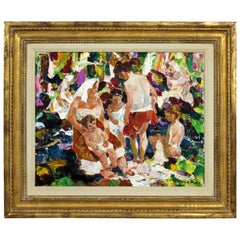
Bathing Group
Bathing Group

Bathing Group

By John Edward Costigan

Located in Sheffield, MA

John Edward Costigan, N.A. American, 1888-1972 Bathing Group Oil on canvas board Signed ‘J.E. Costigan N.A.’ lower left 12 by 16 in. W/frame 20 by 24 i...

Category

1950s Post-Impressionist John Edward Costigan Art
Materials

Oil

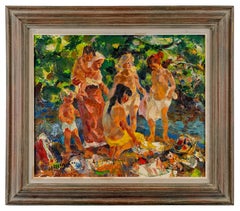
Mid Century Modern Framed Oil Painting Canvas by John E. Costigan The Bathers

Mid Century Modern Framed Oil Painting Canvas by John E. Costigan The Bathers

By John Edward Costigan

Located in Keego Harbor, MI

For your consideration is an outstanding, framed oil painting on canvas, "The Bathers," signed by John Edward Costigan. In excellent condition. The dimensions of the frame are 26" W ...

Category

Mid-20th Century American Mid-Century Modern John Edward Costigan Art
Materials

Canvas, Paint

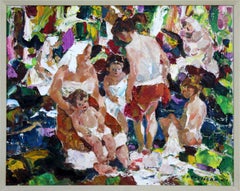
"Bathing Group" Painting by John Edward Costigan

"Bathing Group" Painting by John Edward Costigan

By John Edward Costigan

Located in Sheffield, MA

John Edward Costigan, N.A. American, 1888-1972. Bathing Group. Oil on canvas board. Signed ‘J.E. Costigan N.A.’ lower left. Measures: 12 by 16 in. With ...

Category

1960s American Vintage John Edward Costigan Art
John Edward Costigan art for sale on 1stDibs.
Find a wide variety of authentic John Edward Costigan art available for sale on 1stDibs. You can also browse by medium to find art by John Edward Costigan in etching, oil paint, paint and more. Much of the original work by this artist or collective was created during the 20th century and is mostly associated with the Post-Impressionist style. Not every interior allows for large John Edward Costigan art, so small editions measuring 15 inches across are available. Customers who are interested in this artist might also find the work of Charles Picart le Doux, Henri Riviere, and Edwin Georgi. John Edward Costigan art prices can differ depending upon medium, time period and other attributes. On 1stDibs, the price for these items starts at $600 and tops out at $9,850, while the average work can sell for $2,100.
Artists Similar to John Edward Costigan