John Groth Art

to
3
1
Overall Width
to
Overall Height
to
4
1
2
1
2
2
3
3
2
1
1
1
1
1
1
3
1
1
1
4
11,124
2,854
2,494
1,436
1
4
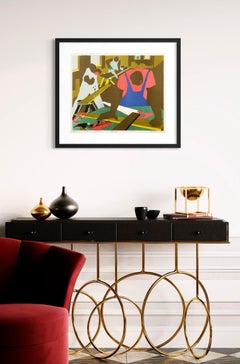
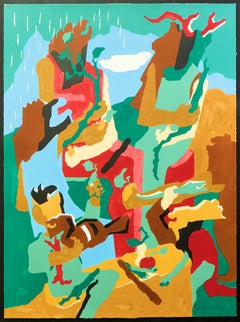
Artist: John Groth
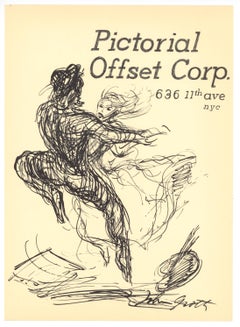
original lithograph

original lithograph

By John Groth

Located in Henderson, NV

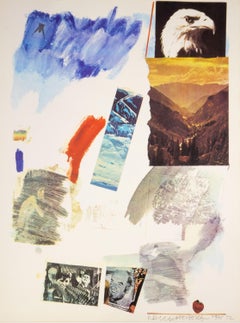
Medium: original lithograph. This lithograph was printed in 1957 for the "Improvisations" portfolio, published by the Artists Equity Association of New York on the occasion of the 19...

Category

1950s John Groth Art
Materials

Lithograph

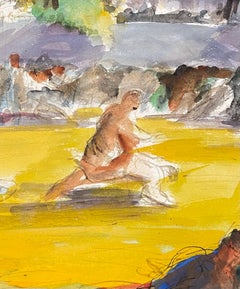
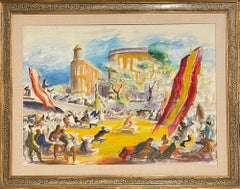
Large Watercolor Painting John Groth, Men Wrestling, Esquire Magazine WPA Artist

Large Watercolor Painting John Groth, Men Wrestling, Esquire Magazine WPA Artist

By John Groth

Located in Surfside, FL

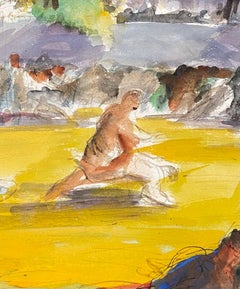
John August Groth (American, 1908-1988) "Wrestling Match," Watercolor painting, hand signed upper right and inscribed upper left, "Las Palmas Canary Islands Lucha Canary Wrestling...

Category

Mid-20th Century American Modern John Groth Art

Materials

Paper, Watercolor

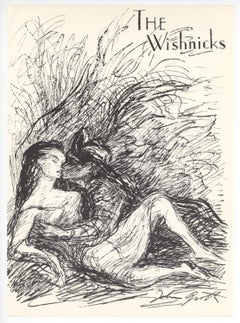
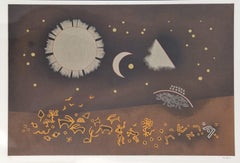
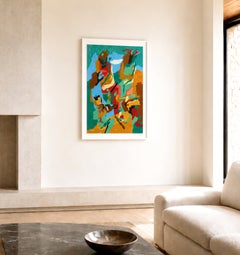
original lithograph

original lithograph

By John Groth

Located in Henderson, NV

Medium: original lithograph. This lithograph was printed in 1956 for the "Improvisations" portfolio, published by the Artists Equity Association of New York on the occasion of the 19...

Category

1950s John Groth Art
Materials

Lithograph

Related Items
"Le port de New York" original lithograph

"Le port de New York" original lithograph

By Paul Guiramand

Located in Henderson, NV

Medium: original lithograph. Printed in Paris in 1964 by Mourlot Freres and issued in an edition of 2000 on Arches wove paper. Size: 10 x 7 1/2 inches (255 x 185 mm). Not signed.

Category

1960s John Groth Art
Materials

Lithograph

Marc Chagall, Clown avec Chèvre Jaune, lithograph, hand signed

Marc Chagall, Clown avec Chèvre Jaune, lithograph, hand signed

By Marc Chagall

Located in Chatsworth, CA

Marc Chagall Clown a la chevre jaune, 1982 Original lithograph in colors on Arches paper Hand signed in pencil and numbered 43/50 from the edition of 50 Dimensions: 35 x 23 inches Fr...

Category

1980s Modern John Groth Art
Materials

Lithograph

Marc Chagall - Homage to Marc Chagall - Original Lithograph

Marc Chagall - Homage to Marc Chagall - Original Lithograph

By Marc Chagall

Located in Collonge Bellerive, Geneve, CH

Marc Chagall Original Lithograph 1969 From the revue XXe Siecle, edition of 12,000 Unsigned, as issued Dimensions: 32 x 24 Condition : Excellent Reference: Mourlot 572 Marc Chagall (born in 1887) Marc Chagall was born in Belarus in 1887 and developed an early interest in art. After studying painting, in 1907 he left Russia for Paris, where he lived in an artist colony on the city’s outskirts. Fusing his own personal, dreamlike imagery with hints of the fauvism and cubism popular in France at the time, Chagall created his most lasting work—including I and the Village (1911)—some of which would be featured in the Salon des Indépendants exhibitions. After returning to Vitebsk for a visit in 1914, the outbreak of WWI trapped Chagall in Russia. He returned to France in 1923 but was forced to flee the country and Nazi persecution during WWII. Finding asylum in the U.S., Chagall became involved in set and costume design before returning to France in 1948. In his later years, he experimented with new art forms and was commissioned to produce numerous large-scale works. Chagall died in St.-Paul-de-Vence in 1985. The Village Marc Chagall was born in a small Hassidic community on the outskirts of Vitebsk, Belarus, on July 7, 1887. His father was a fishmonger, and his mother ran a small sundries shop in the village. As a child, Chagall attended the Jewish elementary school, where he studied Hebrew and the Bible, before later attending the Russian public school. He began to learn the fundamentals of drawing during this time, but perhaps more importantly, he absorbed the world around him, storing away the imagery and themes that would feature largely in most of his later work. At age 19 Chagall enrolled at a private, all-Jewish art school and began his formal education in painting, studying briefly with portrait artist Yehuda Pen. However, he left the school after several months, moving to St. Petersburg in 1907 to study at the Imperial Society for the Protection of Fine Arts. The following year, he enrolled at the Svanseva School, studying with set designer Léon Bakst, whose work had been featured in Sergei Diaghilev's Ballets Russes. This early experience would prove important to Chagall’s later career as well. Despite this formal instruction, and the widespread popularity of realism in Russia at the time, Chagall was already establishing his own personal style, which featured a more dreamlike unreality and the people, places and imagery that were close to his heart. Some examples from this period are his Window Vitebsk (1908) and My Fianceé with Black Gloves (1909), which pictured Bella Rosenfeld, to whom he had recently become engaged. The Beehive Despite his romance with Bella, in 1911 an allowance from Russian parliament member and art patron Maxim Binaver enabled Chagall to move to Paris, France. After settling briefly in the Montparnasse neighborhood, Chagall moved further afield to an artist colony known as La Ruche (“The Beehive”), where he began to work side by side with abstract painters such as Amedeo Modigliani and Fernand Léger as well as the avant-garde poet Guillaume Apollinaire. At their urging, and under the influence of the wildly popular fauvism and cubism, Chagall lightened his palette and pushed his style ever further from reality. I and the Village (1911) and Homage to Apollinaire (1912) are among his early Parisian works, widely considered to be his most successful and representative period. Though his work stood stylistically apart from his cubist contemporaries, from 1912 to 1914 Chagall exhibited several paintings at the annual Salon des Indépendants exhibition, where works by the likes of Juan Gris, Marcel Duchamp and Robert Delaunay were causing a stir in the Paris art world. Chagall’s popularity began to spread beyond La Ruche, and in May 1914 he traveled to Berlin to help organize his first solo exhibition, at Der Sturm Gallery. Chagall remained in the city until the highly acclaimed show opened that June. He then returned to Vitebsk, unaware of the fateful events to come. War, Peace and Revolution In August 1914 the outbreak of World War I precluded Chagall’s plans to return to Paris. The conflict did little to stem the flow of his creative output, however, instead merely giving him direct access to the childhood scenes so essential to his work, as seen in paintings such as Jew in Green (1914) and Over Vitebsk (1914). His paintings from this period also occasionally featured images of the war’s impact on the region, as with Wounded Soldier (1914) and Marching (1915). But despite the hardships of life during wartime, this would also prove to be a joyful period for Chagall. In July 1915 he married Bella, and she gave birth to a daughter, Ida, the following year. Their appearance in works such as Birthday (1915), Bella and Ida by the Window (1917) and several of his “Lovers” paintings give a glimpse of the island of domestic bliss that was Chagall’s amidst the chaos. To avoid military service and stay with his new family, Chagall took a position as a clerk in the Ministry of War Economy in St. Petersburg. While there he began work on his autobiography and also immersed himself in the local art scene, befriending novelist Boris Pasternak, among others. He also exhibited his work in the city and soon gained considerable recognition. That notoriety would prove important in the aftermath of the 1917 Russian Revolution when he was appointed as the Commissar of Fine Arts in Vitebsk. In his new post, Chagall undertook various projects in the region, including the 1919 founding of the Academy of the Arts. Despite these endeavors, differences among his colleagues eventually disillusioned Chagall. In 1920 he relinquished his position and moved his family to Moscow, the post-revolution capital of Russia. In Moscow, Chagall was soon commissioned to create sets and costumes for various productions at the Moscow State Yiddish Theater, where he would paint a series of murals titled Introduction to the Jewish Theater as well. In 1921, Chagall also found work as a teacher at a school for war orphans. By 1922, however, Chagall found that his art had fallen out of favor, and seeking new horizons he left Russia for good. Flight After a brief stay in Berlin, where he unsuccessfully sought to recover the work exhibited at Der Sturm before the war, Chagall moved his family to Paris in September 1923. Shortly after their arrival, he was commissioned by art dealer and publisher Ambroise Vollard to produce a series of etchings for a new edition of Nikolai Gogol's 1842 novel Dead Souls. Two years later Chagall began work on an illustrated edition of Jean de la Fontaine’s Fables, and in 1930 he created etchings for an illustrated edition of the Old Testament, for which he traveled to Palestine to conduct research. Chagall’s work during this period brought him new success as an artist and enabled him to travel throughout Europe in the 1930s. He also published his autobiography, My Life (1931), and in 1933 received a retrospective at the Kunsthalle in Basel, Switzerland. But at the same time that Chagall’s popularity was spreading, so, too, was the threat of Fascism and Nazism. Singled out during the cultural "cleansing" undertaken by the Nazis in Germany, Chagall’s work was ordered removed from museums throughout the country. Several pieces were subsequently burned, and others were featured in a 1937 exhibition of “degenerate art” held in Munich. Chagall’s angst regarding these troubling events and the persecution of Jews in general can be seen in his 1938 painting White Crucifixion. With the eruption of World War II, Chagall and his family moved to the Loire region before moving farther south to Marseilles following the invasion of France. They found a more certain refuge when, in 1941, Chagall’s name was added by the director of the Museum of Modern Art (MOMA) in New York City to a list of artists and intellectuals deemed most at risk from the Nazis’ anti-Jewish campaign. Chagall and his family would be among the more than 2,000 who received visas and escaped this way. Haunted Harbors Arriving in New York City in June 1941, Chagall discovered that he was already a well-known artist there and, despite a language barrier, soon became a part of the exiled European artist community. The following year he was commissioned by choreographer Léonide Massine to design sets and costumes for the ballet Aleko, based on Alexander Pushkin’s “The Gypsies” and set to the music of Pyotr Ilyich Tchaikovsky. But even as he settled into the safety of his temporary home, Chagall’s thoughts were frequently consumed by the fate befalling the Jews of Europe and the destruction of Russia, as paintings such as The Yellow Crucifixion...

Category

1960s Surrealist John Groth Art
Materials

Lithograph

Eduardo Chillida Spanish Artist Original Unused Lithograph Poster

Eduardo Chillida Spanish Artist Original Unused Lithograph Poster

By Eduardo Chillida

Located in Miami, FL

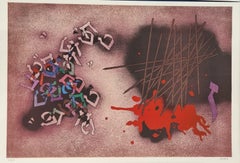
Eduardo Chillida (Spain, 1924-2002) '5 Livres Gravés', 1974 Original poster from show lithograph on paper 25.2 x 17 in. (64 x 43 cm.) Unframed Ref: CHI100-202 Eduardo Chillida He be...

Category

1970s Expressionist John Groth Art
Materials

Lithograph

A Stylish, Vintage 1940s Woman's Fashion Design Study, Marshall Field & Co.

A Stylish, Vintage 1940s Woman's Fashion Design Study, Marshall Field & Co.

Located in Chicago, IL

A stylish, vintage, 1940s fashion study featuring elegant designs for women's evening wear by Lilly Daché, Likely an illustration study for a print advertisement for the famed Chic...

Category

1940s American Modern John Groth Art
Materials

Paper, Watercolor, Pencil

A Stylish Vintage 1940s Fashion Study, Design for Women's Red Evening Gown

A Stylish Vintage 1940s Fashion Study, Design for Women's Red Evening Gown

Located in Chicago, IL

A stylish, vintage, 1940s fashion study featuring an elegant design for a woman's red gown, evening wear. Artwork size: 11 x 8 1/2 inches. Archivally matted to 16 x 12 inches. P...

Category

1940s American Modern John Groth Art
Materials

Paper, Watercolor, Pencil

A Stylish Vintage 1940s Fashion Study, Designs for Women's Active Wear

A Stylish Vintage 1940s Fashion Study, Designs for Women's Active Wear

Located in Chicago, IL

A stylish, vintage, 1940s fashion study featuring elegant designs for women's active wear by Hattie Carnegie. Inscription reads: Left - White jersey slack suit Red gaberdine jacke...

Category

1940s American Modern John Groth Art
Materials

Paper, Watercolor, Pencil

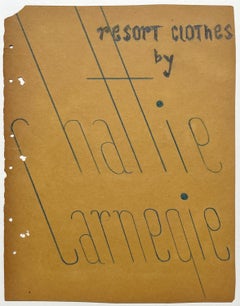
A Stylish, Vintage 1940s Woman's Fashion Study, Cover Design for Hattie Carnegie

A Stylish, Vintage 1940s Woman's Fashion Study, Cover Design for Hattie Carnegie

Located in Chicago, IL

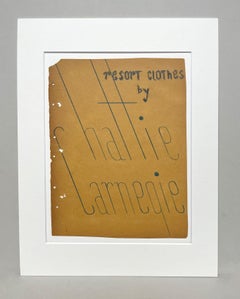
A stylish, vintage, 1940s woman's fashion study featuring an elegant graphic design for a portfolio cover featuring ladies resort clothes by Hattie Carnegie. Artwork size: 11 x 8...

Category

1940s American Modern John Groth Art
Materials

Paper, Pencil, Color Pencil, Watercolor

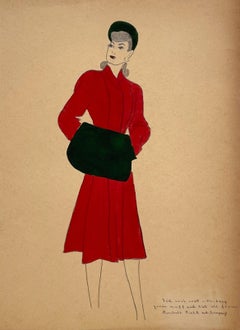
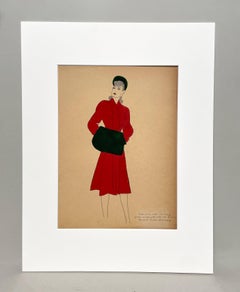
A Stylish, Vintage 1940s Woman's Fashion Design Study, Marshall Field & Co.

A Stylish, Vintage 1940s Woman's Fashion Design Study, Marshall Field & Co.

Located in Chicago, IL

A stylish, vintage, 1940s fashion study featuring an elegant design for a woman's coat, hat and muff, inscribed "Marshall Field & Co". Likely an advertisement illustration study...

Category

1940s American Modern John Groth Art
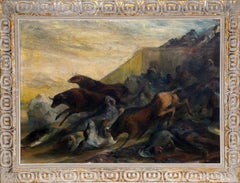
Materials

Paper, Watercolor, Pencil

A Striking, Vintage Early 1940s Fashion Study, Woman with a Suit, Hat & Purse

A Striking, Vintage Early 1940s Fashion Study, Woman with a Suit, Hat & Purse

Located in Chicago, IL

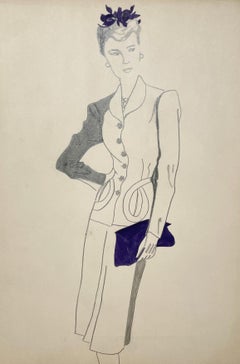
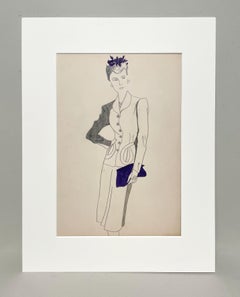
A striking, vintage early 1940s fashion study featuring an elegant young woman wearing a stylish hat, suit and clutch. Image size: 11 x 8 1/4 inches. Archivally matted to 16 x 1...

Category

1940s American Modern John Groth Art
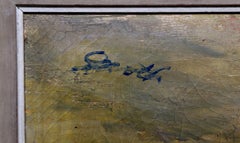
Materials

Paper, Watercolor, Pencil

Colorful 1950s Standing Male Bather in South of France by Andre Delfau

Colorful 1950s Standing Male Bather in South of France by Andre Delfau

By Andre Delfau

Located in Chicago, IL

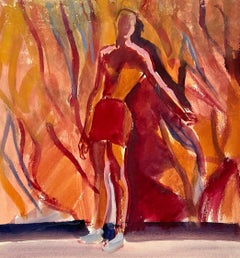
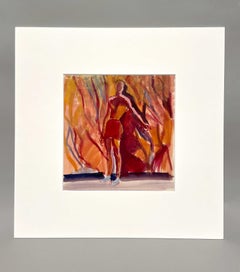
A vibrant 1950s Modern watercolor of a standing male bather in red & orange tones by notable French artist Andre Delfau. Painted in the south of France along the Cote d' azure (...

Category

1950s American Modern John Groth Art

Materials

Watercolor, Paper

A Stylish, Vintage 1940s Woman's Fashion Study, Town and Country, Blum’s Vogue

A Stylish, Vintage 1940s Woman's Fashion Study, Town and Country, Blum’s Vogue

Located in Chicago, IL

A stylish, vintage, 1940s fashion study featuring an elegant design for a woman's autumn suit. Inscription reads: "Brown and grey suit and cape affair from Town and Country, Blum's ...

Category

1940s American Modern John Groth Art

Materials

Paper, Watercolor, Pencil

Previously Available Items
Large Watercolor Painting John Groth, Men Wrestling, Esquire Magazine WPA Artist

Large Watercolor Painting John Groth, Men Wrestling, Esquire Magazine WPA Artist

By John Groth

Located in Surfside, FL

John August Groth (American, 1908-1988) "Wrestling Match," Watercolor painting, hand signed upper right and inscribed upper left, "Las Palmas Canary Islands Lucha Canary Wrestling". Framed Size: 21'' x 29'', 53 x 74 cm (sight); 28.5'' x 36.25'', 72 x 92 cm (frame). Depiction of a wrestling match in a city square. John August Groth (1908 - 1988) was an illustrator and art teacher. He gained recognition as a war correspondent-illustrator. He studies at the Art Institute of Chicago and at Art Students League with Todros Geller, Robert Brackman, Arnold Blanch and George Grosz. He was a member: Society of American Etchers; American Newspaper Guild; Society of Illustrators; Associate Member of the National Academy of Design; American Water Color Society. Positions : Art Director at Esquire 1933 - 1937, Parade Publications 1941 - 1944; War Correspondent for Chicago Sun 1944; American Legion Magazine 1945; Artist-Correspondent in Vietnam 1967.Teacher at Art Students LeagueHe was the first art director of Esquire Magazine and taught at the Art Students League, the Pratt Institute, and the Parsons School of Design. In 1940, he was included in an exhibition at MOMA, titled, "PM Competition: The Artist as Reporter." The exhibition included Philip Guston, Reginald Marsh, John Tworkov, John Heliker, Adolf Dehn, and Chet La More. Groth began sketching intently during the Great Depression after studying at the Art Institute of Chicago. Following the advice of an editor, he penned 100 sketches a day for years. He learned to increase his speed by listening to sports on the radio and sketching the action as fast as he could. "I would listen to the games on the radio at night, and sketch the plays. It made me very quick." His break came when Arnold Gingrich, an editor for Esquire magazine, approached him at an art show in Chicago and offered him a position. "The way (Arnold Gingrich) told it," John Groth says, "he found this barefoot, bearded kid in the park, and the next day made him art director of the world's leading men's fashion magazine. But I swear I was wearing shoes." Groth went on to work as a correspondent and illustrator for the Chicago Sun, Collier's, Sports Illustrated, and The Saturday Evening Post. He developed a passion for war zones. He covered six different wars and was one of the first correspondents in Paris after its liberation. "It is only at war that I feel complete... There, you meet all sort of men -- farmers, mechanics, college professors. It rains on them and it rains on you. The shells burst in the air, and you are there, too." He would make a splash when he beat out friend and rival, Ernest Hemingway, into Paris in 1944. Hemingway was writing for the Chicago Tribune and Groth for the Chicago Sun. Groth was in the first jeep into Paris and got the scoop. His headline read, "Yanks are in Paris!" Hemingway would later write about Groth's technique. “None of us understood the sort of shorthand he sketched in. The men would look at the sketches and see just a lot of lines. It was a great pleasure to find what fine drawings they were when we got to see them. Groth went on to illustrate such classic books as: A Christmas Carol, All Quiet on the Western Front, The Grapes of Wrath, The War Prayer, and Gone with the Wind. Deborah Churchman described Groth's work in a 1980 Washington Post article: "Groth's pictures center on the day-to-day life of people caught in terrifying circumstances -- armies occupying cities, soldiers sweeping roads for land mines, bullfighters facing death." Bernie Schonfeld, a photographer for Life Magazine said of Groth, "John is one of the gentlest people in the world, and he always gets himself into the wildest hell hole." He joined the First Congress of American Artists Against War and Fascism in 1936, along with Stuart Davis, Peter Blume...

Category

Mid-20th Century American Modern John Groth Art

Materials

Paper, Watercolor

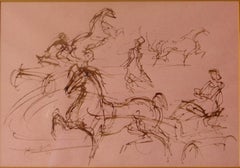
1962 Horse Show
1962 Horse Show

John Groth1962 Horse Show, 1962

Sold

H 16.25 in W 21.75 in D 0.75 in

1962 Horse Show

By John Groth

Located in San Francisco, CA

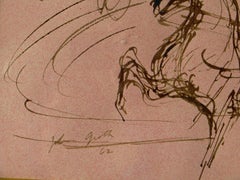
Artist: John Groth – American (1908-1988) Title: 1962 Horse Show Year: 1962 Medium: Drawing: sepia ink wash on paper Sight Size: 12.25 x 18 inches. 31.1 x ...

Category

1960s American Modern John Groth Art

Materials

Paper, Ink

John Groth art for sale on 1stDibs.

Find a wide variety of authentic John Groth art available for sale on 1stDibs. You can also browse by medium to find art by John Groth in lithograph, paint, canvas and more. Much of the original work by this artist or collective was created during the 20th century and is mostly associated with the modern style. Not every interior allows for large John Groth art, so small editions measuring 9 inches across are available. Customers who are interested in this artist might also find the work of Alfred Wands, Ruth Gikow, and Frank Weston Benson. John Groth art prices can differ depending upon medium, time period and other attributes. On 1stDibs, the price for these items starts at $100 and tops out at $4,500, while the average work can sell for $1,925.

Artists Similar to John Groth