John Steuart Curry Paintings

American, 1897-1946
Born in Dunavant, Kansas on November 14, 1897, John Steuart Curry became the youngest member of the famed "Benton-Wood-Curry trio" of Regional Painters of the early 20th-century American Scene movement. He gained a national reputation for his rural Kansas scenes. The artist focused on people who were down-to-earth, plain spoken, and self-reliant, and who made a living through hard physical labor. Curry executed murals dealing with land settlement and racial justice, and his works reflecting these themes are in the Capitol Building in Kansas, the University of Wisconsin, the United States Department of the Interior, and the United States Department of Justice. The artist quit high school and attended the Kansas City Art Institute and School of Design. He transferred to the Art Institute of Chicago. Curry married Clara Derrick in 1923. He studied in Paris in 1927. He was not impressed by the modernist American painters, many of whom were adopting the 'isms' of French contemporary artists. Curry was determined to paint American subjects without European models and to celebrate patriotism, regional pride, and the common man. He settled in Westport, Connecticut. In 1928, he painted Baptism in Kansas. The painting was heralded nationally as work of a new American genre. It was exhibited at the Corcoran Gallery of Art biennial where it met critical acclaim. In 1931, Gertrude Vanderbilt Whitney bought it for her museum. Tornado over Kansas was unveiled in 1929 before the stock market crash and provided the city with the romance of man versus nature theme. In 1933, it received second prize at the Carnegie International Exhibit. In 1930, he had his first one-man exhibition at the Whitney Studio Club. His work of the 1930s contains themes of work, family, and land-- demonstrating the peace, struggle, and perseverance that Curry believed was the essence of American life. In 1934 he married Kathleen Shepard. The United States government selected him to paint murals for the Department of Justice and the Department of Interior. He was appointed Artist-in-Residence in the College of Agriculture at the University of Wisconsin in 1936. He was a member of the Art Students' League and won prizes including: Purchase prize, North West Print Maker, fifth annual Exhibition, 1933; second prize, Thirty-first International Exhibition, Carnegie Institute, 1933; gold medal, PAFA, 1941; prize, Artists for Victory Exhibition, the Metropolitan Museum of Art, 1941. Exhibitions include: “A Celebration of Rural America,” 2007, Danville Museum of Fine Arts and History; “Collective Images: the sketchbooks of John Steuart Curry, 2002, Worcester Art Museum; “Illusions of Eden: Visions of the American Heartland,” 2000, Columbus Museum of Art; “The American Century: Art and Culture 1900-2000,” Whitney Museum of American Art; and “John Steuart Curry: Inventing the Middle West,” 1998, M.H. de Young Memorial Museum. He died in Madison, Wisconsin in 1946.
to
1
1
2
Overall Width
to
Overall Height
to
4
2
2
1
3
1
3
2
2
2
1
1
1
4
4
3
3
6
759
757
741
668
3
1
4
Artist: John Steuart Curry
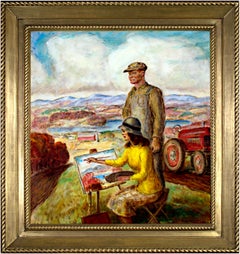
'Sketching Wisconsin' original oil painting, Signed

'Sketching Wisconsin' original oil painting, Signed

By John Steuart Curry

Located in Milwaukee, WI

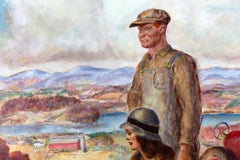
John Steuart Curry "Sketching Wisconsin," 1946 oil on canvas 31.13 x 28 inches, canvas 39.75 x 36.75 x 2.5 inches, frame Signed and dated lower right Overall excellent condition Presented in a 24-karat gold leaf hand-carved wood frame John Steuart Curry (1897-1946) was an American regionalist painter active during the Great Depression and into World War II. He was born in Kansas on his family’s farm but went on to study art in Chicago, Paris and New York as young man. In Paris, he was exposed to the work of masters such as Peter Paul Rubens, Eugène Delacroix and Jacques-Louis David. As he matured, his work showed the influence of these masters, especially in his compositional decisions. Like the two other Midwestern regionalist artists that are most often grouped with him, Grant Wood (American, 1891-1942) and Thomas Hart Benton (American, 1889-1975), Curry was interested in representational works containing distinctly American subject matter. This was contrary to the popular art at the time, which was moving closer and closer to abstraction and individual expression. Sketching Wisconsin is an oil painting completed in 1946, the last year of John Steuart Curry’s life, during which time he was the artist-in-residence at the University of Wisconsin in Madison. The painting is significant in Curry’s body of work both as a very revealing self-portrait, and as a landscape that clearly and sensitively depicts the scenery of southern Wisconsin near Madison. It is also a portrait of the artist’s second wife, Kathleen Gould Curry, and is unique in that it contains a ‘picture within a picture,’ a compositional element that many early painting masters used to draw the eye of the viewer. This particular artwork adds a new twist to this theme: Curry’s wife is creating essentially the same painting the viewer is looking at when viewing Sketching Wisconsin. The triangular composition of the figures in the foreground immediately brings focus to a younger Curry, whose head penetrates the horizon line and whose gaze looks out towards the viewer. The eye then moves down to Mrs. Curry, who, seated on a folding stool and with her hand raised to paint the canvas on the easel before her, anchors the triangular composition. The shape is repeated in the legs of the stool and the easel. Behind the two figures, stripes of furrowed fields fall away gently down the hillside to a farmstead and small lake below. Beyond the lake, patches of field and forest rise and fall into the distance, and eventually give way to blue hills. Here, Curry has subverted the traditional artist’s self-portrait by portraying himself as a farmer first and an artist second. He rejects what he sees as an elitist art world of the East Coast and Europe. In this self-portrait he depicts himself without any pretense or the instruments of his profession and with a red tractor standing in the field behind him as if he was taking a break from the field work. Here, Curry’s wife symbolizes John Steuart Curry’s identity as an artist. Compared with a self-portrait of the artist completed a decade earlier, this work shows a marked departure from how the artist previously presented and viewed himself. In the earlier portrait, Curry depicted himself in the studio with brushes in hand, and with some of his more recognizable and successful canvases behind him. But in Sketching Wisconsin, Curry has taken himself out of the studio and into the field, indicating a shift in the artist’s self-conception. Sketching Wisconsin’s rural subject also expresses Curry’s populist ideals, that art could be relevant to anyone. This followed the broad educational objectives of UW’s artist-in-residence program. Curry was appointed to his position at the University of Wisconsin in 1937 and was the first person to hold any such position in the country, the purpose of which was to serve as an educational resource to the people of the state. He embraced his role at the University with zeal and not only opened the doors of his campus studio in the School of Agriculture to the community, but also spent a great deal of time traveling around the state of Wisconsin to visit rural artists who could benefit from his expertise. It was during his ten years in the program that Curry was able to put into practice his belief that art should be meaningful to the rural populace. However, during this time he also struggled with public criticism, as the dominant forces of the art market were moving away from representation. Perhaps it was Curry’s desire for public acceptance during the latter part of his career that caused him to portray himself as an Everyman in Sketching Wisconsin. Beyond its importance as a portrait of the artist, Sketching Wisconsin is also a detailed and sensitive landscape that shows us Curry’s deep personal connection to his environment. The landscape here can be compared to Wisconsin Landscape of 1938-39 (the Metropolitan Museum of Art), which presents a similar tableau of rolling hills with a patchwork of fields. Like Wisconsin Landscape, this is an incredibly detailed and expressive depiction of a place close to the artist’s heart. This expressive landscape is certainly the result of many hours spent sketching people, animals, weather conditions and topography of Wisconsin as Curry traveled around the state. The backdrop of undulating hills and the sweeping horizon, and the emotions evoked by it, are emphatically recognizable as the ‘driftless’ area of south-central Wisconsin. But while the Metropolitan’s Wisconsin Landscape conveys a sense of uncertainty or foreboding with its dramatic spring cloudscape and alternating bands of light and dark, Sketching Wisconsin has a warm and reflective mood. The colors of the foliage indicate that it is late summer and Curry seems to look out at the viewer approvingly, as if satisfied with the fertile ground surrounding him. The landscape in Sketching Wisconsin is also revealing of what became one of Curry’s passions while artist-in-residence at UW’s School of Agriculture – soil conservation. When Curry was a child in Kansas, he saw his father almost lose his farm and its soil to the erosion of The Dust Bowl. Therefore, he was very enthusiastic about ideas from UW’s School of Agriculture on soil conservation methods being used on Wisconsin farms. In Sketching Wisconsin, we see evidence of crop rotation methods in the terraced stripes of fields leading down the hillside away from the Curry’s and in how they alternate between cultivated and fallow fields. Overall, Sketching Wisconsin has a warm, reflective, and comfortably pastoral atmosphere, and the perceived shift in Curry’s self-image that is evident in the portrait is a positive one. After his rise to favor in the art world in the 1930’s, and then rejection from it due to the strong beliefs presented in his art, Curry is satisfied and proud to be farmer in this self-portrait. Curry suffered from high blood...

Category

1940s American Realist John Steuart Curry Paintings
Materials

Canvas, Oil

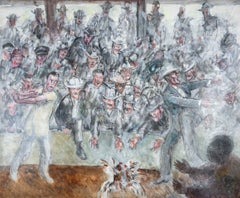
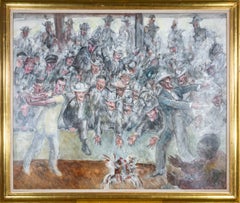
'Cock Fight in Cuba' original Regionalist painting signed by John Steuart Curry

'Cock Fight in Cuba' original Regionalist painting signed by John Steuart Curry

By John Steuart Curry

Located in Milwaukee, WI

John Steuart Curry "Cockfight in Cuba," 1946 oil on canvas Image: 38.25 x 46.25 in Frame: 43.75 x 51.5 in Signed on reverse with initials JSC on lower right stretcher bar John Steu...

Category

1940s American Realist John Steuart Curry Paintings
Materials

Canvas, Oil

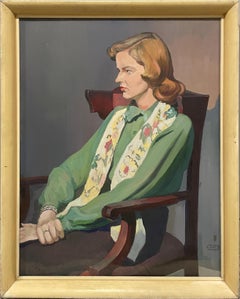
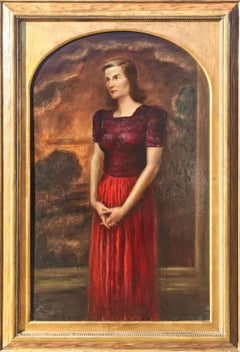
"Portrait of Kathleen Curry, the Artist's Wife" John Steuart Curry

"Portrait of Kathleen Curry, the Artist's Wife" John Steuart Curry

By John Steuart Curry

Located in New York, NY

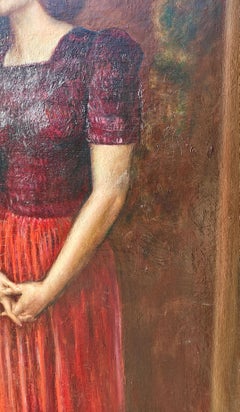
John Steuart Curry Portrait of Kathleen Curry, the Artist's Wife, 1938 Signed and titled "Kathleen" lower left Oil on canvas 55 x 34 inches Provenance The artist Kathleen Curry, the...

Category

1930s American Modern John Steuart Curry Paintings

Materials

Canvas, Oil

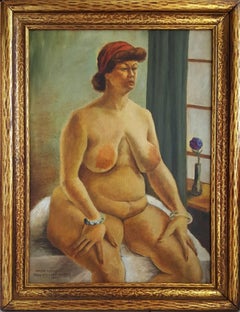
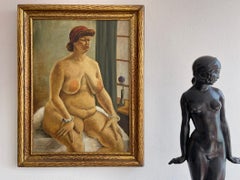
Rubenesque nude woman . full figure Nude Regionalism  - "Hilda Nellis"

Rubenesque nude woman . full figure Nude Regionalism - "Hilda Nellis"

By John Steuart Curry

Located in Miami, FL

Plump, fleshy, or a voluptuous nude - you describe it as you see it. Signed, titled, and dated lower left: John Steuart Curry / 1934 "Hilda Nellis". The present work depicts a natur...

Category

1930s American Realist John Steuart Curry Paintings
Materials

Oil

Related Items
Portrait of Franklin Atwood Park, VP of Singer Mfg. Co.

Portrait of Franklin Atwood Park, VP of Singer Mfg. Co.

Located in Soquel, CA

Portrait of Franklin Atwood Park, VP of Singer Mfg. Co. Stately portrait of Franklin Atwood Park by Arthur Trevethin Nowell (British, 1862-1940). Park is sitting for a classical portrait, wearing a suit with a blue bowtie against a dark background. Of particular note are his glasses and moustache, both rendered with expert detail. Park was the VP and Chairman of the Board for Singer Manufacturing Company and Manager of the Singer Division in Scotland when the portrait was commissioned. We show a digital image of a photographic portrait of Franklin. Signed and dated "A T Nowell. 1922" Includes paper with biographical information on the sitter. Frame size: 37.5"H x 32.5"W Canvas size: 30"H x 25"W Arthur Nowell (British, 1862-1940) was born at Garndiffath, near Pontypool, and was the youngest of six children born to the Rev. John Nowell and his wife Mary...

Category

1920s American Modern John Steuart Curry Paintings

Materials

Canvas, Oil, Stretcher Bars

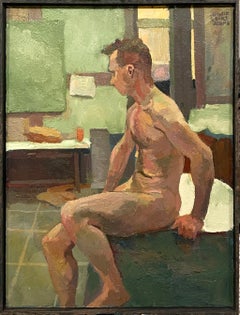
Paul Anton Kaulbach (1864 Hanover - 1930 Berlin) Male Nude

Paul Anton Kaulbach (1864 Hanover - 1930 Berlin) Male Nude

Located in Greding, DE

Depiction of a male nude in diffuse architectural scenery. Signed lower right (Paul) Anton Kaulbach (1864 Hannover - 1930 Berlin). Oil on canvas, in gold-patinated frame. Image size:...

Category

20th Century Abstract Impressionist John Steuart Curry Paintings

Materials

Oil, Canvas

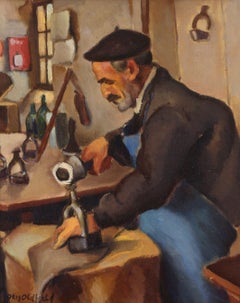
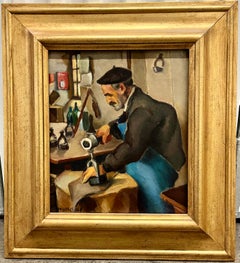
"Old Shoemaker" Ashcan 20th Century Modernism 1924 California WPA Realism Worker

"Old Shoemaker" Ashcan 20th Century Modernism 1924 California WPA Realism Worker

By Otis Oldfield

Located in New York, NY

"Old Shoemaker" Ashcan 20th Century Modernism 1924 California WPA Realism Worker. Signed “Otis Oldfield” lower left. 14 x 12 inches. Exhibited: Galerie des Beaux Arts, San Francisco, CA, 1925 Provenance: Estate of the Artist Born in Sacramento, CA on July 3, 1890, Otis Oldfield left high school at age 16 to work in a local print shop. In 1909 he arrived in San Francisco and enrolled at the Best Art School. After working for two years as a bellhop at the Argonaut Hotel and as a hat check boy at the Cliff House, he had saved enough money for further studies in Paris. In 1911 he sailed for France and enrolled at Académie Julian. Caught up in the activities of wartime Paris, he was an apprentice for a book...

Category

1920s American Realist John Steuart Curry Paintings
Materials

Canvas, Oil

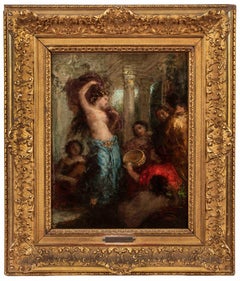
Orientale

Henri Fantin-LatourOrientale, 1899

$28,750

H 16 in W 13.5 in

Orientale

By Henri Fantin-Latour

Located in New York, NY

Signed, lower right: Fantin Provenance: Gustave Tempelaere (1840–1904), Paris; possibly by descent to his son: Julien Tempelaere (1876–1961) and with F. & J. Tempelaere, Paris, prob...

Category

1890s Romantic John Steuart Curry Paintings

Materials

Canvas, Paper, Oil

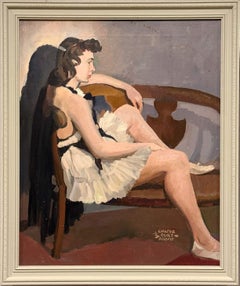
A  nude - Realistic oil painting, Warm tones, Young Polish artist

A nude - Realistic oil painting, Warm tones, Young Polish artist

Located in Warsaw, PL

AGNIESZKA STAAK-JANCZARSKA (born in 1994) A graduate of the State Secondary School of Art of Józef Kluza in Krakow. In 2020, she graduated from the Academy of Fine Arts in Krakow in ...

Category

2010s Naturalistic John Steuart Curry Paintings

Materials

Oil, Cardboard

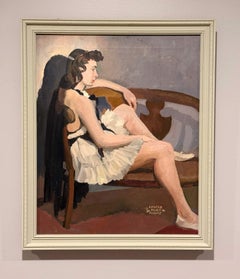
A sitter - Realistic oil painting, Female nude, Warm tones, Young Polish artist

A sitter - Realistic oil painting, Female nude, Warm tones, Young Polish artist

Located in Warsaw, PL

AGNIESZKA STAAK-JANCZARSKA (born in 1994) A graduate of the State Secondary School of Art of Józef Kluza in Krakow. In 2020, she graduated from the Academy of Fine Arts in Krakow in ...

Category

2010s Naturalistic John Steuart Curry Paintings

Materials

Oil, Cardboard

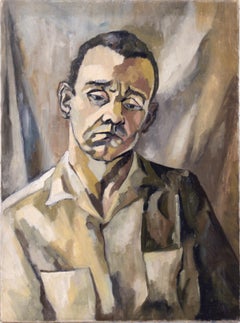
Mid-Century Modern Man - Portrait in Oil on Canvas

Mid-Century Modern Man - Portrait in Oil on Canvas

Located in Soquel, CA

Subtle and moody portrait of a Pensive man by Joan Tidwell (American, 1930-2002). The sitter in the portrait is a middle-aged man looking slightly downwards, wearing a collared shirt. This piece is completed in a tan and green palette, creating a somber feeling. Of particular note are the confident, thick brushstrokes - each one is well-placed in the modernist style. Similar in some ways to Picasso's portraits. Signed "Joan Tidwell" on verso Unframed. Canvas size: 30"H x 22"W oan Gay Tidwell (American, 1930-2002) was born and raised in Hollywood, CA, where she had some success as a child actor. Later, she graduated Magna Cum Laude from the University of Washington with a Master's Degree in English Literature and Drama. Tidwell moved to the Bay...

Category

1960s American Modern John Steuart Curry Paintings

Materials

Canvas, Oil

“Kennebec” Ship Portrait Sidewheeler Steamboat Paddle Steamer Oil on Canvas

“Kennebec” Ship Portrait Sidewheeler Steamboat Paddle Steamer Oil on Canvas

Located in Yardley, PA

A striking and historically attentive portrait of the sidewheel steamer Kennebec, built in 1842. Rendered in crisp profile against a soft, painterly sky and calm Atlantic swells, Cameron’s portrait captures the stately elegance of early American steam navigation. The Kennebec, identified in bold red lettering on her paddle box, is shown under partial sail with twin smokestacks active - suggesting both the hybrid nature of early steam propulsion and the vessel’s readiness for sea. Flying period flags, including a U.S. ensign and company pennants, she presents as a proud representative of the Sanford Steamship Line, for whom she plied the route between Boston, Bangor, and the summer resorts of Maine. Her design, with a wood hull, 230-foot length, and distinctive “hogging truss,” speaks to mid-19th century innovation tailored to coastwise packets. Cameron’s style is reminiscent of 19th-century ship portraiture yet refined with contemporary technical precision. This is an excellent example of his work. This work is oil on canvas and is signed in the lower right. It is housed in its original black frame and retains the artist’s description of the ship on the reverse. Size: 22 inches tall by 44 inches wide (painting) 26 inches tall by 48 inches wide by 1 inch deep (frame) Provenance: Private collection; Acquired from the above About the artist: A Delaware artist, Scott Cameron paints the simple elegance of the America’s Cup races, serene coastal marsh scenes, timeless landscape vistas and historic steamboats in a style reminiscent of the era in which they reigned. An admirer of Andrew Wyeth and the Brandywine School of painters, Scott has combined the detail and quiet stillness of that School in his landscapes with the Luminist School’s sense of light glowing from within. A soft gentle atmosphere seems to fall over each scene adding to the peacefulness of the setting, and a sense of a time gone by. His America’s Cup scenes capture the action at a moment in time, allowing the beauty of the wind-filled sails to become the central design element of each painting. Scott Cameron has exhibited his oil paintings in numerous national and regional shows from the Mystic Seaport Museum to solo and group shows in some of the foremost galleries throughout the Northeast and Mid-Atlantic states. Favorite painting locations are the waterways and coastal inlets of Martha’s Vineyard and Maryland’s Eastern Shore and the gentle rolling landscapes of rural Pennsylvania, Delaware and Maryland. Meticulous research is behind every historic steamboat and America’s Cup painting...

Category

Late 20th Century American Realist John Steuart Curry Paintings
Materials

Canvas, Oil

“Eastern White Pines, c. 1910”, New England Landscape, Signed Oil Painting

“Eastern White Pines, c. 1910”, New England Landscape, Signed Oil Painting

By Charles Warren Eaton

Located in Yardley, PA

“Eastern White Pines, c. 1910” by Charles Warren Eaton (American, 1857-1937). A wonderful example of Eaton’s renowned compositions of Eastern white pine trees in his mature style. A...

Category

Early 20th Century American Realist John Steuart Curry Paintings
Materials

Canvas, Oil, Board

“Penobscot” Ship Portrait Sidewheeler Steamboat Paddle Steamer Oil on Canvas

“Penobscot” Ship Portrait Sidewheeler Steamboat Paddle Steamer Oil on Canvas

Located in Yardley, PA

A wonderful realistic portrait of the Penobscot, a mid-19th century coastal sidewheel steamer, rendered in Cameron’s hallmark marine portrait style - technically meticulous, historically informed, and visually serene. Executed with crisp linework and a soft, luminous palette, the ship is shown in profile navigating calm Atlantic waters under both steam and sail, her red paddle box emblazoned boldly with her name. Commissioned in 1843 by Menemon Sanford’s Steamship Line and constructed in New York, the Penobscot was a near twin to her sister ship, the Kennebec, but became especially prized for her seaworthiness. Measuring 228 feet in length with a 48-foot beam and twin 14-foot paddlewheels, she carried schooner rigging fore and aft, providing the added stability necessary for coastal and offshore passages. Initially assigned to the Maine coastal excursion routes, she would later be reassigned to the elite New York–Philadelphia line and eventually sold and renamed Norfolk for pre-Civil War service along the southern coast. This work is oil on canvas and is signed in the lower right. It is housed in its original black frame and retains the artist’s description of the ship on the reverse. Size: 22 inches tall by 44 inches wide (painting) 26 inches tall by 48 inches wide by 1 inch deep (frame) Provenance: Private collection; Acquired from the above About the artist: A Delaware artist, Scott Cameron paints the simple elegance of the America’s Cup races, serene coastal marsh scenes, timeless landscape vistas and historic steamboats in a style reminiscent of the era in which they reigned. An admirer of Andrew Wyeth and the Brandywine School of painters, Scott has combined the detail and quiet stillness of that School in his landscapes with the Luminist School’s sense of light glowing from within. A soft gentle atmosphere seems to fall over each scene adding to the peacefulness of the setting, and a sense of a time gone by. His America’s Cup scenes capture the action at a moment in time, allowing the beauty of the wind-filled sails to become the central design element of each painting. Scott Cameron has exhibited his oil paintings in numerous national and regional shows from the Mystic Seaport Museum to solo and group shows in some of the foremost galleries throughout the Northeast and Mid-Atlantic states. Favorite painting locations are the waterways and coastal inlets of Martha’s Vineyard and Maryland’s Eastern Shore and the gentle rolling landscapes of rural Pennsylvania, Delaware and Maryland. Meticulous research is behind every historic steamboat and America’s Cup painting...

Category

Late 20th Century American Realist John Steuart Curry Paintings
Materials

Canvas, Oil

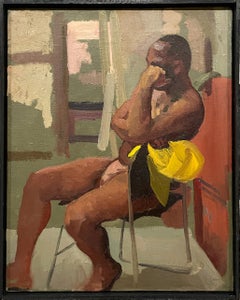
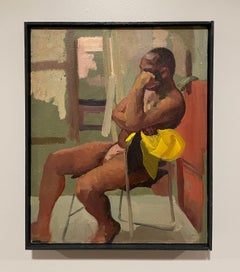
A Large, Captivating 1930s Modern Portrait of a Jamaican Man in a Linen Suit

A Large, Captivating 1930s Modern Portrait of a Jamaican Man in a Linen Suit

By Francis Chapin

Located in Chicago, IL

A Large, Captivating 1930s Modern Portrait of a Jamaican Man in a Linen Suit by famed Chicago artist, Francis Chapin (Am. 1899-1965). A skilled and colorful portrait of a black man seated in a white linen suit, most likely completed during Chapin's trip to Kingston, Jamaica in the 1930s. Chapin exhibited examples of his Jamaican paintings...

Category

1930s American Modern John Steuart Curry Paintings

Materials

Oil, Canvas

"High School Dance" WPA Mid-20th Century Modern American Scene Social Realism

"High School Dance" WPA Mid-20th Century Modern American Scene Social Realism

Located in New York, NY

"High School Dance" WPA Mid-20th Century Modern American Scene Social Realism Heusing (20th Century) "High School Dance" 27 x 32 inches Oil on canvas Signed and dated '47 Lower Righ...

Category

1940s American Realist John Steuart Curry Paintings
Materials

Canvas, Oil

Previously Available Items
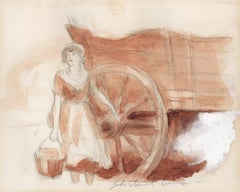
Study for the Mural "Westward Movement"

Study for the Mural "Westward Movement"

By John Steuart Curry

Located in Fairlawn, OH

Study for the Mural "Westward Movement" Graphite, watercolor, gouache and paint on paper, 1936 Signed in pencil lower center (see photo) A study leading up to his mural Justice of th...

Category

1930s American Realist John Steuart Curry Paintings
Materials

Gouache

John Steuart Curry paintings for sale on 1stDibs.

Find a wide variety of authentic John Steuart Curry paintings available for sale on 1stDibs. You can also browse by medium to find art by John Steuart Curry in paint, gouache, oil paint and more. Not every interior allows for large John Steuart Curry paintings, so small editions measuring 9 inches across are available. Customers who are interested in this artist might also find the work of Ernest Fiene, Paul Zimmerman, and Pruett Alexander Carter. John Steuart Curry paintings prices can differ depending upon medium, time period and other attributes. On 1stDibs, the price for these items starts at $5,500 and tops out at $652,500, while the average work can sell for $17,750.
Questions About John Steuart Curry Paintings
  • 1stDibs ExpertMarch 22, 2022
    John Steuart Curry is known for his paintings that captured daily life in rural areas of Kansas. Curry was born in Dunavant, Kansas, in 1897. He painted two murals for the Kansas State Capitol in Topeka: Kansas Pastoral and Tragic Prelude. You'll find a variety of John Steuart Curry art on 1stDibs.