Joseph Baumann Art

to
2
Overall Width
to
Overall Height
to
2
2
2
1
1
1
1
1
2
2
2
10,681
2,826
2,495
1,414
Artist: Joseph Baumann
Related Items
Hidden Cities III: Continuum, by Peter Milton

Hidden Cities III: Continuum, by Peter Milton

By Peter Milton

Located in Palm Springs, CA

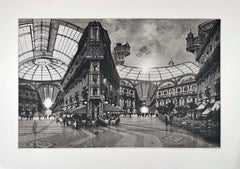
Peter Milton’s Hidden Cities: Continuum transforms the grandeur of the Galleria Vittorio Emanuele into a layered meditation on architecture, memory, and the passage of time. The Gall...

Category

Early 2000s Contemporary Joseph Baumann Art

Materials

Engraving, Etching

Points of Departure: Mary's Turn, by Peter Milton

Points of Departure: Mary's Turn, by Peter Milton

By Peter Milton

Located in Palm Springs, CA

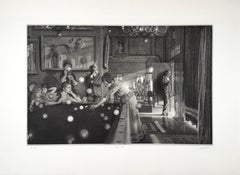
Peter Milton’s Mary’s Turn reimagines a scene where Mary Cassatt and Edgar Degas engage in a game of billiards, reflecting their real-life friendship and rivalry. Cassatt leans forwa...

Category

1990s Contemporary Joseph Baumann Art

Materials

Engraving, Etching

William Hogarth's "Analysis of Beauty": A Set of Two Framed 18th C. Engravings

William Hogarth's "Analysis of Beauty": A Set of Two Framed 18th C. Engravings

By William Hogarth

Located in Alamo, CA

The two plates in this set were created utilizing both engraving and etching techniques by William Hogarth in 1753, originally as illustrations of his book on aesthetics, entitled "Analysis of Beauty". Due to their popularity, these plates were later published separately. The publication line in the lower right reads: "Designed, Engraved, and Publish'd by Wm. Hogarth, March 5th 1753, according to Act of Parliament." Hogarth's original copper plates were refurbished where needed by James Heath and engravings were republished in London in 1822 by Braddock, Cradock & Joy. This was the last time Hogarth's copper plates were used for printing. Most were melted during World War I for the construction of bombs. These large folio sized "Analysis of Beauty" engravings are presented in antiqued gold-colored frames with double mats; the outer silk mats are light brown-colored and the inner mats are dark brown. Each frame measures 27.38" x 31.25" x 1.13". There is one tiny spot in the right margin of plate 1 and another in the lower margin; the latter could be from the printing process. The prints are otherwise in excellent condition. The "Analysis of Beauty" series is in the collection of many major museums, including: The British Museum, The Metropolitan Museum of Art, The Tate Museum, The Chicago Art Institute and The Fine Arts Museums of San Francisco. The first engraving (Plate 1) depicts a courtyard of statues which is filled with some of the most famous works of classical sculpture. The most important sculptures are surrounded by less impressive works. The Medicean Venus (#13) is in the center with a statue of Julius Caesar (#19) to the right, elevated on a pulley with a short, overdressed Brutus stands over the falling Caesar. The Apollo Belvedere (#12) is next. A judge stands to the right with his foot on a cherub (#16). Another crying cherub holds a gallows and wipes his tears with the judge's robe. A sphinx (#21) and the drunken Silenus (#107) are below the Venus. Michaelangelo's torso (#54) and a statue of Antonius (#6) are seen in the foreground. The Farnese Hercules (#3) and a bust of another Hercules (#4) under two statuettes of Isis are also included in the scene. The key to these objects is included in the form of a serpentine line winding around a cone (#26), Hogarth's "Line of Beauty". For Hogarth the winding line is an essential element of beauty in art. Hogarth's theory of beauty is communicated in this plate. Plate 2 is thought to represent the Wanstead Assembly, with the Earl of Tynley and his household. It is an adaptation of a scene in the Happy Marriage series, which complements Hogarth's Marriage à la Mode...

Category

Mid-18th Century Old Masters Joseph Baumann Art

Materials

Engraving, Etching

La diligence de Beaucaire

La diligence de Beaucaire

By Félix Hilaire Buhot

Located in Middletown, NY

Paris: Lemerre, 1880. Etching, drypoint, aquatint (dust ground and spirit ground), spit bite, and roulette in black on cream laid paper with a deckle edge, 6 3/4 x 4 1/2 inches (170 x 112 mm), full margins. Third state (of 3). An illustration from Alphonse Daudet's, Lettres de mon moulin, Paris, 1880. In very good condition with some light uniform toning and two areas of paper tape at the top right and left corners on the verso (from a former mount). With the 1921 J.H. de Bois circular ink stamp in green ink in the lower right margin on the recto (Lugt L.733). [Bourcard 110]. A note regarding the provenance: J. H. de Bois was a well known late-19th century modern art...

Category

1880s French School Joseph Baumann Art

Materials

Laid Paper, Drypoint, Etching, Aquatint

Soup
Soup

Edmund BlampiedSoup, 1920

$850

H 20 in W 16 in D 2 in

Soup

By Edmund Blampied

Located in Plano, TX

Soup. 1920. Drypoint. Appleby 65. 9 x 8 1/8 (sheet 15 x 11 9/16). Edition 100. Illlustrated: Print Collector's Quarterly 13 (1926): 85. Signed in pencil. Edmund Blampied was a painter, etcher, lithographer and sculptor. Born in 1886 to a family of three boys in St. Martin, Jersey, Blampied became interested in drawing at an early age. After visiting the studio of John Helier Lander in 1899, Blampied decided to make a career as an artist. In 1903 he went to London to attend Lambeth Art School, where he studied etching under Walter Seymour. In 1905, he joined the Daily Chronicle as an artist. In that year he was awarded a scholarship to Bolt Court Scool of Photo-engraving and Lithography. In 1912 he left the Chronicle and established his own studio. He earned a living by illustrating novels and short stories. In 1913, he had his first exhibition at the Leicester Gallery in London. The following year he married Marianne Van Abbé. During the 1920's, he became a member of the Royal Society of Painter-Etchers and Engravers. During the 1920s Blampied became a member of the Royal Society of Painters-Etchers and Engravers and exhibited in London to critical acclaim. He produced a folio of comic drawings in the 1930s which was published in New York in 1934 and another that was published in London in 1936. The Keeper of Prints and Drawings at the British Museum published a mongraph on his work. His London exhibitions were highly successful. In 1938, he moved to Bulwarks, St.Aubin in Jersey, but at the onset of the Occupation, had to relocate to Route Orange, St. Brelade. remained there throughout World War II during the German Occupation, despite the fact that his wife was Jewish. During the Occupation he designed bank...

Category

1920s Modern Joseph Baumann Art

Materials

Drypoint, Etching

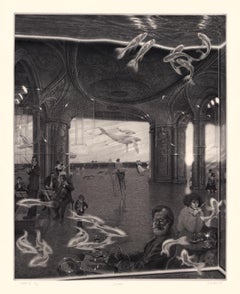
Interiors VI: Soundings

Peter MiltonInteriors VI: Soundings, 1989

$4,250

H 36 in W 29 in D 0.94 in

Interiors VI: Soundings

By Peter Milton

Located in New York, NY

Contemporary artist Peter Milton created this etching and engraving entitled "Interiors VI: Soundings" in 1989. The printed image size is 29 7/8 x 23 13/16 and paper size is 36 x 29 inches. This impression is signed, dated, and titled in pencil and inscribed “93/175” – the 93 impression of 175. “I do love to draw. I feel that I am being granted membership in the Brotherhood of Merlin, conjuring forth some apparition. As a drawing develops, I sense a vague presence coming more and more into focus, something in a white fog emerging and becoming increasingly palpable.” – P. Milton, “The primacy of touch. The Drawings of Peter Milton” “Working in layers, Milton begins with drawings based on people and places, with nods to Western art history and culture. He is a master of the appropriated image, a term that may conjure Andy Warhol and his Pop Art comrades. But Milton steps further back in history, avoiding the Pop sense of cool advertising and popular culture references. Instead, a broader cultural past is tapped through historical photographs of key players, architecture, and locales, which he reinvents by hand. He adds content drawn from his life as an avid reader – always with multiple possible interpretations – thus incorporating deeper meaning in his cinematic worlds. Elements of Greek mythology, classical music, art history, and history coalesce in his images, which embrace the messiness, sorrow, and elation that is life. One is hard-pressed to imagine a more erudite, skilled, passionate, and cheeky soul." – T. L. Johnson and A. Shafer Peter Milton was born in Pennsylvania in 1930. He studied for two years at the Virginia Military Institute...

Category

Late 20th Century Surrealist Joseph Baumann Art

Materials

Engraving, Etching

France at her Furnaces

France at her Furnaces

By James McBey

Located in Plano, TX

1917. Etching. Hardie 175. 8 x 15 (sheet 10 1/8 x 16 15/16). Edition 76. Slight mat line; otherwise excellent condition. A rich impression printed on antique laid paper with full m...

Category

1910s Modern Joseph Baumann Art

Materials

Drypoint, Etching

Interiors VII: The Train from Munich

Interiors VII: The Train from Munich

By Peter Milton

Located in Middletown, NY

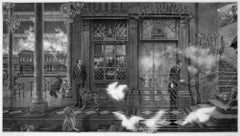
Interiors VII: The Train from Munich Robert E. Townsend, 1991. Resist ground etching and engraving with hand refinement in charcoal, pencil, stabilo, and eraser on BFK Rives white wove paper, 20 x 36 inches (507 x 914 mm), full margins. Signed, titled, dated and numbered 51/175 by the artist in pencil, lower margin. A brilliant, inky impression with luminous light and gradient tones. In excellent condition with one extremely minor and superficial spot of light tan adhesive residue on the verso, unobtrusive and not visible on the recto, with no other visible defects. With the blind stamp of the printer, Robert E. Townsend in the lower left margin. An especially fine impression in superb condition. [Milton 113]. When asked about this work in particular, Milton expressed that his favorite images were his darkest images, in theme, mood, and in ink. Milton, who has said that his work is infused with a postmodern awareness of the past, has focused here in a deeply personal way on a segment of history that continues to haunt us all. The work, published in 1991, evokes one of the darkest periods of European history, the eroding and erasing of European culture under fascism, and the eventual total loss of humanity. The Train from Munich is an especially relevant and emotional work for Milton, who created the piece for his wife, Edith, who escaped Munich in 1939 as a child on the fabled Kinderstransport. The Kinderstransport was a desperate rescue effort on the part of the British government to save as many Jewish children as possible by railway before borders closed on the precipice of the Second World War. Children left their parents behind, and boarded the trains alone, leaving the impending doom of Nazi Germany, they arrived in Great Britain as refugees. More than 10,000 children escaped the holocaust via the Kinderstransport. In Train from Munich, the image itself holds an almost immeasurable amount of symbolism; each inch of the matrix is a successful effort to confront this history in a way that is poignant through a series of motifs. We see the Café disappearing into a ghostlike memory of the past, an allegory to the disintegration of culture, while through the windows we can see a rampant, snarling dog; a portrait of Hitler's shepherd, Blondi. Blondi isn't the only notable figure in the composition. Milton has pointed out that the fading figure of the doorman at the Hotel Metropole is modeled after the artist and intellectual Marcel Duchamp, and the face of the young girl peering...

Category

1990s American Modern Joseph Baumann Art

Materials

Charcoal, ABS, Engraving, Etching
INTERIORS VII: THE TRAIN FROM MUNICH

INTERIORS VII: THE TRAIN FROM MUNICH

By Peter Milton

Located in Portland, ME

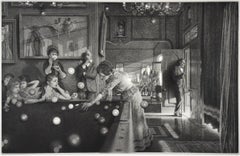
Milton, Peter (American, born 1930). INTERIORS VII: THE TRAIN FROM MUNICH. Milton 113. Resist-ground etching and engraving on copper, 1991. Edition of 175. Signed and dated in pencil. Printed on BFK Rives paper. 20 x 36...

Category

1990s Joseph Baumann Art

Materials

Engraving, Etching
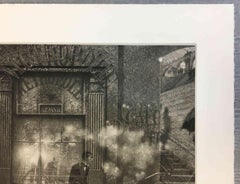
Night Time in a Stable.

Night Time in a Stable.

By Edmund Blampied

Located in Plano, TX

Night Time in a Stable. 1927-28. Drypoint. Appleby 131. 10 1/8 x 12 1/8 (sheet 11 1/2 x 16 1/2). Edition 100. Illustrated: Print Collector's Quarterly 25 (1...

Category

Early 20th Century Modern Joseph Baumann Art

Materials

Drypoint, Etching

INTERIORS IV: HOTEL PARADISE CAFE.

INTERIORS IV: HOTEL PARADISE CAFE.

By Peter Milton

Located in Portland, ME

Milton, Peter (American, born 1930). INTERIORS IV: HOTEL PARADISE CAFE. Milton 110. Resist-ground etching and engraving on copper, 1987. Edition of 175. Signed and dated in pencil. P...

Category

1980s Joseph Baumann Art

Materials

Engraving, Etching
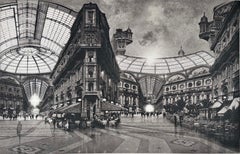
Un Sculpteur de Paris

Un Sculpteur de Paris

By Arthur William Heintzelman

Located in Middletown, NY

Etching and drypoint on cream laid Van Gelder Zonen watermarked paper, 8 7/8 x 6 1/2 inches (220 x 164 mm), full margins. Signed, titled, and inscribed "ed. 100" in pencil, lower mar...

Category

Early 20th Century Modern Joseph Baumann Art

Materials

Laid Paper, Drypoint, Etching

Joseph Baumann art for sale on 1stDibs.

Find a wide variety of authentic Joseph Baumann art available for sale on 1stDibs. You can also browse by medium to find art by Joseph Baumann in engraving, etching and more. Not every interior allows for large Joseph Baumann art, so small editions measuring 15 inches across are available. Customers who are interested in this artist might also find the work of and Matthaeus Merian. Joseph Baumann art prices can differ depending upon medium, time period and other attributes. On 1stDibs, the price for these items starts at $165 and tops out at $165, while the average work can sell for $165.