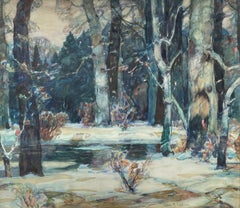
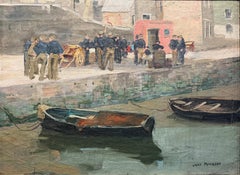
Joseph Yeager Landscape Paintings

American, 1892-1958

Joseph "Joe" Yeager was raised in Cleveland, Ohio, where he went to art school at night and started his art career at 19. He was a commercial artist for the Cleveland Press for seven years, and then worked as the paper’s art director for another seven. In the army, he was a technical research illustrator for the National Advisory Committee for Aeronautics. Yeager later moved to Medina, Ohio, in 1941, and opened Joe Yeager Industrial Design in 1947. He also taught advanced perspective at the Cleveland School of Art.

(Biography provided by Robert Azensky Fine Art)

to
2
Overall Width
to
Overall Height
to
2
1
1
2
2
1
1
1
1
1
1
2

Use search to find more

27
645
627
482
350

Use search to find more

Artist: Joseph Yeager
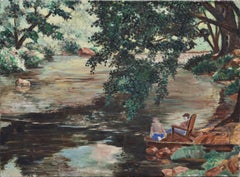
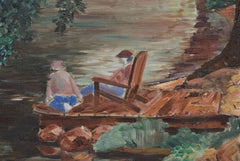
Sitting by the Lake, Mid Century Figurative Landscape

Sitting by the Lake, Mid Century Figurative Landscape

By Joseph Yeager

Located in Soquel, CA

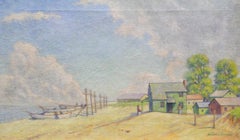
Tranquil figurative landscape of two people sitting on a dock by a lake near Medina, Ohio by Joseph Yeager (American, 20th Century). Circa 1940. Unsigned, but was purchased with a co...

Category

1940s American Impressionist Joseph Yeager Landscape Paintings

Materials

Canvas, Oil

Creekside Campsite - Mid Century Forest Landscape Watercolor

Creekside Campsite - Mid Century Forest Landscape Watercolor

By Joseph Yeager

Located in Soquel, CA

Mid century landscape watercolor of a campsite in the forest by Joseph Yeager (American, 20th Century). This piece is unsigned, but was acquired with a collection of Yeager work dire...

Category

1960s American Impressionist Joseph Yeager Landscape Paintings

Materials

Paper, Watercolor, Pencil

Related Items
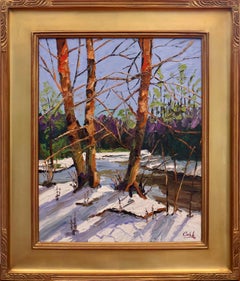
'River Birch' by James Cobb, Framed 20" x 16" Oil on Canvas Painting, 2020

'River Birch' by James Cobb, Framed 20" x 16" Oil on Canvas Painting, 2020

By Jim Cobb

Located in Oklahoma City, OK

This framed 19.875" x 16" oil painting on canvas by Oklahoma-based artist James Cobb depicts a strand of river birch trees in freshly fallen snow. at the he...

Category

2010s American Impressionist Joseph Yeager Landscape Paintings

Materials

Canvas, Oil

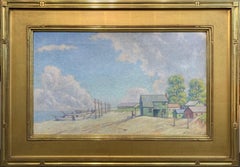
Figures, Boats, and House - Cape May Point, NJ, Impressionist Beach Scene, 1940s

Figures, Boats, and House - Cape May Point, NJ, Impressionist Beach Scene, 1940s

By Albert Van Nesse Greene

Located in Doylestown, PA

"Figures, Boats, and House - Cape May Point, NJ" is a Pennsylvania Beach Scene by American Impressionist painter Albert Van Nesse Greene. The ...

Category

1940s American Impressionist Joseph Yeager Landscape Paintings

Materials

Oil, Canvas

"Other Side of Town (Leading to Pigeon Cove)" Anthony Thieme, Rockport Cape Ann

"Other Side of Town (Leading to Pigeon Cove)" Anthony Thieme, Rockport Cape Ann

By Anthony Thieme

Located in New York, NY

Anthony Thieme (1888 - 1954) Other Side of Town (Leading to Pigeon Cove) Oil on canvas 30 x 36 inches Signed lower left Provenance: David H. Hall Fine Art, Dover, Massachusetts Vose Galleries, Boston, Massachusetts Private Collection, New Jersey Anthony Thieme was born in the Dutch port city of Rotterdam in 1888. He studied at the Academy of Fine Arts in Rotterdam, at the Royal Academy at the Hague, as an apprentice to George Hoecker, a well known stage designer in Düsseldorf, Germany, and to Antonio Mancini, an Italian Impressionist. After completing his studies, Thieme journeyed throughout Europe and South America, working in stage design to support his travels. Thieme first came to the United States in 1917 and initially worked as a set designer and book illustrator first in New York and later in Boston. By the late 1920s, Thieme had married and moved from Boston to Cape Ann in Rockport, Massachusetts, an emerging art colony. Like the other Rockport artists...

Category

Early 20th Century American Impressionist Joseph Yeager Landscape Paintings

Materials

Canvas, Oil

Contemporary Impressionist Painting  'Signs and Lights on Broadway'

Contemporary Impressionist Painting 'Signs and Lights on Broadway'

By Lawrence Kelsey

Located in White Plains, NY

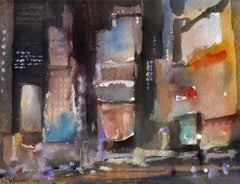
'Signs and Lights on Broadway' 2005 by American artist, Lawrence Kelsey. Gouache, 7.5 x 10 in. / Frame: 16.5 x 20.5 in. Depicting a night view of New York City, this impressionistic...

Category

Early 2000s American Impressionist Joseph Yeager Landscape Paintings

Materials

Gouache

Contemporary Impressionist Painting by Lawrence Kelsey 'The New 42nd Street'

Contemporary Impressionist Painting by Lawrence Kelsey 'The New 42nd Street'

By Lawrence Kelsey

Located in White Plains, NY

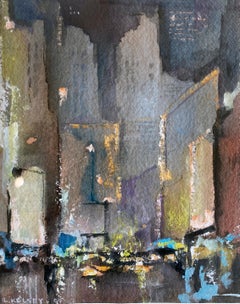
'The New 42nd Street' 2004-2005 by American artist, Lawrence Kelsey. Gouache, 8 x 10.25 in. / Frame: 16.5 x 20.5 in. Depicting a night view of 42nd Street in New York City, this impr...

Category

Early 2000s American Impressionist Joseph Yeager Landscape Paintings

Materials

Gouache

"Beach House Scene" American Impressionist Coastal Landscape Watercolor on Paper

"Beach House Scene" American Impressionist Coastal Landscape Watercolor on Paper

By Martha Walter

Located in New York, NY

This piece is a playful depiction of a beach house scene of the ocean, sand, and view of a house with its garden with joyful colors and precious deta...

Category

Early 20th Century American Impressionist Joseph Yeager Landscape Paintings

Materials

Paper, Watercolor

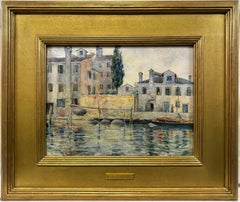
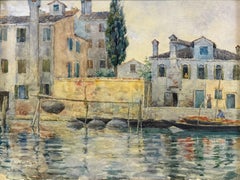
“Venice, 1889” San Pietro di Castello Canals American Impressionist Watercolor

“Venice, 1889” San Pietro di Castello Canals American Impressionist Watercolor

Located in Yardley, PA

“Venice, 1889” by Louis Ritter (American, 1854-1892). A fantastic example of Ritter’s renowned European watercolors. This beautifully poised composition captures the sun-washed faça...

Category

1880s American Impressionist Joseph Yeager Landscape Paintings

Materials

Paper, Watercolor

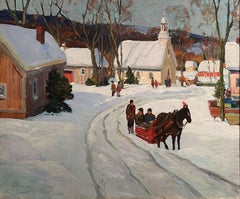
"Mountain Village in Winter" Anthony Thieme, Snowy Landscape

"Mountain Village in Winter" Anthony Thieme, Snowy Landscape

By Anthony Thieme

Located in New York, NY

Anthony Thieme Mountain Village in Winter Signed lower left Oil on canvas 25 x 30 inches Anthony Thieme was born in the Dutch port city of Rotterdam in 1888. He studied at the Acade...

Category

Early 20th Century American Impressionist Joseph Yeager Landscape Paintings

Materials

Canvas, Oil

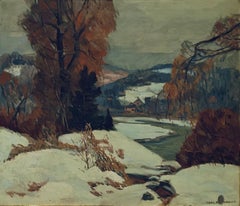
"Winter Landscape with Stream" Carl Rudolph Krafft, Early 20th Century Landscape

"Winter Landscape with Stream" Carl Rudolph Krafft, Early 20th Century Landscape

By Carl Rudolph Krafft

Located in New York, NY

Carl Rudolph Krafft Winter Landscape with Stream Signed lower right and with thumbprint Oil on canvas 25 x 30 inches Carl Rudolph Krafft was born in 1884 in Reading, Ohio, and his ...

Category

Early 20th Century American Impressionist Joseph Yeager Landscape Paintings

Materials

Canvas, Oil

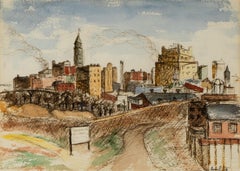
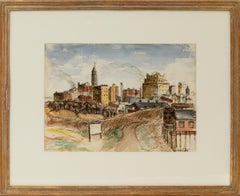
Eunice Katz 1950s Denver Skyline Cityscape Graphite Watercolor Painting

Eunice Katz 1950s Denver Skyline Cityscape Graphite Watercolor Painting

By Eunice Katz

Located in Denver, CO

A rare and evocative 1950s Denver skyline painting by American artist Eunice Katz, combining graphite and watercolor to depict the city’s mid-century urban landscape. This atmospheri...

Category

1950s American Impressionist Joseph Yeager Landscape Paintings

Materials

Watercolor, Graphite

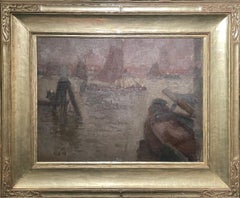
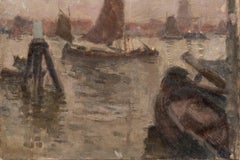
"Soir de Novembre, Dordrecht, " Eugene Vail, Dutch Landscape with Boats, Cloudy

"Soir de Novembre, Dordrecht, " Eugene Vail, Dutch Landscape with Boats, Cloudy

By Eugène Lawrence Vail

Located in New York, NY

Eugène Laurent Vail (1857 - 1934) Soir de Novembre, Dordrecht Oil on canvas 19 1/4 x 25 3/4 inches Signed lower left; titled in two places on the stretcher with various other inscriptions, stamped "MADAME G:VAIL A" and inscribed "177" in ink and "#43" in pencil on a partial label from Garde-Meuble Maple affixed to the stretcher Eugene Vail (Saint-Servan, France September 29, 1857 - Paris, December 28, 1934), the son of a French mother and an American father, Lawrence Eugene Vail, studied at the Stevens Institute of Technology in Hoboken, New Jersey (where Alfred Stieglitz was born in 1864) and graduated with a degree in mechanical engineering in 1877. Then he became a student of William Merritt Chase and J. Carroll Beckwith at the Art Students League before returning to France. He entered the Ecole des Beaux-Arts in 1882 where he was instructed by Alexandre Cabanel, Raphaël Collin, and Dagnan-Bouveret (1852-1929), known as an extreme naturalist. When Bastien-Lepage died in 1884, Dagnan-Bouveret became the leader of the Naturalist School. He definitely made an indelible impression on Vail. According to Louise Cann, Vail soon became an independent painter working at Pont-Aven and Concarneau. It is difficult to determine when he separated from his teachers since he is listed as a student whenever he exhibited at the Paris Salon — that is, until 1899 when he dropped the mention of élève. A picture of a peasant girl, Seulette was his Salon debut painting in 1883, the same year that he sent two scenes of Brittany to the Pennsylvania Academy of the Fine Arts' exhibition, which documents his stay in that region. The next year he exhibited in the Salon: Fishing Port, Concarneau, which went to the Luxembourg Museum (it is now in the Musée Municipal of Brest). It has the Naturalist brown and gray palette and tonalist atmosphere but already shows that Vail had direct experience with scenes of life in coastal villages: "So convincing was his familiarity with the French coast that the critic Thiébault-Sisson claimed him as a Frenchman and declared that no American marine painter could touch his skill." (Maureen C. O'Brien, in Blaugrund, 1989, p. 218). In 1885, Vail exhibited Inner Port at Dieppe and in the following year On the Thames (Private collection), which later won him the Grand Diploma of Honor from an international jury in Berlin in 1891. Widow, the title of Vail's entry in the Salon of 1887 (unlocated), is a striking image of a woman standing on a beach, looking out to the expanse of the ocean where her husband obviously met his end. The innocent child who looks at us may have the same fate in store for him. Then in 1888, Vail completed his masterpiece, Ready, About! a "wall-size" 94 x 125½ inch canvas. The painting won a first-class gold medal in the Salon of 1888, then at the Paris Universal Exposition of 1889, Vail won another gold medal. The first precedent that comes to mind is Théodore Géricault's colossal Raft of the Medusa of 1819 (Louvre), the celebrated romantic image of castaways about to be rescued after being lost at sea. But while Géricault presents a massive, sculpturesque group of figures struggling on a raft just beyond our designated viewing space, Vail pulls the viewer into the picture, or more exactly, extends the diagonally rocking boat into the spectator's area, vividly anticipating the effects of cinematography. There is no more effective way to engage the spectator's attention and sympathies, and the illusionism is especially effective in this life-size picture. Vail's vigorous brushwork — a uniform use of rectangular strokes — adds to the motion-filled, dynamic actuality of this image, and the overall green-gray tonalities evoke the constantly menacing, cold and wet travails in the life of the fishermen in the Atlantic's rough waters. Theodore Child (1889, p. 518) wrote about this painting: "very beautiful in color, and amongst the very strongest and best pictures of this kind in the Exhibition." Dordrecht (unlocated) was Vail's painting exhibited at the Pennsylvania Academy in 1892, and in the following year he showed Fisherman — The North Sea at the Paris Salon, the same year in which he re-exhibited Dordrecht and On the Thames at the World's Columbian Exposition in Chicago. Vail won the coveted Légion d'Honneur in 1894. Some of his paintings found their way to European museums, for example, Soir de novembre (Odessa Museum) and Soir de Bretagne (Museo d'Arte Moderna, Venice). The latter was exhibited at the Exposition Universelle of 1900 in Paris. Also there was Voix de la mer (Voices of the Sea), which we identify as the painting that appears in an interior view of the American section, just to the right of a doorway (fig. 20 in Fischer, 1999), a simple marine painting. Some time after 1900, Vail turned to both impressionism and post-impressionism but no one seems to have charted this course. His Autumn near Beauvais, illustrated in International Studio (1902, p. 211), The Flags, St. Mark's Venice (1903; National Gallery of Art), and Grand Canal, Venice, ca. 1904 (Museum of Art, Rhode Island School of Design) demonstrate an impressionist technique with broken color. Mandel (1977, p. 202) wrote on the latter: "applied in short strokes juxtaposing brilliant hues of orange, blue, white, black and red, with a strong interplay between the warm pink tones of the walls and the green shadows of the black boats which are silhouetted against them." Cann (1937) believed that in Venice, Vail "found his true self." The Flags forecasts the Armistice Day pictures by Hassam and others, painted fifteen years later. Vail became involved in the Society of American Artists in Paris and the Société Internationale de Peinture et de Sculpture, whose membership included Frank Brangwyn, Charles Cottet (1863-1924), the famous Naturalist sculptor Constantin Meunier (1831-1905), Frits Thaulow...

Category

Early 20th Century American Impressionist Joseph Yeager Landscape Paintings
Materials

Canvas, Oil

"Forest Landscape" John F. Carlson, circa 1925 American Impressionist Landscape

"Forest Landscape" John F. Carlson, circa 1925 American Impressionist Landscape

By John F. Carlson

Located in New York, NY

John F. Carlson Forest Landscape, circa 1925 Signed lower right Watercolor on paper Sight 21 x 24 1/2 inches The native Swede John Fabian Carlson became a household name in New Yor...

Category

1920s American Impressionist Joseph Yeager Landscape Paintings
Materials

Paper, Watercolor

"Stone Wharf, Brittany" Jane Peterson, American Impressionist, Boats in Canal

"Stone Wharf, Brittany" Jane Peterson, American Impressionist, Boats in Canal

By Jane Peterson

Located in New York, NY

Jane Peterson Stone Wharf, Brittany, circa 1910 Signed lower right Oil on canvas 18 x 24 inches Provenance Private Collection, New York Born Jennie Christine in Elgin, Illinois, s...

Category

1910s American Impressionist Joseph Yeager Landscape Paintings

Materials

Canvas, Oil

Flowers in a Florida Courtyard, Oil on Canvas, Early 20th Century

Flowers in a Florida Courtyard, Oil on Canvas, Early 20th Century

By Emile Albert Gruppe

Located in New York, NY

The painting is signed lower right. It depicts wisteria blooming brightly above a white courtyard entrance.

Category

Early 20th Century American Impressionist Joseph Yeager Landscape Paintings

Materials

Canvas, Oil

"Train Station, " Max Kuehne, Industrial City Scene, American Impressionism

"Train Station, " Max Kuehne, Industrial City Scene, American Impressionism

By Max Kuehne

Located in New York, NY

Max Kuehne (1880 - 1968) Train Station, circa 1910 Watercolor on paper 8 1/4 x 10 1/4 inches Signed lower right Provenance: Private Collection, Illinois Max Kuehne was born in Halle, Germany on November 7, 1880. During his adolescence the family immigrated to America and settled in Flushing, New York. As a young man, Max was active in rowing events, bicycle racing, swimming and sailing. After experimenting with various occupations, Kuehne decided to study art, which led him to William Merritt Chase's famous school in New York; he was trained by Chase himself, then by Kenneth Hayes Miller. Chase was at the peak of his career, and his portraits were especially in demand. Kuehne would have profited from Chase's invaluable lessons in technique, as well as his inspirational personality. Miller, only four years older than Kuehne, was another of the many artists to benefit from Chase's teachings. Even though Miller still would have been under the spell of Chase upon Kuehne's arrival, he was already experimenting with an aestheticism that went beyond Chase's realism and virtuosity of the brush. Later Miller developed a style dependent upon volumetric figures that recall Italian Renaissance prototypes. Kuehne moved from Miller to Robert Henri in 1909. Rockwell Kent, who also studied under Chase, Miller, and Henri, expressed what he felt were their respective contributions: "As Chase had taught us to use our eyes, and Henri to enlist our hearts, Miller called on us to use our heads." (Rockwell Kent, It's Me O Lord: The Autobiography of Rockwell Kent. New York: Dodd, Mead and Co., 1955, p. 83). Henri prompted Kuehne to search out the unvarnished realities of urban living; a notable portion of Henri's stylistic formula was incorporated into his work. Having received such a thorough foundation in art, Kuehne spent a year in Europe's major art museums to study techniques of the old masters. His son Richard named Ernest Lawson as one of Max Kuehne's European traveling companions. In 1911 Kuehne moved to New York where he maintained a studio and painted everyday scenes around him, using the rather Manet-like, dark palette of Henri. A trip to Gloucester during the following summer engendered a brighter palette. In the words of Gallatin (1924, p. 60), during that summer Kuehne "executed some of his most successful pictures, paintings full of sunlight . . . revealing the fact that he was becoming a colorist of considerable distinction." Kuehne was away in England the year of the Armory Show (1913), where he worked on powerful, painterly seascapes on the rocky shores of Cornwall. Possibly inspired by Henri - who had discovered Madrid in 1900 then took classes there in 1906, 1908 and 1912 - Kuehne visited Spain in 1914; in all, he would spend three years there, maintaining a studio in Granada. He developed his own impressionism and a greater simplicity while in Spain, under the influence of the brilliant Mediterranean light. George Bellows convinced Kuehne to spend the summer of 1919 in Rockport, Maine (near Camden). The influence of Bellows was more than casual; he would have intensified Kuehne's commitment to paint life "in the raw" around him. After another brief trip to Spain in 1920, Kuehne went to the other Rockport (Cape Ann, Massachusetts) where he was accepted as a member of the vigorous art colony, spearheaded by Aldro T. Hibbard. Rockport's picturesque ambiance fulfilled the needs of an artist-sailor: as a writer in the Gloucester Daily Times explained, "Max Kuehne came to Rockport to paint, but he stayed to sail." The 1920s was a boom decade for Cape Ann, as it was for the rest of the nation. Kuehne's studio in Rockport was formerly occupied by Jonas Lie. Kuehne spent the summer of 1923 in Paris, where in July, André Breton started a brawl as the curtain went up on a play by his rival Tristan Tzara; the event signified the demise of the Dada movement. Kuehne could not relate to this avant-garde art but was apparently influenced by more traditional painters — the Fauves, Nabis, and painters such as Bonnard. Gallatin perceived a looser handling and more brilliant color in the pictures Kuehne brought back to the States in the fall. In 1926, Kuehne won the First Honorable Mention at the Carnegie Institute, and he re-exhibited there, for example, in 1937 (Before the Wind). Besides painting, Kuehne did sculpture, decorative screens, and furniture work with carved and gilded molding. In addition, he designed and carved his own frames, and John Taylor Adams encouraged Kuehne to execute etchings. Through his talents in all these media he was able to survive the Depression, and during the 1940s and 1950s these activities almost eclipsed his easel painting. In later years, Kuehne's landscapes and still-lifes show the influence of Cézanne and Bonnard, and his style changed radically. Max Kuehne died in 1968. He exhibited his work at the National Academy of Design, the Art Institute of Chicago, the Carnegie Institute in Pittsburgh, the Memorial Art Gallery of the University of Rochester, and in various New York City galleries. Kuehne's works are in the following public collections: the Detroit Institute of Arts (Marine Headland), the Whitney Museum (Diamond Hill...

Category

1910s American Impressionist Joseph Yeager Landscape Paintings
Materials

Paper, Watercolor

Previously Available Items
Stormy Rocky Coast Seascape

Stormy Rocky Coast Seascape

By Joseph Yeager

Located in Soquel, CA

One piece out of many in a series of vibrant ocean seascapes by Joseph Yeager (American, 1892-1958) on heavy watercolor paper with ragged edges. Unframed and signed "Joe Yeager" in t...

Category

19th Century American Impressionist Joseph Yeager Landscape Paintings
Materials

Watercolor, Laid Paper

Ocean Study and Rocks Seascape

Ocean Study and Rocks Seascape

By Joseph Yeager

Located in Soquel, CA

One piece out of many in a series of vibrant ocean seascapes by Joseph Yeager (American, 1892-1958) on heavy bond arches watercolor paper. Unframed and signed "Joe Yeager" in the low...

Category

19th Century American Impressionist Joseph Yeager Landscape Paintings
Materials

Paper, Watercolor

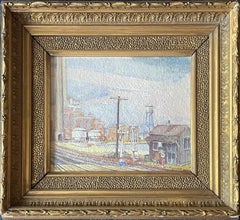
Medina Train Station Industrial Landscape

Medina Train Station Industrial Landscape

By Joseph Yeager

Located in Soquel, CA

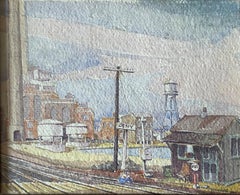
Vibrant industrial landscape of the train station in Medina, Ohio by Joe Yeager (American, 1892-1958). Signed by the artist in the lower right corner. Presented in a complimentary wo...

Category

Mid-20th Century American Realist Joseph Yeager Landscape Paintings
Materials

Canvas, Oil

Joseph Yeager landscape paintings for sale on 1stDibs.
Find a wide variety of authentic Joseph Yeager landscape paintings available for sale on 1stDibs. You can also browse by medium to find art by Joseph Yeager in paint, canvas, fabric and more. Much of the original work by this artist or collective was created during the 20th century and is mostly associated with the Impressionist style. Not every interior allows for large Joseph Yeager landscape paintings, so small editions measuring 30 inches across are available. Customers who are interested in this artist might also find the work of William Lemos, William Frates, and Les Anderson. Joseph Yeager landscape paintings prices can differ depending upon medium, time period and other attributes. On 1stDibs, the price for these items starts at $700 and tops out at $1,720, while the average work can sell for $1,200.