La Ba Quan Art

Vietnamese, b. 1976
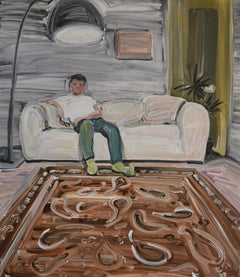
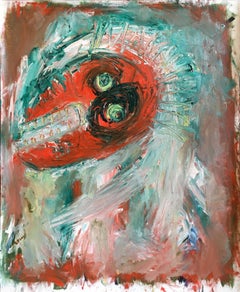
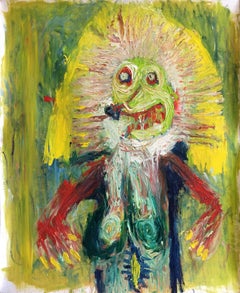
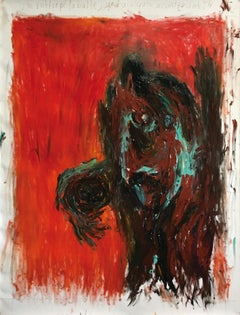
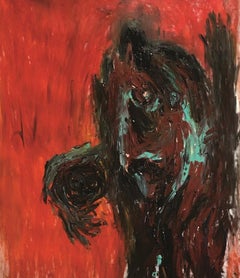
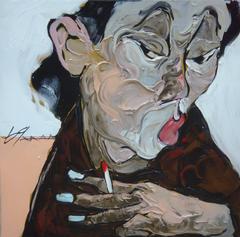
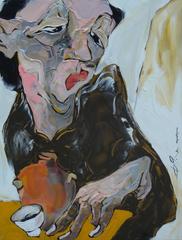
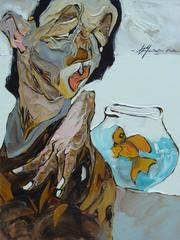
La Ba Quan is a Vietnamese fine art painter, born in 1976 in Nam Dinh Province. His subject of matter are human emotions, joy and sorrow, powerfully depicted in his distorted portraits. Quan graduated from College of Arts Nam Dinh at Nam Dinh province in 1999. After experiencing in various kinds of work, in order to gain knowledge and skill, Quan decided to come back and got his Bachelor of Art degree at Hanoi University of Fine Arts in 2005 in Vietnam. To enhance the methodology and logic and literary argument, he studied and got the Master of Fine Arts degree at Hanoi University of Fine Arts in 2010. La Ba Quan paints with thick layers of paint, often directly from the tube using a palette knife to achieve his result. Since 2005, he has been working on a series of portraits named The emotion of an old man. This series of paintings, as well as many of his other works, are inspired by his father who endured hardship and poverty during the war time. His paintings directly reflect on his life and his father's life, showing the admiration and gratitude towards his nation, which suffered the painful war period, and whose memories return in Quan's haunting portrait images. Focused on individual stories and personal conditions, he manages to narrate their living tales and paint their wordless misery, inner feeling and sorrow and sometimes, happiness.
to
4
2
1
2
Overall Width
to
Overall Height
to
5
3
2
3
2
5
5
5
5
5
11,519
2,870
2,492
1,536
5
Artist: La Ba Quan
'Thinking' Figurative Expressionist Portrait Painting

'Thinking' Figurative Expressionist Portrait Painting

By La Ba Quan

Located in Rye, NY

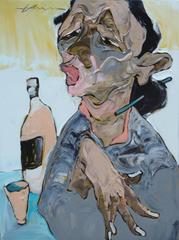
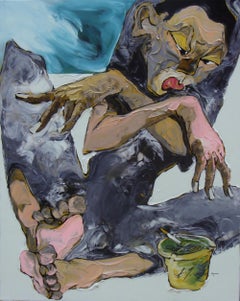
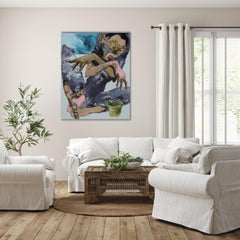
‘Thinking’ is a medium size vertical expressionist figurative oil on canvas painting created by Vietnamese artist La Ba Quan in 2011. Featuring a palette made of grey, soft blue, green and pink, the painting brings to mind the fascinating aura of a Chaim Soutine. This expressionist painting is dominated by the tortuous lines of the man’s silhouette...

Category

2010s Contemporary La Ba Quan Art

Materials

Canvas, Oil
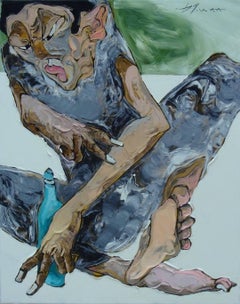
Emotional
Emotional

La Ba QuanEmotional, 2011

$2,880Sale Price|20% Off

Emotional

By La Ba Quan

Located in Rye, NY

‘Emotional’ is a large expressionist figurative oil on canvas painting of vertical format created by Vietnamese artist La Ba Quan in 2011. Featuring a palette made of grey, brown, bl...

Category

21st Century and Contemporary Expressionist La Ba Quan Art

Materials

Canvas, Oil

Surprised
Surprised

Surprised

By La Ba Quan

Located in Rye, NY

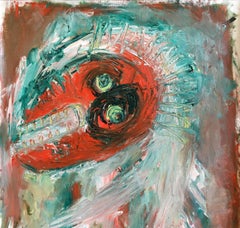
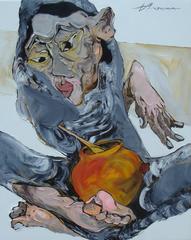
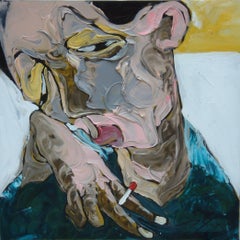
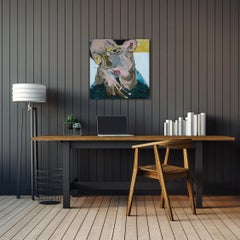
‘Surprised’ is a medium size square expressionist figurative oil on canvas painting created by Vietnamese artist La Ba Quan in 2011. Featuring a palette made of grey, soft blue, gree...

Category

2010s Contemporary La Ba Quan Art

Materials

Canvas, Oil
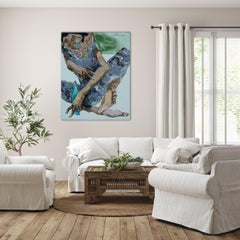
'Arms Crossed' Figurative Expressionist Painting

'Arms Crossed' Figurative Expressionist Painting

By La Ba Quan

Located in Rye, NY

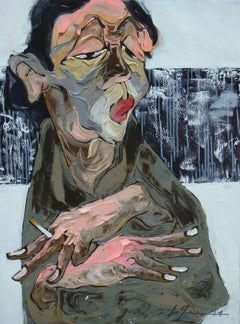
‘Arms Crossed’ is a medium size vertical expressionist figurative oil on canvas painting created by Vietnamese artist La Ba Quan in 2011. Featuring a palette made of grey, soft blue, green and pink, the painting brings to mind the fascinating aura of a Chaim Soutine. This expressionist painting is dominated by the tortuous lines of the man’s silhouette...

Category

21st Century and Contemporary Expressionist La Ba Quan Art

Materials

Canvas, Oil
Related Items
Incoherence of compulsory ways #1 - Hélène Duclos, Contemporary figurative paint

Incoherence of compulsory ways #1 - Hélène Duclos, Contemporary figurative paint

By Hélène Duclos

Located in Paris, FR

Oil on canvas Signed lower right Unique work 1 / Hélène DUCLOS, 2016 – Artist Statement “Questioning the human condition and the position of being alive – What is it to be a living being? Who / what can we believe? Who / what can we trust? How real is our view of the world? And how is that perspective angled, and ultimately limited? These are the issues at the heart of my work as an artist. Painting, drawing, engraving and embroidery give me the freedom to approach my subjects from an ambivalent and flexible standpoint. I am building up a dynamic body of work, like pieces that you can put together in one way or another to shape different structures, pierced with numerous openings. And the title that I give each piece acts as a possible clue as to how to enter inside that system. I can portray both softness and monstrosities. I focus on the links and barriers lying between living beings and their surroundings, and evoke how permeable these connections are. My aim is not to create a visual documentary reporting fact, but rather immerse myself in observing everyday life, and in a host of images depicting real events (pictures, photos and videos). Instilled with these images, I can give a more personalized, unique and allegorical vision of the world around me. I am also interested in the key transition periods of human existence, those turning points that forge our identity within a family, a group, and society as a whole at the heart of a specific environment. I centre on what makes up and creates cohesion (rituals, myths and tales….), and indeed the opposite - what leads to life becoming shattered, hindered and frustrated (moving populations, exile and migration…) Amidst a landscape roaming with wild beasts and hybrid creatures, between love and separation, metaphors for our own desires and fears lie in hiding, or reveal themselves in the painted or embroidered spaces. Sometimes they are etched with lines, symbols and tiny architectural designs. These works might depict our inner landscapes, as if harking back to a primordial and cosmic point of origin. My most recent collections recreate the images of bodies or landscapes using abstract zones and figurative details that have no direct link with either anatomy or geography. Intimacy and the unspeakable are themes that run throughout my work, and I make sure to incorporate areas of both visual tension and relief, so as to give the viewer the space to project him or herself into the work. And here, such paradoxes can only be reached through the interplay between abstraction and figuration.” 2 / Thierry Delcourt Psychiatrist, psychoanalyst and author of works on the process of artistic creation, and the conditions of existential and social creativity : "Entering into the world of Hélène Duclos in her drawings, paintings, embroidery and words means letting yourself be carried away by a torrent towards strange shores of creation where only a few artists have ever dared to venture. As if perched on a watchtower on the threshold of different worlds, Hélène Duclos throws us out of our depth, plunging us into spaces filled with destitute mankind, and guiding us through her stem-like maze of a scheme, bristling with roots and clues. But the mystery here, like a poetic, human rebus that never ends, only compels us to take a closer look.” 3 / Hélène Duclos ‘s biography : After graduating from the Duperré School of Applied Arts in Paris with a degree in textile design, I set off on a six-month sea voyage from Vannes in Brittany, to Dakar. On returning to France, I set up my atelier...

Category

2010s Contemporary La Ba Quan Art

Materials

Canvas, Oil
Peacocks 36. Figurative Oil Painting, Colorful, Pop art, Animals, Polish artist

Peacocks 36. Figurative Oil Painting, Colorful, Pop art, Animals, Polish artist

By Rafał Gadowski

Located in Warsaw, PL

RAFAŁ GADOWSKI (born in 1973) Studied at The European Academy of Arts in Warsaw Faculty of Painting, as well as at the Faculty of Graphic Art at the Cracow Academy of Fine Arts. He...

Category

2010s Expressionist La Ba Quan Art

Materials

Canvas, Oil
By the sea Hélène Duclos Contemporary art painting blue landscape sky

By the sea Hélène Duclos Contemporary art painting blue landscape sky

By Hélène Duclos

Located in Paris, FR

Oil paint on canvas Unique work Hand-signed by the artist The red necklace of the naked Queens “My artistic research has expanded over the years, crossing paths already traveled a...

Category

2010s Contemporary La Ba Quan Art

Materials

Canvas, Oil
Change of paradigm #1 - Hélène Duclos, Contemporary figurative painting

Change of paradigm #1 - Hélène Duclos, Contemporary figurative painting

By Hélène Duclos

Located in Paris, FR

Oil on canvas Signed Unique work 1 / Hélène DUCLOS, 2016 – Artist Statement “Questioning the human condition and the position of being alive – What is i...

Category

21st Century and Contemporary Contemporary La Ba Quan Art

Materials

Canvas, Oil
Sawah Landscape
Sawah Landscape

Auke SonnegaSawah Landscape, 1954

$21,882

H 19.89 in W 23.82 in D 1.97 in

Sawah Landscape

Located in Amsterdam, NL

A sawah landscape, Sumatra Signed and dated 'Sonnega '54' (lower right), and annotated 'Voor Jan de Bas 1-1-1970 / R de Bas' (on the reverse) oil on canvas, 50,5x60,5 cm Provenance: - Collection Pieter de Bas (1909-1979) Mr de Bas was head of the MULO school and acting head of the HBS school in Medan. Thence by descent to the present owner. Exhibited: - Hotel de Boer, Medan 1954, where acquired by the first owner. The light I observed everywhere was of a special quality, fluorescent blue, shone from nowhere but radiated from every point, oddly with great depth and intensity. The light in an entirely different dimension came from nowhere and went nowhere shimmering with the glow of a bright blue jewel. The most important thing I discovered was of being omnipresent and able to understand everything at the same time, yes I could fathom creation completely. Auke Sonnega, born March 9, 1910 in Leeuwarden, known as the painter, primarily of young Balinese men and women. Originally raised in the reformed denomination, the parents of Auke apparently practised theosophy and their children, including Auke were taught these principles. The talent for drawing revealed itself at an early stage which in 1926 lead to a 4-year study of textile design at the Academy for Art and Craft in Amsterdam. He completed the academy in 1930 and worked in a carpet factory in Twente until 1934 and then followed in his sister Aafje’s footsteps leaving the Netherlands to go to the Dutch East Indies where in 1935 he started working as a graphic designer with an advertising bureau in Batavia. He was able to travel through Java and Bali on the motorbike that he brought with him from Europe, and was paid for his travelogue, enhanced with his own photo’s which appeared in several Dutch newspapers and magazines. In the 1930’s two Europeans, Walter Spies and Rudolf Bonnet...

Category

Mid-20th Century Expressionist La Ba Quan Art

Materials

Canvas, Oil
Cylcic movement #1 - Hélène Duclos, 21st Century, Contemporary figurative paint

Cylcic movement #1 - Hélène Duclos, 21st Century, Contemporary figurative paint

By Hélène Duclos

Located in Paris, FR

Oil on canvas Signed lower right Unique work 1 / Hélène DUCLOS, 2016 – Artist Statement “Questioning the human condition and the position of being alive – What is it to be a living being? Who / what can we believe? Who / what can we trust? How real is our view of the world? And how is that perspective angled, and ultimately limited? These are the issues at the heart of my work as an artist. Painting, drawing, engraving and embroidery give me the freedom to approach my subjects from an ambivalent and flexible standpoint. I am building up a dynamic body of work, like pieces that you can put together in one way or another to shape different structures, pierced with numerous openings. And the title that I give each piece acts as a possible clue as to how to enter inside that system. I can portray both softness and monstrosities. I focus on the links and barriers lying between living beings and their surroundings, and evoke how permeable these connections are. My aim is not to create a visual documentary reporting fact, but rather immerse myself in observing everyday life, and in a host of images depicting real events (pictures, photos and videos). Instilled with these images, I can give a more personalized, unique and allegorical vision of the world around me. I am also interested in the key transition periods of human existence, those turning points that forge our identity within a family, a group, and society as a whole at the heart of a specific environment. I centre on what makes up and creates cohesion (rituals, myths and tales….), and indeed the opposite - what leads to life becoming shattered, hindered and frustrated (moving populations, exile and migration…) Amidst a landscape roaming with wild beasts and hybrid creatures, between love and separation, metaphors for our own desires and fears lie in hiding, or reveal themselves in the painted or embroidered spaces. Sometimes they are etched with lines, symbols and tiny architectural designs. These works might depict our inner landscapes, as if harking back to a primordial and cosmic point of origin. My most recent collections recreate the images of bodies or landscapes using abstract zones and figurative details that have no direct link with either anatomy or geography. Intimacy and the unspeakable are themes that run throughout my work, and I make sure to incorporate areas of both visual tension and relief, so as to give the viewer the space to project him or herself into the work. And here, such paradoxes can only be reached through the interplay between abstraction and figuration.” 2 / Thierry Delcourt Psychiatrist, psychoanalyst and author of works on the process of artistic creation, and the conditions of existential and social creativity : "Entering into the world of Hélène Duclos in her drawings, paintings, embroidery and words means letting yourself be carried away by a torrent towards strange shores of creation where only a few artists have ever dared to venture. As if perched on a watchtower on the threshold of different worlds, Hélène Duclos throws us out of our depth, plunging us into spaces filled with destitute mankind, and guiding us through her stem-like maze of a scheme, bristling with roots and clues. But the mystery here, like a poetic, human rebus that never ends, only compels us to take a closer look.” 3 / Hélène Duclos ‘s biography : After graduating from the Duperré School of Applied Arts in Paris with a degree in textile design, I set off on a six-month sea voyage from Vannes in Brittany, to Dakar. On returning to France, I set up my atelier...

Category

21st Century and Contemporary Contemporary La Ba Quan Art

Materials

Canvas, Oil
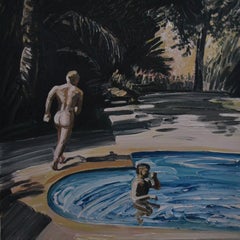
Change of paradigm #3 - Hélène Duclos, 21st Century, Contemporary figurative

Change of paradigm #3 - Hélène Duclos, 21st Century, Contemporary figurative

By Hélène Duclos

Located in Paris, FR

Oil on canvas Signed lower right Unique work 1 / Hélène DUCLOS, 2016 – Artist Statement “Questioning the human condition and the position of being alive – What is it to be a living...

Category

21st Century and Contemporary Contemporary La Ba Quan Art

Materials

Canvas, Oil
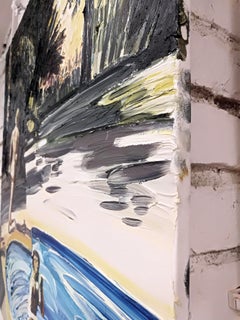
Amedee de La PATELLIERE, Eclipse with 4 Characters, 1928

Amedee de La PATELLIERE, Eclipse with 4 Characters, 1928

Located in Saint Amans des cots, FR

Oil on canvas by Amedee de La PATELLIERE, France, 1928. Eclipse with four characters. With frame: 63x54 cm - 24.8x21.25 inches ; without frame: 41x33 cm - 16.15x13 inches. Format 6F....

Category

1920s Expressionist La Ba Quan Art

Materials

Canvas, Oil
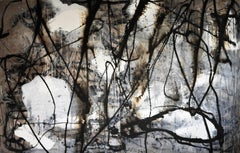
Toujours la Vie Recommence

Edouard GoergToujours la Vie Recommence, 1958

$3,500

H 24.41 in W 21.03 in D 1.58 in

Toujours la Vie Recommence

By Edouard Goerg

Located in Saint Amans des cots, FR

Oil on canvas by Edouard Goerg (1893-1969), France, 1958. Life is always the same. Acquired in 2017 from the personal collection of Edouard Goerg. Measurements : with frame : 62.5x53.4 cm - 24.6x21 inches, without frame : 55x46 cm - 21.7x18.1 inches, format 10F. Signed "E.Goerg" (see photo). Preserved by the painter, then by his family since his death in 1969, this painting appeared in 2017. Entitled "Always life begins again", it is a crepuscular work. Testamentary one could say, so much the statement which is made there is definitive. The fact that he kept it until his death tends to consolidate this vision. Far from the empty looks and death faces of the rebellious era of sarcastic expressionism, the terrifying and compassionate testimony of the Spanish war, and the post-WWII flower women, we are dealing here with a a form of reasonable abdication, but honest. This idea that although everything changes, nothing changes. Changed times, actors, ideas, the same comedy occupies the society. Having given up the idea of ​​changing the latter, Goerg accepts the fact that the only alternative is to stay there or get lost. But stay afloat with his values, completely independent, whatever the cost is. This work is similar to La Vie Recommence of 1935, reproduced on page 54 of Gaston Diehl's book devoted to the painter (Éditions de Clermont, 1947). On the latter, the artist depicts his vision of life, from birth to death, made of hope, fear, cruelty, resignation and fatality. 23 years later, Toujours La Vie Recommence shows us the road traveled by the painter. It is no longer a matter of denunciation, but ultimately of acceptance of reality and the difficulty of staying there yourself. The admirer of Hieronymus Bosch gives us an inspired composition. The hand of God, the only expression of physical beauty in this work, comes down from heaven to give life. Symbolically, it holds an egg that dispenses the element from which the human protagonists find their birth, and in which they move and tangle more than they impose. Beautiful allegory of society. Four characters, two women and two men evolve in this societal marigot. The man in the foreground, ruddy face, evolves with ease. His body is supple, flexible, adaptable. The woman on the left observes him with admiration. Obviously, this man is in his place and causes rapture. The right man with massive shoulders and wrapped, shows a physical maladjustment to the activity he is doing. He struggles to stay afloat, his face expresses effort, even exhaustion. But he assumes. He does with what he has, with what he is. The other woman shows him the greatest indifference. What is not the case of the demonic archangel (recurrent in the works of Bosch) with the stunted body, who leads the dance and holds this character, we understand the painter, under his control as to have fun. As this character cannot change bodies, Goerg cannot change values. He does it with. Had he not said to the critic Roger Brielle: "Independents, sensitive and just men, that's what we must strive to stay in this world in disarray". Goerg will have come to narrative expressionism to give us a balance sheet allegory of his deep self and his condition. Édouard Goerg is one of the major artists of his generation. Coming from a Champagne family, he was born in Sidney, Australia, in 1893, during a professional stay of his father. After passing through London, he arrives in Paris at the age of seven. At twenty, between 1913 and 1914, he studieds painting at the Académie Ranson with Maurice Denis and Paul Sérusier. He travels to Italy and India. Mobilized in 1914, he is sent to Artois, then to Argonne. From 1920, he exhibits at the Salon des Independants, then at the Salon d'Automne where he joins with Laboureur. At Berthe Weil, in 1924, he participates in the exhibitions of the Gromaire group, a prelude to a series of exhibitions in Paris (Berthe Weill, Bernheim Jeune), as in Brussels (Le Centaure). Goerg illustrates books including Table of the beyond by F.Boutet. In 1928, he meets Paul Guillaume who exhibits his works in Boston and the Art Institute of Chicago. He continues to show his works, satires of the bourgeois manners, at Bernheim Jeune, then at Lucie Krogh. In 1934, he travels to Belgium and Holland where he paints surrealist paintings that will be exhibited at Jeanne Castel. In 1935-1936, he meets Aragon, who opened the doors of the houses of the cultures created by the Association of Writers and Revolutionary Artists. The Spanish war and the Second World War mark it deeply. He must protect his daughter and his Jewish women...

Category

1950s Expressionist La Ba Quan Art

Materials

Canvas, Oil
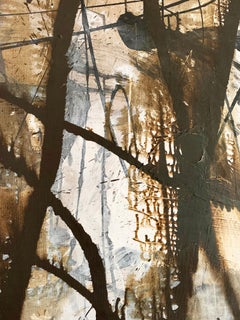
Bories-en-Provence Village Near Gordes, Large Oil on Canvas

Bories-en-Provence Village Near Gordes, Large Oil on Canvas

Located in Saint Amans des cots, FR

Oil on canvas by Paul Clement (1906-), France, 1967. Bories-en-Provence near Gordes. Measurements : with frame: 106x87 cm - 41.7x34.25 inches, without frame: 100x81 cm - 39.4x31.9 in...

Category

1960s Expressionist La Ba Quan Art

Materials

Canvas, Oil
Previously Available Items
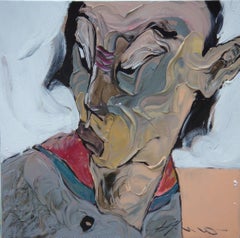
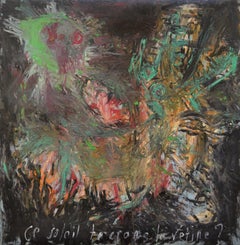
Impulsive

La Ba QuanImpulsive, 2011

Sold

H 20 in W 20 in

Impulsive

By La Ba Quan

Located in Rye, NY

Oil on canvas painting with dimensionsof 20" H x 20" W.

Category

2010s Contemporary La Ba Quan Art

Materials

Canvas, Oil Crayon
La Ba Quan art for sale on 1stDibs.

Find a wide variety of authentic La Ba Quan art available for sale on 1stDibs. You can also browse by medium to find art by La Ba Quan in canvas, fabric, oil paint and more. Much of the original work by this artist or collective was created during the 21st century and contemporary and is mostly associated with the contemporary style. Not every interior allows for large La Ba Quan art, so small editions measuring 20 inches across are available. Customers who are interested in this artist might also find the work of Nguyen The Hung, Linda Dumont, and Samuel B. Kpetenkple. La Ba Quan art prices can differ depending upon medium, time period and other attributes. On 1stDibs, the price for these items starts at $3,000 and tops out at $5,500, while the average work can sell for $3,500.