Lon Megargee Art

to
3
2
2
Overall Width
to
Overall Height
to
7
2
2
1
4
1
4
2
1
6
5
3
2
1
1
1
1
3
2
1
1
1
7
11,243
2,855
2,494
1,437
3
1
7
Artist: Lon Megargee
Longhorns by Lon Megargee

Longhorns by Lon Megargee

By Lon Megargee 1

Located in Phoenix, AZ

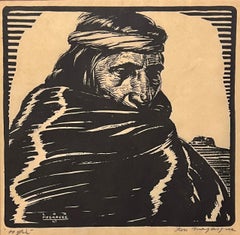
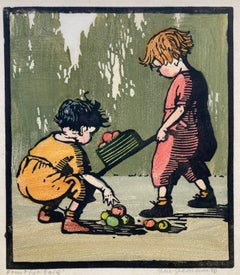
Lon Megargee 1883-1960 "Self Portrait" Wood block print Signed in plate, lower right Image size: 15.63 x 12 inches Frame size xx x xx inches Creator of S...

Category

1930s American Impressionist Lon Megargee Art

Materials

Screen

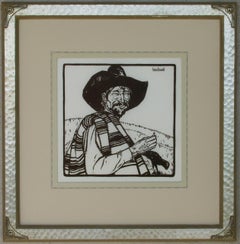
The Sheepherder by Lon Megargee

The Sheepherder by Lon Megargee

By Lon Megargee 1

Located in Phoenix, AZ

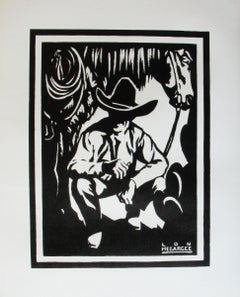
Lon Megargee 1883-1960 "The Sheepherder" Wood block print Signed in plate, lower right Image size: 10 x 10 inches Frame size 22 x 22 inches Creator of Stetson's hat logo "Last Drop from his Hat" Lon Megargee 1883 - 1960 At age 13, Lon Megargee came to Phoenix in 1896 following the death of his father in Philadelphia. For several years he resided with relatives while working at an uncle’s dairy farm and at odd jobs. He returned to Philadelphia in 1898 – 1899 in order to attend drawing classes at the Pennsylvania Academy of the Fine Arts. Back in Phoenix in 1899, he decided at the age of 16 to try to make his living as a cowboy. Lon moved to the cow country of Wickenburg, Arizona where he was hired by Tex Singleton’s Bull Ranch. He later joined the Three Bar R. . . and after a few years, was offered a job by Billy Cook of the T.T. Ranch near New River. By 1906, Megargee had learned his trade well enough to be made foreman of Cook’s outfit. Never shy about taking risks, Lon soon left Cook to try his own hand at ranching. He partnered with a cowpuncher buddy, Tom Cavness, to start the El Rancho Cinco Uno at New River. Unfortunately, the young partners could not foresee a three-year drought that would parch Arizona, costing them their stock and then their hard-earned ranch. Breaking with his romantic vision of cowboy life, Megargee finally turned to art full time. He again enrolled at the Pennsylvania Academy of Art and then the Los Angeles School of Art and Design during 1909 – 1910. The now well-trained student took his first trip to paint “en plein air” (outdoors) to the land of Hopi and Navajo peoples in northern Arizona. After entering paintings from this trip in the annual Territorial Fair at Phoenix, in 1911, he surprisingly sold his first oil painting to a major enterprise – the Santa Fe Railroad . . . Lon received $50 for “Navajos Watching the Santa Fe Train.” He soon sold the SFRR ten paintings over the next two years. For forty years the railroad was his most important client, purchasing its last painting from him in 1953. In a major stroke of good fortune during his early plein-air period, Megargee had the opportunity to paint with premier artist, William R. Leigh (1866 – 1955). Leigh furnished needed tutoring and counseling, and his bright, impressionistic palette served to enhance the junior artist’s sense of color and paint application. In a remarkable display of unabashed confidence and personable salesmanship, Lon Megargee, at age 30, forever linked his name with Arizona art history. Despite the possibility of competition from better known and more senior artists, he persuaded Governor George Hunt and the Legislature in 1913 to approve 15 large, historic and iconic murals for the State Capitol Building in Phoenix. After completing the murals in 1914, he was paid the then princely sum of roughly $4000. His Arizona statehood commission would launch Lon to considerable prominence at a very early point in his art career. Following a few years of art schooling in Los Angeles, and several stints as an art director with movie studios, including Paramount, Megargee turned in part to cover illustrations for popular Western story magazines in the 1920s. In the 1920s, as well, Lon began making black and white prints of Western types and of genre scenes from woodblocks. These prints he generally signed and sold singly. In 1933, he published a limited edition, signed and hard-cover book (about 250 copies and today rare)containing a group of 28 woodblock images. Titled “The Cowboy Builds a Loop,” the prints are noteworthy for strong design, excellent draftsmanship, humanistic and narrative content, and quality. Subjects include Southwest Indians and cowboys, Hispanic men and women, cattle, horses, burros, pioneers, trappers, sheepherders, horse traders, squaw men and ranch polo players. Megargee had a very advanced design sense for simplicity and boldness which he demonstrated in how he used line and form. His strengths included outstanding gestural (action) art and strong figurative work. He was superb in design, originality and drawing, as a study of his prints in the Hays collection reveals. In 1944, he published a second group of Western prints under the same title as the first. Reduced to 16 images from the original 28 subjects, and slightly smaller, Lon produced these prints in brown ink on a heavy, cream-colored stock. He designed a sturdy cardboard folio to hold each set. For the remainder of his life, Lon had success selling these portfolios to museum stores, art fairs and shows, and to the few galleries then selling Western art. Drawing on real working and life experiences, Lon Megargee had a comprehensive knowledge, understanding and sensitivity for Southwestern subject matter. Noted American modernist, Lew Davis...

Category

Early 20th Century American Impressionist Lon Megargee Art

Materials

Woodcut

Siesta by Lon Megargee 1929, Archival Pigmrnt Print

Siesta by Lon Megargee 1929, Archival Pigmrnt Print

By Lon Megargee 1

Located in Phoenix, AZ

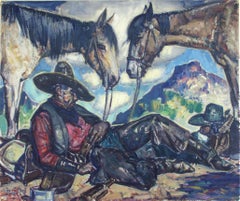
Tequila Siesta Lon Megargee Archival Pigment Print 100% 300 gram cotton rag paper Size: 22.5 x 27 inches Paper size: 24 x 28.5 inches Creator of the iconic logo for the Stetson Hat Company, " Last Drop From his Stetson", still in use today. Fine Art Estate of Lon Megargee, Collier Gallery At age 13, Lon Megargee came to Phoenix in 1896 following the death of his father in Philadelphia. For several years he resided with relatives while working at an uncle’s dairy farm and at odd jobs. He returned to Philadelphia in 1898 – 1899 in order to attend drawing classes at the Pennsylvania Academy of the Fine Arts. Back in Phoenix in 1899, he decided at the age of 16 to try to make his living as a cowboy. Lon moved to the cow country of Wickenburg where he was hired by Tex Singleton’s Bull Ranch. He later joined the Three Bar Ranch . . . and, after a few years, was offered a job by Billy Cook...

Category

1920s Lon Megargee Art

Materials

Archival Pigment

2 Lazy 2 P

2 Lazy 2 P

By Lon Megargee 1

Located in Phoenix, AZ

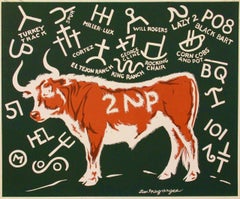
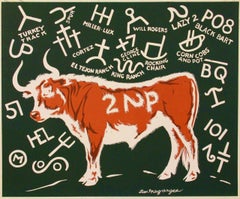
2 Lazy 2P, ca. 1939 Lon Megargee Serigraph 20 x 24 inches Signed in screen Original serigraph print by Lon Megargee 1883 - 1960 Featured in "Hot Irons" by Oren Arnold and John Hale, 1940 SHIPPING CHARGES INCLUDE SHIPPING, PACKAGING & INSURANCE Lon Megargee created this serigraph from his commission with Oren Arnold and John Hale to do their dust jacket for the book, " Hot Irons", 1940. Arnold and Hale wanted to establish a reference work, an "authority", with a entertaining history about the evolution of the brand. Megargee created a painting of a steer that was branded with the script, 2 Lazy 2 P. Surrounding the steer is a random display of famous brands of ranches in the Southwest. It was well received and must have prompted Megargee to create the likeness as a print. The brand is described in chapter thirteen, page 207-208 and says, " Ed Stram, who was Arizona state veterinarian for sixteen years, fire-branded his cattle with this peculiar crest. It isn't peculiar unless you have an equally peculiar sense of humor. At a glance it appears to be just another typically unimaginative brand, but it has been used to make many a thousand girls blush, and a few thousand bashful young men as well". COLLIER GALLERY, FINE ART ESTATE OF LON MEGARGEE Born and raised in Philadelphia, Pennsylvania, Lon Megargee, at age 13, ran away from his upper class home and went West in 1896 led by his zest for the wild and adventuresome life. There he established a reputation as a cowboy painter and illustrator with work most associated with Arizona Brewing Company ads featuring humorous aspects of cowboy life. In his youth, he worked as a free-lance cowboy, exhibition roper, poker dealer, and bronco buster in Arizona, and then went east again to study art in Philadelphia at the Pennsylvania Academy of Fine Arts, and to New York at the Art Students League and Pratt Institute. He returned to Arizona, living in Cave Creek, Salt River Canyon, Phoenix and the last years of his life near Sedona. His Phoenix home later became a popular hotel and dining place called the Hermosa Inn. Megargee was a ranch owner and also did oil canvases of the places he loved and the cowboy life he admired. By 1910, he was among the earliest resident artists, and was probably the best known artist in Arizona. His name was first associated with a landscape series of 15 large murals for the Capitol Building, newly constructed just after Arizona became a state in 1912. Another one of his paintings, Elemental, was the first painting by an artist living in Arizona to be acquired for the Municipal Collection of Phoenix. These works were chosen from entries in the State Fair, where he continued to win prizes for figure and landscape painting. From 1911 to 1953, he did numerous commission works for the Santa Fe Railroad, including a work titledNavajos Watching a Santa Fe Train. Between 1915 and 1930, he also painted in the Los Angeles area of California and had entries in the California State Fair. He died in Cottonwood, Arizona. After his death, theSaturday Evening Post had a double-page reproduction of his painting Cowboy's Dream. Creator of the iconic logo for the Stetson Hat Company, " Last Drop From his Stetson", still in use today. Fine Art Estate of Lon Megargee We offer signed in print and original signature block prints. Custom, hand carved, signature frames, with archival standards and a speciality in hand dyed mats and french matting are provided for a beautiful and timeless presentation. Megargee explored different mediums; printmaking captivated him in particular. The contrast of the black and white block print method captured perfectly his interpretation of a bold American West. The first print was produced around 1921 and culminated with the creation of “The Cowboy Builds a Loop” in 1933 with 28 images and poetry by his friend, Roy George. Megargee continued producing prints throughout the 1940s and early 50s. At age 13, Lon Megargee came to Phoenix in 1896 following the death of his father in Philadelphia. For several years he resided with relatives while working at an uncle’s dairy farm and at odd jobs. He returned to Philadelphia in 1898 – 1899 in order to attend drawing classes at the Pennsylvania Academy of the Fine Arts. Back in Phoenix in 1899, he decided at the age of 16 to try to make his living as a cowboy. Lon moved to the cow country of Wickenburg where he was hired by Tex Singleton’s Bull Ranch. He later joined the Three Bar Ranch . . . and, after a few years, was offered a job by Billy Cook...

Category

1930s American Modern Lon Megargee Art

Materials

Screen

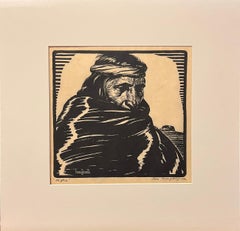
Hopi by Lon Megargee, Original Signed Block Print ca. 1920s

Hopi by Lon Megargee, Original Signed Block Print ca. 1920s

By Lon Megargee 1

Located in Phoenix, AZ

Title: Hopi ca. 1920s Artist: Lon Megargee Medium: Block Print Size: 11 x 11 inches (Sight Measurement) SHIPPING CHARGES INCLUDE SHIPPING, PACKAGING & INSURANCE Creator of Stetson's hat logo "Last Drop from his Hat" Image of Lon Megargee not included in purchase. Lon Megargee 1883 - 1960 At age 13, Lon Megargee came to Phoenix in 1896 following the death of his father in Philadelphia. For several years he resided with relatives while working at an uncle’s dairy farm and at odd jobs. He returned to Philadelphia in 1898 – 1899 in order to attend drawing classes at the Pennsylvania Academy of the Fine Arts. Back in Phoenix in 1899, he decided at the age of 16 to try to make his living as a cowboy. Lon moved to the cow country of Wickenburg, Arizona where he was hired by Tex Singleton’s Bull Ranch. He later joined the Three Bar R. . . and after a few years, was offered a job by Billy Cook of the T.T. Ranch near New River. By 1906, Megargee had learned his trade well enough to be made foreman of Cook’s outfit. Never shy about taking risks, Lon soon left Cook to try his own hand at ranching. He partnered with a cowpuncher buddy, Tom Cavness, to start the El Rancho Cinco Uno at New River. Unfortunately, the young partners could not foresee a three-year drought that would parch Arizona, costing them their stock and then their hard-earned ranch. Breaking with his romantic vision of cowboy life, Megargee finally turned to art full time. He again enrolled at the Pennsylvania Academy of Art and then the Los Angeles School of Art and Design during 1909 – 1910. The now well-trained student took his first trip to paint “en plein air” (outdoors) to the land of Hopi and Navajo peoples in northern Arizona. After entering paintings from this trip in the annual Territorial Fair at Phoenix, in 1911, he surprisingly sold his first oil painting to a major enterprise – the Santa Fe Railroad . . . Lon received $50 for “Navajos Watching the Santa Fe Train.” He soon sold the SFRR ten paintings over the next two years. For forty years the railroad was his most important client, purchasing its last painting from him in 1953. In a major stroke of good fortune during his early plein-air period, Megargee had the opportunity to paint with premier artist, William R. Leigh (1866 – 1955). Leigh furnished needed tutoring and counseling, and his bright, impressionistic palette served to enhance the junior artist’s sense of color and paint application. In a remarkable display of unabashed confidence and personable salesmanship, Lon Megargee, at age 30, forever linked his name with Arizona art history. Despite the possibility of competition from better known and more senior artists, he persuaded Governor George Hunt and the Legislature in 1913 to approve 15 large, historic and iconic murals for the State Capitol Building in Phoenix. After completing the murals in 1914, he was paid the then princely sum of roughly $4000. His Arizona statehood commission would launch Lon to considerable prominence at a very early point in his art career. Following a few years of art schooling in Los Angeles, and several stints as an art director with movie studios, including Paramount, Megargee turned in part to cover illustrations for popular Western story magazines in the 1920s. In the 1920s, as well, Lon began making black and white prints of Western types and of genre scenes from woodblocks. These prints he generally signed and sold singly. In 1933, he published a limited edition, signed and hard-cover book (about 250 copies and today rare)containing a group of 28 woodblock images. Titled “The Cowboy Builds a Loop,” the prints are noteworthy for strong design, excellent draftsmanship, humanistic and narrative content, and quality. Subjects include Southwest Indians and cowboys, Hispanic men and women, cattle, horses, burros, pioneers, trappers, sheepherders, horse traders, squaw men and ranch polo players. Megargee had a very advanced design sense for simplicity and boldness which he demonstrated in how he used line and form. His strengths included outstanding gestural (action) art and strong figurative work. He was superb in design, originality and drawing, as a study of his prints in the Hays collection reveals. In 1944, he published a second group of Western prints under the same title as the first. Reduced to 16 images from the original 28 subjects, and slightly smaller, Lon produced these prints in brown ink on a heavy, cream-colored stock. He designed a sturdy cardboard folio to hold each set. For the remainder of his life, Lon had success selling these portfolios to museum stores, art fairs and shows, and to the few galleries then selling Western art. Drawing on real working and life experiences, Lon Megargee had a comprehensive knowledge, understanding and sensitivity for Southwestern subject matter. Noted American modernist, Lew Davis...

Category

1920s American Impressionist Lon Megargee Art

Materials

Woodcut

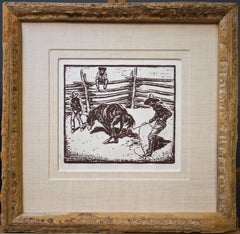
Bronc by Lon Megargee, Woodblock Print ca. 1920s with Handmade Saguaro Rib Frame

Bronc by Lon Megargee, Woodblock Print ca. 1920s with Handmade Saguaro Rib Frame

By Lon Megargee 1

Located in Phoenix, AZ

SHIPPING CHARGES INCLUDE SHIPPING, PACKAGING & **INSURANCE** Bronc by Lon Megargee, Woodblock Print ca. 1920s Handmade Saguaro Rib Frame, double linen mat, museum archival materials Bronc Woodblock Print, signed in print Image: 8 3/4 x 9 7/8 inches Frame: 21 x 20 inches SHIPPING CHARGES INCLUDES, SHIPPING, PACKAGING & INSURANCE FINE ART ESTATE OF LON MEGARGEE Megargee Custom Handmade Saguaro Frame We offer signed in print and original signature block prints. Custom, hand carved, signature frames, with archival standards and a speciality in hand dyed mats and french matting are provided for a beautiful and timeless presentation. Free shipping Continental US Biography Megargee explored different mediums; printmaking captivated him in particular. The contrast of the black and white block print method captured perfectly his interpretation of a bold American West. The first print was produced around 1921 and culminated with the creation of “The Cowboy Builds a Loop” in 1933 with 28 images and poetry by his friend, Roy George. Megargee continued producing prints throughout the 1940s and early 50s. Creator of the iconic logo for the Stetson Hat Company, " Last Drop From his Stetson", still in use today. Fine Art Estate of Lon Megargee At age 13, Lon Megargee came to Phoenix in 1896 following the death of his father in Philadelphia. For several years he resided with relatives while working at an uncle’s dairy farm and at odd jobs. He returned to Philadelphia in 1898 – 1899 in order to attend drawing classes at the Pennsylvania Academy of the Fine Arts. Back in Phoenix in 1899, he decided at the age of 16 to try to make his living as a cowboy. Lon moved to the cow country of Wickenburg where he was hired by Tex Singleton’s Bull Ranch. He later joined the Three Bar Ranch . . . and, after a few years, was offered a job by Billy Cook...

Category

Early 20th Century Lon Megargee Art

Materials

Woodcut

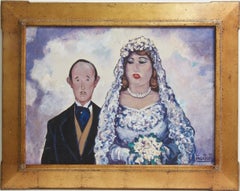
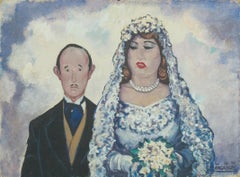
Love Honor Obey?
Love Honor Obey?

Love Honor Obey?

By Lon Megargee 1

Located in Phoenix, AZ

SHIPPING CHARGES INCLUDE SHIPPING, PACKAGING & **INSURANCE** Love Honor Obey? Lon Megargee ca. 1940 Oil on Board Size: 19.75 x 26.75 inches Frame: 26.75...

Category

1940s American Impressionist Lon Megargee Art

Materials

Oil

Related Items
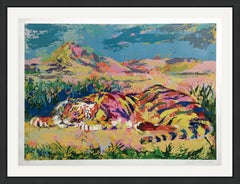
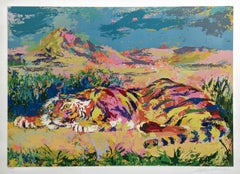
Delacroix's Tiger, Serigraph on Paper, Hand Signed, Edition of 300, 1977

Delacroix's Tiger, Serigraph on Paper, Hand Signed, Edition of 300, 1977

By LeRoy Neiman

Located in Aventura, FL

Hand signed numbered by the artist in pencil. Serigraph on Paper. Framed. Edition of 300. Artwork is in excellent condition. Certificate of authenticity included. All reasonable o...

Category

1970s Impressionist Lon Megargee Art

Materials

Paper, Screen

Seishi Ai-oi Genji – Set of 12 Shunga works together w/astrological commentary

Seishi Ai-oi Genji – Set of 12 Shunga works together w/astrological commentary

By Utagawa Kunisada (Toyokuni III)

Located in Middletown, NY

Set of 12 woodblock prints in colors on handmade, laid mulberry paper, 6 3/4 x 10 1/4 inches (170 x 258 mm), printed in Ka-ei 4 (1851). Each print with minor handling wear, otherwise in excellent condition with bright and fresh color, and with details printed in silver ink. The images themselves contain several illusive characters indicating the publisher which are obfuscated by figures, as intended. Presented loose, as issued. A fine set. The astrological commentary print has a large and meandering blind stamp with a bird and palm frond motif. This print lists various phrases concerning the Twelve Zodiac Animals as historically counted in Japan, and appears to include erotic commentary on the traits of people born under each of the twelve signs. These Shunga images were issued in books that paralleled (in an erotic fashion...

Category

Mid-19th Century Edo Lon Megargee Art

Materials

Ink, Handmade Paper, Woodcut

Black Horse
Black Horse

Black Horse

By Tokuriki Tomikichiro

Located in Middletown, NY

circa 1950. Woodblock print in black and gray ink on Japon laid paper, 10 1/4 x 15 3/4 inches (260 x 398 mm), full margins. With the artist's embossed chop mark in red ink in the l...

Category

Mid-20th Century Edo Lon Megargee Art

Materials

Handmade Paper, Woodcut

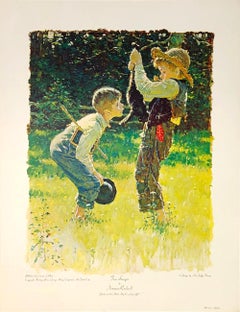
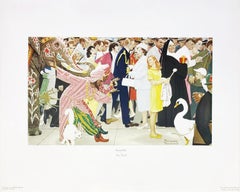
The Texan Collotype Print, American Impressionist, Unsigned, 1970s

The Texan Collotype Print, American Impressionist, Unsigned, 1970s

By Norman Rockwell

Located in Aventura, FL

Collotype in colors on paper. Unsigned. Title and copyright info in typeset lower margin. Artwork is in excellent condition. All reasonable offers will be considered.

Category

1970s American Impressionist Lon Megargee Art

Materials

Paper

Modernist FOLK ART Original Pencil Lithograph "GRAY DAY AT THE BEACH"

Modernist FOLK ART Original Pencil Lithograph "GRAY DAY AT THE BEACH"

By Doris Lee

Located in New York, NY

Doris Lee Lithograph 1964 Edition Size: 250 Image Size: 12 x 9.5 inches Sheet Size: 16.75 x 13 inches Reference: AAA 1532 Signed lower left Condition: Good Provenance: ASA Doris Emrick Lee...

Category

1960s Folk Art Lon Megargee Art

Materials

Lithograph, Archival Pigment

Verdiana with Hearts

Verdiana with Hearts

By David Salle

Located in Miami, FL

This new work by David Salle is part of his latest print editions. Salle's collage like painting usually feature a separate portrait side of he painting, which these women are from. ...

Category

2010s Pop Art Lon Megargee Art

Materials

Archival Pigment

The Three Graces, from Publius Maro Vergil: Les Géorgiques

The Three Graces, from Publius Maro Vergil: Les Géorgiques

By Aristide Maillol

Located in Middletown, NY

Woodcut printed in black on buff laid paper, 4 1/2 x 5 3/8 inches (113 x 135 mm), full margins. Scattered minor foxing in the lower right sheet quadrant, recto, and with the lower sh...

Category

Mid-20th Century French School Lon Megargee Art

Materials

Laid Paper, Woodcut

Paix, Désarmement pour le Succès de la Conférence au Sommet, Paris, Mai 1960

Paix, Désarmement pour le Succès de la Conférence au Sommet, Paris, Mai 1960

By Pablo Picasso

Located in Spokane, WA

Pablo Picasso "Paix, Désarmement pour le succès de la Conférence au Sommet, Paris, Mai 1960" Original Vintage Poster, 1952/1960. Archival linen backed and ready to frame. This pos...

Category

1960s American Modern Lon Megargee Art

Materials

Lithograph

Mother and Children
Mother and Children

Edna HibelMother and Children, c.1970

$1,400

H 40 in W 29 in D 2 in

Mother and Children

By Edna Hibel

Located in San Francisco, CA

This artwork "Mother and Children" c.1970, is a colors lithograph on paper by American artist Edna Hibel, 1917-2014. It is signed and numbered II 3/10 Ed. 200 in pencil by the artist. The The artwork (sheet ) size is 34 x 23 inches, framed size is 40 x 29 inches. Custom framed in original wooden decorated grey/silver frame. It is in excellent condition. About the artist: Edna Hibel, a painter of sentimental pictures of children, has had a more than 60-year career as painter and lithographer and promoter of peace through exhibitions of her artwork. She was born in 1917 in Boston, Massachusetts. Her parents were Abraham and Lena Hibel, and she was raised in the Boston area and educated at Brookline High School where she met her future husband, Theodore Plotkin. She began to paint when she was nine years old and learned watercolor during summers at the shore where her family vacationed in Maine and Hull, Massachusetts. Hibel studied at the Boston Museum School of Fine Arts, from 1935-39, receiving a Sturtevant Traveling Fellowship to Mexico. In Boston, in 1966, she began lithography, continuing in 1970 in Zurich, where she still works every year. She has created lithographic works with up to 32 stones (or colors) on paper, silk, wood veneer and porcelain. The latter pieces are called lithographs on porcelain and result from a complicated process, that she keeps a secret, whereby she transfers stone lithographic color separations onto Bavarian hard paste porcelain. Hibel has created the "Arte Ovale" series and various plaques with this technique. She organized the Edna Hibel Museum of Art, in Jupiter, Florida, to display and promote her work and also created a United Nations stamp, "Mother Earth." In 1995, she was commissioned by the Foundation of the U.S. National Archives to commemorate the 75th anniversary of women receiving the universal right to vote. At the ceremony, Ms. Lucy Baines Johnson referred to Hibel as the "Heart and Conscience of America." In November, 2001, the World Cultural Council based in Mexico City gave her the Leonardo da Vinci World Award of Arts. Hibel's work has been exhibited in museums and galleries in more than 20 countries including Russia, Brazil, China, Costa Rica, and the United States, and under the royal patronage of Count and Countess Bernadotte of Germany, Count Thor Bonde of Sweden, Prince and the late Princess Rainier of Monaco and Her Majesty Queen Elizabeth II of England. Pope John Paul II gave her a medal of honor as did the late Belgian King Baudouin. She also received honorary Doctoral degrees including from Eureka College, and Northwood University of Florida, Michigan and Texas. She also has received many humanitarian honors for her charitable efforts for children's and medical charities. Her exhibitions "Golden Bridge" and " Peace Through Wisdom" were efforts to promote peace and cultural understanding between China, the United States, Yugoslavia and Russia, and a television documentary titled "Hibel's Russian Palette" was based on her trips and art shows in Leningrad, now St. Petersburg. In 2001, Edna received a Lifetime Achievement Award from "Women in the Visual Arts," an organization of artists in the South Florida area. Works in Permanent Collections: Harvard University Boston University Museum of Fine Arts, Boston Springfield Museum of Arts, Massachusetts University of New Hampshire Fleischmann Collection, Cincinnati Detroit Art Institute Milwaukee Art Museum Phoenix Art Museum La Jolla Museum, California Lowe Gallery, University of Miami, Florida Columbus Museum of Arts and Crafts, Georgia WarrenHall Coutts, Ill, Memorial Museum of Art, El Dorado, Kansas Palais des Nations,Geneva, Switzerland United Nations Headquarters, New York City Norton Gallery, West Palm Beach, Florida de Saisset Museum, Santa Clara, California Russian Academy of Art, St. Petersburg, Russia Hibel Museum of Art, Lake Worth, Florida One Artist Exhibitions: Shacknow Museum of Fine Arts, Plantation, Florida, 2000 Cornell Museum of Art and History, Delray Beach, Florida, 1999 (and 1993) Klutznick National Jewish Museum, Washington, D.C., 1999 The Museum of Printing History, Houston, Texas, 1999 (and 1998) Mitsukoshi Fine Art Gallery, Tokyo, Japan, 1995 (and 1994) Lyme Academy of Fine Art, Old Lyme, Connecticut, 1994 Grenchen Art Museum, and Galerie BrechbUhl, Grenchen, Switzerland, 1992 Soviet Union Academy of Art, and Exhibition Hall of the Russian Union of Artists, Leningrad (St. Petersburg), Russia, U.S.S.R., 1990 Northern Indiana Arts Association Gallery, Munste~ Indiana, 1990 Galerie Vindobona, Bad Kissingen,West Germany, 1988 The National Museum of Women in the Arts, Washington, D.C., 1989 St. Peter An...

Category

Late 20th Century American Impressionist Lon Megargee Art

Materials

Lithograph

"White Calf, " Farm Genre Scene Original Lithograph by Thomas Hart Benton

"White Calf, " Farm Genre Scene Original Lithograph by Thomas Hart Benton

By Thomas Hart Benton

Located in Milwaukee, WI

"White Calf" is an original lithograph print by Thomas Hart benton. It features the image of a man milking a cow while her calf lays down in front. Benton's breathtaking way of rende...

Category

1940s American Modern Lon Megargee Art

Materials

Lithograph

Fox Hunt Screen Print, Hand Signed, Impressionist, 1974, Edition of 300
Fox Hunt Screen Print, Hand Signed, Impressionist, 1974, Edition of 300
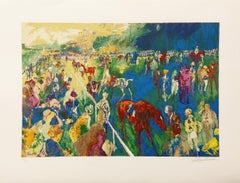
By LeRoy Neiman

Located in Aventura, FL

Hand signed numbered by the artist. Artwork image size 20.25 x 27 inches. Artwork is in excellent condition. Certificate of Authenticity included. Edition of 300. All reasonable off...

Category

1970s Impressionist Lon Megargee Art

Materials

Paper, Screen
Previously Available Items
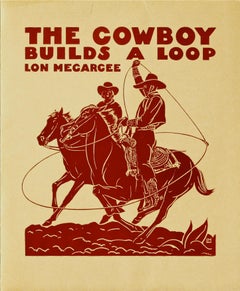
The Cowboy Builds a Loop by  Lon Megargee,  Portfolio of Sixteen Prints 1944

The Cowboy Builds a Loop by Lon Megargee, Portfolio of Sixteen Prints 1944

By Lon Megargee 1

Located in Phoenix, AZ

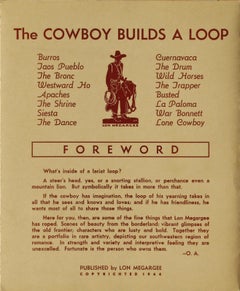
SHIPPING CHARGES INCLUDE SHIPPING, PACKAGING & **INSURANCE** Condition is excellent. This portfolio is very rare and rarely in this quality of condition. I can send additional images showing the pristine condition of the folio. This is the 1944 “The Cowboy Builds a Loop” portfolio from the fine art estate of Lon Megargee. 
It contains 16 images chosen from his 1933 original book “The Cowboy 
Builds a Loop”, which contains 28 plates and poems. The 1944 portfolio was created as 
an extension of the book which was no longer available. The prints were likely done on a letter set press using the images from the 1933 book and are not the original block prints, which are larger. I don’t know how many of the 1944 portfolios were made, but I don’t feel that they were produced in large numbers as would be done today. The foreword is written by Oren Arnold, novelist, journalist, and humorist, 1900-1980. Paper size is 12 x 8.75 inches, images vary within that size. Portfolio contains 16 prints. Creator of the iconic logo for the Stetson Hat Company, " Last Drop From his Stetson", still in use today. Fine Art Estate of Lon Megargee At age 13, Lon Megargee came to Phoenix in 1896 following the death of his father in Philadelphia. For several years he resided with relatives while working at an uncle’s dairy farm and at odd jobs. He returned to Philadelphia in 1898 – 1899 in order to attend drawing classes at the Pennsylvania Academy of the Fine Arts. Back in Phoenix in 1899, he decided at the age of 16 to try to make his living as a cowboy. Lon moved to the cow country of Wickenburg where he was hired by Tex Singleton’s Bull Ranch. He later joined the Three Bar Ranch . . . and, after a few years, was offered a job by Billy Cook...

Category

1940s Other Art Style Lon Megargee Art

Materials

Other Medium

2 Lazy 2 P

2 Lazy 2 P

By Lon Megargee 1

Located in Phoenix, AZ

2 Lazy 2P, ca. 1939 Lon Megargee Serigraph 20 x 24 inches Signed in screen Original serigraph print by Lon Megargee 1883 - 1960 Featured in "Hot Irons"...
Category

1930s Lon Megargee Art

Materials

Screen
Lon Megargee art for sale on 1stDibs.

Find a wide variety of authentic Lon Megargee art available for sale on 1stDibs. You can also browse by medium to find art by Lon Megargee in woodcut print, screen print, oil paint and more. Much of the original work by this artist or collective was created during the 20th century and is mostly associated with the Impressionist style. Not every interior allows for large Lon Megargee art, so small editions measuring 10 inches across are available. Lon Megargee art prices can differ depending upon medium, time period and other attributes. On 1stDibs, the price for these items starts at $1,500 and tops out at $22,000, while the average work can sell for $2,900.