Louis-Auguste Leconte de Roujou Art

b. 1863

Louis Auguste Leconte de Roujou was a French painter and etcher. He studied art in Paris under Jean Gigoux. He regularly exhibited his work at the Paris Salon between 1850–70. Throughout his career, Leconte de Roujou both etched and painted views of various locations in France, Italy and Spain.

to
2
2
1
1
1
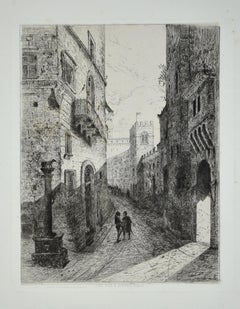
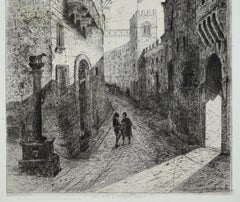
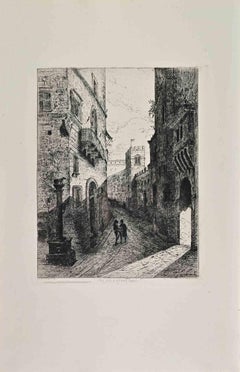
Une A Sienne - Etching by Leconte de Roujou - Late 19th Century

Une A Sienne - Etching by Leconte de Roujou - Late 19th Century

By Louis-Auguste Leconte de Roujou

Located in Roma, IT

Une A Sienne is a black and White etching realized by Leconte de Roujou in the Late 19th Century.  Titled in the lower Image Size: 32x26 Very good impression. Realized by Cadart ...

Category

Late 19th Century Impressionist Louis-Auguste Leconte de Roujou Art

Materials

Etching

Related Items
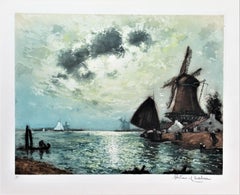
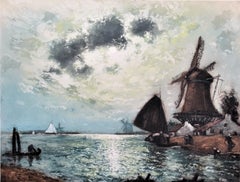
l'Entree du Port, Netherland

Heran Chabanl'Entree du Port, Netherland, 1930

$500

H 15 in W 18.25 in D 0.01 in

l'Entree du Port, Netherland

By Heran Chaban

Located in San Francisco, CA

This artwork "l'Entree du Port, Netherland" c. 1930 is an original color aquatint on wove paper by French/Armenian artist Heran Chaban, 1887-1939. It is h...

Category

Mid-20th Century Impressionist Louis-Auguste Leconte de Roujou Art

Materials

Aquatint

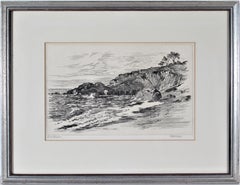
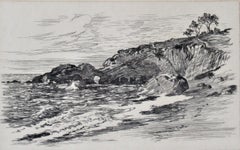
Arch Beach, California

Arch Beach, California

Located in San Francisco, CA

This artwork titled "Arch Beach, California" c.1910 is an original etching on Wove paper by American artist Harley DeWitt Nichols, 1859-1939. It is hand signed and titled in pencil by the artist. The plate mark (image) size is 6.5 x 9.5 inches, framed size is 13 x 17 inches. it is custom framed in a wooden silver frame, with off white matting. It is in excellent condition, especially considering the age. About the artist: Born in the small rural Wisconsin town of Barton, Harley lived a peripatetic life. As a young child, he accompanied his family to Lincoln, Nebraska where he found great excitement in the roaming herds of buffalo and Native Americans. It was in these years that a talent for drawing was discovered. In 1870, after several years of hardship, his father moved the family back to Wisconsin. At the age of 11 he became a water boy...

Category

Early 20th Century American Impressionist Louis-Auguste Leconte de Roujou Art

Materials

Etching

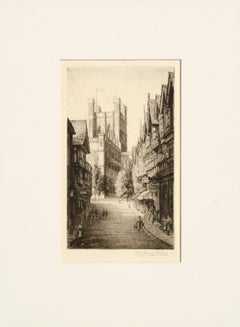
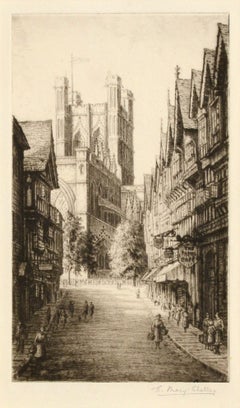
Early 20th Century British Street Scene - 1920s Figurative Landscape Etching

Early 20th Century British Street Scene - 1920s Figurative Landscape Etching

By E. Mary Shelley

Located in Soquel, CA

Highly detailed figurative landscape lithograph of a street in London with a towering cathedral, old buildings, and figures walking the street below by E. Mary Shelley (English, late...

Category

1920s Impressionist Louis-Auguste Leconte de Roujou Art

Materials

Paper, Etching

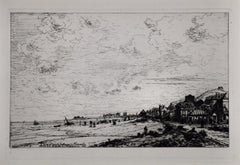
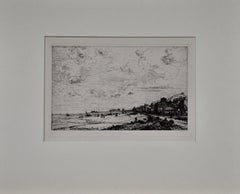
The Beach in Normandy, France, Near Bayeux: A 19th C. Etching by Maxime Lalanne

The Beach in Normandy, France, Near Bayeux: A 19th C. Etching by Maxime Lalanne

By Maxime Lalanne

Located in Alamo, CA

This is a mid 19th century etching entitled "Point de Depart de Guillaume de Normandie, Beuzeval, Emboucher de la Dives Calvados (The point of departure of William of Normandy (William the Conqueror)), created by Maxime Lalanne and published in 'L'Illustration Nouvelle' in 1868 by Alfred Cadart. The etching depicts the beach at Beuzeval in Normandy; with the shore in the foreground on the right lined by a row of houses, the sea at the left, and an expansive sky above. There are people on the beach and sailboats in the water. This is the point of departure of William the Conqueror for his voyage to England in 1066, resulting in his victory over the Anglo-Saxons at the Battle of Hastings and the establishment of Norman rule. The events are memorialized in the Bayeux tapestry, created by William's wife. This etching is presented in a white mat that is suitable for framing. This excellent impression is printed on thick chain-linked, laid cream-colored paper with wide margins. It is signed in plate in the lower right and titled in the plate in the lower left. There is a collector's stamp (either an "NC" or a "CN") in the lower right corner. The sheet measures 9.5" high by 12.75" wide and the mat measures 13.5" high by 16" wide. There are two tiny faint spots in the periphery of the upper margin, but the print is otherwise in excellent condition. This etching is held by many museums and institutions, including The British Museum, The Yale University Art Gallery, The Cleveland Museum of Art, The Philadelphia Museum of Art, Columbia University Libraries and The William Morris Gallery...

Category

Late 19th Century Louis-Auguste Leconte de Roujou Art

Materials

Etching

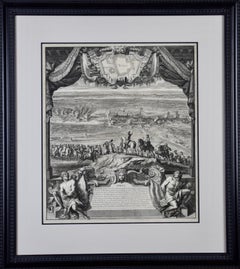
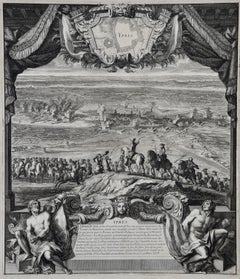
Daniel Marot's The Siege of the Dutch Fortified City of Ypres by Louis XIV

Daniel Marot's The Siege of the Dutch Fortified City of Ypres by Louis XIV

By Daniel Marot

Located in Alamo, CA

"Ypres, Grand Ville Riche & Marchande" is an engraving and etching by Daniel Marot (le Vieux) (1661–1752). It depicts a view of the siege of the city of Ypres and its citadel on the left in the Spanish Netherlands by Louis XIV's troops. This battle took place between March 18 and March 25, 1678, as part of the Franco-Dutch War. Marot illustrated in great detail (best appreciated with magnification) the French attack on the strong pentagonal citadel on the extreme left, which had been built recently in anticipation of a French attack. The trenches built by the French approaching the town are seen on the right. King Louis XIV can be seen in the foreground surveying the battle mounted on his white horse, surrounded by his officers and troops. The print is presented in an attractive ornate black wood frame with a cream-colored double mat with a black inner trim. It is glazed with plexiglas. The frame measures 25.38" x 22.63" x .88". The engraving, frame, mat and glazing are in excellent condition. Artist: Daniel Marot (1661–1752) was also called "Le Vieux". He was the son of the famous architect, Jean Marot. Marot had diverse interests and talents. In addition to his art, he designed garden projects, architectural ornaments, furniture, and even upholstery. Marot as a Huguenot protestant was forced to leave France in 1685 following the revocation of the Edict of Nantes. He emigrated to Holland, where he worked for William of Orange (an arch enemy of his former employer Louis XIV). Marot was largely responsible for the interiors of Williams palace at the Loo. In 1694 he went Britain as William had married Queen Mary and he had become King William III of England. He later returned to Holland in about 1698 and died in the Hague in 1752. He left a lasting legacy on the decorative arts in the Netherlands, where his grand version of the Louis XIV style remained popular into the 1730s. Historical Background: In October 1677, Mary Stuart, niece and possible successor of Charles II of England, married Louis XIV's arch enemy William III of Orange...

Category

Late 17th Century Old Masters Louis-Auguste Leconte de Roujou Art

Materials

Engraving, Etching
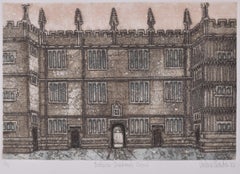
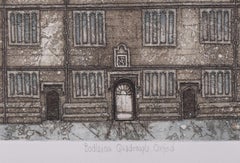
Bodleian Library, University of Oxford 20th century etching by Valerie Thornton

Bodleian Library, University of Oxford 20th century etching by Valerie Thornton

Located in London, GB

To see more, scroll down to "More from this Seller" and below it click on "See all from this Seller." Valerie Thornton (1931-1991) Bodleian Quadrangle, Oxford (1983) Etching 24 x 35 cm Numbered 13/75 lower left, titled below, and signed and dated lower right, all in pencil. A very good example of Thornton's recognisable and unusual etching style. Her work is deeply concerned with material, and many of her etchings focus on eroded stone, emotive landscapes, and weathered architecture. Here, Thornton draws out the exceptional texture of the Bodleian Library's local stone. Valerie Thornton was a British etcher and printmaker. She was born in London, but was evacuated to Canada with her two brothers during World War II. She returned to London in 1944 and studied at the Byam Shaw School of Art in 1949. From 1950 to 1953 Thornton studied under P.F. Millard at the Regent Street Polytechnic, then spent eight months at Atelier 17 in Paris. In the early 1960s, she moved to New York and worked at Pratt Graphic Art Center. In 1955, she succeeded Howard Hodgkin as assistant art teacher at Charterhouse School and in 1965 she became a founding member of the Print Makers Council. In 1970 she became a Fellow of the Royal Society of Painters-Etchers and Engravers. Thornton was a member of The Regent Street Group (a group of nine artists who studied together at the Regent Street Polytechnic in the early 1950s). The group also included Susan Horsfield, Renate Meyer, Michael Lewis...

Category

1980s Abstract Louis-Auguste Leconte de Roujou Art

Materials

Etching

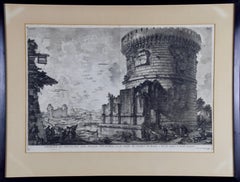
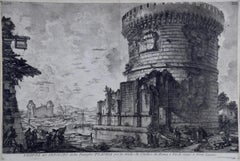
Ancient Roman Architecture: Original Framed 18th C. Etching by G. Piranesi

Ancient Roman Architecture: Original Framed 18th C. Etching by G. Piranesi

By Giovanni Battista Piranesi

Located in Alamo, CA

"Veduta del Sepolcro della Famiglia Plauzia per la Strada Che Conduce da Roma a Tivoli vicino a Ponte Lugano" from "Le Antichità Romane" (Roman Antiquities), one of the most famous works by Piranesi. "Antichita" illustrates the tombs along the Appian Way...

Category

Early 18th Century Old Masters Louis-Auguste Leconte de Roujou Art

Materials

Etching, Engraving, Drypoint

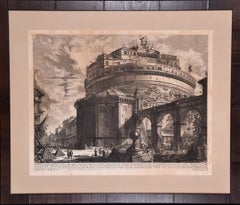
Hadrian's Mausoleum, Castel S. Angelo: A Framed 18th Century Etching by Piranesi

Hadrian's Mausoleum, Castel S. Angelo: A Framed 18th Century Etching by Piranesi

By Giovanni Battista Piranesi

Located in Alamo, CA

This large framed 18th century etching by Giovanni Battista Piranesi entitled "Veduta del Mausoleo d'Elio Adriana ora chiamato Castello S. Angelo nella parte opposta alla Facciata de...

Category

1750s Old Masters Louis-Auguste Leconte de Roujou Art

Materials

Etching

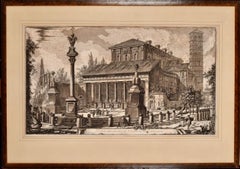
Basilica of San Lorenzo in Rome: A Framed 18th Century Etching by Piranesi

Basilica of San Lorenzo in Rome: A Framed 18th Century Etching by Piranesi

By Giovanni Battista Piranesi

Located in Alamo, CA

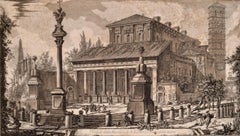
This large framed 18th century etching by Giovanni Battista Piranesi entitled "Veduta della Basilica di S. Lorenzo fuor della mura" (Basilica of San Lorenzo Outside the Walls), published in Rome in 1750 in Piranesi's Vedute di Roma (Views of Rome), This etching depicts the Basilica of San Lorenzo Outside the Walls, which is a Roman Catholic papal basilica and parish church, located in Rome, Italy. The Basilica is one of the Seven Pilgrim Churches of Rome and one of the five "papal basilicas". It was built as a shrine to the martyred Roman deacon St. Lawrence. This Piranesi etching is held by many museums and institutions, including: The Metropolitan Museum, The British Museum, The National Gallery of Art, The Yale University Art Gallery, and The Harvard Museum of Art. This magnificent etching is presented in a brown-colored wood frame and a tan French...

Category

1750s Old Masters Louis-Auguste Leconte de Roujou Art

Materials

Etching

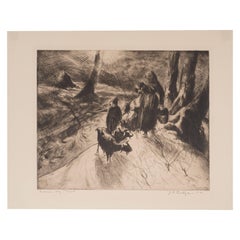
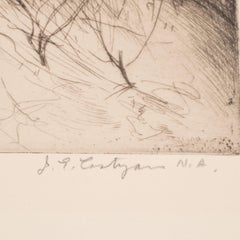
"Woman, Boy and Goats", Original Signed Etching by John E. Costigan

"Woman, Boy and Goats", Original Signed Etching by John E. Costigan

By John Costigan

Located in New York, NY

This original, limited edition etching, was realized by the esteemed American artist John E. Costigan, who is represented in the collections of the Metropolitan Museum, the Philips Memorial Gallery in Washington and the Brooklyn Museum, to name only a few of the many institutions that feature his work. This print, with its highly considered composition and its loose style of figuration- deftly balances realism and abstraction- helps to explain his acclaim. This etching features a mother walking with her child and two goats in a forested glen. It is a Classic pastoral scene rendered in Costigan's inimitable style- somewhere between Theodore Rousseau and Thomas Hart Benton. These offer a beautiful glimpse of a bygone American pastoral...

Category

1930s American Impressionist Louis-Auguste Leconte de Roujou Art

Materials

Etching

Vachère au Bord de l'Eau

Camille PissarroVachère au Bord de l'Eau, 1890

$1,463Sale Price|24% Off

H 7.75 in W 5.25 in

Vachère au Bord de l'Eau

By Camille Pissarro

Located in Santa Monica, CA

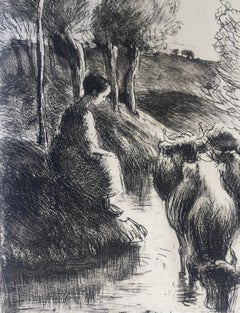
CAMILLE PISSARRO (French 1830-1903) VACHERE au BORD de l’EAU 1890 (Delteil 93 viii/viii) Etching, unsigned as published in “Gazette des Beaux Arts”, Paris, 1890. On laid paper Very...

Category

1890s Impressionist Louis-Auguste Leconte de Roujou Art

Materials

Drypoint, Etching

Four Framed Hogarth Engravings "Four Times of the Day"

Four Framed Hogarth Engravings "Four Times of the Day"

By William Hogarth

Located in Alamo, CA

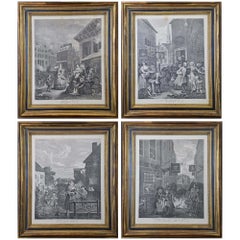
The four plates in this "Four Times of the Day" set were created utilizing both engraving and etching techniques by William Hogarth in 1738. Hogarth's original copper plates were refurbished where needed by James Heath and these engravings were republished in London in 1822 by Braddock, Cradock & Joy. This was the last time Hogarth's original copper plates were used for printing. Most were melted down during World War I for the construction of bombs. Printed upon early nineteenth century wove paper and with large, full margins as published by William Heath in 1822. The inscription below each print reads "Invented Painted & Engraved by Wm. Hogarth & Publish'd March 25. 1738 according to Act of Parliament". These large folio sized "Four Times of the Day" engravings/etchings are presented in complex gold-colored wood frames with black bands and scalloped gold inner trim. A majority of each thick impressive frame is covered with glass applied near the outer edge. Each frame measures 25.75" high, 22.25" wide and 1.88" deep. There are a few small dents in the edge of these frames, which are otherwise in very good condition. "Morning" has two focal areas of discoloration in the upper margin and some discoloration in the right margin, a short tear in the left margin and a short tear or crease in the right margin. "Noon" has a spot in the upper margin that extends into the upper image, but it is otherwise in very good condition. "Evening" has a faint spot in the upper margin, but it is otherwise in very good condition. "Night" is in excellent condition. The "Four Times of the Day" series is in the collection of many major museums, including: The British Museum, The Metropolitan Museum of Art, The Tate Museum, The Chicago Art Institute and The Victoria and Albert Museum. Through this series Hogarth is portraying early 18th century London street life at "Four Times of the Day". His characters are exhibiting their personalities, quircks, strange activities, but he also wants to draw attention the disparities between the wealthy aristocracy and the common working class. Plate 1, "Morning" depicts morning in Covent Garden in the winter in front of Tom King...

Category

Mid-18th Century Old Masters Louis-Auguste Leconte de Roujou Art

Materials

Engraving, Etching
Louis-auguste Leconte De Roujou art for sale on 1stDibs.

Find a wide variety of authentic Louis-Auguste Leconte de Roujou art available for sale on 1stDibs. You can also browse by medium to find art by Louis-Auguste Leconte de Roujou in etching and more. Not every interior allows for large Louis-Auguste Leconte de Roujou art, so small editions measuring 13 inches across are available. Customers who are interested in this artist might also find the work of Carlo Perrin, Maxime Lalanne, and David Lucas. Louis-Auguste Leconte de Roujou art prices can differ depending upon medium, time period and other attributes. On 1stDibs, the price for these items starts at $212 and tops out at $212, while the average work can sell for $212.

Artists Similar to Louis-Auguste Leconte de Roujou