Louis Joseph Soulas Art

to
2
Overall Width
to
Overall Height
to
2
1
1
1
2
2
2
1
1
1
1
1
1
1
1
1
2
10,636
2,826
2,495
1,414
1
1
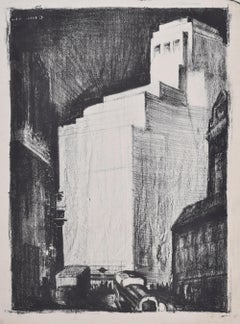
Artist: Louis Joseph Soulas
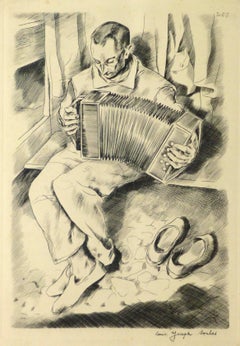
French Etching - Retour des Prisoniers

French Etching - Retour des Prisoniers

By Louis Joseph Soulas

Located in Houston, TX

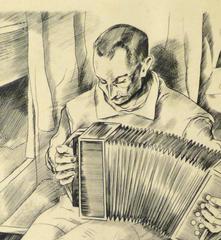
Detailed black and white etching of a man playing the accordion by artist Louis Joseph Soulas, 1944. Signed lower right. Original artwork on paper displayed on a white mat with a ...

Category

1940s Louis Joseph Soulas Art

Materials

Lithograph
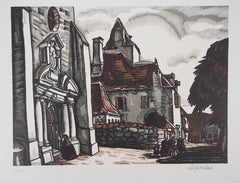
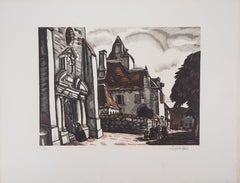
Roman Church near Bordeaux - Original wooodcut, Handsigned

Roman Church near Bordeaux - Original wooodcut, Handsigned

By Louis Joseph Soulas

Located in Paris, IDF

Louis SOULAS (1905-1954) Roman Church near Bordeaux, 1928 Original woodcut Handsigned in pencil Numbered /160 On vellum 32.5 x 25.5 cm (c. 13 x 10 in) Bears the blind stamp of the e...

Category

1920s Art Deco Louis Joseph Soulas Art

Materials

Woodcut

Related Items
Le Petit Prince En Grand Manteau - Antoine De Saint-Exupéry

Le Petit Prince En Grand Manteau - Antoine De Saint-Exupéry

Located in Sint-Truiden, BE

Color lithograph after the watercolor illustrations by Antoine de Saint-Exupéry from his beloved masterpiece "The Little Prince". This lithograph was printed and published in 2009 ...

Category

Early 2000s Louis Joseph Soulas Art

Materials

Lithograph
RENÉ MAGRITTE Le Maître d'École -  1955 Limited edition Lithograph - Surrealism

RENÉ MAGRITTE Le Maître d'École - 1955 Limited edition Lithograph - Surrealism

By (after) René Magritte

Located in Madrid, Madrid

LE MAÎTRE D'ÉCOLE, 1955 (THE SCHOOLMASTER) Date of creation: 2010 Medium: Lithograph on BFK Rives Paper Edition: 275 Size: 60 x 45 cm Observations: Lithograph on BFK Rives paper plat...

Category

Mid-20th Century Surrealist Louis Joseph Soulas Art

Materials

Lithograph
Winter Trees — Sōsaku Hanga Japanese Woodblock Print

Winter Trees — Sōsaku Hanga Japanese Woodblock Print

Located in Myrtle Beach, SC

Hajime Namiki, 'Tree Scene 159', color woodcut, edition 200, 2022. Signed in pencil and with the artist’s red seal. Titled, numbered '37/200' and dated, in pencil. A very fine impres...

Category

21st Century and Contemporary Contemporary Louis Joseph Soulas Art

Materials

Woodcut

"Pensive (Thoughtful)" Print 40 x 30 inch Ed. of 50 by Gerard Marti

"Pensive (Thoughtful)" Print 40 x 30 inch Ed. of 50 by Gerard Marti

By Gerard Marti

Located in Culver City, CA

"Pensive (Thoughtful)" Print 40 x 30 inch Ed. of 50 by Gerard Marti Lithograph Not framed. Ships rolled in tube Signed and numbered by the artist. “Pensive” is an elegant evening ...

Category

21st Century and Contemporary Contemporary Louis Joseph Soulas Art

Materials

Lithograph
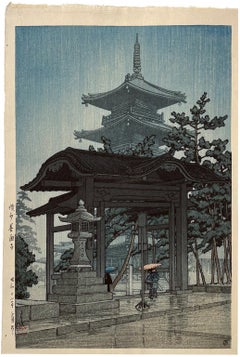
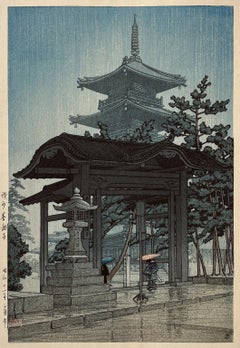
'The Beach at Kaiganji in Sanuki Province'  — Lifetime Impression

'The Beach at Kaiganji in Sanuki Province' — Lifetime Impression

By Kawase Hasui

Located in Myrtle Beach, SC

Kawase Hasui, 'The Beach at Kaiganji in Sanuki Province (Sanuki Kaiganji no hama),' from the series Collected Views of Japan II, Kansai Edition (Nihon fûkei shû II Kansai hen), woodblock print, 1934. A very fine, atmospheric impression, with fresh colors; the full sheet, in excellent condition. Signed 'Hasui' with the artist’s seal 'Kawase', lower left. Published by Watanabe Shozaburo with the Watanabe ‘D’ seal indicating an early impression printed between 1931 - 1941. Stamped faintly 'Made in Japan' in the bottom center margin, verso. Horizontal ôban; image size 9 3/8 x 14 1/4 inches (238 x 362 mm); sheet size approximately 10 5/16 x 15 1/2 inches ( 262 x 394 mm). Collections: Art Institute of Chicago; Austrian Museum of Applied Arts (Vienna); Honolulu Museum of Art; Museum of Fine Arts, Boston; National Museum in Warsaw; University of Wisconsin-Madison. ABOUT THE ARTIST “I do not paint subjective impressions. My work is based on reality...I can not falsify...(but) I can simplify…I make mental impressions of the light and color at the time of sketching. While coloring the sketch, I am already imagining the effects in a woodblock print.” — Kawase Hasui Hasui Kawase...

Category

1930s Showa Louis Joseph Soulas Art

Materials

Woodcut

'Chion-in Temple Gate' from 'Eight Scenes of Cherry Blossoms' — Jizuri Seal

'Chion-in Temple Gate' from 'Eight Scenes of Cherry Blossoms' — Jizuri Seal

By Hiroshi Yoshida

Located in Myrtle Beach, SC

Hiroshi Yoshida, 'Chion-in Temple Gate (Sunset)' from the series 'Eight Scenes of Cherry Blossoms (Sakura hachi dai: Sakura mon)', color woodblock print, 1935. Signed in brush 'Yoshida' and in pencil 'Hiroshi Yoshida'. A superb, early impression, with fresh colors; the full sheet with margins, on cream Japan paper; an area of slight toning in the top right sheet corner, not affecting the image, otherwise in excellent condition. Marked with a jizuri (self-printed) seal, upper left margin. Self-published by the artist. Image size 9 5/8 x 14 3/4 inches (444 x 375 mm); sheet size 10 7/8 x 16 inches (276 x 406 mm). Archivally sleeved, unmatted. Provenance: M. Nakazawa, Tokyo. Literature: Japanese Landscapes of the 20th Century (Hotei Publishing calendar), 2001, May. Collections: Honolulu Museum of Art, Museum of Fine Arts, Boston. ABOUT THE IMAGE Located in Kyoto, Chionin is the main temple of the Jodo sect of Japanese Buddhism, one of the most popular Buddhist sects in Japan, having millions of followers. The Sanmon Gate, Chionin's entrance gate, standing 24 meters tall and 50 meters wide, it is the largest wooden temple gate in Japan and dates back to the early 1600s. Behind the gate, a broad set of stairs leads to the main temple grounds. ABOUT THE ARTIST Painter and printmaker Yoshida Hiroshi (1876-1950) is regarded as one of the greatest artists of the Japanese 'shin hanga' (New Print) movement. Yoshida was born as the second son of Ueda Tsukane in Kurume, Fukuoka Prefecture, a schoolteacher from an old samurai family. In 1891 he was adopted by his art teacher Yoshida Kasaburo in Fukuoka and took his surname. In 1893 he went to Kyoto to study painting, and the following year to Tokyo to join Koyama Shotaro's Fudosha private school; he also became a member of the Meiji Fine Arts Society. These institutions taught and advocated Western-style painting, greatly influencing Yoshida’s artistic development. In 1899 Yoshida had his first American exhibition at Detroit Museum of Art (now Detroit Institute of Art), making the first of many visits to the US and Europe. In 1902 he helped reorganize the Meiji Fine Arts Society, renaming it the Taiheiyo-Gakai (Pacific Painting...

Category

1930s Showa Louis Joseph Soulas Art

Materials

Woodcut

1980s Italian Signed Numbered and Dated Original Work on Paper

1980s Italian Signed Numbered and Dated Original Work on Paper

By Ugo Attardi

Located in Roma, IT

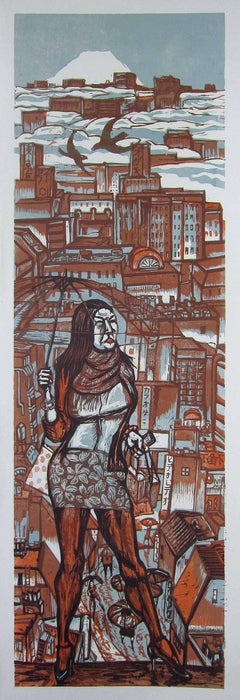
This is a wonderful colour lithograph entitled ‘Scorcio di Roma con profilo femminile’ (View of Rome with female profile) by Italian artist Ugo Attardi (1923-2006). The work is a gr...

Category

1980s Contemporary Louis Joseph Soulas Art

Materials

Lithograph
Roland Garros 1996

Roland Garros 1996

Located in Winterswijk, NL

Color offset lithograph - created on the occasion of the tennis tournament 1996 Signed in print In great condition

Category

1990s Louis Joseph Soulas Art

Materials

Color, Lithograph

Le Plagiat - 20th Century, Surrealist, Lithograph, Figurative Print

Le Plagiat - 20th Century, Surrealist, Lithograph, Figurative Print

By (after) René Magritte

Located in Sint-Truiden, BE

Color lithograph after the 1940 oil on canvas by René Magritte, printed signature of Magritte and numbered from the edition of 300. The lithograph features the dry stamps of the Magritte Foundation & ADAGP and is countersigned in pencil by Mr. Charly Herscovici, President of the Magritte Foundation, Chairman of the Magritte Museum and unique representative of the Magritte Succession. A proof of edition is printed on the back of the lithograph, guaranteeing its authenticity. Magritte was a Belgian surrealist artist whose witty and thought-provoking images challenged observers? preconditioned perceptions of reality. Magritte's work frequently displays a juxtaposition of ordinary objects in an unusual context, giving new meanings to familiar things.Magritte grew up in a simple and somewhat tragic household. His father was a modest tailor. His mother, who was mentally unsound, committed suicide in the year 1912. Magritte started drawing at a young age, and his first paintings, produced c. 1915, were Impressionistic in style.Magritte first worked as a draughtsman in a wallpaper factory and, in the year 1922, fell in love with and married Georgette Berger. In 1926, Magritte signed...

Category

20th Century Surrealist Louis Joseph Soulas Art

Materials

Lithograph
'Taos Placita' — American Southwest Regionalist Masterwork

'Taos Placita' — American Southwest Regionalist Masterwork

By Gustave Baumann

Located in Myrtle Beach, SC

Gustave Baumann, 'Taos Placita', color woodcut, 1947, edition 125. Baumann 132. Signed, titled, and numbered '20-125' in pencil; with the artist’s Hand-in-Heart chop. A superb, richly-inked impression, with fresh colors, on fibrous oatmeal wove paper; the full sheet with margins (2 to 3 1/8 inches); slight rippling at the left sheet edge, in excellent condition. Matted to museum standards, unframed. Image size 9 5/8 x 11 1/4 inches (244 x 286 mm); sheet size 13 1/4 x 17 inches (337 x 432 mm). Collections: Harwood Museum of Art, New Mexico Museum of Art, Phoenix Art Museum, Scottsdale Art Museum, Wichita Art Museum. ABOUT THE ARTIST Gustave Baumann (1881-1971) was a renowned printmaker and a leading figure of the American color woodcut revival whose exquisite craftsmanship and vibrant imagery captured the essence of the Southwest. "A brilliant printmaker, Baumann brought to the medium a full mastery of the craft of woodworking that he acquired from his father, a German cabinetmaker. This craftsmanship was coupled with a strong artistic training that resulted in the handsome objects we see in the exhibition today. After discovering New Mexico in 1918, Baumann began to explore in his woodblock prints of this period the light. color, and architectural forms of that landscape. His prints of this period are among the most beautiful and poetic images of the American West." —Lewis I. Sharp, Director, Denver Art Museum Baumann, the son of a craftsman, immigrated to the United States from Germany with his family when he was ten, settling in Chicago. From 1897 to 1904, he studied in the evenings at the Art Institute of Chicago, working in a commercial printmaking shop during the day. In 1905, he returned to Germany to attend the Kunstwerbe Schule in Munich, where he decided on a career in printmaking. He returned to Chicago in 1906 and worked for a few years as a graphic designer of labels. Baumann made his first prints in 1909 and exhibited them at the Art Institute of Chicago the following year. In 1910, he moved to the artists’ colony in Nashville, Indiana, where he explored the creative and commercial possibilities of a career as a printmaker. In 1915, he exhibited his color woodcuts at the Panama-Pacific International Exposition in San Francisco, winning the gold medal. Among Baumann’s ongoing commercial activities was his work for the Packard Motor Car Company from 1914 to 1920 where he produced designs, illustrations, and color woodcuts until 1923. In 1919, Baumann’s printmaking work dominated the important exhibition of American color woodcuts at the Detroit Institute of Arts. Twenty-six of his prints were included, far more than the works of any other artist. A set of his blocks, a preparatory drawing, and seven progressive proofs complemented the exhibition. That same year, Baumann worked in New York and, over the summer, in Provincetown, Massachusetts. His airy images of Cape Cod employed soft, pastel colors and occasionally showed the influence of the white-line woodcut technique. Many of his Chicago artist friends had traveled to the southwest, and Baumann became intrigued by their paintings, souvenirs, and stories of an exotic place named Taos, New Mexico. In the summer of 1918, he spent the summer in Taos sketching and painting before visiting Santa Fe. Paul Walter, the director of the Museum of New Mexico, offered him a studio in the museum's basement. Inspired by the rugged beauty of the Southwest—the vibrant colors and dramatic landscapes of the region became a central theme in his work, influencing his artistic style and subject matter for the remainder of his career. Later in the decade, he traveled to the West Coast and made prints of California landscape. Baumann's prints became synonymous with the Southwest, capturing the spirit of its place in America's identity with a unique sense of authenticity and reverence. His iconic images of desert vistas, pueblo villages, and indigenous cultures served as visual tributes to the region's rich cultural heritage, earning him a dedicated following among collectors and curators alike. A true craftsman and artist, Baumann completed every step of the printmaking process himself, cutting each block, mixing the inks, and printing every impression on the handmade paper he selected. His dedication to true craftsmanship and his commitment to preserving the integrity of his artistic vision earned him widespread acclaim and recognition within the art world. About the vibrant colors he produced, Baumann stated, “A knowledge of color needs to be acquired since they don’t all behave the same way when ground or mixed...careful chemistry goes into the making of colors, with meticulous testing for permanence. While complicated formulae evolve new colors, those derived from Earth and metal bases are still the most reliable.” In the 1930s, Baumann became interested in puppet theater. He designed and carved his own marionettes and established a little traveling company. From 1943 to 1945, the artist carved an altarpiece for the Episcopal Church of the Holy Faith in Santa Fe. In 1952, a retrospective exhibition of his prints was mounted at the New Mexico Museum of Fine Arts. Throughout his prolific career, Baumann executed nearly four hundred color woodcuts. Baumann’s woodcuts...

Category

1940s American Modern Louis Joseph Soulas Art

Materials

Woodcut

Louis Joseph Soulas art for sale on 1stDibs.

Find a wide variety of authentic Louis Joseph Soulas art available for sale on 1stDibs. Not every interior allows for large Louis Joseph Soulas art, so small editions measuring 1 inch across are available. Customers who are interested in this artist might also find the work of Bernard Brussel-Smith, Franz Oswald Schiffers, and Diana Thorne. Louis Joseph Soulas art prices can differ depending upon medium, time period and other attributes. On 1stDibs, the price for these items starts at $350 and tops out at $350, while the average work can sell for $350.

Artists Similar to Louis Joseph Soulas