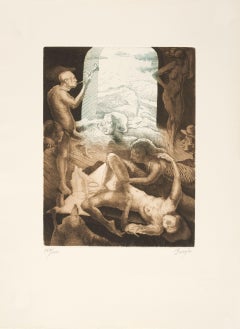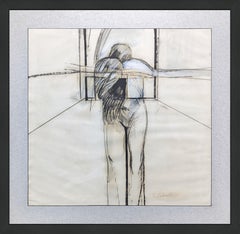
Luis Caballero Art

Colombian, 1947-1995
Born in Bogotá, Colombia, on August 27, 1947, Luis Caballero, a painter, and draftsman, was considered one of the most important figures in Colombian art. He died of AIDS at age 52 on June 19, 1995. The Luis Caballero Award, the most essential plastic arts award in Colombia, bears his name. His work was shown in the 1969 Biennale de Paris and the 1984 Venice Biennale. In 1961 Caballero began his studies in Fine Arts at the University de Los Andes in Colombia. He recognized the painter Juan Antonio Roda and his teacher, the artist Marta Traba, who influenced his work. In 1963, she traveled to France, where Caballero entered the Académie de la Grande Chaumière in Paris 3, where he lived for several years. During this period, he said he was influenced by the work of De Kooning and Bacon. In 1968, he won the first prize at the I Bienal de Medellín. That same year, Luis Caballero settled permanently in Paris. In 1970 his work began to observe the history of art; this inclination was highlighted in 1973 in an exhibition in Bogotá, with an apparent reference to the Renaissance. He returned to Bogotá in 1995 on the occasion of an exhibition of a drawing series at the Luis Ángel Arango Library.
to
2
1
1
Overall Width
to
Overall Height
to
4
1
2
1
2
3
1
3
2
1
1
1
1
1
3
2
1
1
1
4
10,817
2,842
2,494
1,421
2
2
2
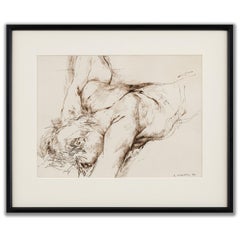
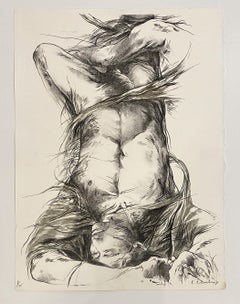
Artist: Luis Caballero
Untitled
Untitled

Untitled

By Luis Caballero

Located in London, GB

Pen and ink on paper Signed and dated (lower right) 28cm × 38cm (42cm × 50cm framed) A Colombian painter, draughtsman and lithographer, known for his depictions of the male nude, wi...

Category

1970s Contemporary Luis Caballero Art

Materials

Paper, Ink, Pen

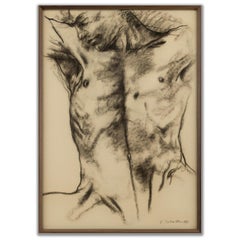
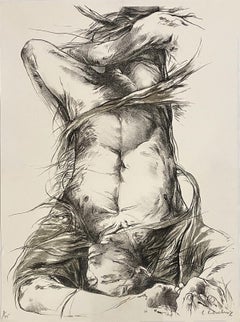
Untitled (Torso)
Untitled (Torso)

Untitled (Torso)

By Luis Caballero

Located in London, GB

Charcoal on paper Signed and dated (lower right) 105cm × 73cm (109cm × 78cm framed) A Colombian painter, draughtsman and lithographer, known for his depictions of the male nude, wit...

Category

1980s Contemporary Luis Caballero Art

Materials

Paper, Charcoal

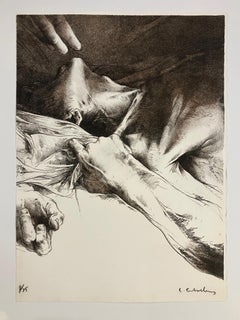
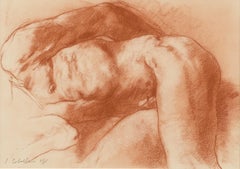
Unititled male nude limited edition print

Unititled male nude limited edition print

By Luis Caballero

Located in Miami Beach, FL

Unititled male nude by Luis Caballero Lithography on paper Limited edition print Edition 8/75 Size: 15 in H x 10.7 in W Signed in the lower right corner. Numbered in the lower left ...

Category

1990s Luis Caballero Art

Materials

Lithograph, Paper

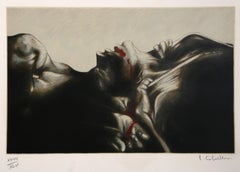
Untitled II male figurative limited edition print

Untitled II male figurative limited edition print

By Luis Caballero

Located in Miami Beach, FL

Untitled II, by Luis Caballero Lithography Size: 15 in H x 10.7 in W Edition 8/75 Signed in the lower right corner. Numbered in the lower left corner. Great condition with flaws. ...

Category

1980s Luis Caballero Art

Materials

Cardboard, Lithograph

Related Items
El Pensador (The Thinker), Hand Signed Lithograph, Contemporary, 1970s, 62/75

El Pensador (The Thinker), Hand Signed Lithograph, Contemporary, 1970s, 62/75

By Rafael Canogar

Located in Aventura, FL

Color lithograph with photolithography. Hand signed lower right by Rafael Canogar. Hand numbered 62/75 lower left corner. Artwork size 22 x 29 inches. Frame size 30 x 37 inches. ...

Category

1970s Contemporary Luis Caballero Art

Materials

Paper, Lithograph

Marc Chagall - Inspiration - Original Lithograph from "Chagall Lithographe" v. 2

Marc Chagall - Inspiration - Original Lithograph from "Chagall Lithographe" v. 2

By Marc Chagall

Located in Collonge Bellerive, Geneve, CH

Marc Chagall Original Lithograph from Chagall Lithographe 1957-1962. VOLUME II. 1963 Dimensions: 32 x 24 cm From the unsigned edition of 10000 copies without margins Reference: Mourlot 398 Condition : Excellent Marc Chagall (born in 1887) Marc Chagall was born in Belarus in 1887 and developed an early interest in art. After studying painting, in 1907 he left Russia for Paris, where he lived in an artist colony on the city’s outskirts. Fusing his own personal, dreamlike imagery with hints of the fauvism and cubism popular in France at the time, Chagall created his most lasting work—including I and the Village (1911)—some of which would be featured in the Salon des Indépendants exhibitions. After returning to Vitebsk for a visit in 1914, the outbreak of WWI trapped Chagall in Russia. He returned to France in 1923 but was forced to flee the country and Nazi persecution during WWII. Finding asylum in the U.S., Chagall became involved in set and costume design before returning to France in 1948. In his later years, he experimented with new art forms and was commissioned to produce numerous large-scale works. Chagall died in St.-Paul-de-Vence in 1985. The Village Marc Chagall was born in a small Hassidic community on the outskirts of Vitebsk, Belarus, on July 7, 1887. His father was a fishmonger, and his mother ran a small sundries shop in the village. As a child, Chagall attended the Jewish elementary school, where he studied Hebrew and the Bible, before later attending the Russian public school. He began to learn the fundamentals of drawing during this time, but perhaps more importantly, he absorbed the world around him, storing away the imagery and themes that would feature largely in most of his later work. At age 19 Chagall enrolled at a private, all-Jewish art school and began his formal education in painting, studying briefly with portrait artist Yehuda Pen. However, he left the school after several months, moving to St. Petersburg in 1907 to study at the Imperial Society for the Protection of Fine Arts. The following year, he enrolled at the Svanseva School, studying with set designer Léon Bakst, whose work had been featured in Sergei Diaghilev's Ballets Russes. This early experience would prove important to Chagall’s later career as well. Despite this formal instruction, and the widespread popularity of realism in Russia at the time, Chagall was already establishing his own personal style, which featured a more dreamlike unreality and the people, places and imagery that were close to his heart. Some examples from this period are his Window Vitebsk (1908) and My Fianceé with Black Gloves (1909), which pictured Bella Rosenfeld, to whom he had recently become engaged. The Beehive Despite his romance with Bella, in 1911 an allowance from Russian parliament member and art patron Maxim Binaver enabled Chagall to move to Paris, France. After settling briefly in the Montparnasse neighborhood, Chagall moved further afield to an artist colony known as La Ruche (“The Beehive”), where he began to work side by side with abstract painters such as Amedeo Modigliani and Fernand Léger as well as the avant-garde poet Guillaume Apollinaire. At their urging, and under the influence of the wildly popular fauvism and cubism, Chagall lightened his palette and pushed his style ever further from reality. I and the Village (1911) and Homage to Apollinaire (1912) are among his early Parisian works, widely considered to be his most successful and representative period. Though his work stood stylistically apart from his cubist contemporaries, from 1912 to 1914 Chagall exhibited several paintings at the annual Salon des Indépendants exhibition, where works by the likes of Juan Gris, Marcel Duchamp and Robert Delaunay were causing a stir in the Paris art world. Chagall’s popularity began to spread beyond La Ruche, and in May 1914 he traveled to Berlin to help organize his first solo exhibition, at Der Sturm Gallery. Chagall remained in the city until the highly acclaimed show opened that June. He then returned to Vitebsk, unaware of the fateful events to come. War, Peace and Revolution In August 1914 the outbreak of World War I precluded Chagall’s plans to return to Paris. The conflict did little to stem the flow of his creative output, however, instead merely giving him direct access to the childhood scenes so essential to his work, as seen in paintings such as Jew in Green (1914) and Over Vitebsk (1914). His paintings from this period also occasionally featured images of the war’s impact on the region, as with Wounded Soldier (1914) and Marching (1915). But despite the hardships of life during wartime, this would also prove to be a joyful period for Chagall. In July 1915 he married Bella, and she gave birth to a daughter, Ida, the following year. Their appearance in works such as Birthday (1915), Bella and Ida by the Window (1917) and several of his “Lovers” paintings give a glimpse of the island of domestic bliss that was Chagall’s amidst the chaos. To avoid military service and stay with his new family, Chagall took a position as a clerk in the Ministry of War Economy in St. Petersburg. While there he began work on his autobiography and also immersed himself in the local art scene, befriending novelist Boris Pasternak, among others. He also exhibited his work in the city and soon gained considerable recognition. That notoriety would prove important in the aftermath of the 1917 Russian Revolution when he was appointed as the Commissar of Fine Arts in Vitebsk. In his new post, Chagall undertook various projects in the region, including the 1919 founding of the Academy of the Arts. Despite these endeavors, differences among his colleagues eventually disillusioned Chagall. In 1920 he relinquished his position and moved his family to Moscow, the post-revolution capital of Russia. In Moscow, Chagall was soon commissioned to create sets and costumes for various productions at the Moscow State Yiddish Theater...

Category

1960s Surrealist Luis Caballero Art

Materials

Lithograph

Homage to Picasso Etching, Signed, Pop Art, Edition of 99, 1991, Framed

Homage to Picasso Etching, Signed, Pop Art, Edition of 99, 1991, Framed

By Peter Max

Located in Aventura, FL

Etching on paper. Hand signed and numbered by Peter Max. From the edition of 99. Frame size approx 27 x 24 inches. Artwork is in excellent condition. Certificate of authenticity included. All reasonable offers will be considered. About the Artist: Peter Max (American, born 1937) is known for his unique brand of rainbow-hued prints and paintings, which he has created since the early 1960s. Employing painterly strokes, his illustrations incorporate a wide spectrum of colors and patterns as seen in his Umbrella Man series. “I'm just wowed by the universe. I'm just glad to do something I love to do. I love color, I love painting, I love shapes...

Category

1990s Pop Art Luis Caballero Art

Materials

Paper, Lithograph

La Chevelure - Color Lithograph - 2007 - Henri Matisse

La Chevelure - Color Lithograph - 2007 - Henri Matisse

By (after) Henri Matisse

Located in Sint-Truiden, BE

Color lithograph after the work by Henri Matisse, plate-signed by Matisse from the edition of 200. This lithograph was printed and published in 2007 in Paris using 100% cotton 300 g...

Category

Early 2000s Fauvist Luis Caballero Art

Materials

Handmade Paper, Lithograph

My House II Silkscreen Print on Paper, Signed, 14/100, Contemporary

My House II Silkscreen Print on Paper, Signed, 14/100, Contemporary

By Christopher Wool

Located in Aventura, FL

7 Color Silkscreen on 335 GSM Matt Custom Paper. Hand signed, dated and numbered by the artist. Numbered 14/100 (there are also 10 artist's proofs). Published by Counter Editions, London. Printed by Brand X Editions, New York. Artwork size 40 x 30 inches. Custom framed as pictured. Frame size approx 46 x 36 inches. Artwork is in excellent condition. All reasonable offers will be considered. About the Artist: Christopher Wool is a contemporary American painter. In his paintings, Wool contrasts bold stenciled text or abstract brushwork with white backgrounds. In the stenciled works, words run together and breaks arrive at the edges of the canvas, as seen in his Apocalypse Now (1988), which bears the phrase “SELL THE HOUSE SELL THE CAR SELL THE KIDS.” “With the painting the inspiration comes from the process of the work itself,” Wool reflected. “Like music [making the work] is an emotional experience. It’s a visual language and it’s almost impossible to put words to it.” Born on September 16, 1955 in Boston, MA, Wool studied briefly at Sarah Lawrence College, but quickly left to enroll at the New York Studio School. A contemporary of Jean-Michel Basquiat, Julian Schnabel, Cindy Sherman, and others in New York’s downtown art scene in the 1980s, Wool introduced graffiti techniques to his work, later incorporating silkscreens and paint rollers. The artist’s work has been exhibited at numerous institutions around the world, including the Museum of Contemporary Art in Los Angeles, the Gesellschaft für Moderne Kunst am Museum Ludwig in Cologne, and the Guggenheim Museum in New York. Wool currently lives and works between Marfa, TX and New York, NY with his wife the painter Charline von Heyl.

Category

Early 2000s Contemporary Luis Caballero Art

Materials

Paper, Screen
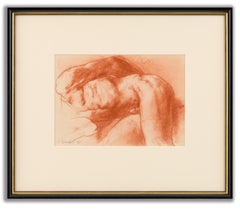
Untitled Composition (Poligrafa, Redfern, Figurative, Surreal, 50% OFF MUST GO)

Untitled Composition (Poligrafa, Redfern, Figurative, Surreal, 50% OFF MUST GO)

By Jorge Castillo

Located in Kansas City, MO

Jorge Castillo Untitled Composition from "Ediciones Poligrafa, Barcelona at Redfern Gallery, London" Original Color Lithograph Year: 1979 Size: 10 x 7.325 inches (25.4 × 18.61 cm) Ed...

Category

1970s Surrealist Luis Caballero Art

Materials

Lithograph

Samurai

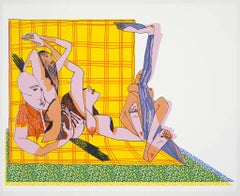
Red GroomsSamurai, 1997

$1,000

H 8.5 in W 8.5 in

Samurai

By Red Grooms

Located in Lyons, CO

Color lithograph, Edition 40. Red Grooms and Master printer Bud Shark began their many print collaborations in 1981 with “Mountaintime”, followed in 1982 by their first three-dimensional lithograph, “Ruckus...

Category

1990s Contemporary Luis Caballero Art

Materials

Lithograph

An Exquisite 1940s Modern Lithograph of a Female Nude Model, "Flying Figure"

An Exquisite 1940s Modern Lithograph of a Female Nude Model, "Flying Figure"

By Harold Haydon

Located in Chicago, IL

An Exquisite, 1940s Modern Lithograph of a Voluptuous Female Nude Model, "Flying Figure" by Notable Chicago Artist, Harold Haydon (Am. 1909-1994). Completed in 1949, this is a uniqu...

Category

1930s American Modern Luis Caballero Art

Materials

Paper, Lithograph

Grand Prix De Rome Submission Circa 1906 Académie D’Homme Nude With Arrow

Grand Prix De Rome Submission Circa 1906 Académie D’Homme Nude With Arrow

Located in Sutton Poyntz, Dorset

A Grand Prix De Rome Submission Circa 1906. “Académie D’Homme” Nude Throwing An Arrow. Period Print (Lithograph or Heliogravure). Image size 19 inches x 12.2 inches ( 48cm x 31cm ). Frame size 22 inches x 15.4 inches ( 56cm x 39cm ). Available for sale; this antique reproductive plate (usually a lithograph or heliogravure) after the original competition drawing is annotated Premier Grand Prix De Rome and is dated in the margin 1906. The print is presented and supplied in a sympathetic contemporary wooden frame (which is shown in these photographs) and behind glass. This antique print is in good material condition with age toning to the paper along with a scattering of aged blemishes. It is supplied ready to hang and display. The print carries a dedication lower right in the margin. An incomplete (partial) ink stamp in the lower left hand corner makes reference to an Anvers (Antwerp) institution. This finely executed early 20th-century figure print of a drawing is of the Académie d’Homme genre (traditional academic nude study). It depicts a nude male figure in dynamic contrapposto, shown mid-action as he prepares to throw an arrow. The pose combines classical balance with controlled movement, reflecting the rigorous standards of French academic training at the turn of the century. The image is a period print, likely produced as a lithograph or heliogravure, after an original competition drawing. It is annotated “Premier Grand Prix de Rome” and dated 1906 in the margin, indicating that the original of this work was a submission to the prestigious Prix de Rome competition, the highest accolade for academic artists in France. Such works were commonly reproduced for study, reference and institutional circulation and it is likely that this reproduction was made in the same year, or shortly afterwards. Rendered with careful anatomical precision, the figure demonstrates a deep understanding of musculature, proportion and weight distribution, hallmarks of École des Beaux-Arts instruction. The neutral background focuses attention entirely on the human form, emphasising clarity of line and sculptural modelling. This circa 1906 academic male nude print...

Category

Early 20th Century Academic Luis Caballero Art

Materials

Paper, Lithograph

She Lay Down Deep Beneath the Sea

She Lay Down Deep Beneath the Sea

By Tracey Emin

Located in London, GB

2012 Offset lithograph in colours on wove paper 80 x 60 cm Signed in black in by Tracey Emin Published by Turner Contemporary Accompanied by a gallery Certificate of Authenticity Tr...

Category

2010s Contemporary Luis Caballero Art

Materials

Paper, Lithograph, Offset

Marc Chagall - Original Lithograph

Marc ChagallMarc Chagall - Original Lithograph, 1963

$1,471

H 9.45 in W 12.6 in D 0.04 in

Marc Chagall - Original Lithograph

By Marc Chagall

Located in Collonge Bellerive, Geneve, CH

Marc Chagall Original Lithograph 1963 Dimensions: 32 x 24 cm Reference: Chagall Lithographe 1957-1962. VOLUME II. Condition : Excellent Marc Chagall (born in 1887) Marc Chagall was born in Belarus in 1887 and developed an early interest in art. After studying painting, in 1907 he left Russia for Paris, where he lived in an artist colony on the city’s outskirts. Fusing his own personal, dreamlike imagery with hints of the fauvism and cubism popular in France at the time, Chagall created his most lasting work—including I and the Village (1911)—some of which would be featured in the Salon des Indépendants exhibitions. After returning to Vitebsk for a visit in 1914, the outbreak of WWI trapped Chagall in Russia. He returned to France in 1923 but was forced to flee the country and Nazi persecution during WWII. Finding asylum in the U.S., Chagall became involved in set and costume design before returning to France in 1948. In his later years, he experimented with new art forms and was commissioned to produce numerous large-scale works. Chagall died in St.-Paul-de-Vence in 1985. The Village Marc Chagall was born in a small Hassidic community on the outskirts of Vitebsk, Belarus, on July 7, 1887. His father was a fishmonger, and his mother ran a small sundries shop in the village. As a child, Chagall attended the Jewish elementary school, where he studied Hebrew and the Bible, before later attending the Russian public school. He began to learn the fundamentals of drawing during this time, but perhaps more importantly, he absorbed the world around him, storing away the imagery and themes that would feature largely in most of his later work. At age 19 Chagall enrolled at a private, all-Jewish art school and began his formal education in painting, studying briefly with portrait artist Yehuda Pen. However, he left the school after several months, moving to St. Petersburg in 1907 to study at the Imperial Society for the Protection of Fine Arts. The following year, he enrolled at the Svanseva School, studying with set designer Léon Bakst, whose work had been featured in Sergei Diaghilev's Ballets Russes. This early experience would prove important to Chagall’s later career as well. Despite this formal instruction, and the widespread popularity of realism in Russia at the time, Chagall was already establishing his own personal style, which featured a more dreamlike unreality and the people, places and imagery that were close to his heart. Some examples from this period are his Window Vitebsk (1908) and My Fianceé with Black Gloves (1909), which pictured Bella Rosenfeld, to whom he had recently become engaged. The Beehive Despite his romance with Bella, in 1911 an allowance from Russian parliament member and art patron Maxim Binaver enabled Chagall to move to Paris, France. After settling briefly in the Montparnasse neighborhood, Chagall moved further afield to an artist colony known as La Ruche (“The Beehive”), where he began to work side by side with abstract painters such as Amedeo Modigliani and Fernand Léger as well as the avant-garde poet Guillaume Apollinaire. At their urging, and under the influence of the wildly popular fauvism and cubism, Chagall lightened his palette and pushed his style ever further from reality. I and the Village (1911) and Homage to Apollinaire (1912) are among his early Parisian works, widely considered to be his most successful and representative period. Though his work stood stylistically apart from his cubist contemporaries, from 1912 to 1914 Chagall exhibited several paintings at the annual Salon des Indépendants exhibition, where works by the likes of Juan Gris, Marcel Duchamp and Robert Delaunay were causing a stir in the Paris art world. Chagall’s popularity began to spread beyond La Ruche, and in May 1914 he traveled to Berlin to help organize his first solo exhibition, at Der Sturm Gallery. Chagall remained in the city until the highly acclaimed show opened that June. He then returned to Vitebsk, unaware of the fateful events to come. War, Peace and Revolution In August 1914 the outbreak of World War I precluded Chagall’s plans to return to Paris. The conflict did little to stem the flow of his creative output, however, instead merely giving him direct access to the childhood scenes so essential to his work, as seen in paintings such as Jew in Green (1914) and Over Vitebsk (1914). His paintings from this period also occasionally featured images of the war’s impact on the region, as with Wounded Soldier (1914) and Marching (1915). But despite the hardships of life during wartime, this would also prove to be a joyful period for Chagall. In July 1915 he married Bella, and she gave birth to a daughter, Ida, the following year. Their appearance in works such as Birthday (1915), Bella and Ida by the Window (1917) and several of his “Lovers” paintings give a glimpse of the island of domestic bliss that was Chagall’s amidst the chaos. To avoid military service and stay with his new family, Chagall took a position as a clerk in the Ministry of War Economy in St. Petersburg. While there he began work on his autobiography and also immersed himself in the local art scene, befriending novelist Boris Pasternak, among others. He also exhibited his work in the city and soon gained considerable recognition. That notoriety would prove important in the aftermath of the 1917 Russian Revolution when he was appointed as the Commissar of Fine Arts in Vitebsk. In his new post, Chagall undertook various projects in the region, including the 1919 founding of the Academy of the Arts. Despite these endeavors, differences among his colleagues eventually disillusioned Chagall. In 1920 he relinquished his position and moved his family to Moscow, the post-revolution capital of Russia. In Moscow, Chagall was soon commissioned to create sets and costumes for various productions at the Moscow State Yiddish Theater...

Category

1960s Surrealist Luis Caballero Art

Materials

Lithograph

Previously Available Items
Untitled (large original drawing on paper)

Untitled (large original drawing on paper)

By Luis Caballero

Located in Aventura, FL

Original pencil, oil and charcoal on paper. Hand signed lower front by Luis Caballero. Artwork size: 25.56 x 25.56 inches. Frame size: 35 x 36 inches. Artwork is in excellent con...

Category

1970s Contemporary Luis Caballero Art

Materials

Oil, Charcoal, Pencil

Male Nude
Male Nude

Luis CaballeroMale Nude, 1985

Sold

H 25.99 in W 22.05 in D 0.79 in

Male Nude

By Luis Caballero

Located in London, GB

Red chalk on paper, signed and dated (lower left), 27cm x 38cm, (53cm x 63cm framed). The picture is framed behind museum quality non-reflective UV glass. Born in Bogotá Caballero ...

Category

1980s Post-War Luis Caballero Art

Materials

Paper, Charcoal

Luis Caballero art for sale on 1stDibs.

Find a wide variety of authentic Luis Caballero art available for sale on 1stDibs. You can also browse by medium to find art by Luis Caballero in lithograph, board, cardboard and more. Not every interior allows for large Luis Caballero art, so small editions measuring 11 inches across are available. Luis Caballero art prices can differ depending upon medium, time period and other attributes. On 1stDibs, the price for these items starts at $1,500 and tops out at $1,500, while the average work can sell for $1,500.