Maria Elisabeth Wrede Art

French, 1898-1981

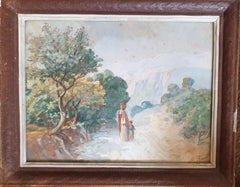
A student of Fernand Léger and Amédée Ozenfant, Maria Elisabeth Wrede was part of the circle of Paul Valéry and Ivan and Claire Goll and was friends with painter Robert Delaunay and his wife Sonja Delaunay-Terk. Wrede was a talented painter, with a special inclination for watercolor. She became known mainly for her portraits of famous people, such as Jean Cocteau, Valéry and his wife, André Maurois, Colette, Picasso e.a., which she drew in pencil. Wrede’s drawings are included in other travel accounts, such as Cyclades by Aloys de Marignac of 1936.

to
1
1
1
Overall Width
to
Overall Height
to
2
2
1
1
1
1
1
1
1
2
10,579
2,791
2,503
1,386
2
Artist: Maria Elisabeth Wrede
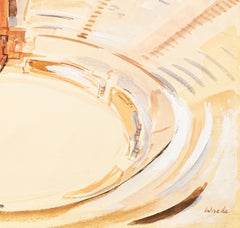
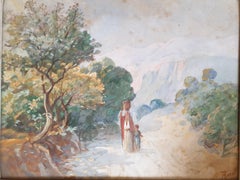
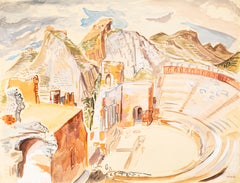
The Ancient Theater - Watercolor on Paper by M.E. Wrede - Mid 20th Century
By Maria Elisabeth Wrede
Located in Roma, IT
The Ancient Theater is an original modern artwork realized by the Austrian artist Maria Elisabeth Wrede in the first half of the XX Century. Original colored watercolor on paper. H...
Category

Mid-20th Century Maria Elisabeth Wrede Art

Materials

Watercolor

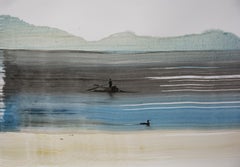
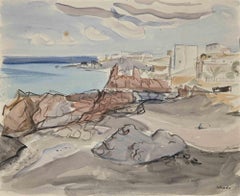
Seascape - Watercolor on Paper by M.E. Wrede - Early 20th Century
By Maria Elisabeth Wrede
Located in Roma, IT
Seascape is a drawing in Watercolor on paper realized by Maria Elisabeth Wrede in the Early-20th Century. Good conditions. Hand-signed. The artwork is depicted through soft stroke...
Category

Mid-20th Century Maria Elisabeth Wrede Art

Materials

Paper
Related Items
19th Century Loch Tay Scottish Landscape
By Aaron Edwin Penley
Located in Soquel, CA
Masterful Scottish watercolor landscape of Loch Tay with boats and small figures on the short by Aaron Edwin Penley (English, 1826-1897)....
Category

1870s Realist Maria Elisabeth Wrede Art

Materials

Paper, Watercolor

Fairy in the Pussy Willows with Baby and Spider Web Fantasy Children's Book
Located in Miami, FL
This work is presented more as a concept piece since it's condition is destresed. Signed lower right Illustrator Hazel Frazee was a Female Illustrator in the first quarter of the 20...
Category

1920s Art Nouveau Maria Elisabeth Wrede Art

Materials

Pencil, Watercolor, Paper

George Elbert Burr 1924 Drawing – Storm over Arizona Desert Landscape, Southwest
By George Elbert Burr
Located in Denver, CO
This rare 1924 colored pencil drawing by renowned American artist George Elbert Burr (1859–1939) beautifully captures the raw, untamed drama of the Arizona de...
Category

Early 20th Century American Impressionist Maria Elisabeth Wrede Art

Materials

Paper, Color Pencil

"Times Square" Mid 20th Century 1937 Modernism Broadway Drawing NYC Cityscape
Located in New York, NY
"Times Square" Mid 20th Century 1937 Modernism Broadway Drawing NYC Cityscape Philip Goodwin (20th Century) "Times Square," 23 ½ x 17 ¼ inches. Gouache...
Category

1930s American Modern Maria Elisabeth Wrede Art

Materials

Paper, Gouache

MOMA Exhibited Watercolor by Chicago Artist Francis Chapin, "Tourists in Taxco"
By Francis Chapin
Located in Chicago, IL
A charming, vibrant, early Mexican city street scene by famed Chicago Modern artist Francis Chapin (Am. 1899-1965). Titled "Tourists in Taxco", the watercolor was exhibited at the M...
Category

1930s American Modern Maria Elisabeth Wrede Art

Materials

Paper, Watercolor

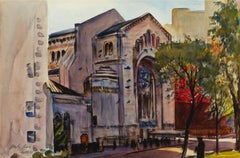
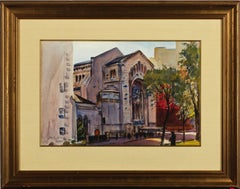
Fort Tryon Park
Located in Middletown, NY
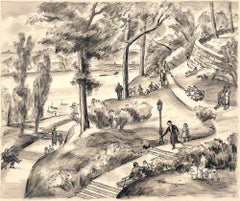
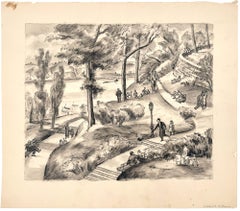
Ink and wash in gray ink on buff wove paper, 13 1/4 x 15 inches (337 x 382 mm), the full sheet. Signed in pencil in the lower right margin. In good condition with a 2-inch horizontal...
Category

Mid-20th Century American Modern Maria Elisabeth Wrede Art

Materials

Handmade Paper, Ink

Norwegian Pine Grove - The inner glow of the trees -
Located in Berlin, DE
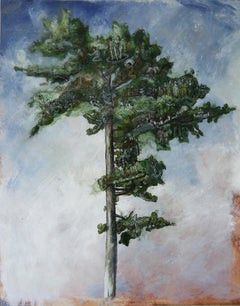
Themistokles von Eckenbrecher (1842 Athens - 1921 Goslar), Norwegian pine grove, 1901. Watercolor on blue-green paper, 30 x 22 cm. Signed, dated and inscribed in his own hand "TvE. Fagermes [i.e. Fagermes]. 26.6.[19]01." - Slight crease throughout at left margin, otherwise in good condition. About the artwork Themistokles von Eckenbrecher often traveled to Norway to study the nature that fascinated him there. On June 26, 1901, near the southern Norwegian town of Fagernes, in the summer evening sun, he saw a small pine grove, which he immediately captured in a watercolor. He exposed the trees growing on a small hill in front of the background, so that the pines completely define the picture and combine to form a tense motif. The tension comes from the contrast of form and color. The trunks, growing upward, form a vertical structure that is horizontally penetrated by the spreading branches and the pine needles, which are rendered as a plane. This structural tension is further intensified by the color contrast between the brown-reddish iridescent trunks and branches and the green-toned needlework. Themistokles von Eckenbrecher, however, does not use the observed natural scene as an inspiring model for a dance of color and form that detaches itself from the motif and thus treads the path of abstracting modernism. Its inner vitality is to be brought to light and made aesthetically accessible through the work of art. It is precisely in order to depict the inner vitality of nature that von Eckenbrecher chooses the technique of watercolor, in which the individual details, such as the needles, are not meticulously worked out, but rather a flowing movement is created that unites the contrasts. The trees seem to have formed the twisted trunks out of their own inner strength as they grew, creatingthose tense lineations that the artist has put into the picture. The inner strength continues in the branches and twigs, culminating in the upward growth of the needles. At the same time, the trunks, illuminated by the setting sun, seem to glow from within, adding an almost dramatic dimension to the growing movement. Through the artwork, nature itself is revealed as art. In order to make nature visible as art in the work, von Eckenbrecher exposes the group of trees so that they are bounded from the outside by an all-encompassing contour line and merge into an areal unity that enters into a figure-ground relationship with the blue-greenish watercolor paper. The figure-ground relationship emphasizes the ornamental quality of the natural work of art, which further enforces the artwork character of the group of trees. With the presentation of Themistokles von Eckenbrecher's artistic idea and its realization, it has become clear that the present watercolor is not a study of nature in the sense of a visual note by the artist, which might then be integrated into a larger work context, but a completely independent work of art. This is why von Eckenbrecher signed the watercolor. In addition, it is marked with a place and a date, which confirms that this work of nature presented itself to him in exactly this way at this place at this time. At the same time, the date and place make it clear that the natural work of art has been transferred into the sphere of art and thus removed from the time of the place of nature. About the artist Themistocles' parents instilled a life of travel in their son, who is said to have spoken eleven languages. His father, who was interested in ancient and oriental culture, was a doctor and had married Francesca Magdalena Danelon, an Italian, daughter of the British consul in Trieste. During a stay in Athens - Gustav von Eckenbrecher was a friend of Heinrich von Schliemann and is said to have given him crucial clues as to the location of Troy - Themistokles saw the light of day in 1842. After an interlude in Berlin, where Themistokles was educated at the English-American School, the journey began again. From 1850 to 1857 the family lived in Constantinople, after which the father opened a practice in Potsdam, where Themistokles, who wanted to become a painter, was taught by the court painter Carl Gustav Wegener. In 1861 the von Eckenbrechers left Potsdam and settled in Düsseldorf. There Themistokles received two years of private tuition from Oswald Aschenbach, who greatly admired the talented young artist. After his artistic training, he undertook extensive travels, often accompanied by Prince Peter zu Sayn-Wittgenstein, which took him to northern and eastern Europe, but above all to the Middle East and even to South America. The paintings that resulted from these journeys established his artistic reputation and led to his participation in large panoramas such as the 118 x 15 metre Entry of the Mecca Caravan into Cairo, painted for the City of Hamburg in 1882. 1882 was also the start of a total of 21 study trips to Scandinavia, most of them to Norway, and the unique Norwegian landscape with its rugged fjords became a central motif in his work. Along with Anders Askevold and Adelsteen Normann...
Category

Early 1900s Naturalistic Maria Elisabeth Wrede Art

Materials

Watercolor

19th Century Watercolour Drawing of Autumnal Trees in Northern Ireland Forest
Located in Preston, GB
19th Century Watercolour Drawing of Autumnal Trees in Northern Ireland Forest, by 19th Century Artist, William Hume Art measures 11 x 8 inches Frame measures 17 x 13 inches Pres...
Category

Early 20th Century Impressionist Maria Elisabeth Wrede Art

Materials

Watercolor, Archival Paper

A Stylized, Modern 1930s Art Deco Drawing of Two Young Men Planting a Tree
By Harold Haydon
Located in Chicago, IL
A Stylized, 1930s Art Deco Pastel Landscape Drawing of Two Young Men Planting a Tree by Notable Chicago Modern Artist, Harold Haydon (Am. 1909-1994). Artwork size: 9 x 12 inches, u...
Category

1930s American Modern Maria Elisabeth Wrede Art

Materials

Paper, Charcoal, Pastel

"Good Health Week" WPA American Scene Mid 20th Century Modern Social Realism
By Jo Cain
Located in New York, NY
"Good Health Week" WPA American Scene Mid 20th Century Modern Social Realism Jo Cain (1904 – 2003) Good Health Week 10 ½ x 15 1/2 inches Oil on pape...
Category

1940s American Realist Maria Elisabeth Wrede Art

Materials

Paper, Oil

La Chasseur a l'Arc - Fauvist Still Life Study Gouache by Raoul Dufy
By Raoul Dufy
Located in Marlow, Buckinghamshire
Signed and titled gouache on paper figures in landscape circa 1920 by French fauvist painter Raoul Dufy. The piece is executed in red and blue and the design depicts a hunter on hors...
Category

1920s Fauvist Maria Elisabeth Wrede Art

Materials

Paper, Gouache

An 1950's Modernist Watercolor of Amsterdam by Francis Chapin
By Francis Chapin
Located in Chicago, IL
A colorful, charming 1950s Mid-Century, architectural cityscape of Amsterdam by notable Chicago Modern artist Francis Chapin. Artwork size: 7 3/4 x 10 3/4 inches. Archivally matte...
Category

1950s Modern Maria Elisabeth Wrede Art

Materials

Watercolor, Paper, Ink

Maria Elisabeth Wrede art for sale on 1stDibs.

Find a wide variety of authentic Maria Elisabeth Wrede art available for sale on 1stDibs. You can also browse by medium to find art by Maria Elisabeth Wrede in paint, paper, watercolor and more. Not every interior allows for large Maria Elisabeth Wrede art, so small editions measuring 19 inches across are available. Customers who are interested in this artist might also find the work of Jean Chapin, Jane Levy, and Gustave Bourgogne. Maria Elisabeth Wrede art prices can differ depending upon medium, time period and other attributes. On 1stDibs, the price for these items starts at $321 and tops out at $836, while the average work can sell for $578.

Artists Similar to Maria Elisabeth Wrede