Max Ernst Posters

American, German, French, 1891-1976

Born in Germany in 1891, later naturalized as an American, then a French citizen, Max Ernst was a pioneer in the Dada and Surrealist movements, the boundaries of which he pushed with his unconventional methods of printmaking, drawing and collage.

Ernst had no formal art training — and that may have been his greatest asset. He produced his first work following four years serving in World War I. At the time, he was in Cologne, Germany, working closely with fellow Dada pioneers Jean Arp and Johannes Baargeld. His output during this period consisted largely of collages, which allowed him to represent the shards, rubble and explosions from his traumatic wartime experience.

In 1922, Ernst moved to France, where he soon became affiliated with Surrealism, the avant-garde art movement taking shape in Paris. Alongside Man Ray, Joan Miró and a couple of others, Ernst was among the first visual artists to experiment with imagery and techniques associated with Surrealism.

Ernst’s greatest contribution to the Surrealist movement was his invention of frottage (French for “rubbing”), wherein an artist rubs a pencil or crayon over a paper atop a textured surface, and later grattage (French for “scraping”), where a similar technique is applied with paint. Both methods showcase Ernst’s fascination with the unconscious and serendipitous elements of artistic creation, a theme that connected the Dadaists and the Surrealists. Ernst had deep knowledge of psychoanalysis and Sigmund Freud’s dream theories, which were big influences on Surrealists. He was among the first Surrealists to use Freud’s work to examine his own creative impulses. He also published a series of books of his collages, all of which were deeply symbolic and often philosophical.

When Germany occupied France during World War II, Ernst escaped to America with the help of patron and collector Peggy Guggenheim, whom he married in 1941. While living in New York, Ernst’s work and techniques proved instrumental in inspiring the early development of Abstract Expressionism — influencing Robert Motherwell and Jackson Pollock in particular. He later moved to Sedona, Arizona, where he lived with his fourth wife, Dorothea Tanning, a fellow Surrealist and prolific visual artist and poet.

While Ernst and Tanning are largely responsible for Sedona’s reputation as an artist colony, they relocated to France in the 1950s and remained until Ernst’s death in Paris in 1976.

Find original Max Ernst art on 1stDibs.

to
1
1
2
Height
to
Width
to
1
1
2
1
1
1
1
2
2
2
2
2
2
182
51
39
37
33
Creator: Max Ernst
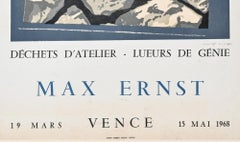
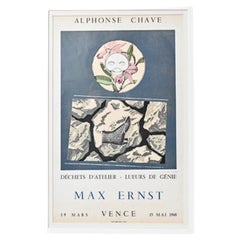
Max Ernst “Déchets d’Atelier” vintage signed poster

Max Ernst “Déchets d’Atelier” vintage signed poster

By Max Ernst

Located in Henley-on Thames, Oxfordshire

Signed Max Ernst original lithographic poster from the “Déchets d’Atelier” exhibition held at Galerie Alphonse Chave in Vence 1968 hand signed in pe...

Category

1960s French Modern Vintage Max Ernst Posters

Materials

Paper

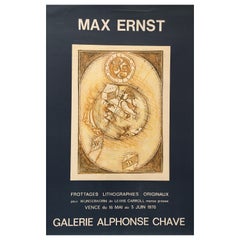
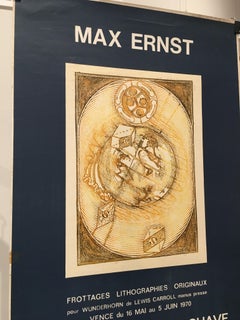
Original Vintage Art Exhibition Poster MAX ERNST, 1970 Galerie Alphonse Chave

Original Vintage Art Exhibition Poster MAX ERNST, 1970 Galerie Alphonse Chave

By Max Ernst

Located in Melbourne, Victoria

Original vintage Art Exhibition Poster MAX ERNST, 1970 Galerie Alphonse Chave "A key member of first Dada and then Surrealism in Europe in the 1910s and 1920s, Max Ernst used a va...

Category

1970s French Mid-Century Modern Vintage Max Ernst Posters

Materials

Paper

Related Items
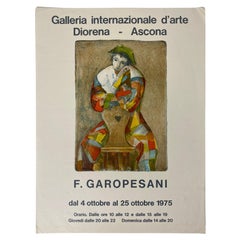
Original Italian Art Exhibition Poster - Ferruccio Garopesani

Original Italian Art Exhibition Poster - Ferruccio Garopesani

$440Sale Price|20% Off

H 22.25 in W 16.63 in D 0.07 in

Original Italian Art Exhibition Poster - Ferruccio Garopesani

Located in Miami, FL

Original Italian art exhibition poster by painter and designer Ferruccio Garopesani. Presented in 1975 at the Galleria International d'Arte - Diorena - Ascona, Italy. A native of ...

Category

Mid-20th Century Italian Mid-Century Modern Max Ernst Posters

Materials

Paper

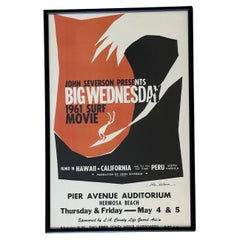
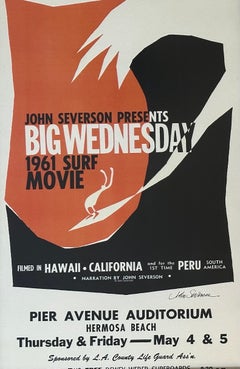
"Surf Culture" Vintage "Big Wednesday" Movie Poster Signed by John Severson

"Surf Culture" Vintage "Big Wednesday" Movie Poster Signed by John Severson

By John Severson Productions

Located in San Diego, CA

A very nice "Surf Culture" vintage "Big Wednesday" movie poster signed by surf industry pioneer and "Surfer Magazine" founder John Severson circa 1990s. The piece is in great condition with vibrant colors and measures 12"W x 18"H; it is presented in a black metal frame and has a picture of Severson with the original owner at the signing on the back. Severson was the producer of this 1961 surfer cult classic. I believe this piece is a reprint and not an original poster from 1961. Nevertheless, it would make a "must have" addition to any surf memorabilia collector! #3179 John Severson, well known as the creator of the internationally acclaimed SURFER Magazine, grew up surfing off the beaches of Southern California. He began his career as a painter, selling his first works while finishing his Master’s Degree at Long Beach State College. In the ’50s he became the first person to create a large body of art relating to the Hawaii-California surf culture. Since then he has provided a steady output of oil paintings, watercolors, drawings, and prints. In 1958, John used his art, photography, and surfing passion to create a popular surf movie series. His films included SURF SAFARI, SURF FEVER, BIG WEDNESDAY, and PACIFIC VIBRATIONS. Severson's smash hits posters from the ’50s and ’60s, remain collector favorites. As a surfer, Severson was known for riding big waves, and for his innovative performance style in big surf. In 1961, he won the Peru International Surfing Championships and was a finalist in the U.S. and Hawaiian Championships. With the founding of SURFER, John’s art focused on the magazine and graphics. His painting “Surf Bebop” was selected as the outstanding cover painting of 1963 by Communication Arts. Surfer During the ’60s, he authored two surf books...

Category

Late 20th Century American Max Ernst Posters
Materials

Paper

Original Vintage Art Exhibition Advertising Poster M-Maybe Roy Lichtenstein

Original Vintage Art Exhibition Advertising Poster M-Maybe Roy Lichtenstein

By Roy Lichtenstein

Located in London, GB

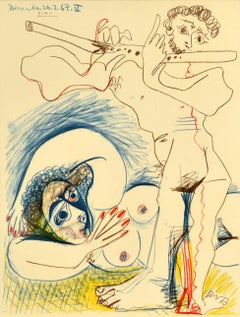
Original vintage exhibition advertising poster featuring the romance comics 1965 Pop Art painting M-Maybe designed in 1965 by the notable pop artist Roy Lichtenstein (1923-1997), dep...

Category

Early 2000s German Max Ernst Posters
Materials

Paper

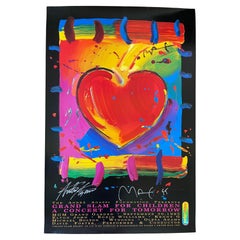
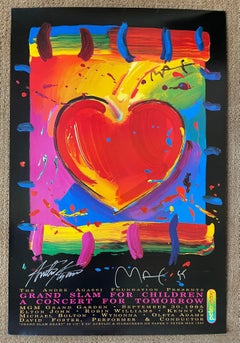
Heart Poster Signed by Peter Max & Andre Agassi

Heart Poster Signed by Peter Max & Andre Agassi

$680Sale Price / item|20% Off

H 36 in W 24 in D 0.1 in

Heart Poster Signed by Peter Max & Andre Agassi

By Peter Max

Located in San Diego, CA

Vintage “Grand Slam for Children A Concert for Tomorrow” / Heart lithograph poster signed by Peter Max and tennis great, Andre Agassi, circa 1995. The concert was held at the MGM Grand Garden in Las Vegas, NV on September 30, 1995 and featured Elton John, Robin Williams, Kenny G, Michael Bolton...

Category

Late 20th Century American Expressionist Max Ernst Posters

Materials

Paper

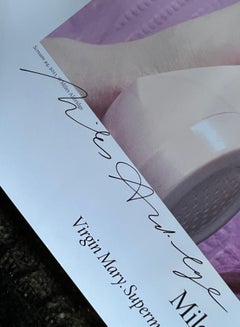
Richard Avedon Hand-Signed Vintage Poster Nastassja Kinski and the Serpent, 1981

Richard Avedon Hand-Signed Vintage Poster Nastassja Kinski and the Serpent, 1981

By Richard Avedon

Located in Studio City, CA

This famous image/poster by renowned photographer Richard Avedon features an image of one of the most recognizable, iconic and celebrated images of the 20th century of a young, beaut...

Category

1980s American Modern Vintage Max Ernst Posters

Materials

Paper

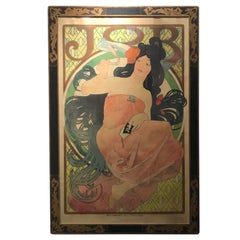
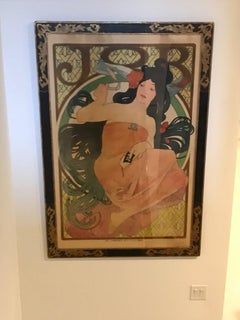
Art Nouveau Alphonse Mucha Original JOB Poster, 1898

Art Nouveau Alphonse Mucha Original JOB Poster, 1898

$35,000

H 66.25 in W 44.75 in D 1 in

Art Nouveau Alphonse Mucha Original JOB Poster, 1898

By Alphonse Mucha

Located in North Bergen, NJ

Alphonse Mucha 1898 JOB poster. Excellent condition with beautiful frame under plexiglass ready to hang. Poster for 'Job' cigarette paper (1898) 'JOB' is a ...

Category

1890s Art Nouveau Antique Max Ernst Posters

Materials

Paper

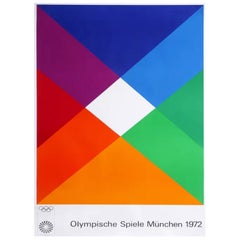
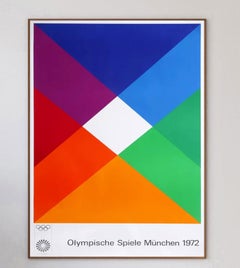
1972 Munich Olympic Games - Max Bill Original Vintage Poster

1972 Munich Olympic Games - Max Bill Original Vintage Poster

By Max Bill

Located in Winchester, GB

Swiss artist & graphic designer Max Bill was one of 29 artists commissioned to produce posters for the 1972 Munich Olympic Games. In the run-up to...

Category

1970s German Vintage Max Ernst Posters

Materials

Paper

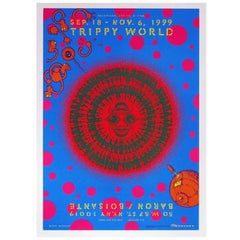
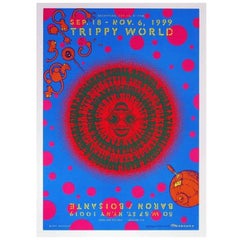
Victor Moscoso, Signed Vintage Exhibition Poster ‘Trippy World’

Victor Moscoso, Signed Vintage Exhibition Poster ‘Trippy World’

By Victor Moscoso

Located in Brooklyn, NY

Signed vintage Victor Moscoso exhibition poster Published in conjunction with 'Trippy World' - a 1999 exhibition held at Baron/Boisante gallery, New York. Off-set lithograph Measures: 16 x 20 inches Hand signed in pencil (lower right). Very good to excellent overall condition Signed First printing; 1999; acquired directly from Baron/Boisante. Victor Moscoso was among the most gifted and influential artists to emerge from the '60s counterculture, pioneering not only the psychedelic concert poster designs made famous during San Francisco's Summer of Love, but also making his mark in underground comix. Born in Spain and raised in Brooklyn, Moscoso attended Cooper Union Art School before studying at the Yale School of Art; he arrived on the west coast in 1959 to enroll at the San Francisco Art Institute, and after graduation remained at the school for another five years to teach lithography. Alongside Rick Griffin, Wes Wilson, Stanley Mouse, and Alton Kelley...

Category

1960s Bohemian Vintage Max Ernst Posters

Materials

Paper

20th Century Ernst Busch European Commercial Art Poster

20th Century Ernst Busch European Commercial Art Poster

Located in Rio Vista, CA

Large 20th century artwork lithograph poster artwork created by Ernst Busch for Ovignac Senglet Cognac. The poster "Curacao Singlet" features a woman seated at a bar smoking with a t...

Category

20th Century Swiss Art Deco Max Ernst Posters

Materials

Plexiglass, Wood, Paper

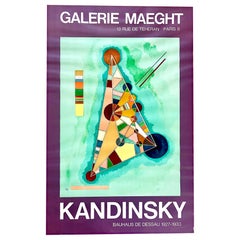
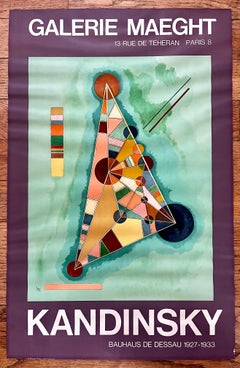
Calder Exhibition Poster, Galerie Maeght, 1959

Calder Exhibition Poster, Galerie Maeght, 1959

$1,200

H 25.5 in W 18.5 in D 1 in

Calder Exhibition Poster, Galerie Maeght, 1959

Located in Savannah, GA

An original exhibition poster lithograph for Alexander Calder show at Galerie Maeght in Paris, 1959. 18 ½ by 25 ½ inches

Category

1950s French Vintage Max Ernst Posters

Materials

Glass, Wood, Paper

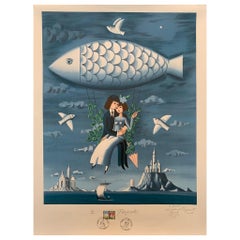
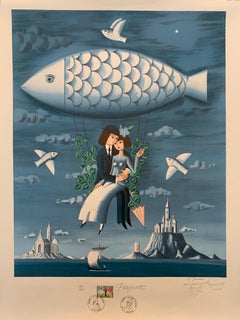
Original Vintage Poster, 'D’amoureux Au Poisson' Signed by Raymond Peynet

Original Vintage Poster, 'D’amoureux Au Poisson' Signed by Raymond Peynet

$1,120Sale Price|20% Off

H 29.53 in W 21.66 in D 0 in

Original Vintage Poster, 'D’amoureux Au Poisson' Signed by Raymond Peynet

By Raymond Peynet

Located in Melbourne, Victoria

Original Vintage Poster, 'D’amoureux Au Poisson' Signed by Raymond Peynet Raymond Peynet was a French artist and illustrator. Peynet was known for his illustrations of couples, specifically, couples in love. Peynet was born in Paris in 1908 , he began drawing at a young age. He studied at the École Estienne and the École des Arts Décoratifs in Paris, this is where he developed his distinctive style. Peynet's style was characterised by delicate lines and slender characters. In 1930, Peynet began working for the weekly magazine "Le Rire," where he published his first illustrations of love couples. These images quickly gained attention from the public and became very popular, leading Peynet to publish a collection of these illustrations titled "Les Amoureux de Peynet...

Category

Late 20th Century French Modern Max Ernst Posters
Materials

Paper

Max Ernst posters for sale on 1stDibs.

Max Ernst posters are available for sale on 1stDibs. These distinctive items are frequently made of paper and are designed with extraordinary care. There are many options to choose from in our collection of Max Ernst posters, although black editions of this piece are particularly popular. Many of the original posters by Max Ernst were created in the modern style in france during the 20th century. If you’re looking for additional options, many customers also consider posters by Roman Cieslewicz, Marc Chagall, and Raymond Savignac. Prices for Max Ernst posters can differ depending upon size, time period and other attributes — on 1stDibs, these items begin at $650 and can go as high as $3,223, while a piece like these, on average, fetch $1,936.
Questions About Max Ernst Posters
  • 1stDibs ExpertApril 26, 2024
    Max Ernst lived in several places during his life. He was born in Brühl, Germany, in 1881 and later moved to Bonn to attend the university located there. Then he settled in Cologne, not far from his birthplace. In 1922, Ernst moved to France, where he soon became affiliated with Surrealism, the avant-garde art movement taking shape in Paris. Alongside Man Ray, Joan Miró and others, Ernst was among the first visual artists to experiment with imagery and techniques associated with Surrealism. When Germany occupied France during World War II, Ernst escaped to America with the help of patron and collector Peggy Guggenheim, whom he married in 1941. While living in New York, Ernst's work and techniques proved instrumental in inspiring the early development of Abstract Expressionism. He later moved to Sedona, Arizona, where he lived with his fourth wife, Dorothea Tanning, a fellow Surrealist and prolific visual artist and poet. While Ernst and Tanning are largely responsible for Sedona's reputation as an artist colony, they relocated to France in the 1950s and remained there until Ernst's death in Paris in 1976. On 1stDibs, shop a collection of Max Ernst art.
  • 1stDibs ExpertMarch 13, 2024
    You can see Max Ernst paintings in many places around the world. The Max Ernst Museum Brühl des LVR in Brühl, Germany, is home to one of the largest exhibitions of his work. Other museums that have Max Ernst paintings in their permanent collections include the Museum of Modern Art in New York, New York; the San Francisco Museum of Modern Art in San Francisco, California; the Art Institute of Chicago in Chicago, Illinois and the Detroit Institute of Arts in Detroit, Michigan. Explore a range of Max Ernst art on 1stDibs.
  • 1stDibs ExpertOctober 15, 2024
    Max Ernst used Surrealism to process the traumas he experienced during World War I. His early works consisted largely of collages, which allowed him to represent the shards, rubble and explosions from his wartime experience. In 1922, Ernst moved to France, where he soon became affiliated with Surrealism, the avant-garde art movement taking shape in Paris. Alongside Man Ray, Joan Miró and others, Ernst was among the first visual artists to experiment with the imagery and techniques that became associated with Surrealist art. Ernst’s greatest contribution to the Surrealist movement is often considered his invention of frottage, wherein an artist rubs a pencil or crayon over a paper atop a textured surface, and later grattage, where a similar technique is applied with paint. Both methods showcase Ernst’s fascination with the unconscious and serendipitous elements of artistic creation, a theme that connected the Dadaists and the Surrealists. Explore a range of Max Ernst art on 1stDibs.
  • 1stDibs ExpertNovember 20, 2024
    Max Ernst contributed to Surrealism by pushing the boundaries of the movement with his unconventional methods of printmaking, drawing and collage. He invented frottage (French for “rubbing”), wherein an artist rubs a pencil or crayon over a paper atop a textured surface, and later grattage (French for “scraping”), where a similar technique is applied with paint. Both methods showcase Ernst’s fascination with the unconscious and serendipitous elements of artistic creation, a theme that resonated with the Dadaists and the Surrealists. Ernst had deep knowledge of psychoanalysis and Sigmund Freud’s dream theories, which were big influences on Surrealists. He was among the first Surrealists to use Freud’s work to examine his own creative impulses. He also published a series of books of his collages, all of which were deeply symbolic and often philosophical. Explore a selection of Max Ernst art on 1stDibs.
  • 1stDibs ExpertOctober 30, 2024
    How much Max Ernst paintings are worth depends on their size, history, condition and other factors. In 2023, his oil-on-panel piece Taya's Sun sold for more than $304,000 at auction. Ernst was a pioneer in the Dada and Surrealist movements, pushing their boundaries with his unconventional methods of printmaking, drawing and collage. If you own an Ernst, consider having a certified appraiser or experienced art dealer evaluate it. Explore a selection of Max Ernst art on 1stDibs.