Max Kaus Art

to
1
1
Overall Width
to
Overall Height
to
2
1
1
2
2
1
1
1
1
2
1
2
11,586
2,878
2,492
1,574
1
1
Artist: Max Kaus
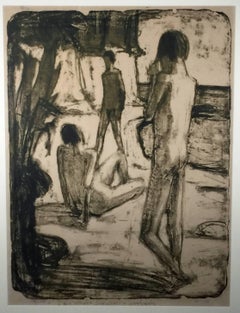
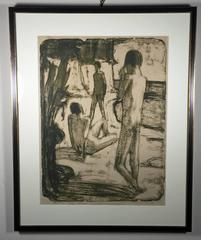
BADENDE MANNER: (THREE MALE BATHERS AT THE SHORE)

BADENDE MANNER: (THREE MALE BATHERS AT THE SHORE)

By Max Kaus

Located in Portland, ME

Kaus, Max. BADENDE MANNER: (THREE MALE BATHERS AT THE SHORE). Lithograph, c. 1924. Signed, lower left, in pencil, and numbered 6-10, further inscribed, lo...

Category

1920s Expressionist Max Kaus Art

Materials

Lithograph

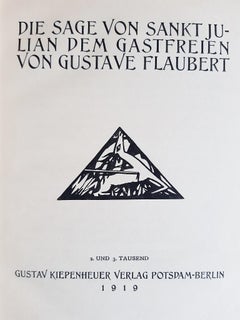
Die sage von Sankt Julian dem Gastfreien - Rare book by Max Kaus - 1919

Die sage von Sankt Julian dem Gastfreien - Rare book by Max Kaus - 1919

By Max Kaus

Located in Roma, IT

Die sage von Sankt Julian dem Gastfreien is an original modern rare book written by Gustave Flaubert and illustrated by Max Kaus (1891 - 1977) in 1919. Original First Edition / Seco...

Category

1910s Expressionist Max Kaus Art

Materials

Paper, Lithograph

Related Items
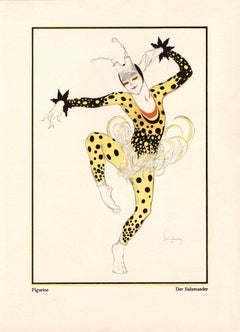
Kostume, Plakate, und Dekorationen, "Der Salamander"

Kostume, Plakate, und Dekorationen, "Der Salamander"

By Walter Schnackenberg

Located in Palm Beach, FL

Walter Schnackenberg’s style changed several times during his long and successful career. Having studied in Munich, the artist traveled often to Paris where he fell under the spell of the Henri de Toulouse-Lautrec’s colorful and sensuous posters depicting theatrical and decadent subjects. Schnackenberg became a regular contributor of similar compositions to the German magazines Jugend and Simplicissimus before devoting himself to the design of stage scenery and costumes. In the artist’s theatrical work, his mastery of form, ornamentation, and Orientalism became increasingly evident. He excelled at combining fluid Art Nouveau outlines, with spiky Expressionist passages, and the postures and patterns of the mysterious East...

Category

1910s Expressionist Max Kaus Art

Materials

Lithograph

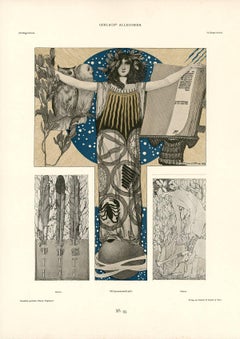
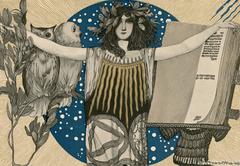
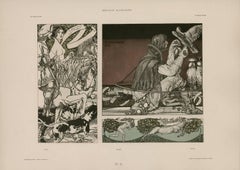
Gerlach's Allegorien Plate #93: "Science" Lithograph by Carl Otto Czeschka

Gerlach's Allegorien Plate #93: "Science" Lithograph by Carl Otto Czeschka

By Carl Otto Czeschka

Located in Palm Beach, FL

after Carl Otto Czeschka, (1878-1960), Austrian A leading member of the Vienna Secession and later the Wiener Werkstätte (Viennese Workshop), Carl Otto Czeschka was a vital figur...

Category

1890s Vienna Secession Max Kaus Art

Materials

Lithograph

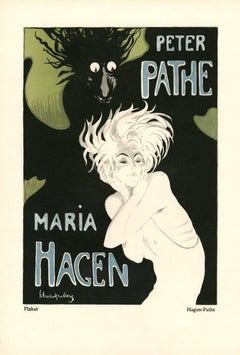
Kostume, Plakate, und Dekorationen, "Shadows & Light"

Kostume, Plakate, und Dekorationen, "Shadows & Light"

By Walter Schnackenberg

Located in Palm Beach, FL

Walter Schnackenberg’s style changed several times during his long and successful career. Having studied in Munich, the artist traveled often to Paris where he fell under the spell of the Henri de Toulouse-Lautrec’s colorful and sensuous posters depicting theatrical and decadent subjects. Schnackenberg became a regular contributor of similar compositions to the German magazines Jugend and Simplicissimus before devoting himself to the design of stage scenery and costumes. In the artist’s theatrical work, his mastery of form, ornamentation, and Orientalism became increasingly evident. He excelled at combining fluid Art Nouveau outlines, with spiky Expressionist passages, and the postures and patterns of the mysterious East. In his later years, Schnackenberg explored the unconscious, using surreal subject matter and paler colors that plainly portrayed dreams and visions, some imbued with political connotations. His drawings, illustrations, folio prints, and posters are highly sought today for their exceedingly imaginative qualities, enchanting subject matter, and arresting use of color. SCHNACKENBERG: KOSTUME, PLAKATE UND DEKORATIONEN, a cardboard bound art book consisting of 43 prints of work by Walter Schnackenberg, 30 of which are color lithographs that are signed and some are titled and dated in the plate, as well as black and white prints and photographs with accompanying text by Oskar Bie; lithographs printed at Kunstanstalt Oskar Consee in Munich, other images printed by Gesellschaft Pick & Co. in Munich, the text and cover with color images by Schnackenberg front and verso printed by R. Oldenbourg in Munich; published by Musarion Verlag, Munich, 1920. The majority of Walter Schnackenberg’s artistic output was destroyed by bomb attacks in Munich in 1944. The highly publicized 2013 auction in New York of the recovered pre-war poster collection once belonging to German poster aficionado, Hans Sachs has reintroduced the world to Walter Schnackenberg’s graphic genius and priceless ephemeral art from a lost era. Besides the museum world, designer Karl Lagerfeld is one of the most prodigious collectors of Schnackenberg. Flipping through the pages of Kostume, Plakate und Dekorationen, it becomes quite clear that Schnackenberg’s collection is ground zero at the crossroads of early modern fashion where the cult of celebrity meets up with dance, music, theater and cabaret, film and the graphic medium. Berlin and Munich under Germany’s Weimar Republic in the first quarter of the 20th century produced just the atmosphere to feed this burgeoning industry. Rising inflation sparked a recklessness to live large for the moment and heightened a desire for escapism. An influx of Indian and East Asian dancers and musicians added to the artsy bohemian cultural mix. A new decadence and tolerance resulted. Film boldly featured provocative subject matter. Cabarets became popular venues giving rise to the demi-monde in which people from all social stations mixed more freely in a thriving underground economy and culture where there was a blurring of boundaries and of social codes. Noted art historian and cultural doyen, Oskar Bie astutely observes in his introduction to Schnackenberg’s publication that what unites the images is fantasy and advertisement. Schnackenberg uses the eye as an instrument to brilliantly construct and convey this double message. His personages never directly confront the viewer. Their eyes gaze off in the distance like those of the screenplayer and film star Hedamaria Scholz in Schnackenberg’s “Die Rodelhexe” movie poster. Their eyes follow the path of a dance composition or become a transfixed and ogling male gaze such as the iconic 1911 Odeon Casino poster...

Category

1910s Expressionist Max Kaus Art
Materials

Lithograph

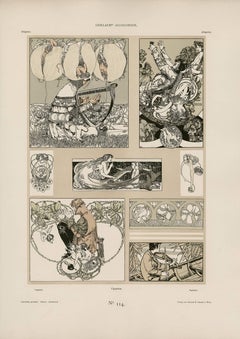
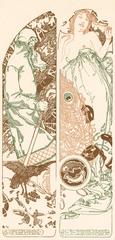
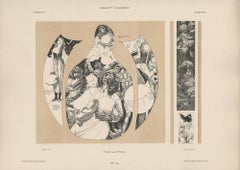
Gerlach's Allegorien Plate #114: "Vignettes" Lithograph by Carl Otto Czeschka

Gerlach's Allegorien Plate #114: "Vignettes" Lithograph by Carl Otto Czeschka

By Carl Otto Czeschka

Located in Palm Beach, FL

after Carl Otto Czeschka, (1878-1960), Austrian A leading member of the Vienna Secession and later the Wiener Werkstätte (Viennese Workshop), Carl Otto Czeschka was a vital figur...

Category

1890s Vienna Secession Max Kaus Art

Materials

Lithograph

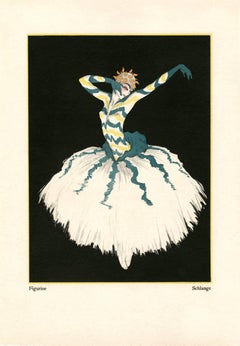
Kostume, Plakate, und Dekorationen, "Schlange (Snake)"

Kostume, Plakate, und Dekorationen, "Schlange (Snake)"

By Walter Schnackenberg

Located in Palm Beach, FL

Walter Schnackenberg’s style changed several times during his long and successful career. Having studied in Munich, the artist traveled often to Paris where he fell under the spell of the Henri de Toulouse-Lautrec’s colorful and sensuous posters depicting theatrical and decadent subjects. Schnackenberg became a regular contributor of similar compositions to the German magazines Jugend and Simplicissimus before devoting himself to the design of stage scenery and costumes. In the artist’s theatrical work, his mastery of form, ornamentation, and Orientalism became increasingly evident. He excelled at combining fluid Art Nouveau outlines, with spiky Expressionist passages, and the postures and patterns of the mysterious East. In his later years, Schnackenberg explored the unconscious, using surreal subject matter and paler colors that plainly portrayed dreams and visions, some imbued with political connotations. His drawings, illustrations, folio prints, and posters are highly sought today for their exceedingly imaginative qualities, enchanting subject matter, and arresting use of color. SCHNACKENBERG: KOSTUME, PLAKATE UND DEKORATIONEN, a cardboard bound art book consisting of 43 prints of work by Walter Schnackenberg, 30 of which are color lithographs that are signed and some are titled and dated in the plate, as well as black and white prints and photographs with accompanying text by Oskar Bie; lithographs printed at Kunstanstalt Oskar Consee in Munich, other images printed by Gesellschaft Pick & Co. in Munich, the text and cover with color images by Schnackenberg front and verso printed by R. Oldenbourg in Munich; published by Musarion Verlag, Munich, 1920. The majority of Walter Schnackenberg’s artistic output was destroyed by bomb attacks in Munich in 1944. The highly publicized 2013 auction in New York of the recovered pre-war poster collection once belonging to German poster aficionado, Hans Sachs has reintroduced the world to Walter Schnackenberg’s graphic genius and priceless ephemeral art from a lost era. Besides the museum world, designer Karl Lagerfeld is one of the most prodigious collectors of Schnackenberg. Flipping through the pages of Kostume, Plakate und Dekorationen, it becomes quite clear that Schnackenberg’s collection is ground zero at the crossroads of early modern fashion where the cult of celebrity meets up with dance, music, theater and cabaret, film and the graphic medium. Berlin and Munich under Germany’s Weimar Republic in the first quarter of the 20th century produced just the atmosphere to feed this burgeoning industry. Rising inflation sparked a recklessness to live large for the moment and heightened a desire for escapism. An influx of Indian and East Asian dancers and musicians added to the artsy bohemian cultural mix. A new decadence and tolerance resulted. Film boldly featured provocative subject matter. Cabarets became popular venues giving rise to the demi-monde in which people from all social stations mixed more freely in a thriving underground economy and culture where there was a blurring of boundaries and of social codes. Noted art historian and cultural doyen, Oskar Bie astutely observes in his introduction to Schnackenberg’s publication that what unites the images is fantasy and advertisement. Schnackenberg uses the eye as an instrument to brilliantly construct and convey this double message. His personages never directly confront the viewer. Their eyes gaze off in the distance like those of the screenplayer and film star Hedamaria Scholz in Schnackenberg’s “Die Rodelhexe” movie poster. Their eyes follow the path of a dance composition or become a transfixed and ogling male gaze such as the iconic 1911 Odeon Casino poster...

Category

1910s Expressionist Max Kaus Art
Materials

Lithograph

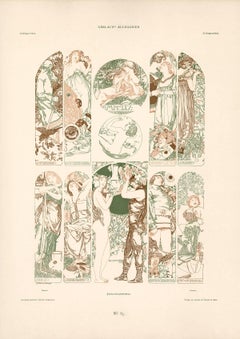
Gerlach's Allegorien Plate #83: "Seasons" Lithograph by Carl Otto Czeschka

Gerlach's Allegorien Plate #83: "Seasons" Lithograph by Carl Otto Czeschka

By Carl Otto Czeschka

Located in Palm Beach, FL

after Carl Otto Czeschka, (1878-1960), Austrian A leading member of the Vienna Secession and later the Wiener Werkstätte (Viennese Workshop), Carl Otto Czeschka was a vital fi...

Category

1890s Vienna Secession Max Kaus Art

Materials

Lithograph

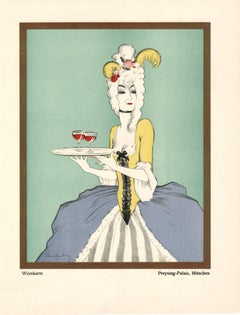
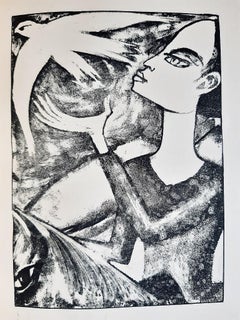
Kostume, Plakate, und Dekorationen, "Preysing-Palais Munich"

Kostume, Plakate, und Dekorationen, "Preysing-Palais Munich"

By Walter Schnackenberg

Located in Palm Beach, FL

Walter Schnackenberg’s style changed several times during his long and successful career. Having studied in Munich, the artist traveled often to Paris where he fell under the spell o...

Category

1910s Expressionist Max Kaus Art
Materials

Lithograph

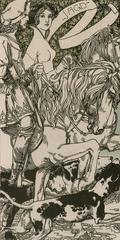
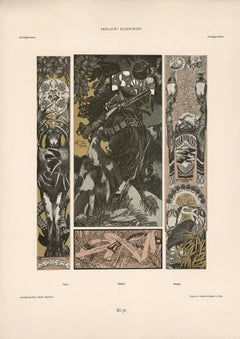
Gerlach's Allegorien Plate #85: "Hunting" Lithograph by Carl Otto Czeschka

Gerlach's Allegorien Plate #85: "Hunting" Lithograph by Carl Otto Czeschka

By Carl Otto Czeschka

Located in Palm Beach, FL

after Carl Otto Czeschka, (1878-1960), Austrian A leading member of the Vienna Secession and later the Wiener Werkstätte (Viennese Workshop), Carl Otto Czeschka was a vital figur...

Category

1890s Vienna Secession Max Kaus Art

Materials

Lithograph

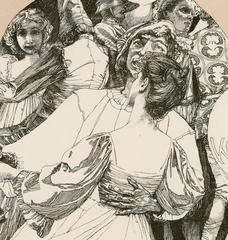
Gerlach's Allegorien Plate #78: "Dance & Wine" Lithograph by Carl Otto Czeschka

Gerlach's Allegorien Plate #78: "Dance & Wine" Lithograph by Carl Otto Czeschka

By Carl Otto Czeschka

Located in Palm Beach, FL

after Carl Otto Czeschka, (1878-1960), Austrian A leading member of the Vienna Secession and later the Wiener Werkstätte (Viennese Workshop), Carl Otto Czeschka was a vital figur...

Category

1890s Vienna Secession Max Kaus Art

Materials

Lithograph

Gerlach's Allegorien Plate #78: "Hunting" Lithograph by Carl Otto Czeschka

Gerlach's Allegorien Plate #78: "Hunting" Lithograph by Carl Otto Czeschka

By Carl Otto Czeschka

Located in Palm Beach, FL

after Carl Otto Czeschka, (1878-1960), Austrian A leading member of the Vienna Secession and later the Wiener Werkstätte (Viennese Workshop), Carl Otto Czeschka was a vital figur...

Category

1890s Vienna Secession Max Kaus Art

Materials

Lithograph

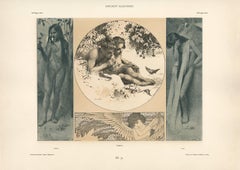
Gerlach's Allegorien Plate #30: "Love" Lithograph

Gerlach's Allegorien Plate #30: "Love" Lithograph

By Koloman Moser

Located in Palm Beach, FL

Koloman Moser (1868 –1918), AUSTRIAN Instead of applying his flair and art education solely to painting, Koloman Moser embodied the idea of Gesamt Kunstwerk (all-embracing art w...

Category

1890s Vienna Secession Max Kaus Art

Materials

Lithograph

Previously Available Items
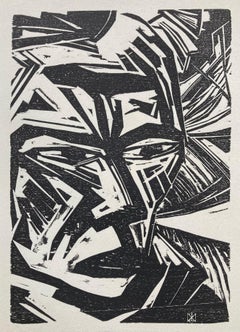
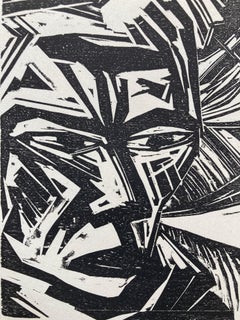
KOPF (Head)
KOPF (Head)

Max KausKOPF (Head), 1920

Sold

H 11.375 in W 8 in

KOPF (Head)

By Max Kaus

Located in Santa Monica, CA

MAX KAUS (German 1891-1977) KOPF (Head( (Rifkind 1387) Woodcut, unsigned, monogram in block. As issued as plate 1 from “Genius” Zeitschrift für werdende und alte Kunst, vol. 2, no. ...

Category

1920s Expressionist Max Kaus Art
Materials

Woodcut

Max Kaus art for sale on 1stDibs.

Find a wide variety of authentic Max Kaus art available for sale on 1stDibs. You can also browse by medium to find art by Max Kaus in lithograph, paper, woodcut print and more. Much of the original work by this artist or collective was created during the 20th century and is mostly associated with the Expressionist style. Not every interior allows for large Max Kaus art, so small editions measuring 8 inches across are available. Customers who are interested in this artist might also find the work of Max Pechstein, Otto Mueller, and Conrad Felixmuller. Max Kaus art prices can differ depending upon medium, time period and other attributes. On 1stDibs, the price for these items starts at $450 and tops out at $7,500, while the average work can sell for $668.