By Takashi Murakami
Located in Greenwich, CT
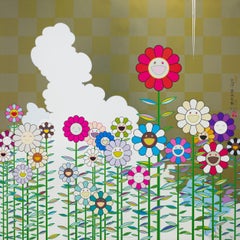
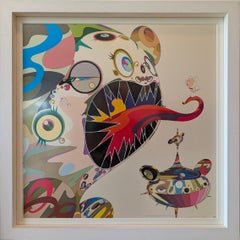
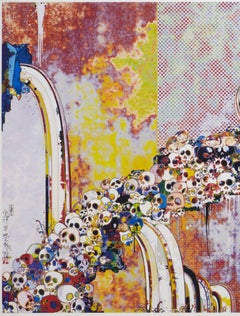
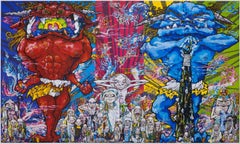
'Red Demon and Blue Demon with 48 Arthats' is a large-format offset lithograph by Takashi Murakami, image size 28 x 46.5 inches and framed size 37.5 x 56 inches. From the edition of 300, signed lower right and numbered 191/300. Framed in a contemporary, white frame.
In the 2017 monograph, ‘The Octopus Eats its Own Legs’, Michael Dylan Foster writes, “Akiko Miki has noted that in his more recent work Murakami has made a ‘shift not only to being concerned with the notion of religion – a main component, along with capitalism, behind the creation of art – but also towards a more serious engagement with the traditions of Japanese art.’ These concerns, manifested in his explicit invocations of folkloric imagery and creatures from both religion and art, are particularly apparent in ‘The 500 Arhats,’ his monumental twenty-four-paneled, 100-meter-long painting. The work portrays five hundred wizened and grotesque arhats, Buddhist religious figures who, as art historian Nobuo Tsuji puts it, ‘normally… stay in the mountains practicing religious austerities, only appearing after a fire, tsunami, earthquake, or some other disaster has occurred, as a kind of rescue team.’
The gargantuan painting represents Murakami’s interest in creating – in the wake of Japan’s tragedy of earthquake, tsunami, and nuclear disaster on March 11, 2011 – ‘a work of art that would be deemed indispensable to our times.’ The inspiration came directly from a series of exchanges between Murakami and Tsuji, whose critical work the artist had long admired.”
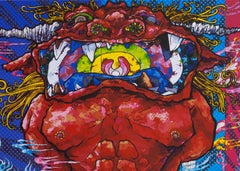
Regarding the red and blue demons in the present artwork, these are allusions to Japan’s folkloric tradition of ‘oni’ – ogre or devil-like creatures who in ancient times were associated with bad fortunes and events, but in modern times are more ambiguous.
“…Murakami’s invocation of the oni suggests that – unlike his arhats, or his baku and hakutaku – these beings have not come as part of the post-disaster ‘rescue team’ but may represent the very inhuman forces that cause disaster. A closer examination of the figures, however, reveals that Murakami has incorporated other cultural allusions that complicate a one-sided interpretation. …these poses are reminiscent of the so-called Niō guardian...
Category
21st Century and Contemporary Contemporary Michele Cascarano Art