Joseph Webster Golinkin Art

American, 1896-1977
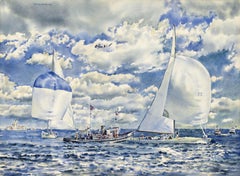
JOSEPH WEBSTER GOLINKIN (1896-1977) Painter, printmaker, naval officer, politician, environmentalist, and philanthropist. He was a true Renaissance man – excelling in everything he pursued. Joseph Golinkin was born in Chicago on September 10, 1896, and studied at the Art Institute of Chicago. He entered the United States Naval Academy and, upon graduation, was commissioned as an Ensign and immediately deployed to serve in World War I. He remained in the Navy until 1922, when he resigned his commission to pursue his original career as an artist. He remained, however, in the active reserve as a Lieutenant Commander. After leaving the Navy, Golinkin moved to New York, where he studied at the Art Students League with Ash Can school artist George Luks. The two artists became fast friends, and Luks introduced him to many other artists. During the 1920s and 1930s, Golinkin exhibited with several other well-known artists, including George Bellows, Joseph Margulies, and David Shotwell. He was also represented by several renowned dealers in New York City, including Ferargil Galleries, Macbeth Gallery, and Van der Straeten. He had one-person shows at the Museum of the City of New York, the Macbeth Gallery, Ferargil Galleries, Gump's in San Francisco, the San Francisco Art Gallery, and the Los Angeles Olympics in 1984. His works are part of many museum collections, including the Metropolitan Museum, New York Public Library, Museum of the City of New York, Library of Congress, and the Art Institute of Chicago. As an artist, Golinkin worked in many mediums, including painting, watercolor, and lithography. While his subjects varied, two would dominate his work – scenes of New York and sports. He produced a large body of prints, drawings, and lithographs surrounding these two subjects. His images of New York include scenes of both city life and the structures, capturing the ambiance of the late 1920s and early 1930s. The sporting events Golinkin depicted include baseball, bicycle racing, bowling, boxing, football, hockey, horse racing, horse shows, golf, polo, tennis, track and field, wrestling, and yacht racing. He was awarded the Gold Medal for Artistic Excellence in Relation to Sport at the X Olympiad in 1932 and again at the XI Olympiad in 1936. Golinkin's sporting scenes have been reproduced as posters for several Olympic Games. His work is also in the collections of the Baseball Hall of Fame, the Palm Beach Polo Club, Madison Square Garden, numerous yacht clubs, and in the personal collections of well-known athletes and sports enthusiasts throughout the world. When the Navy reactivated him in 1938, his artistic career was put on hold. He served with great distinction during WWII, was awarded the Bronze Star, and retired from the Navy in 1958 with the rank of Rear Admiral. His other careers include serving for twelve years as Mayor of Centre Island, New York. As an early environmentalist, he formed a nonpartisan civic association that successfully opposed building a Robert Moses proposed bridge that would have connected Oyster Bay and Rye, New York.
to
1
5
2
Overall Width
to
Overall Height
to
8
5
2
5
3
6
3
2
2
2
2
2
2
1
1
1
1
1
1
3
3
3
2
1
8
10,491
2,808
2,500
1,414
2
4
8
Artist: Joseph Webster Golinkin
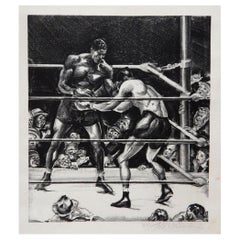
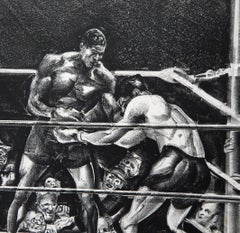
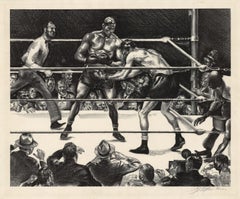
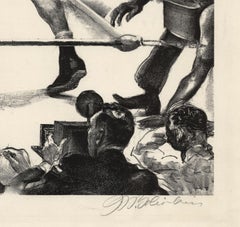
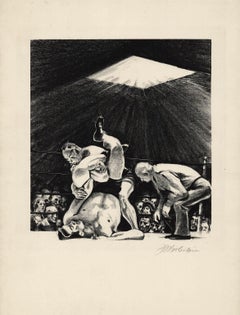
Joe Louis vs. Max Baer at Yankee Stadium

Joe Louis vs. Max Baer at Yankee Stadium

By Joseph Webster Golinkin

Located in New York, NY

LOUIS & BAER AT YANKEE STADIUM. This lithograph from circa 1935 was printed in an edition of 50. This particular impression is signed in pencil and inscribed “25/50.” The image size is 15 7/8 x 19 ¾ inches and the paper (sheet) size is 19 1/8 x 22 7/8 inches. There are two small purple estate stamps on verso. "I define fear as standing across the ring from Joe Louis and knowing he wants to go home early." – Max Baer...

Category

1930s Naturalistic Joseph Webster Golinkin Art

Materials

Lithograph

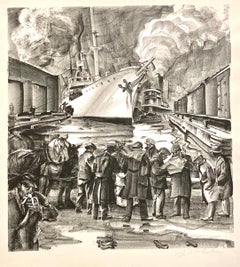
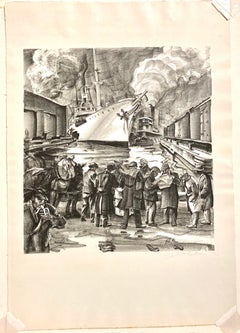
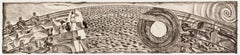
Joseph Webster Golinkin, On the Dock, Banana Boat, New Orleans

Joseph Webster Golinkin, On the Dock, Banana Boat, New Orleans

By Joseph Webster Golinkin

Located in New York, NY

Chicago-born Golinkin studied at the Artist Students League with George Luks. After working as an illustrator for New York papers he joined the Navy in 1939 and retired as a Rear Adm...

Category

1930s Ashcan School Joseph Webster Golinkin Art

Materials

Lithograph

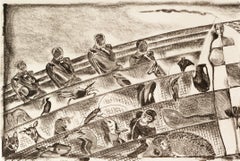
Wrestling [untitled].

Wrestling [untitled].

By Joseph Webster Golinkin

Located in New York, NY

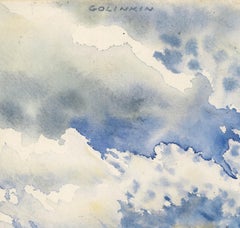
“WRESTLING” is a watercolor by Joseph Golinkin created circa 1940. This piece is painted to the paper's edge and signed in red paint in the upper left. The watercolor paper size is 20 7/8 x 15 ¾ inches. Joseph Webster Golinkin...

Category

1930s Naturalistic Joseph Webster Golinkin Art

Materials

Watercolor, Graphite

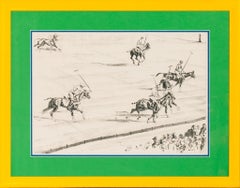
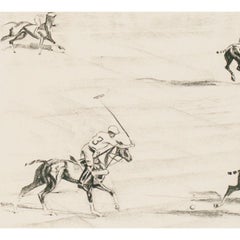
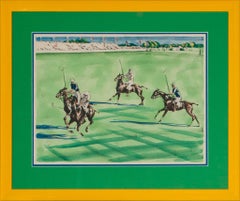
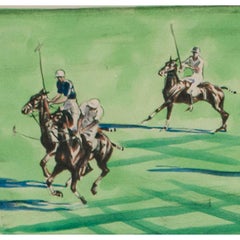
"Polo Scene"
"Polo Scene"

"Polo Scene"

By Joseph Webster Golinkin

Located in Bristol, CT

Classic c1930s polo field scene by Joseph Webster Golinkin (1896-1977) Art Sz: 10 1/4"H x 14 3/4"W Frame Sz: 15 1/2"H x 20"W Joseph Webster Golinkin (September 10, 1896 – Septembe...

Category

1930s Joseph Webster Golinkin Art

Materials

Lithograph

Related Items
Niagra Falls Spring and Winter Watercolor Landscapes

Niagra Falls Spring and Winter Watercolor Landscapes

By Maude Leach

Located in Houston, TX

Original watercolor landscape painting of Niagra falls in the winter and in the spring. The pair of paintings are signed by the artist in the bottom corne...

Category

20th Century Naturalistic Joseph Webster Golinkin Art

Materials

Watercolor

Marc Chagall - Inspiration - Original Lithograph from "Chagall Lithographe" v. 2

Marc Chagall - Inspiration - Original Lithograph from "Chagall Lithographe" v. 2

By Marc Chagall

Located in Collonge Bellerive, Geneve, CH

Marc Chagall Original Lithograph from Chagall Lithographe 1957-1962. VOLUME II. 1963 Dimensions: 32 x 24 cm From the unsigned edition of 10000 copies without margins Reference: Mourlot 398 Condition : Excellent Marc Chagall (born in 1887) Marc Chagall was born in Belarus in 1887 and developed an early interest in art. After studying painting, in 1907 he left Russia for Paris, where he lived in an artist colony on the city’s outskirts. Fusing his own personal, dreamlike imagery with hints of the fauvism and cubism popular in France at the time, Chagall created his most lasting work—including I and the Village (1911)—some of which would be featured in the Salon des Indépendants exhibitions. After returning to Vitebsk for a visit in 1914, the outbreak of WWI trapped Chagall in Russia. He returned to France in 1923 but was forced to flee the country and Nazi persecution during WWII. Finding asylum in the U.S., Chagall became involved in set and costume design before returning to France in 1948. In his later years, he experimented with new art forms and was commissioned to produce numerous large-scale works. Chagall died in St.-Paul-de-Vence in 1985. The Village Marc Chagall was born in a small Hassidic community on the outskirts of Vitebsk, Belarus, on July 7, 1887. His father was a fishmonger, and his mother ran a small sundries shop in the village. As a child, Chagall attended the Jewish elementary school, where he studied Hebrew and the Bible, before later attending the Russian public school. He began to learn the fundamentals of drawing during this time, but perhaps more importantly, he absorbed the world around him, storing away the imagery and themes that would feature largely in most of his later work. At age 19 Chagall enrolled at a private, all-Jewish art school and began his formal education in painting, studying briefly with portrait artist Yehuda Pen. However, he left the school after several months, moving to St. Petersburg in 1907 to study at the Imperial Society for the Protection of Fine Arts. The following year, he enrolled at the Svanseva School, studying with set designer Léon Bakst, whose work had been featured in Sergei Diaghilev's Ballets Russes. This early experience would prove important to Chagall’s later career as well. Despite this formal instruction, and the widespread popularity of realism in Russia at the time, Chagall was already establishing his own personal style, which featured a more dreamlike unreality and the people, places and imagery that were close to his heart. Some examples from this period are his Window Vitebsk (1908) and My Fianceé with Black Gloves (1909), which pictured Bella Rosenfeld, to whom he had recently become engaged. The Beehive Despite his romance with Bella, in 1911 an allowance from Russian parliament member and art patron Maxim Binaver enabled Chagall to move to Paris, France. After settling briefly in the Montparnasse neighborhood, Chagall moved further afield to an artist colony known as La Ruche (“The Beehive”), where he began to work side by side with abstract painters such as Amedeo Modigliani and Fernand Léger as well as the avant-garde poet Guillaume Apollinaire. At their urging, and under the influence of the wildly popular fauvism and cubism, Chagall lightened his palette and pushed his style ever further from reality. I and the Village (1911) and Homage to Apollinaire (1912) are among his early Parisian works, widely considered to be his most successful and representative period. Though his work stood stylistically apart from his cubist contemporaries, from 1912 to 1914 Chagall exhibited several paintings at the annual Salon des Indépendants exhibition, where works by the likes of Juan Gris, Marcel Duchamp and Robert Delaunay were causing a stir in the Paris art world. Chagall’s popularity began to spread beyond La Ruche, and in May 1914 he traveled to Berlin to help organize his first solo exhibition, at Der Sturm Gallery. Chagall remained in the city until the highly acclaimed show opened that June. He then returned to Vitebsk, unaware of the fateful events to come. War, Peace and Revolution In August 1914 the outbreak of World War I precluded Chagall’s plans to return to Paris. The conflict did little to stem the flow of his creative output, however, instead merely giving him direct access to the childhood scenes so essential to his work, as seen in paintings such as Jew in Green (1914) and Over Vitebsk (1914). His paintings from this period also occasionally featured images of the war’s impact on the region, as with Wounded Soldier (1914) and Marching (1915). But despite the hardships of life during wartime, this would also prove to be a joyful period for Chagall. In July 1915 he married Bella, and she gave birth to a daughter, Ida, the following year. Their appearance in works such as Birthday (1915), Bella and Ida by the Window (1917) and several of his “Lovers” paintings give a glimpse of the island of domestic bliss that was Chagall’s amidst the chaos. To avoid military service and stay with his new family, Chagall took a position as a clerk in the Ministry of War Economy in St. Petersburg. While there he began work on his autobiography and also immersed himself in the local art scene, befriending novelist Boris Pasternak, among others. He also exhibited his work in the city and soon gained considerable recognition. That notoriety would prove important in the aftermath of the 1917 Russian Revolution when he was appointed as the Commissar of Fine Arts in Vitebsk. In his new post, Chagall undertook various projects in the region, including the 1919 founding of the Academy of the Arts. Despite these endeavors, differences among his colleagues eventually disillusioned Chagall. In 1920 he relinquished his position and moved his family to Moscow, the post-revolution capital of Russia. In Moscow, Chagall was soon commissioned to create sets and costumes for various productions at the Moscow State Yiddish Theater...

Category

1960s Surrealist Joseph Webster Golinkin Art

Materials

Lithograph

Marc Chagall - The Red Rider - Original Lithograph

Marc Chagall - The Red Rider - Original Lithograph

By Marc Chagall

Located in Collonge Bellerive, Geneve, CH

Marc Chagall - Original Lithograph The Red Rider From the unsigned, unnumbered lithograph printed in the literary review XXe Siecle 1957 See Mourlot 191 Dimensions: 32 x 24 cm Publisher: G. di San Lazzaro. Marc Chagall (born in 1887) Marc Chagall was born in Belarus in 1887 and developed an early interest in art. After studying painting, in 1907 he left Russia for Paris, where he lived in an artist colony on the city’s outskirts. Fusing his own personal, dreamlike imagery with hints of the fauvism and cubism popular in France at the time, Chagall created his most lasting work—including I and the Village (1911)—some of which would be featured in the Salon des Indépendants exhibitions. After returning to Vitebsk for a visit in 1914, the outbreak of WWI trapped Chagall in Russia. He returned to France in 1923 but was forced to flee the country and Nazi persecution during WWII. Finding asylum in the U.S., Chagall became involved in set and costume design before returning to France in 1948. In his later years, he experimented with new art forms and was commissioned to produce numerous large-scale works. Chagall died in St.-Paul-de-Vence in 1985. The Village Marc Chagall was born in a small Hassidic community on the outskirts of Vitebsk, Belarus, on July 7, 1887. His father was a fishmonger, and his mother ran a small sundries shop in the village. As a child, Chagall attended the Jewish elementary school, where he studied Hebrew and the Bible, before later attending the Russian public school. He began to learn the fundamentals of drawing during this time, but perhaps more importantly, he absorbed the world around him, storing away the imagery and themes that would feature largely in most of his later work. At age 19 Chagall enrolled at a private, all-Jewish art school and began his formal education in painting, studying briefly with portrait artist Yehuda Pen. However, he left the school after several months, moving to St. Petersburg in 1907 to study at the Imperial Society for the Protection of Fine Arts. The following year, he enrolled at the Svanseva School, studying with set designer Léon Bakst, whose work had been featured in Sergei Diaghilev's Ballets Russes. This early experience would prove important to Chagall’s later career as well. Despite this formal instruction, and the widespread popularity of realism in Russia at the time, Chagall was already establishing his own personal style, which featured a more dreamlike unreality and the people, places and imagery that were close to his heart. Some examples from this period are his Window Vitebsk (1908) and My Fianceé with Black Gloves (1909), which pictured Bella Rosenfeld, to whom he had recently become engaged. The Beehive Despite his romance with Bella, in 1911 an allowance from Russian parliament member and art patron Maxim Binaver enabled Chagall to move to Paris, France. After settling briefly in the Montparnasse neighborhood, Chagall moved further afield to an artist colony known as La Ruche (“The Beehive”), where he began to work side by side with abstract painters such as Amedeo Modigliani and Fernand Léger as well as the avant-garde poet Guillaume Apollinaire. At their urging, and under the influence of the wildly popular fauvism and cubism, Chagall lightened his palette and pushed his style ever further from reality. I and the Village (1911) and Homage to Apollinaire (1912) are among his early Parisian works, widely considered to be his most successful and representative period. Though his work stood stylistically apart from his cubist contemporaries, from 1912 to 1914 Chagall exhibited several paintings at the annual Salon des Indépendants exhibition, where works by the likes of Juan Gris, Marcel Duchamp and Robert Delaunay were causing a stir in the Paris art world. Chagall’s popularity began to spread beyond La Ruche, and in May 1914 he traveled to Berlin to help organize his first solo exhibition, at Der Sturm Gallery. Chagall remained in the city until the highly acclaimed show opened that June. He then returned to Vitebsk, unaware of the fateful events to come. War, Peace and Revolution In August 1914 the outbreak of World War I precluded Chagall’s plans to return to Paris. The conflict did little to stem the flow of his creative output, however, instead merely giving him direct access to the childhood scenes so essential to his work, as seen in paintings such as Jew in Green (1914) and Over Vitebsk (1914). His paintings from this period also occasionally featured images of the war’s impact on the region, as with Wounded Soldier (1914) and Marching (1915). But despite the hardships of life during wartime, this would also prove to be a joyful period for Chagall. In July 1915 he married Bella, and she gave birth to a daughter, Ida, the following year. Their appearance in works such as Birthday (1915), Bella and Ida by the Window (1917) and several of his “Lovers” paintings give a glimpse of the island of domestic bliss that was Chagall’s amidst the chaos. To avoid military service and stay with his new family, Chagall took a position as a clerk in the Ministry of War Economy in St. Petersburg. While there he began work on his autobiography and also immersed himself in the local art scene, befriending novelist Boris Pasternak, among others. He also exhibited his work in the city and soon gained considerable recognition. That notoriety would prove important in the aftermath of the 1917 Russian Revolution when he was appointed as the Commissar of Fine Arts in Vitebsk. In his new post, Chagall undertook various projects in the region, including the 1919 founding of the Academy of the Arts. Despite these endeavors, differences among his colleagues eventually disillusioned Chagall. In 1920 he relinquished his position and moved his family to Moscow, the post-revolution capital of Russia. In Moscow, Chagall was soon commissioned to create sets and costumes for various productions at the Moscow State Yiddish Theater, where he would paint a series of murals titled Introduction to the Jewish Theater as well. In 1921, Chagall also found work as a teacher at a school for war orphans. By 1922, however, Chagall found that his art had fallen out of favor, and seeking new horizons he left Russia for good. Flight After a brief stay in Berlin, where he unsuccessfully sought to recover the work exhibited at Der Sturm before the war, Chagall moved his family to Paris in September 1923. Shortly after their arrival, he was commissioned by art dealer and publisher Ambroise Vollard to produce a series of etchings for a new edition of Nikolai Gogol's 1842 novel Dead Souls. Two years later Chagall began work on an illustrated edition of Jean de la Fontaine’s Fables, and in 1930 he created etchings for an illustrated edition of the Old Testament, for which he traveled to Palestine to conduct research. Chagall’s work during this period brought him new success as an artist and enabled him to travel throughout Europe in the 1930s. He also published his autobiography, My Life (1931), and in 1933 received a retrospective at the Kunsthalle in Basel, Switzerland. But at the same time that Chagall’s popularity was spreading, so, too, was the threat of Fascism and Nazism. Singled out during the cultural "cleansing" undertaken by the Nazis in Germany, Chagall’s work was ordered removed from museums throughout the country. Several pieces were subsequently burned, and others were featured in a 1937 exhibition of “degenerate art” held in Munich. Chagall’s angst regarding these troubling events and the persecution of Jews in general can be seen in his 1938 painting White Crucifixion. With the eruption of World War II, Chagall and his family moved to the Loire region before moving farther south to Marseilles following the invasion of France. They found a more certain refuge when, in 1941, Chagall’s name was added by the director of the Museum of Modern Art (MOMA) in New York City to a list of artists and intellectuals deemed most at risk from the Nazis’ anti-Jewish campaign. Chagall and his family would be among the more than 2,000 who received visas and escaped this way. Haunted Harbors Arriving in New York City in June 1941, Chagall discovered that he was already a well-known artist there and, despite a language barrier, soon became a part of the exiled European artist community. The following year he was commissioned by choreographer Léonide Massine to design sets and costumes for the ballet Aleko, based on Alexander Pushkin’s “The Gypsies” and set to the music of Pyotr Ilyich Tchaikovsky. But even as he settled into the safety of his temporary home, Chagall’s thoughts were frequently consumed by the fate befalling the Jews of Europe and the destruction of Russia, as paintings such as The Yellow Crucifixion...

Category

1950s Surrealist Joseph Webster Golinkin Art

Materials

Lithograph

Clemente Untitled B: surreal mythical landscape, voyage with ocean, Venus, snake

Clemente Untitled B: surreal mythical landscape, voyage with ocean, Venus, snake

By Francesco Clemente

Located in New York, NY

A black and white, large-scale surreal mythical landscape of an ocean voyage, with a snake wrapped around a clock, a ship, Venus sculpture, greek urns, and snakes, printed in black o...

Category

1980s Contemporary Joseph Webster Golinkin Art

Materials

Lithograph

Portrait of Daniel Schlumberger aged 34

Portrait of Daniel Schlumberger aged 34

Located in BELEYMAS, FR

Early 20th-century French School Portrait of Daniel Schlumberger at age 34 Pastel H. 99.5 cm; W. 63.5 cm Title and dated lower right. Unsigned 1913 The Schlumberger family, of Prote...

Category

1910s French School Joseph Webster Golinkin Art

Materials

Paper, Pastel

Cairo Citadel Palm, Cyanotype on Paper, Desert Botanical Tree in Blue Tones

Cairo Citadel Palm, Cyanotype on Paper, Desert Botanical Tree in Blue Tones

By Kind of Cyan

Located in Barcelona, ES

This is an exclusive handprinted limited edition cyanotype. This cyanotype shows a desert palm tree located in the majestic mediterranean city of Cairo, Egypt. Details: + Title: C...

Category

2010s Naturalistic Joseph Webster Golinkin Art

Materials

Photographic Film, Other Medium, Emulsion, Watercolor, Archival Paper, P...

Original California Ferrari Louis Vuitton Parc de Bagatelle hand signed poster

Original California Ferrari Louis Vuitton Parc de Bagatelle hand signed poster

By Razzia (Gérard Courbouleix–Dénériaz)

Located in Spokane, WA

Original 1989 Louis Vuitton Automobile Classiques Poster –Hand Signed, Archival Linen-Backed. This poster was created for the Concours d’Elegance ...

Category

1980s American Modern Joseph Webster Golinkin Art

Materials

Lithograph

Baobab N11 by Calo Carratalá - black and white drawing, African trees

Baobab N11 by Calo Carratalá - black and white drawing, African trees

By Calo Carratalá

Located in Paris, FR

Baobab N11 from the series: ‘Baobab. La sombra de África’ (‘Baobab. Africa’s shadow’), is a drawing by the contemporary Spanish artist, Calo Carratalá. This drawing is mounted on a w...

Category

2010s Naturalistic Joseph Webster Golinkin Art

Materials

Paper, Graphite

Life study of a male nude in repose - European School, late 18th Century

Life study of a male nude in repose - European School, late 18th Century

Located in Middletown, NY

European School, late 18th century. Red chalk with primo pensiero in graphite on cream laid paper, 8 1/2 x 11 1/2 inches (215 x 293 mm). Scattered light handling wear and multiple s...

Category

Late 18th Century Naturalistic Joseph Webster Golinkin Art

Materials

Chalk, Laid Paper, Pencil, Graphite

Norwegian Pine Grove - The inner glow of the trees -

Norwegian Pine Grove - The inner glow of the trees -

Located in Berlin, DE

Themistokles von Eckenbrecher (1842 Athens - 1921 Goslar), Norwegian pine grove, 1901. Watercolor on blue-green paper, 30 x 22 cm. Signed, dated and inscribed in his own hand "TvE. Fagermes [i.e. Fagermes]. 26.6.[19]01." - Slight crease throughout at left margin, otherwise in good condition. About the artwork Themistokles von Eckenbrecher often traveled to Norway to study the nature that fascinated him there. On June 26, 1901, near the southern Norwegian town of Fagernes, in the summer evening sun, he saw a small pine grove, which he immediately captured in a watercolor. He exposed the trees growing on a small hill in front of the background, so that the pines completely define the picture and combine to form a tense motif. The tension comes from the contrast of form and color. The trunks, growing upward, form a vertical structure that is horizontally penetrated by the spreading branches and the pine needles, which are rendered as a plane. This structural tension is further intensified by the color contrast between the brown-reddish iridescent trunks and branches and the green-toned needlework. Themistokles von Eckenbrecher, however, does not use the observed natural scene as an inspiring model for a dance of color and form that detaches itself from the motif and thus treads the path of abstracting modernism. Its inner vitality is to be brought to light and made aesthetically accessible through the work of art. It is precisely in order to depict the inner vitality of nature that von Eckenbrecher chooses the technique of watercolor, in which the individual details, such as the needles, are not meticulously worked out, but rather a flowing movement is created that unites the contrasts. The trees seem to have formed the twisted trunks out of their own inner strength as they grew, creatingthose tense lineations that the artist has put into the picture. The inner strength continues in the branches and twigs, culminating in the upward growth of the needles. At the same time, the trunks, illuminated by the setting sun, seem to glow from within, adding an almost dramatic dimension to the growing movement. Through the artwork, nature itself is revealed as art. In order to make nature visible as art in the work, von Eckenbrecher exposes the group of trees so that they are bounded from the outside by an all-encompassing contour line and merge into an areal unity that enters into a figure-ground relationship with the blue-greenish watercolor paper. The figure-ground relationship emphasizes the ornamental quality of the natural work of art, which further enforces the artwork character of the group of trees. With the presentation of Themistokles von Eckenbrecher's artistic idea and its realization, it has become clear that the present watercolor is not a study of nature in the sense of a visual note by the artist, which might then be integrated into a larger work context, but a completely independent work of art. This is why von Eckenbrecher signed the watercolor. In addition, it is marked with a place and a date, which confirms that this work of nature presented itself to him in exactly this way at this place at this time. At the same time, the date and place make it clear that the natural work of art has been transferred into the sphere of art and thus removed from the time of the place of nature. About the artist Themistocles' parents instilled a life of travel in their son, who is said to have spoken eleven languages. His father, who was interested in ancient and oriental culture, was a doctor and had married Francesca Magdalena Danelon, an Italian, daughter of the British consul in Trieste. During a stay in Athens - Gustav von Eckenbrecher was a friend of Heinrich von Schliemann and is said to have given him crucial clues as to the location of Troy - Themistokles saw the light of day in 1842. After an interlude in Berlin, where Themistokles was educated at the English-American School, the journey began again. From 1850 to 1857 the family lived in Constantinople, after which the father opened a practice in Potsdam, where Themistokles, who wanted to become a painter, was taught by the court painter Carl Gustav Wegener. In 1861 the von Eckenbrechers left Potsdam and settled in Düsseldorf. There Themistokles received two years of private tuition from Oswald Aschenbach, who greatly admired the talented young artist. After his artistic training, he undertook extensive travels, often accompanied by Prince Peter zu Sayn-Wittgenstein, which took him to northern and eastern Europe, but above all to the Middle East and even to South America. The paintings that resulted from these journeys established his artistic reputation and led to his participation in large panoramas such as the 118 x 15 metre Entry of the Mecca Caravan into Cairo, painted for the City of Hamburg in 1882. 1882 was also the start of a total of 21 study trips to Scandinavia, most of them to Norway, and the unique Norwegian landscape with its rugged fjords became a central motif in his work. Along with Anders Askevold and Adelsteen Normann...

Category

Early 1900s Naturalistic Joseph Webster Golinkin Art

Materials

Watercolor

Marc Chagall - Original Lithograph

Marc ChagallMarc Chagall - Original Lithograph, 1963

$1,502

H 9.45 in W 12.6 in D 0.04 in

Marc Chagall - Original Lithograph

By Marc Chagall

Located in Collonge Bellerive, Geneve, CH

Marc Chagall Original Lithograph 1963 Dimensions: 32 x 24 cm Reference: Chagall Lithographe 1957-1962. VOLUME II. Condition : Excellent Marc Chagall (born in 1887) Marc Chagall was born in Belarus in 1887 and developed an early interest in art. After studying painting, in 1907 he left Russia for Paris, where he lived in an artist colony on the city’s outskirts. Fusing his own personal, dreamlike imagery with hints of the fauvism and cubism popular in France at the time, Chagall created his most lasting work—including I and the Village (1911)—some of which would be featured in the Salon des Indépendants exhibitions. After returning to Vitebsk for a visit in 1914, the outbreak of WWI trapped Chagall in Russia. He returned to France in 1923 but was forced to flee the country and Nazi persecution during WWII. Finding asylum in the U.S., Chagall became involved in set and costume design before returning to France in 1948. In his later years, he experimented with new art forms and was commissioned to produce numerous large-scale works. Chagall died in St.-Paul-de-Vence in 1985. The Village Marc Chagall was born in a small Hassidic community on the outskirts of Vitebsk, Belarus, on July 7, 1887. His father was a fishmonger, and his mother ran a small sundries shop in the village. As a child, Chagall attended the Jewish elementary school, where he studied Hebrew and the Bible, before later attending the Russian public school. He began to learn the fundamentals of drawing during this time, but perhaps more importantly, he absorbed the world around him, storing away the imagery and themes that would feature largely in most of his later work. At age 19 Chagall enrolled at a private, all-Jewish art school and began his formal education in painting, studying briefly with portrait artist Yehuda Pen. However, he left the school after several months, moving to St. Petersburg in 1907 to study at the Imperial Society for the Protection of Fine Arts. The following year, he enrolled at the Svanseva School, studying with set designer Léon Bakst, whose work had been featured in Sergei Diaghilev's Ballets Russes. This early experience would prove important to Chagall’s later career as well. Despite this formal instruction, and the widespread popularity of realism in Russia at the time, Chagall was already establishing his own personal style, which featured a more dreamlike unreality and the people, places and imagery that were close to his heart. Some examples from this period are his Window Vitebsk (1908) and My Fianceé with Black Gloves (1909), which pictured Bella Rosenfeld, to whom he had recently become engaged. The Beehive Despite his romance with Bella, in 1911 an allowance from Russian parliament member and art patron Maxim Binaver enabled Chagall to move to Paris, France. After settling briefly in the Montparnasse neighborhood, Chagall moved further afield to an artist colony known as La Ruche (“The Beehive”), where he began to work side by side with abstract painters such as Amedeo Modigliani and Fernand Léger as well as the avant-garde poet Guillaume Apollinaire. At their urging, and under the influence of the wildly popular fauvism and cubism, Chagall lightened his palette and pushed his style ever further from reality. I and the Village (1911) and Homage to Apollinaire (1912) are among his early Parisian works, widely considered to be his most successful and representative period. Though his work stood stylistically apart from his cubist contemporaries, from 1912 to 1914 Chagall exhibited several paintings at the annual Salon des Indépendants exhibition, where works by the likes of Juan Gris, Marcel Duchamp and Robert Delaunay were causing a stir in the Paris art world. Chagall’s popularity began to spread beyond La Ruche, and in May 1914 he traveled to Berlin to help organize his first solo exhibition, at Der Sturm Gallery. Chagall remained in the city until the highly acclaimed show opened that June. He then returned to Vitebsk, unaware of the fateful events to come. War, Peace and Revolution In August 1914 the outbreak of World War I precluded Chagall’s plans to return to Paris. The conflict did little to stem the flow of his creative output, however, instead merely giving him direct access to the childhood scenes so essential to his work, as seen in paintings such as Jew in Green (1914) and Over Vitebsk (1914). His paintings from this period also occasionally featured images of the war’s impact on the region, as with Wounded Soldier (1914) and Marching (1915). But despite the hardships of life during wartime, this would also prove to be a joyful period for Chagall. In July 1915 he married Bella, and she gave birth to a daughter, Ida, the following year. Their appearance in works such as Birthday (1915), Bella and Ida by the Window (1917) and several of his “Lovers” paintings give a glimpse of the island of domestic bliss that was Chagall’s amidst the chaos. To avoid military service and stay with his new family, Chagall took a position as a clerk in the Ministry of War Economy in St. Petersburg. While there he began work on his autobiography and also immersed himself in the local art scene, befriending novelist Boris Pasternak, among others. He also exhibited his work in the city and soon gained considerable recognition. That notoriety would prove important in the aftermath of the 1917 Russian Revolution when he was appointed as the Commissar of Fine Arts in Vitebsk. In his new post, Chagall undertook various projects in the region, including the 1919 founding of the Academy of the Arts. Despite these endeavors, differences among his colleagues eventually disillusioned Chagall. In 1920 he relinquished his position and moved his family to Moscow, the post-revolution capital of Russia. In Moscow, Chagall was soon commissioned to create sets and costumes for various productions at the Moscow State Yiddish Theater...

Category

1960s Surrealist Joseph Webster Golinkin Art

Materials

Lithograph

Previously Available Items
Arm Scissors
Arm Scissors

Arm Scissors

By Joseph Webster Golinkin

Located in New York, NY

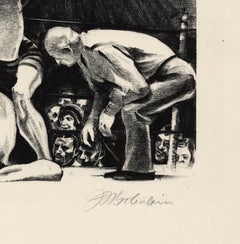
Joseph Golinkin created the lithograph entitled “Arm Scissors” circa 1938. This piece is signed in pencil, lower right, and titled and inscribed “3/50” at the lower left paper edge. The printed image size is 13.25 x 11.88 inches and the overall paper (sheet) size is 23 x 16 inches. Beautifully composed “Arm Scissors” also exudes the excitement of the moment through the spectator’s expressions and the crouched referee. JOSEPH WEBSTER GOLINKIN...

Category

1930s Naturalistic Joseph Webster Golinkin Art

Materials

Lithograph

Joseph Webster Golinkin art for sale on 1stDibs.

Find a wide variety of authentic Joseph Webster Golinkin art available for sale on 1stDibs. If you’re browsing the collection of art to introduce a pop of color in a neutral corner of your living room or bedroom, you can find work that includes elements of green and other colors. You can also browse by medium to find art by Joseph Webster Golinkin in lithograph, paint, watercolor and more. Not every interior allows for large Joseph Webster Golinkin art, so small editions measuring 14 inches across are available. Customers who are interested in this artist might also find the work of Charles De Wolf Brownell, Henri Gadbois, and Harry Rogers. Joseph Webster Golinkin art prices can differ depending upon medium, time period and other attributes. On 1stDibs, the price for these items starts at $750 and tops out at $11,250, while the average work can sell for $2,220.
Artists Similar to Joseph Webster Golinkin