By Olof Arborelius
Located in Stockholm, Stockholm
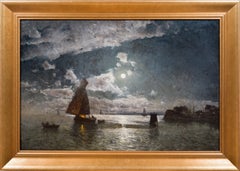
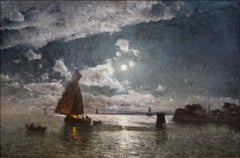
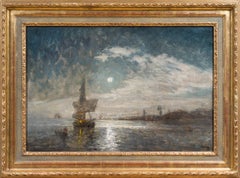
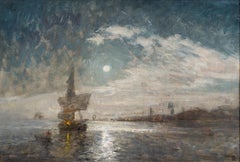
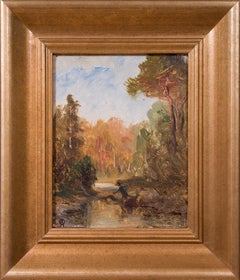
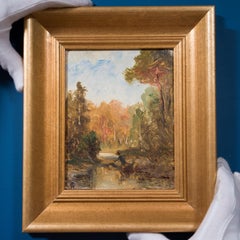
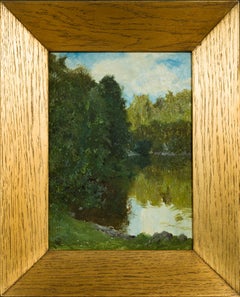
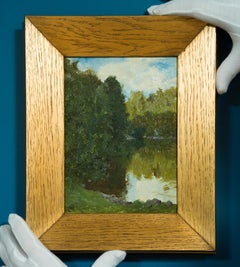
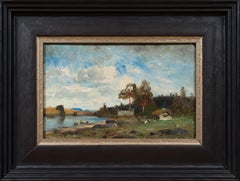
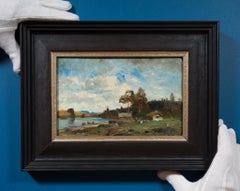
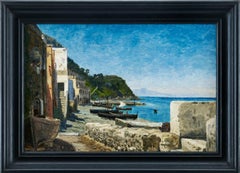
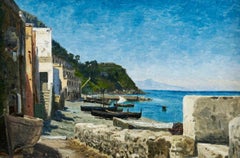
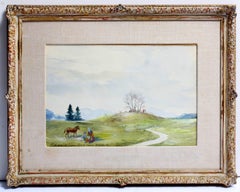
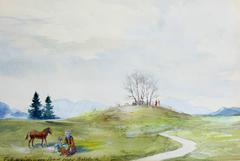
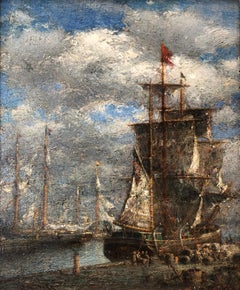
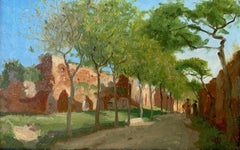
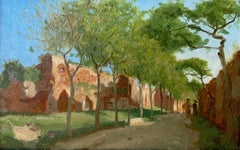
An oil study painted en plein air of a roman priest and a franciscan monk walking around among the old ruins of ancient Rome in the Palatine Hill near San Bonaventura al Palatino. Painted circa 1870-72 by Olof Arborelius (1842-1915). Signed with "OA". Oil on paper laid on cardboard.
Olof Per Ulrik Arborelius, was a Swedish folk life and landscape painter and professor at the Royal Art Academy in Stockholm 1902–1909. After seven years of studies at the Royal Art Academy, Arborelius went on a three-year study tour in Europe. When he returned to Sweden in 1872, he was appointed agré at the Art Academy. For a few years he worked as a senior teacher there and at the Royal Institute of Technology in Stockholm. In 1902 he was appointed professor at the Royal Academy of Arts.
Olof Arborelius was shaped by Swedish genre painting in the 1860s and was closely associated with the Düsseldorf School. He did join the opposition movement early on in the 1880s but was very little influenced by impressionist painting. In the choice of motifs, however, he adopted the free realism of his opponents. In later years, he developed increasingly brighter colors and a greater monumentality in the compositions.
Descendants of the artist have on several occasions donated material to the Royal Academy of Arts. This includes several sketchbooks from his youth. In one of Olof Arborelius's sketchbooks it was found in 1998 that the artist had put several stamps on a sheet. The stamps, 22 in number, all come from different European countries and were issued in the 1850s. They were probably put in place in 1858, forgotten and remained untouched for 140 years. This is probably the oldest stamp collection in the world that remains in its original condition.
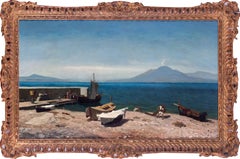
Olof Arborelius was in Italy in the fall of 1870 to January 1872. There he mainly executed oil sketches painted plein air which are characterized by their small format and dissolved style where light and atmosphere play a decisive role. A number of these were exhibited at the memorial exhibition organized by the Swedish Artists Association in 1910 (no. 13-19, 60-87), at the Swedish-French Art Gallery in Stockholm, "Exhibition. Olof Arborelius. Oil paintings. Carl Eldh and Kai Nielsen Sculpture", April 1931 and at the memorial exhibition at the National Museum 11 February-10 March 1943 (no. 30-67).
Viggo Loos, The breakthrough of outdoor painting in Swedish art 1860-85, 1935, p. 122 writes about these:
"Alfred Wahlberg's and Gustaf Rydberg's pictures form an overture to our plein air painting. Arborelius's Italian studies, with their coloristic sensitivity and their intensive study of air and light, can rightly be included in that overture. In them, the artist reached an artistic peak under French influence.”
In the catalog for the memorial exhibition of Arborelius at the National Museum in 1943, curator Folke Holmér wrote the following about Arborelius' oil studies from Italy:
´His sketches from the Mediterranean coast are among the most painterly in his early production and can easily measure up to the best that Swedish artists have achieved in Italy.'
Three of Arborelius' Italian oil studies are in the National Museum's collections; View from Rome towards the Arch of Septimus Severus...
Category
1870s Naturalistic Olof Arborelius Art