By Otto Bacher
Located in Fairlawn, OH
Otto Bacher (1856-1909)
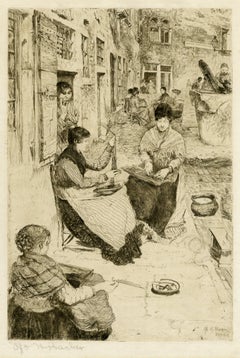
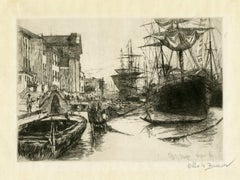
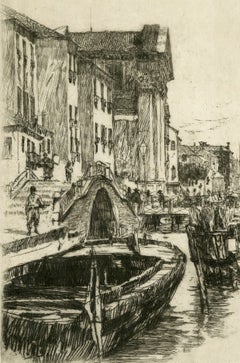
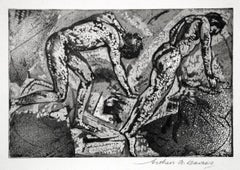
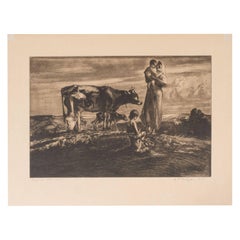
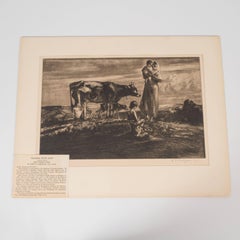
Perleria (Bead Stringers), Venice
Etching, 1881
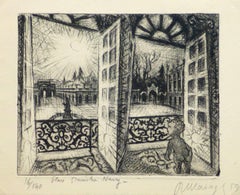
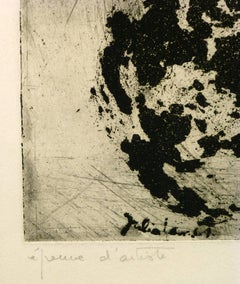
Signed in pencil lower left (see photo)
From: Etchings of Venice
Reference: Andrew Venice 1
Condition: Excellent
Image/Plate size: 13 x 8 7/8 inches
Sheet size: 14 1/2 x 10 1/16 inches
Comes with a very ncie original Kenneday Gallery frame
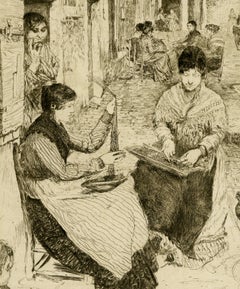
Perleria, also known as Bead Stringers, presents Venice through the working lives of its inhabitants. Women gather in an enclosed courtyard, absorbed in their tasks, while doorways and receding architectural spaces connect the foreground group with figures farther within. The composition’s intimate scale of observation shifts attention from the city’s celebrated monuments to the daily activities that sustained it. The Cleveland Museum of Art holds an impression under the title Etchings of Venice: Bead Stringers, identifying it as Andrew 7.
Bacher organizes the scene through the relationship between seated figures, worn masonry, and shadowed openings. Fine etched lines describe the women’s clothing and the surrounding architecture, while denser passages of hatching establish depth and enclosure. The workers’ concentrated poses give the composition a quiet rhythm: its interest rests in repeated gestures and shared occupation rather than dramatic incident. Bead stringing, a traditional Venetian women’s trade, provides both the subject and the organizing human activity of the image.
Born in Cleveland, Bacher developed his art through European study and close association with Frank Duveneck. In 1880 he traveled to Venice with the American artists known as “Duveneck’s boys,” entering the circle of James McNeill Whistler. Already an accomplished etcher, Bacher became Whistler’s collaborator as well as an attentive student of his methods. Whistler used Bacher’s printing press and inks during the summer of 1880, placing the younger artist directly within the practical production of the Venetian etchings. Bacher later recalled their association in With Whistler in Venice (1908).
Perleria belongs to this formative Venetian context. Its attention to an ordinary working environment accords with the interest in overlooked corners and everyday subjects shared by artists of the etching revival. Yet the substantial figures and closely articulated setting give Bacher’s scene its own character. The print combines architectural observation with a sustained interest in people, recording Venice as an inhabited and productive city.
The composition is represented in the Cleveland Museum of Art, where the impression entered as a gift of Charles W. Bingham in 1920, and at the Indianapolis Museum of Art at Newfields, which catalogs it as Perleria. These institutional holdings provide useful reference impressions for the work.
Otto H. Bacher (1856-1909)
Otto Henry Bacher was born in Cleveland, Ohio, to a family of German descent. He first studied art at the age of sixteen with local genre trompe l'oeil still-life artist, DeScott Evans. Although he studied with Evans for less than one year, Bacher's early work, comprised mainly of still lifes, betrays Evans's influence. After a short period in Philadelphia, where he studied at the Pennsylvania Academy of the Fine Arts, Bacher returned to Cleveland and met Willis Seaver Adams...
Category
1880s American Impressionist Otto Bacher Prints and Multiples