George Biddle Prints and Multiples

American, 1885-1973

Born to a prominent family in Philadelphia on January 24, 1885, George Biddle put his interest in art aside to accommodate his family's wishes and study law. He graduated from Harvard University in 1908 and Harvard Law in 1911, becoming a member of the Philadelphia bar. However, by the end of that same year, Biddle abandoned law and began studying art at the Académie Julian in Paris. Biddle continued his studies at the Pennsylvania Academy of Fine Arts during 1912 and 1913. He returned to Europe in 1914, studying in Munich and then in Madrid, where he studied printmaking. Biddle also spent the summers of 1915 and 1916 painting Impressionist works in France before he enlisted in the army in 1917. Following World War I, Biddle experimented in sculpture and graphics in Tahiti for two years and then in France between 1924–26. In 1927, Biddle returned to the United States settling in Croton-on-Hudson, New York. The following year, he traveled through Mexico on a sketching trip with Mexican muralist, Diego Rivera. During the Great Depression, Biddle actively sought government funding for the arts. His correspondence with President Franklin D. Roosevelt, who was a former classmate at Groton Preparatory School and Harvard, resulted in the establishment of the Federal Arts Project of the Works Progress Administration. The Depression fueled Biddle's desire to create socially conscious art. He established himself as a Social Realist through powerful murals depicting poverty. The Tenement, which he created in 1935 for the Department of Justice Building in Washington, D.C., was his first federally commissioned mural. The project led to controversy as people deemed his depiction of poverty to be inartistic. In addition to his artwork, Biddle authored several art books including An Artist at War and An American Artist's Story and he contributed regularly to national art magazines. In 1937, Biddle wrote the introduction for Boardman Robinson: Ninety-Three Drawings which was published by the Colorado Springs Fine Arts Center, where he taught in 1936 and 1937. In addition to teaching in Colorado, Biddle later taught at the Otis College of Art and Design in Los Angeles, the American Academy in Rome and Saugatuck, Michigan. He served as a chairman of the U.S. War Artists Committee during World War II and in 1950, President Truman appointed him to the Fine Arts Commission for which he served a 14-year term. Biddle died on November 6, 1973, in Croton-on-Hudson.

to
3
Overall Width
to
Overall Height
to
6
1,284
982
912
877
5
4
1
2
1
4
4
2
2
1
1
1
1
1
1
1
5
5
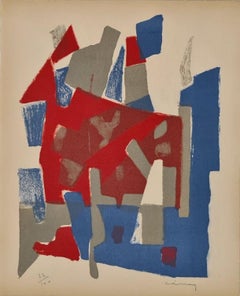
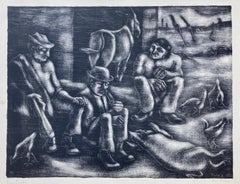
Artist: George Biddle
original lithograph

original lithograph

By George Biddle

Located in Henderson, NV

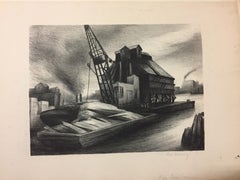
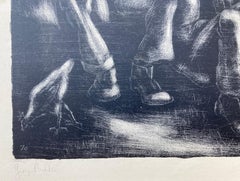
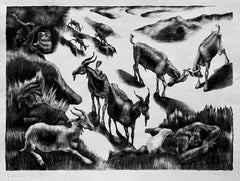
Medium: original lithograph. This lithograph is from the rare 1950 "Improvisations" portfolio, published by the Artists Equity Association of New York on the occasion of the 1950 Spr...

Category

1950s George Biddle Prints and Multiples

Materials

Lithograph

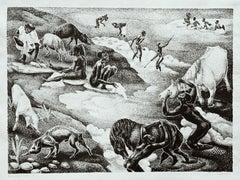
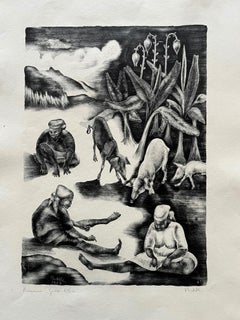
Goat Herder's Wife

Goat Herder's Wife

By George Biddle

Located in New York, NY

George Biddle (1885-1973), Goat Herder’s Wife, 1928, lithograph, signed in pencil lower right and titled and numbered (64/100) in pencil lower left margin [with the inscription ”Bidd...

Category

1920s Realist George Biddle Prints and Multiples

Materials

Lithograph

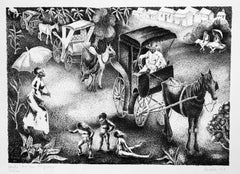
Hombre! Que Sin Vergeunza!

Hombre! Que Sin Vergeunza!

By George Biddle

Located in New York, NY

George Biddle (1885-1973), Hombre! Que Sin Vergeunza!, 1928, lithograph, signed and dated in pencil lower right, titled and numbered lower left [also signed in plate lower left ”Biddle/1928/44]. References: Pennigar 78, Trotter 44. Edition 100. In excellent condition (never framed, without light or time staining), with wide margins, the full sheet, 9 3/4 x 13 3/4, the sheet 15 1/2 x 20 1/2 inches. Printed by George C. Miller. On cream wove paper with the FRANCE watermark. Archival mounting (mylar unattached mounting between acid-free board). A fine, fresh impression, in pristine condition. According to Pennigar the title translates roughly to “Buddy! Aren’t you ashamed of yourself!” The title refers to the composition: the well-groomed man with his foot up in the carriage passes a group of naked little boys...

Category

1920s American Realist George Biddle Prints and Multiples

Materials

Lithograph

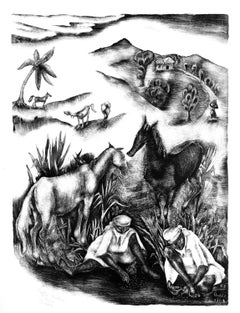
Banana Grove

Banana Grove

By George Biddle

Located in New York, NY

George Biddle (1885-1973), Banana Grove, lithograph, 1928. Signed, titled and numbered in pencil [also annotated in the plate “Biddle/1928, lower right “47). References: Pennigar 81, Trotter 47. In excellent condition, the full sheet, on cream wove BFK RIVES paper, with their (partial) watermark. 12 1/2 x 9, the sheet 20 x 16, archival mounting (non attached mylar hinging between acid free board, glassine cover). A fine fresh rich impression in pristine condition. After Groton, Harvard College...

Category

1920s Realist George Biddle Prints and Multiples

Materials

Lithograph

Coffee Huskers

Coffee Huskers

By George Biddle

Located in New York, NY

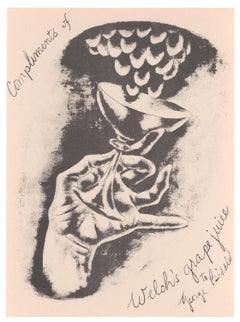
George Biddle (1885-1973), Coffee Huskers, 1928, lithograph, signed, titled and numbered [also inscribed ’43/Biddle/1928 in the plate]. Reference: Pennigar 77, Trotter 43. From the edition of 100, on Rives cream wove paper, with the Rives watermark. In excellent condition, probably never framed or matted, the full sheet, 13 1/4 x 9 3/4, the sheet 16 x 11 1/2 inches, archival mounting (mylar non-attached hinging between acid free boards glassine cover). A fine black impression. Biddle wrote of this lithograph, in 1943: “After scraping the tusche away…I worked back with a pensil (sic) and again with diamond. This all adds to the richness of texture and color.” This work produces a very sophisticated lithographic look, akin in some ways to drypoint work in etching. After Groton, Harvard College and Harvard Law (and several breakdowns) Biddle concluded that a conventional career in law was not for him; he decided on art, went to Paris, worked with Mary Cassatt and familiarized himself with modernist currents in art (as well as more traditional European art). After serving in WWI, and the dissolution of his marriage, he became interested in working outside of the European tradition (although his travels continued to include Europe, and he spent a period working under the influence of Jules Pascin in Paris in the mid-‘20’s). Coffee Huskers, like many of the Mexican and Haitian prints...

Category

1920s American Realist George Biddle Prints and Multiples
Materials

Lithograph

Related Items
The Golden Gate
The Golden Gate

The Golden Gate

By Adolf Arthur Dehn

Located in Fairlawn, OH

The Golden Gate Lithograph on wove paper watermarked GC, 1940 Signed in pencil by the artist (see photo) Publisher: Associated American Artists Edition: 189, unnumbered The image depicts The Golden Gate Bridge which connects San Francisco and Marin County, California References And Exhibitions: Illustrated: Adams, The Sensuous Life of Adolf Dehn, Fig. 13.17, page 324 Reference: L & O 325 AAA Index 391 Adolf Dehn, American Watercolorist and Printmaker, 1895-1968 Adolf Dehn was an artist who achieved extraordinary artistic heights, but in a very particular artistic sphere—not so much in oil painting as in watercolor and lithography. Long recognized as a master by serious print collectors, he is gradually gaining recognition as a notable and influential figure in the overall history of American art. In the 19th century, with the invention of the rotary press, which made possible enormous print runs, and the development of the popular, mass-market magazines, newspaper and magazine illustration developed into an artistic realm of its own, often surprisingly divorced from the world of museums and art exhibitions, and today remains surprisingly overlooked by most art historians. Dehn in many regards was an outgrowth of this world, although in an unusual way, since as a young man he produced most of his illustrative work not for popular magazines, such as The Saturday Evening Post, but rather for radical journals, such as The Masses or The Liberator, or artistic “little magazines” such as The Dial. This background established the foundation of his outlook, and led later to his unique and distinctive contribution to American graphic art. If there’s a distinctive quality to his work, it was his skill in introducing unusual tonal and textural effects into his work, particularly in printmaking but also in watercolor. Jackson Pollock seems to have been one of many notable artists who were influenced by his techniques. Early Years, 1895-1922 For an artist largely remembered for scenes of Vienna and Paris, Adolf Dehn’s background was a surprising one. Born in Waterville, Minnesota, on November 22, 1895, Dehn was the descendent of farmers who had emigrated from Germany and homesteaded in the region, initially in a one-room log cabin with a dirt floor. Adolf’s father, Arthur Clark Dehn, was a hunter and trapper who took pride that he had no boss but himself, and who had little use for art. Indeed, during Adolf’s boyhood the walls of his bedroom and the space under his bed were filled with the pelts of mink, muskrats and skunks that his father had killed, skinned and stretched on drying boards. It was Adolf’s mother, Emilie Haas Dehn, a faithful member of the German Lutheran Evangelical Church, who encouraged his interest in art, which became apparent early in childhood. Both parents were ardent socialists, and supporters of Eugene Debs. In many ways Dehn’s later artistic achievement was clearly a reaction against the grinding rural poverty of his childhood. After graduating from high school in 1914 at the age of 19—an age not unusual in farming communities at the time, where school attendance was often irregular—Dehn attended the Minneapolis School of Art from 1914 to 1917, whose character followed strongly reflected that of its director, Munich-trained Robert Kohler, an artistic conservative but a social radical. There Dehn joined a group of students who went on to nationally significant careers, including Wanda Gag (later author of best-selling children’s books); John Flanagan (a sculptor notable for his use of direct carving) Harry Gottlieb (a notable social realist and member of the Woodstock Art Colony), Elizabeth Olds (a printmaker and administrator for the WPA), Arnold Blanch (landscape, still-life and figure painter, and member of the Woodstock group), Lucille Lunquist, later Lucille Blanch (also a gifted painter and founder of the Woodstock art colony), and Johan Egilrud (who stayed in Minneapolis and became a journalist and poet). Adolf became particularly close to Wanda Gag (1893-1946), with whom he established an intense but platonic relationship. Two years older than he, Gag was the daughter of a Bohemian artist and decorator, Anton Gag, who had died in 1908. After her husband died, Wanda’s mother, Lizzi Gag, became a helpless invalid, so Wanda was entrusted with the task of raising and financially supporting her six younger siblings. This endowed her with toughness and an independent streak, but nonetheless, when she met Dehn, Wanda was Victorian and conventional in her artistic taste and social values. Dehn was more socially radical, and introduced her to radical ideas about politics and free love, as well as to socialist publications such as The Masses and The Appeal to Reason. Never very interested in oil painting, in Minneapolis Dehn focused on caricature and illustration--often of a humorous or politically radical character. In 1917 both Dehn and Wanda won scholarships to attend the Art Students League, and consequently, in the fall of that year both moved to New York. Dehn’s art education, however, ended in the summer of 1918, shortly after the United States entered World War I, when he was drafted to serve in the U. S. Army. Unwilling to fight, he applied for status as a conscientious objector, but was first imprisoned, then segregated in semi-imprisonment with other Pacifists, until the war ended. The abuse he suffered at this time may well explain his later withdrawal from taking political stands or making art of an overtly political nature. After his release from the army, Dehn returned to New York where he fell under the spell of the radical cartoonist Boardman Robinson and produced his first lithographs. He also finally consummated his sexual relationship with Wanda Gag. The Years in Europe: 1922-1929 In September of 1921, however, he abruptly departed for Europe, arriving in Paris and then moving on to Vienna. There in the winter of 1922 he fell in love with a Russian dancer, Mura Zipperovitch, ending his seven-year relationship with Wanda Gag. He and Mura were married in 1926. It was also in Vienna that he produced his first notable artistic work. Influenced by European artists such as Jules Pascin and Georg Grosz, Dehn began producing drawings of people in cafes, streets, and parks, which while mostly executed in his studio, were based on spontaneous life studies and have an expressive, sometimes almost childishly wandering quality of line. The mixture of sophistication and naiveté in these drawings was new to American audiences, as was the raciness of their subject matter, which often featured pleasure-seekers, prostitutes or scenes of sexual dalliance, presented with a strong element of caricature. Some of these drawings contain an element of social criticism, reminiscent of that found in the work of George Grosz, although Dehn’s work tended to focus on humorous commentary rather than savagely attacking his subjects or making a partisan political statement. Many Americans, including some who had originally been supporters of Dehn such as Boardman Robinson, were shocked by these European drawings, although George Grocz (who became a friend of the artist in this period) admired them, and recognized that Dehn could also bring a new vision to America subject matter. As he told Dehn: “You will do things in America which haven’t been done, which need to be done, which only you can do—as far at least as I know America.” A key factor in Dehn’s artistic evolution at this time was his association with Scofield Thayer...

Category

1940s American Realist George Biddle Prints and Multiples
Materials

Lithograph

Lithograph of American rural life timeless with architecture monochrome

Lithograph of American rural life timeless with architecture monochrome

By Thomas Hart Benton

Located in London, GB

A man raises his hand to his chin, his neck tilted and face turned to look at a dilapidated farmhouse, barely held together by planks of wood and exposed to the elements. Behind him ...

Category

1930s American Modern George Biddle Prints and Multiples

Materials

Lithograph

The Creation - Gimel Dalet

The Creation - Gimel Dalet

Located in Jerusalem, IL

Ten original lithographs, printed by Mourlot Paris in the 1970's. Issued 150 copies numbered and signed. 102/150. Creation was inspired by the Kabalistic conception of the Hebrew Al...

Category

1970s Symbolist George Biddle Prints and Multiples
Materials

Lithograph

Tulips in a Vase
Tulips in a Vase

Gary BukovnikTulips in a Vase, 1995

$893

H 35 in W 29.5 in D 0.01 in

Tulips in a Vase

By Gary Bukovnik

Located in San Francisco, CA

This artwork "Tulips in a Vase" 1995 is an original color lithograph on Wove paper by noted American artist Gary Bukovnik, born 1947. It is hand signed, dated and numbered 169/200 in...

Category

Mid-20th Century American Realist George Biddle Prints and Multiples
Materials

Lithograph

Halfway to Lamey, American Western Art Lithograph by Noel Daggett

Halfway to Lamey, American Western Art Lithograph by Noel Daggett

By Noel Daggett

Located in Long Island City, NY

Noel Daggett, American (1925 - 2005) - Halfway to Lamey, Year: circa 1979, Medium: Lithograph, signed and numbered in pencil, Edition: 300, AP 40, Image Size: 18 x 22 inches, Siz...

Category

1970s American Realist George Biddle Prints and Multiples
Materials

Lithograph

Lithograph of American rural life timeless and romantic

Lithograph of American rural life timeless and romantic

By Thomas Hart Benton

Located in London, GB

A fine impression of this very popular image with full margins (smaller on top and bottom) published by Associated American Artists.

Category

1930s American Modern George Biddle Prints and Multiples
Materials

Lithograph

Lithograph of American rural life timeless and romantic monochrome

Lithograph of American rural life timeless and romantic monochrome

By Thomas Hart Benton

Located in London, GB

In this sentimental work from 1939, Benton expresses his admiration for the rural lifestyle of the Midwest. He highlights the connection between man and the land by depicting two fig...

Category

1930s American Modern George Biddle Prints and Multiples
Materials

Lithograph

Los Angeles Crashing Waves, Handmade Cyanotype on Paper, Nautical Seascape, Blue

Los Angeles Crashing Waves, Handmade Cyanotype on Paper, Nautical Seascape, Blue

By Kind of Cyan

Located in Barcelona, ES

This series of cyanotype triptychs showcases the beauty of nature scenes, including stunning beaches and oceans, as well as the intricate textures of water, forests, and skies. These...

Category

2010s American Realist George Biddle Prints and Multiples
Materials

Lithograph, Paper

Lithograph of American rural life timeless figures monochrome

Lithograph of American rural life timeless figures monochrome

By Thomas Hart Benton

Located in London, GB

In this charming regionalist lithograph, Benton captures a classic Midwestern American scene: two men talking, drinking, and smoking together in a bar. Titled 'Discussion', the artwo...

Category

1930s American Modern George Biddle Prints and Multiples
Materials

Lithograph

untitled
untitled

Richard Huntuntitled, 2022

$3,000

H 36 in W 25 in

untitled

By Richard Hunt

Located in New York, NY

untitled lithograph drawn in 2022 and published in an edition of 43. Measuring 36 by 25 inches, the work is designated number 9 of 43 lower left and signed in pencil "R Hunt...

Category

2010s Abstract George Biddle Prints and Multiples
Materials

Lithograph

HEARTLAND Hand Drawn Lithograph, Winter Landscape Stone Farmhouse Bucks County

HEARTLAND Hand Drawn Lithograph, Winter Landscape Stone Farmhouse Bucks County

By Peter Sculthorpe

Located in Union City, NJ

HEARTLAND is an original hand drawn, limited edition lithograph by Peter Sculthorpe (b.1948 Ontario, Canada) printed using hand lithography techniques on archival Arches paper, 100% ...

Category

1980s Realist George Biddle Prints and Multiples
Materials

Lithograph

Previously Available Items
River Life, Haiti

George BiddleRiver Life, Haiti, 1928

Sold

H 12.25 in W 16.6 in D 1 in

River Life, Haiti

By George Biddle

Located in New York, NY

George Biddle (1885-1973), River Life, Haiti, 1928, lithograph, signed and dated in pencil lower right margin, titled and numbered lower left margin. Reference: Pennigar 84, Trotter ...

Category

1920s Realist George Biddle Prints and Multiples
Materials

Lithograph

POOR WHITES
POOR WHITES

George BiddlePOOR WHITES, 1932

Sold

H 10 in W 14.25 in

POOR WHITES

By George Biddle

Located in Santa Monica, CA

GEORGE BIDDLE (1885 - 1973) POOR WHITES, 1932 (Pennigar 104) Lithograph, signed and titled in pencil edition. 40. Image 11 x 14 1/4 inches, sheet 14 x 19 5/8 inches.

Category

1930s American Modern George Biddle Prints and Multiples
Materials

Lithograph

Polley Pulque! (Mexican beer like beverage that is cactus based from WPA era)

Polley Pulque! (Mexican beer like beverage that is cactus based from WPA era)

By George Biddle

Located in New Orleans, LA

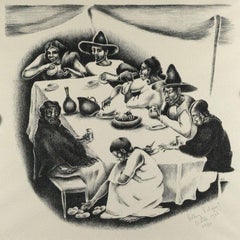
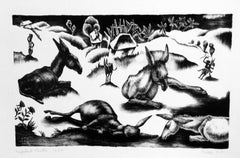
An original lithograph signed, titled and numbered in pencil. This impression is #28 out of an edition of 50. Mexicans have been brewing pulque from the juice of cactus-like maguey plants for centuries, but the viscous, beer-like beverage fell out of favor starting in the 1970s as pulque got a bad reputation as a peasant's drink. The nutrient-rich drink is making a comeback among a new generation of Mexicans. Born on January 24, 1885 in Philadelphia, George Biddle received his B.A. from Harvard where he then completed his doctorate in law. He received art instruction at the Pennsylvania Academy of the Fine Arts, at the Académie Julian in Paris and then in Munich. During the first world war, Biddle lived in Giverny (1915-16) where he painted outdoor nudes...

Category

1920s American Modern George Biddle Prints and Multiples
Materials

Lithograph

The Expectant Thistles

The Expectant Thistles

By George Biddle

Located in New York, NY

George Biddle (1885-1973), The Expectant Thistles, 1928, lithograph, signed and dated in pencil lower right, titled and numbered in pencil lower left [also inscribed in the plate low...

Category

1920s American Realist George Biddle Prints and Multiples

Materials

Lithograph

George Biddle prints and multiples for sale on 1stDibs.
Find a wide variety of authentic George Biddle prints and multiples available for sale on 1stDibs. You can also browse by medium to find art by George Biddle in lithograph and more. Much of the original work by this artist or collective was created during the 20th century and is mostly associated with the modern style. Not every interior allows for large George Biddle prints and multiples, so small editions measuring 9 inches across are available. Customers who are interested in this artist might also find the work of John Edward Costigan, Jack Beal, and Peter Moran. George Biddle prints and multiples prices can differ depending upon medium, time period and other attributes. On 1stDibs, the price for these items starts at $50 and tops out at $575, while the average work can sell for $300.