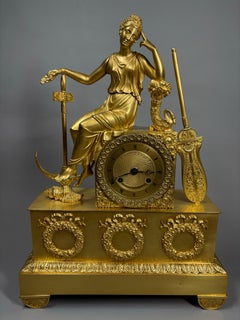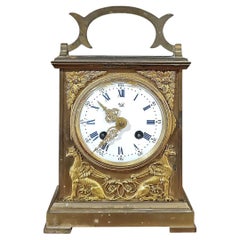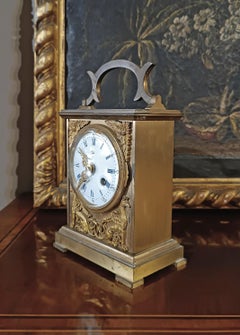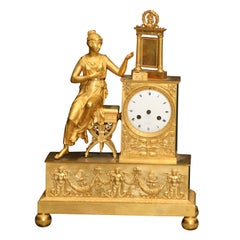
Pierre-Basile Lepaute Clocks

to
1
1
1
1
1
1
1
1
Height
to
Width
to
1
1
1
1
125
72
45
41
Creator: Pierre-Basile Lepaute
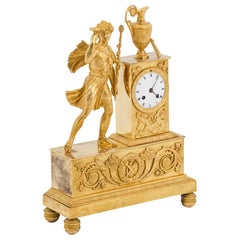
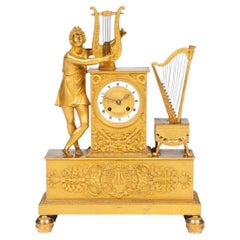
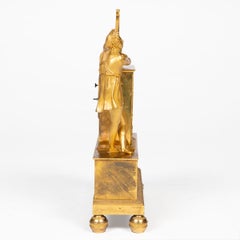
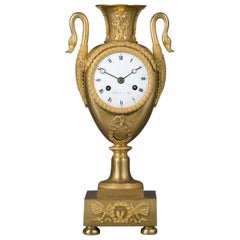
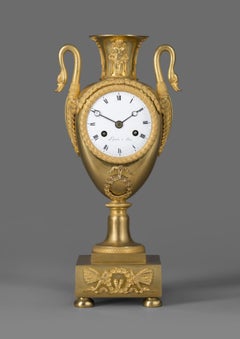
Empire Clock in the Form of a Classical Urn, by Maison Lepautre, circa 1825

Empire Clock in the Form of a Classical Urn, by Maison Lepautre, circa 1825

By Pierre-Basile Lepaute

Located in Brighton, West Sussex

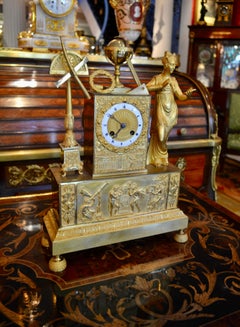
A gilt bronze Empire clock in the form of a classical urn, by Maison Lepautre. French, circa 1825. The dial signed 'Lepaute a Paris'. The clock has an ornate cast bezel with a 3-inch porcelain dial with Roman numerals and Breguet style hands. The twin train eight-day movement with outside count wheel striking on a bell and silk thread suspension. This elegant Empire style clock has a gilt bronze case in the form of a classical urn with swan neck handles and a winged cherub to the neck. The circular pedestal base is raised on a footed stepped square plinth. The Lepaute family were the premier French clockmakers of their day. Their significance lies in their contribution to the clock making industry which had hitherto come under the trade of locksmiths. The family held the brevet Horlogers du Roi. Jean-André Lepaute (1720–1789) arrived in Paris at an early age and in 1740 founded the family business. A skilled artist and mechanic, he quickly gained an excellent reputation. He was received as maître by the clockmakers guild in 1759, was granted royal lodgings from the king in The Luxembourg Palace, and was entrusted with the construction of the majority of the great public clocks of Paris. He executed, amongst others, those in The Luxembourg Palace, the Jardin des Plantes, the Château de Bellevue and the Château des Ternes. His clock at Paris’s École Militaire still works today. Three editions of his Traité d’Horlogerie were published in Paris in 1755, 1760 and 1767. A small volume, Description de Plusieurs Ouvrages d’Horlogerie appeared in 1764. Jean-André’s wife, Nicole-Reine Etable de la Brière (1723-1788), was a highly esteemed mathematician and astronomer. Her passion for science lent itself to Lepaute’s work and she played an active role in the scientific and mathematical aspects of the clock making. Jean-André’s younger brother Jean-Baptiste Lepaute (1727-1802) joined him in Paris in 1747 and immediately started working for the family business. He was received as maître in 1776 and was known for the clocks he constructed for the Paris Hôtel de Ville (1780), destroyed in a fire of 1871, and for the Hôtel des Invalides (1784). Jean-Baptiste took over the workshop when Jean-André retired in 1775. After Jean-Baptiste’s death in 1802, the firm was taken over by his nephew Pierre-Basil Lepaute (1750-1843) where he was duly joined by his own nephew Jean-Joseph (1768-1846) and son Pierre-Michel (1785-1849). By 1816, Pierre-Michel Lepaute was in charge of the business. His masterpieces include the astronomical clock in Paris’s Bureau...

Category

Early 19th Century French Empire Antique Pierre-Basile Lepaute Clocks

Materials

Bronze

Related Items
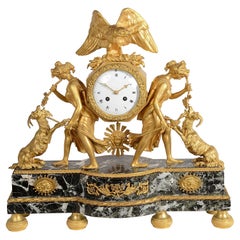
French Empire Style Mantel Clock, circa 1820

French Empire Style Mantel Clock, circa 1820

$16,565

H 19.69 in W 20.08 in D 6.3 in

French Empire Style Mantel Clock, circa 1820

Located in Brighton, Sussex

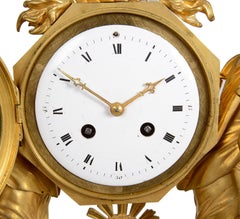
A very impressive and stylish early 19th Century gilded ormolu and green marble mantle clock, having two classical maidens either side feeding Rams, an Eagle above the circular white...

Category

Early 19th Century French Empire Antique Pierre-Basile Lepaute Clocks

Materials

Marble, Ormolu

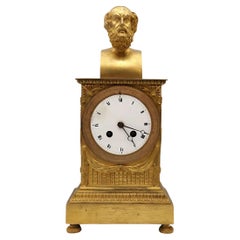
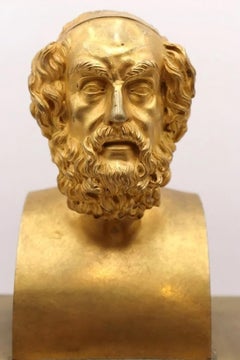
A Homer bust ormolu empire clock in the manner of Thomire

A Homer bust ormolu empire clock in the manner of Thomire

$2,100Sale Price|40% Off

H 15 in W 7 in D 5 in

A Homer bust ormolu empire clock in the manner of Thomire

By Pierre-Philippe Thomire

Located in Harrington Park, NJ

AN EMPIRE ORMOLU BUST OF HOMER After the Antique The bearded bust of Homer on a rectangular clock decorate with lyres and gryphon heads on the side

Category

Early 19th Century French Empire Antique Pierre-Basile Lepaute Clocks

Materials

Bronze, Ormolu

Gilt Bronze Mantle Clock by Claude Galle, French Empire, Circa 1805

Gilt Bronze Mantle Clock by Claude Galle, French Empire, Circa 1805

$6,620Sale Price|20% Off

H 20.28 in W 12.8 in D 5.91 in

Gilt Bronze Mantle Clock by Claude Galle, French Empire, Circa 1805

By Claude Galle

Located in Lisbon, PT

This rare early 19th-century French Empire style gilt bronze mantle clock was created by the renowned Claude Gallé for the 1807 Exhibition. Gallé is considered one of the finest bro...

Category

19th Century French Empire Antique Pierre-Basile Lepaute Clocks

Materials

Marble, Metal, Bronze, Enamel, Ormolu

Clock in Gilt Bronze, Empire Period

Clock in Gilt Bronze, Empire Period

$3,862

H 18.9 in W 13.39 in D 4.73 in

Clock in Gilt Bronze, Empire Period

Located in Saint-Ouen, FR

Clock in chiselled and gilt bronze composed by a rectangular base on which stand the dial-plate and a statuette of Bacchus. Round dial-plate with Roman numbers off-center on the righ...

Category

19th Century European Empire Antique Pierre-Basile Lepaute Clocks

Materials

Bronze

French Empire Clock Depicting Apollo God of Music and the Arts

French Empire Clock Depicting Apollo God of Music and the Arts

Located in Vancouver, British Columbia

A gilt bronze and griotte marble French Empire clock depicting Apollo Greek God of Music Art Literature and Sciences. The clock shows a a gilt bronze winged figure of Apollo leaning against a griotte marble altar pedestal decorated with gilt bronze garlands. At the center of the pedestal is the clock’s dial and movement. Sitting on top of the pedestal is a standing harp, a mallet and a scroll. The whole is supported by a griotte marble base with a gilt bronze frieze showing a number of frolicking and dancing cupids playing music, drinking wine waving laurel wreaths, carrying a standard and even crowning a bust of Athena. The base sits on two owl feet...

Category

Early 19th Century French Empire Antique Pierre-Basile Lepaute Clocks

Materials

Griotte Marble, Bronze

French Mantel Clock of Empire Period of "Borne" Form

French Mantel Clock of Empire Period of "Borne" Form

Located in London, GB

Attractive french Empire clock in patinated bronze and ormolu of milestone or "borne" form. Having very fine applied ormolu mounts to the front and side of the case with also a fine ...

Category

1810s French Antique Pierre-Basile Lepaute Clocks

Materials

Bronze, Ormolu

French Empire Gilt Bronze Allegorical Clock of the Astronomical Sciences

French Empire Gilt Bronze Allegorical Clock of the Astronomical Sciences

Located in Vancouver, British Columbia

A fine example of a period French Empire mantle clock in finely chased and gilded bronze made in France in the first quarter of the 19thC. One of the Greek muses with a star atop h...

Category

Early 19th Century French Empire Antique Pierre-Basile Lepaute Clocks

Materials

Bronze

A French Empire Clock of the Roman Goddess Aurora Announcing a New Day

A French Empire Clock of the Roman Goddess Aurora Announcing a New Day

$5,200Sale Price|20% Off

H 17.5 in W 15.5 in D 5.5 in

A French Empire Clock of the Roman Goddess Aurora Announcing a New Day

Located in Vancouver, British Columbia

A period French Empire allegorical mantel clock with a case of finely chased and gilt bronze. Aurora stands to the left of the circular clock plinth draping a starry cloak over the g...

Category

Early 19th Century French Empire Antique Pierre-Basile Lepaute Clocks

Materials

Bronze

A French Gilt bronze Charles X mantel clock, circa 1825

A French Gilt bronze Charles X mantel clock, circa 1825

Located in Sleepy Hollow, NY

A French Charles X period gilt bronze figural mantel clock circa 1825. Saint-Nicolas-d'Aliermont and Paris, c. 1825. The sculptural group represents an allegory of navigation or Hop...

Category

1820s French Charles X Antique Pierre-Basile Lepaute Clocks

Materials

Bronze, Ormolu

French Empire Clock
French Empire Clock

French Empire Clock

$5,150

H 17.5 in W 13 in D 5 in

French Empire Clock

Located in Hudson, NY

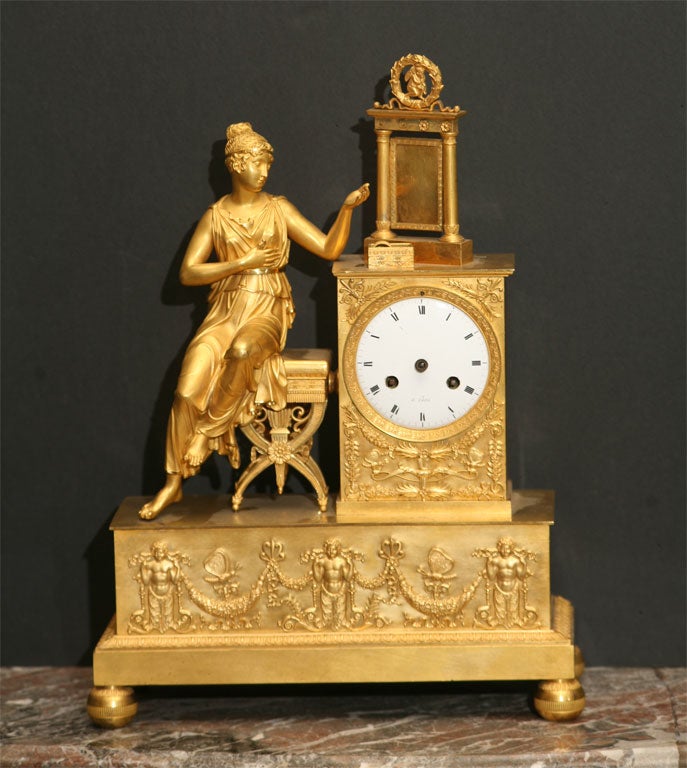
A very finely cast gilt bronze clock depicting Psyche at her toilet. The reflective mirror of polished bronze and that each element is cast separately then screwed on is an excellent...

Category

19th Century French Empire Antique Pierre-Basile Lepaute Clocks

Materials

Ormolu

The Astronomy Lesson French Empire Mantel Clock

The Astronomy Lesson French Empire Mantel Clock

$34,500

H 16 in W 15.44 in D 5 in

The Astronomy Lesson French Empire Mantel Clock

Located in New Orleans, LA

This magnificent French Empire ormolu mantel clock features the iconic Neoclassical genre scene often referred to as "The Astronomy Lesson." A popular motif during this period, Emper...

Category

19th Century French Empire Antique Pierre-Basile Lepaute Clocks

Materials

Marble, Enamel, Ormolu

Pierre-basile Lepaute clocks for sale on 1stDibs.

Pierre-Basile Lepaute clocks are available for sale on 1stDibs. These distinctive items are frequently made of metal and are designed with extraordinary care. There are many options to choose from in our collection of Pierre-Basile Lepaute clocks, although gold editions of this piece are particularly popular. Many of the original clocks by Pierre-Basile Lepaute were created in the Empire style in france during the 19th century. If you’re looking for additional options, many customers also consider clocks by and Jean-Simon Deverberie. Prices for Pierre-Basile Lepaute clocks can differ depending upon size, time period and other attributes — on 1stDibs, these items begin at $5,301 and can go as high as $5,301, while a piece like these, on average, fetch $5,301.