Raymond Jonson Art

American, 1891-1992
Raymond Jonson (1891-1982) is best known as one of the founders of the Transcendental Painters Group in Santa Fe, where he settled in 1924 and painted works that were pure abstraction. Before this time, he was in Chicago for fourteen years and there had many formative experiences that led to his later career. His mentor in Chicago was modernist B.J.O. Nordfeldt, and he was much affected by the Armory Show Exhibition of 1913 when it traveled to Chicago.
to
2
Overall Width
to
Overall Height
to
2
1
1
2
1
1
1
1
2
1
1
1
1
2
11,047
2,850
2,494
1,430
2
2
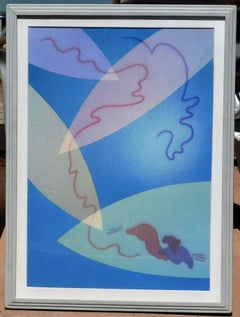
Artist: Raymond Jonson
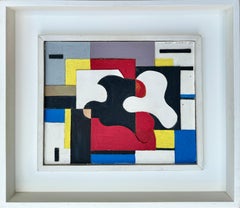
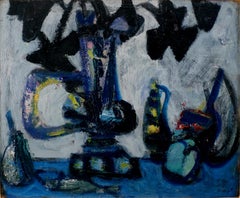
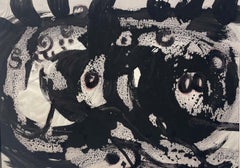
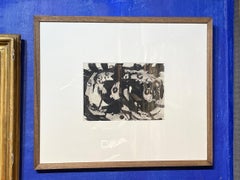
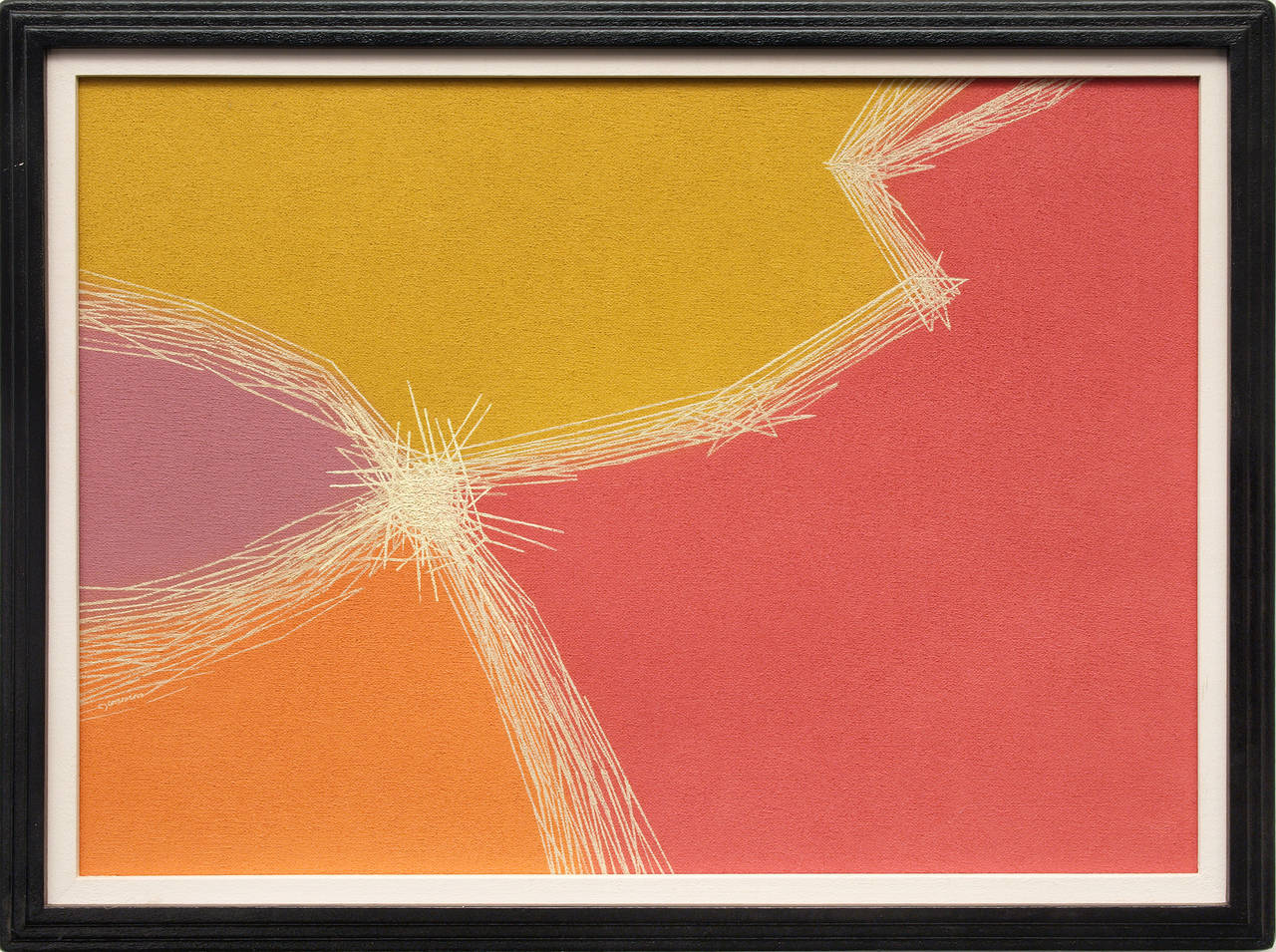
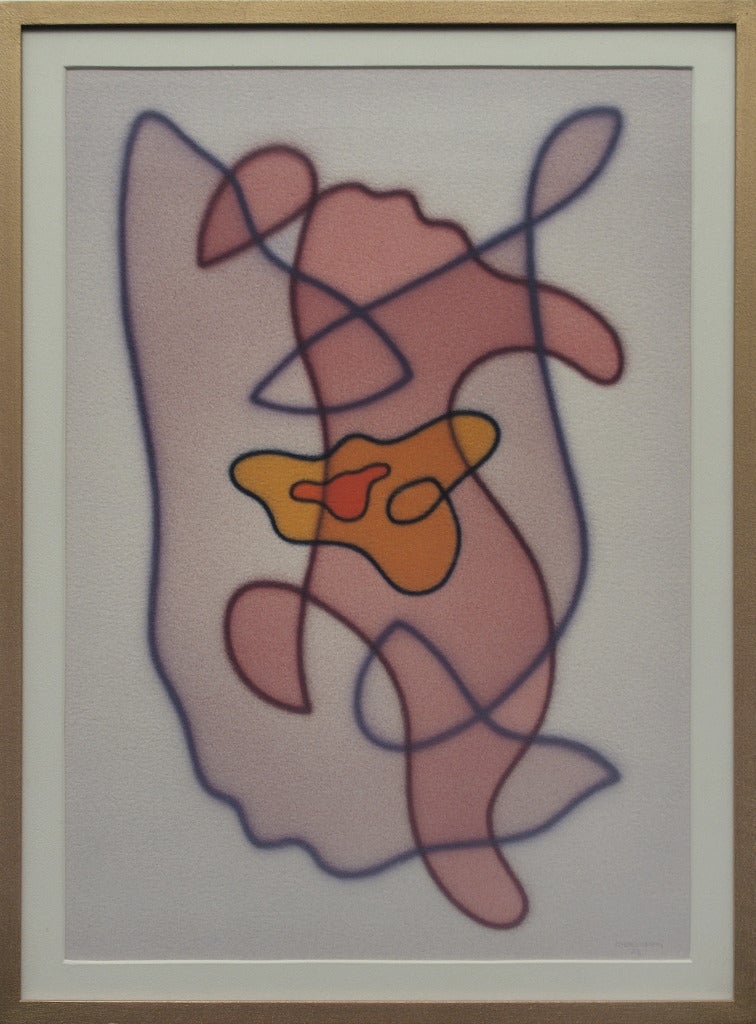
Raymond Jonson Abstract Watercolor, 1941 - Casein Tempera No. 1

Raymond Jonson Abstract Watercolor, 1941 - Casein Tempera No. 1

By Raymond Jonson

Located in Phoenix, AZ

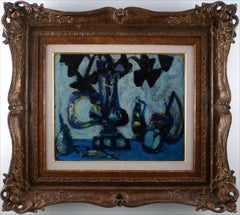
Great abstract work by Transcendental painter Raymond Jonson (1891-1982) Titled: “Casein Tempera No. 1”. Medium: Tempera. Dated: 1941. Image measures: 30" H x 22" W. Frame measures: ...

Category

Mid-20th Century Abstract Raymond Jonson Art

Materials

Tempera

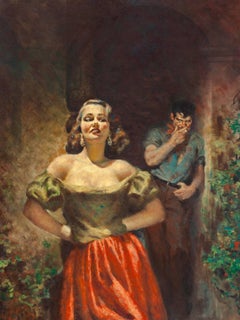
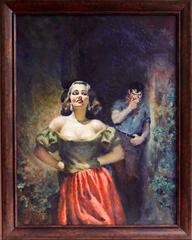
The Naked Rich, Paperback Cover

The Naked Rich, Paperback Cover

By Raymond Jonson

Located in Fort Washington, PA

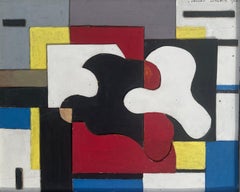
Date: 1953 Medium: Oil on Canvas Laid on Board Dimensions: 27.50" x 21.25" Signature: Titled and Dated '1952' Verso This illustration was published as the cover for The Naked R...

Category

1950s Raymond Jonson Art

Materials

Canvas, Oil, Board

Related Items
Hadrian's Antinous - Contemporary Framed Oil Painting on Canvas

Hadrian's Antinous - Contemporary Framed Oil Painting on Canvas

By Richard Gibbons

Located in Chicago, IL

The love affair between the Emperor Hadrian and his Greek companion Antinous is perhaps the most famous and tragic romance in Ancient Rome. So great that it inspired the final great...

Category

21st Century and Contemporary Contemporary Raymond Jonson Art

Materials

Canvas, Oil, Board

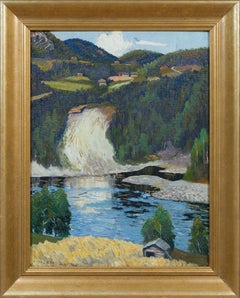
Waterfall and Timber – A View from Norrland

Waterfall and Timber – A View from Norrland

By Oscar Lycke

Located in Stockholm, SE

Provenance: Acquired directly from Katarina Gunnarsson, who inherited the painting from her mother, Barbro, the daughter of the artist. This striking landscape by Oscar Lycke depict...

Category

Early 20th Century Post-Impressionist Raymond Jonson Art

Materials

Canvas, Oil, Board

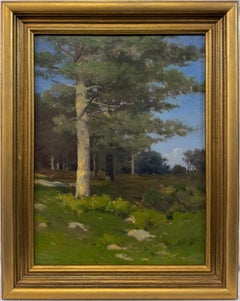
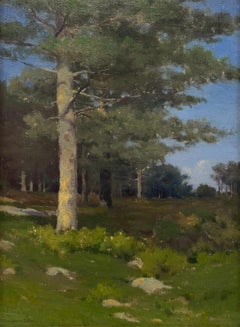
“Eastern White Pines, c. 1910”, New England Landscape, Signed Oil Painting

“Eastern White Pines, c. 1910”, New England Landscape, Signed Oil Painting

By Charles Warren Eaton

Located in Yardley, PA

“Eastern White Pines, c. 1910” by Charles Warren Eaton (American, 1857-1937). A wonderful example of Eaton’s renowned compositions of Eastern white pine trees in his mature style. A...

Category

Early 20th Century American Realist Raymond Jonson Art

Materials

Canvas, Oil, Board

Children Bathing by a Rocky Shore, Skagen, 1892

Children Bathing by a Rocky Shore, Skagen, 1892

Located in Stockholm, SE

Paul Graf (1866–1903), Swedish Children Bathing by a Rocky Shore, 1892 signed Graf and indistinctly dated 1892 oil on canvas mounted on panel unframed 139 × 175 cm (54.7 × 68.9 in)...

Category

1890s Post-Impressionist Raymond Jonson Art

Materials

Canvas, Oil, Board

Landscape with Artist.  Mid-Century Chicago Modernist Oil Painting.

Landscape with Artist. Mid-Century Chicago Modernist Oil Painting.

By William Schwartz

Located in Marco Island, FL

Chicago Modernist, William Schwartz, painted this dynamic landscape of an artist painting en plein air. He studied at the Art Institute of Chicago shortly after emigrating to the Un...

Category

Mid-20th Century American Modern Raymond Jonson Art

Materials

Canvas, Oil, Board

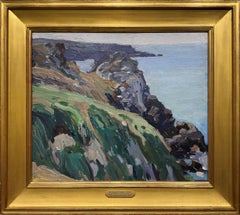
"Untitled (Coastal Cliffs, Brittany)" George Oberteuffer, Impressionist, Sea

"Untitled (Coastal Cliffs, Brittany)" George Oberteuffer, Impressionist, Sea

Located in New York, NY

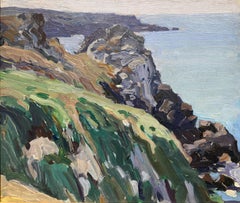
George Oberteuffer Untitled (Coastal Cliffs, Brittany), circa 1912 Oil on canvasboard 15 x 21 1/2 inches Born in Philadelphia, George Oberteuffer is best remembered for his Impress...

Category

1910s American Impressionist Raymond Jonson Art

Materials

Canvas, Oil, Board

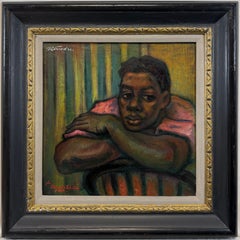
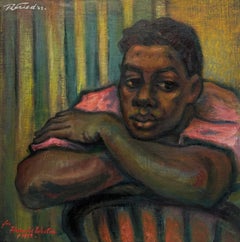
"The Champ, 1942" Joe Louis "Brown Bomber" Boxer Portrait Ex-Museum Oil Signed

"The Champ, 1942" Joe Louis "Brown Bomber" Boxer Portrait Ex-Museum Oil Signed

Located in Yardley, PA

“The Champ, 1942” by Theodore Fried (1902-1980) This important portrait by Hungarian-American artist Theodore Fried depicts the legendary boxer Joe Louis aka “The Brown Bomber” and ...

Category

1940s American Modern Raymond Jonson Art

Materials

Canvas, Oil, Board

On the Beach.  Woman Reading.  Mid-Century Chicago Modernist Oil Painting.

On the Beach. Woman Reading. Mid-Century Chicago Modernist Oil Painting.

By William Schwartz

Located in Marco Island, FL

Chicago Modernist, William Schwartz, painted this intimate painting of a woman reading titled On the Beach. He studied at the Art Institute of Chicago shortly after emigrating to th...

Category

Mid-20th Century American Modern Raymond Jonson Art

Materials

Canvas, Oil, Board

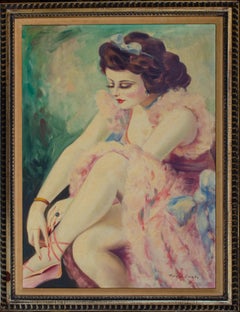
Art Nouveau Ballerina Painting by Mystery European Artist

Art Nouveau Ballerina Painting by Mystery European Artist

Located in New York, NY

Mystery European Artist Untitled, c. 20th Century Oil on canvas board 31 x 22 3/4 in. Framed: 36 1/4 x 28 x 1 1/2 in. Signed lower right

Category

20th Century Art Nouveau Raymond Jonson Art

Materials

Canvas, Oil, Board

"Along Peconic Bay, Long Island" Irving Ramsey Wiles, Impressionist Work

"Along Peconic Bay, Long Island" Irving Ramsey Wiles, Impressionist Work

By Irving Ramsey Wiles

Located in New York, NY

Irving Ramsey Wiles Along Peconic Bay, Long Island Signed lower left Oil on canvas laid on cardboard 8 x 10 inches In his heyday—the first quarter of the twentieth century—Irving W...

Category

1910s American Impressionist Raymond Jonson Art

Materials

Canvas, Oil, Cardboard

20th Century Floral Still Life by Mystery Artist

20th Century Floral Still Life by Mystery Artist

Located in New York, NY

Mystery Artist Untitled (floral still life), c. 20th Century Oil (?) on canvas board Sight: 14 3/4 x 20 1/2 in. Framed: 20 1/2 x 26 1/3 x 1 in.

Category

20th Century American Impressionist Raymond Jonson Art

Materials

Canvas, Oil, Board

Interior with a Seated Figure - 20th Century Oil Painting with Female Figure

Interior with a Seated Figure - 20th Century Oil Painting with Female Figure

By Peter Greenham

Located in Kingsclere, GB

Peter Greenham British, 1909-1992 Interior with a Seated Figure oil on canvas-board 20.5 x 32.5 cm 8 1/8 x 12 3/4 in Peter Greenham was a distinguished figurative painter of portrai...

Category

20th Century Raymond Jonson Art

Materials

Canvas, Oil, Board

Previously Available Items
Oil No. 9
Oil No. 9

Oil No. 9

By Raymond Jonson

Located in Denver, CO

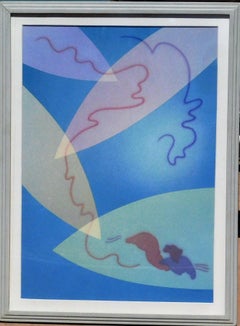
Framed dimensions measure 23.5 x 31.5 inches. Expedited and International Shipping available; please contact us for a quote. About the artist: Seeking the spiritual in art, Raymond Jonson developed an abstract style of painting that was unique in pre-1940s New Mexico. While his colleagues in the Transcendentalist Painting Group similarly shared his interest in the metaphysical, Jonson alone found his means in a non-objective relationship of forms. Strongly influenced by Kandinsky, the painter moved from stylized representations of nature to formalist expressions of universal harmony. In order to achieve his aims, he became a master of materials, known for his meticulous working methods. Born in Iowa, Jonson spent his early years moving around the country with his family, necessitated by his minister father's work. They finally settled in Portland, Oregon, in 1902, and this same year Raymond had a spiritual experience in which he sensed the presence of God. When his family's Baptist faith disappointed him, he transposed this feeling to art, to which he committed his life. When the Portland Art Association established its Museum Art School, Jonson enrolled as its first student. His dedication led him to Chicago to study at the Academy of Fine Arts, a very good commercial school, which afforded a strong grounding in drawing. Here he met B.J.O. Nordfedlt, a Swedish immigrant, who introduced the younger Jonson to the colorist experimentation of the Fauves. The Arthur Dove exhibition and the Armory Show brought to Chicago both expanded his awareness of the emotive possibilities of modernist art movements. From 1912 to 1917, Jonson was lighting, stage set, costume, and graphics designer for the Chicago Little Theater, America's first experimental theater. Among their bold departures was a minimalist aesthetic, which reduced the stage elements and enhanced the dramatic content with light. Devising the 9-switch dimmer board, Jonson (going by C. Raymond Johnson) became an international theater figure. He also met his wife, Vera White, secretary for the theater and poet. On a trip to the Colorado Rockies in 1917, Jonson was moved by the power of this sublime landscape and its clarity of light. He began to consider how paint could express light -- material into immaterial. Teaching at the Chicago Art Institute, he was able to get away to the MacDowell Art Colony in 1919, and his elevated sensibilities increasingly perceived the oppressive side of city life. Believing the aim of life was toward harmony, Jonson placed new emphasis on design as a unifying principle. Reading Kandinsky's "The Art of Spiritual Harmony" further convinced him that the mission of art was to make this harmony visible. In 1922, he spent the entire summer in Santa Fe, and his experience there filtered into his work upon returning to Chicago. When his mother supplied the money for a studio, he moved to New Mexico in 1924, building his home across the street from his friend Nordfeldt. Jonson pursued the concept of order as found in "simple basic motives of spaces and interesting variety of shapes and spaces, a balance of line direction." In the work of the late 20s, he submits natural forms, such as mesas and even the Grand Canyon, to a dynamic patterning in which the quality of light becomes a design element. Significantly, Jonson thought that emotion could be included by creating juxtaposed rhythms within the composition. Influenced by Indian design, these paintings recall Art Deco ornamentation in the combination of organic and geometric motifs and the electric color effects. Taking the next leap, Jonson set about purifying his work of all representation. Beginning in the thirties, he explored new ways applications of color and tonality to suggest the quality of transparency, which created the sense of different planes within one surface. Philosophically, this transparency was the artistic means to "expose the spirit of man." Carefully painting gradations, he achieved luminosity and, with colors close to each other, vibration. He eventually used an airbrush for further ethereal effects. Rather than suggest the metaphysical with subject matter, Jonson proposed an approach to painting which de-materialized the actual physical object. In 1938, he and Emil Bisttram were the core of the Transcendentalist Painters Group, which advanced these principles among other artists in Santa Fe and Taos. As advocate and impresario, Jonson casts a long shadow. Although there was strong sentiment against it, he organized the modern wing of the Museum of New Mexico. In 1934, he painted six murals for the University of New Mexico, which began his relationship with the Albuquerque institution. For many years, he commuted there from Santa Fe but in 1950 he moved there to the gallery/studio provided. Upon his retirement in 1954, he continued to stage exhibitions, thus making the gallery a citadel of modernism in the Southwest. The building itself is a landmark of Pueblo Revival...

Category

1950s Abstract Expressionist Raymond Jonson Art
Materials

Alabaster

Watercolor, NO. 20
Watercolor, NO. 20

Watercolor, NO. 20

By Raymond Jonson

Located in Denver, CO

Provenance: Private Collection, Colorado

Category

1940s Abstract Raymond Jonson Art
Materials

Watercolor

Raymond Jonson art for sale on 1stDibs.
Find a wide variety of authentic Raymond Jonson art available for sale on 1stDibs. You can also browse by medium to find art by Raymond Jonson in board, canvas, fabric and more. Not every interior allows for large Raymond Jonson art, so small editions measuring 22 inches across are available. Customers who are interested in this artist might also find the work of Cecil Crosley Bell, Irene Rice Pereira, and Byron Browne. Raymond Jonson art prices can differ depending upon medium, time period and other attributes. On 1stDibs, the price for these items starts at $9,500 and tops out at $9,500, while the average work can sell for $9,500.

Artists Similar to Raymond Jonson