Richard Erdoes Art

to
3
1
Overall Width
to
Overall Height
to
4
2
2
1
1
4
3
2
2
1
1
1
1
1
1
1
1
1
1
1
1
1
1
1
1
1
4
4
4
3
3
4
11,205
2,855
2,494
1,437
4
Artist: Richard Erdoes
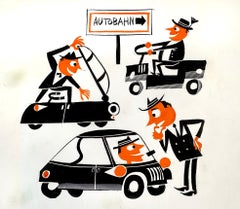
BMW Isetta, Messerschmitt  Cars Autobahn - Humorous Mid-Century Illustration

BMW Isetta, Messerschmitt Cars Autobahn - Humorous Mid-Century Illustration

By Richard Erdoes

Located in Miami, FL

One of the hallmarks of great art is recognizing the artist's style instantly. This is the case with Richard Erdoes. His highly stylized comic figures are expressive and communicate the story delightfully and joyfully. Even though this work is rendered in flat, minimalistic two colors, the inventive shape relationships and positive and negative areas convey a very high level of artistic skill. The present work was done on assignment for the prestigious Standard Oil ( Exxon's predecessor ) corporation's company magazine, The Lamp. Although not a newstand magazine, The Lamp had the highest editional and artistic content. Work is unsigned and unframed. Richard Erdoes (Hungarian Erdős, German Erdös; July 7, 1912 – July 16, 2008) was an American artist, photographer, illustrator and author. Early life Erdoes was born in Frankfurt,to Maria Josefa Schrom on July 7, 1912. His father, Richárd Erdős Sr., was a Jewish Hungarian...

Category

1950s Outsider Art Richard Erdoes Art

Materials

Gouache, Illustration Board, Pencil

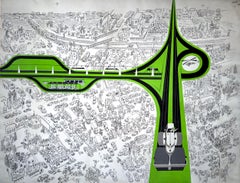
Mid Century Expressway Proposal Over Norman Rockwell Town

Mid Century Expressway Proposal Over Norman Rockwell Town

By Richard Erdoes

Located in Miami, FL

Artist Richard Erdoes is as undervalued as he is overlooked. Rarely does an artwork come on that market that combines sharp-witted originality with mind-boggling technical proficiency. In “Mid-Century Expressway,” Erodes painstakingly draws a birds-eye view of a Norman Rockwell-like town buzzing with activity. He paints far away and close up in one image. Each block has its own charming Americana story unfolding. The closer the viewer gets to each scene, the more detail is revealed. In black and white, the artist describes not only the architecture and infrastructure but also human activity - lot's of it. Erodes’s congested town is humming. Overflowing trains, packed busses, zooming cars, stuffed trucks, frenzied pedestrians and even a marching band is depicted with great whit. But do not worry. Progress is coming and all will be well. Superimposed onto this black and white clogged urban scene is a proposed new highway. It's painted in a punchy green and creates an unexpectedly distinct design. The artwork was most likely done for Fortune Magazine or the like. Notice he Esso Gasoline signs...

Category

1950s Minimalist Richard Erdoes Art

Materials

Paper, Ink, Gouache, Pen

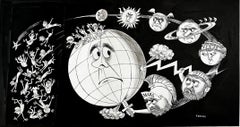
Apocalypse, Catastrophic Destruction of the World, Surrealism - Life Magazine

Apocalypse, Catastrophic Destruction of the World, Surrealism - Life Magazine

By Richard Erdoes

Located in Miami, FL

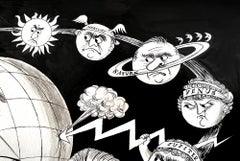
Apocalypse in 1962? At the height of the Cold War, Life Magazine commissions an illustration that describes the world's end by means other than a nuclear war with Russia. Richard Erdoes brilliantly illustrates the work with his highly stylized painting technique. My favorite part of the work is on the left side showing a group of people packed together as they fall into oblivion. A clear reference would be Hieronymus Bosch's "The Last Judgment " Once Again the World Ends." Illustration published in Life Magazine, Feb. 9, 1962 Signed in lower right image. Unframed Richard Erdoes (Hungarian Erdős, German Erdös; July 7, 1912 – July 16, 2008) was an American artist, photographer, illustrator and author. Early life Erdoes was born in Frankfurt,[1] to Maria Josefa Schrom on July 7, 1912. His father, Richárd Erdős Sr., was a Jewish Hungarian opera singer who had died a few weeks earlier in Budapest on June 9, 1912.[2] After his birth, his mother lived with her sister, the Viennese actress Leopoldine ("Poldi") Sangora,[3] He described himself as "equal parts Austrian, Hungarian and German, as well as equal parts Catholic, Protestant and Jew..."[4] Career He was a student at the Berlin Academy of Art in 1933, when Adolf Hitler came to power. He was involved in a small underground paper where he published anti-Hitler political cartoons which attracted the attention of the Nazi regime. He fled Germany with a price on his head. Back in Vienna, he continued his training at the Kunstgewerbeschule, now the University of Applied Arts, Vienna.[5] He also wrote and illustrated children's books and worked as a caricaturist for Tag and Stunde, anti-Nazi newspapers. After the Anschluss of Austria in 1938 he fled again, first to Paris, where he studied at the Academie de la Grande Chaumiere, and then London, England before journeying to the United States. He married his first wife, fellow artist Elsie Schulhof (d. xxxx) in London, shortly before their arrival in New York City. In New York City, Erdoes enjoyed a long career as a commercial artist, and was known for his highly detailed, whimsical drawings. He created illustrations for such magazines as Stage, Fortune, Pageant, Gourmet, Harper's Bazaar, Sports Illustrated, The New York Times, Time, National Geographic and Life Magazine, where he met his second wife, Jean Sternbergh (d. 1995) who was an art director there. The couple married in 1951 and had three children.[6] Erdoes also illustrated many children's books. An assignment for Life in 1967 took Erdoes to the Pine Ridge Indian Reservation for the first time, and marked the beginning of the work for which he would be best known. Erdoes was fascinated by Native American culture, outraged at the conditions on the reservation and deeply moved by the Civil Rights Movement that was raging at the time. He wrote histories, collections of Native American stories...

Category

1960s Surrealist Richard Erdoes Art

Materials

Mixed Media, Gouache, Board, Illustration Board

Environmental Prognostication Coil Narrative   "Homo Sapiens R.I.P."

Environmental Prognostication Coil Narrative "Homo Sapiens R.I.P."

By Richard Erdoes

Located in Miami, FL

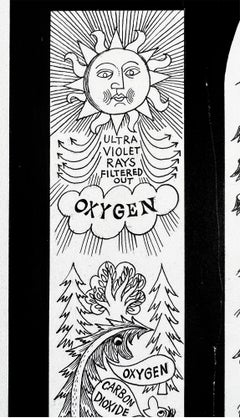
"They paved paradise and put up a parking lot," Joni Mitchell said. - - Created in 1969, at the dawn of the American environmental movement, artist Richard Erdoes draws a sequential narrative in the form of a coil. From inception to destruction, it illustrates a list of things that humans are doing to destroy the world we live in. The work was commissioned for school-age humans and executed in a whimsically comic way. Yet the underlying narrative is sophisticated and foreshadows a world that could be on the brink of ecological disaster. Graphically and conceptually, this work exhibits an endless amount of creativity and Erdoes cartoony style is one to fall in love with. Signed lower right. Unframed 12.4 inches Width: 12.85 inches Height is the live area. Board is 16x22 inches. Richard Erdoes (Hungarian Erdős, German Erdös; July 7, 1912 – July 16, 2008) was an American artist, photographer, illustrator and author. Early life Erdoes was born in Frankfurt,to Maria Josefa Schrom on July 7, 1912. His father, Richárd Erdős Sr., was a Jewish Hungarian opera singer who had died a few weeks earlier in Budapest on June 9, 1912.After his birth, his mother lived with her sister, the Viennese actress Leopoldine ("Poldi") Sangora,He described himself as "equal parts Austrian, Hungarian and German, as well as equal parts Catholic, Protestant and Jew..."[4] Career He was a student at the Berlin Academy of Art in 1933, when Adolf Hitler came to power. He was involved in a small underground paper where he published anti-Hitler political cartoons which attracted the attention of the Nazi regime. He fled Germany with a price on his head. Back in Vienna, he continued his training at the Kunstgewerbeschule, now the University of Applied Arts, Vienna.[5] He also wrote and illustrated children's books and worked as a caricaturist for Tag and Stunde, anti-Nazi newspapers. After the Anschluss of Austria in 1938 he fled again, first to Paris, where he studied at the Academie de la Grande Chaumiere, and then London, England before journeying to the United States. He married his first wife, fellow artist Elsie Schulhof (d. xxxx) in London, shortly before their arrival in New York City. In New York City, Erdoes enjoyed a long career as a commercial artist, and was known for his highly detailed, whimsical drawings. He created illustrations for such magazines as Stage, Fortune, Pageant, Gourmet, Harper's Bazaar, Sports Illustrated, The New York Times, Time, National Geographic and Life Magazine, where he met his second wife, Jean Sternbergh (d. 1995) who was an art director there. The couple married in 1951 and had three children.[6] Erdoes also illustrated many children's books. An assignment for Life in 1967 took Erdoes to the Pine Ridge Indian Reservation for the first time, and marked the beginning of the work for which he would be best known. Erdoes was fascinated by Native American culture, outraged at the conditions on the reservation and deeply moved by the Civil Rights Movement that was raging at the time. He wrote histories, collections of Native American stories...

Category

1960s American Realist Richard Erdoes Art

Materials

Ink, Gouache, Illustration Board
Related Items
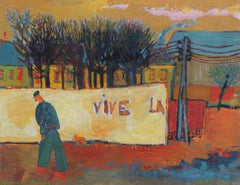
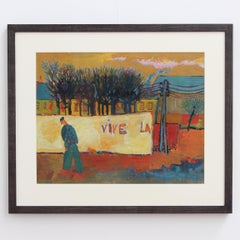
Winter in Provence, Gouache on Paper, Modern Style, Signed, 1970s

Winter in Provence, Gouache on Paper, Modern Style, Signed, 1970s

By Raymond Debieve

Located in London, GB

'Winter in Provence', gouache on art paper, by Raymond Debiève (circa 1970s). There is both beauty and melancholy in this delightfully charming artwork. The artist's naive style is at odds with the refinement, poise and sophistication of the painting. Perhaps the artist was making a statement as well with the broken wall...

Category

1970s Modern Richard Erdoes Art

Materials

Gouache, Paper

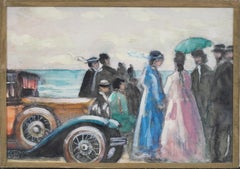
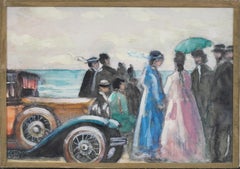
Vintage French Impressionist Monogrammed High Society Beach Scene Classic Cars

Vintage French Impressionist Monogrammed High Society Beach Scene Classic Cars

Located in Buffalo, NY

Vintage French beach scene painting. Watercolor on paper. Signed. Framed. Measuring: 9 by 12 inches overall, and 7.5 by 11 painting alone. Excellent condition, ready to hang and enj...

Category

1940s Impressionist Richard Erdoes Art

Materials

Watercolor

TOBACCO ROAD Mid 20th Century Realism 1940 Drawing from the Novel WPA Literary 2

TOBACCO ROAD Mid 20th Century Realism 1940 Drawing from the Novel WPA Literary 2

By David Fredenthal

Located in New York, NY

TOBACCO ROAD Mid 20th Century Realism 1940 Drawing from the Novel WPA Literary 2 10 1/2 x 6 (sight), Signed David Fredenthal lower right. Framed by Lowy....

Category

1930s American Realist Richard Erdoes Art

Materials

Paper, Ink, Watercolor

TOBACCO ROAD Mid 20th Century Realism 1940 Drawing from the Novel WPA Literary 3

TOBACCO ROAD Mid 20th Century Realism 1940 Drawing from the Novel WPA Literary 3

By David Fredenthal

Located in New York, NY

TOBACCO ROAD Mid 20th Century Realism 1940 Drawing from the Novel WPA Literary 3 10 1/2 x 6 (sight), Signed David Fredenthal lower right. Framed by Lowy. Offered here is one of several original drawings by WPA artist David Fredenthal that were first published in the 1940 illustrated edition of the novel TOBACCO ROAD by Erskine Caldwell. Background on the Drawing Erskine Caldwell remarked, on seeing the work of David Fredenthal, 26-year-old painter: "That boy could draw my Tobacco Road people." A casual comment, it was enormously productive. The young painter was just finishing a two-year Guggenhcim Fellowship, preceded by a year's study in Paris, two one-man shows at New York's Downtown Gallery, and a fellowship at the Cranbrook Academy near Detroit. He was out in Colorado Springs when he heard what Caldwell had said about him. Fredenthal hadn't read Tobacco Road. He had not even seen the play - now breaking all records in its seventh year on Broadway. But he swapped a portrait for a second-hand Ford and headed East. In New York he learned that Dnell, Sloan & Pearce were bringing out a deluxe edition of Tobacco Road. But he had no entrée to the publishers, and Caldwell, to his disappointment, was out of town. So he drove on to Georgia to have a look at the Tobacco Road people. He found Dr. I. C. Caldwell, the author's father, in Wrens, Ga., going on his ministerial rounds among people like the Lesters. Fredenthal got a room from a couple who ran a 1-pump filling station...

Category

1930s American Realist Richard Erdoes Art

Materials

Paper, Ink, Watercolor

Parc des Buttes-Chaumont Gouache, Post-Impressionist, Framed, 1930s

Parc des Buttes-Chaumont Gouache, Post-Impressionist, Framed, 1930s

By Lucien Génin

Located in London, GB

'Parc des Buttes-Chaumont' in Paris, gouache on art paper, by Lucien Génin (circa 1930s). A charming depiction of well turned out Parisians enjoying a day at the park. Boaters, strollers and swans all co-mingle around the peaceful lake. The reflection of the rocky bluff in the water is superbly treated by Génin. It's a cheerful and uplifting image of days-gone-by in 1930s Paris. The park takes its name from the 'bare hill' (chauve-mont) that once occupied the site. It became a place where gypsum was mined, and where the limestone was quarried to be used in buildings in Paris and the United States. Worse, though, it was a site that also became a dumping ground. Luckily, during the 19th-century renovation of Paris under Napoleon III, chauve-mont was chosen as a place for a large park, as part of the emperor's fascination with endowing Paris with green spaces. The artificial lake created at that time wraps around a hilly central island. The lake attracts waterfowl and other birds and is stocked with fish. The 19th-century planners cleaned up the site and added tons of soil to fill the pits left by a limestone mining operation. Then dynamite was used to "sculpt" the site into the craggy shapes seen today, including the 50-metre-high central hill with cliffs, an interior grotto, pinnacles, and arches. Up on top, overlooking the rest of the park - and depicted in this artwork - is a small, round belvedere, based on the Roman Temple of Vesta in Italy. From that spot you can see a lovely view of Montmartre and the white cupolas of the Sacre-Coeur. The painting is in very good condition. It has been newly framed and glazed with museum-quality glass (anti-reflective and UV protection) to preserve this significant artwork for decades to come. Dimensions with frame: H 62 cm / 24.4" W 76 cm / 29.9" Dimensions without frame: H 48.5 cm / 19.1" W 63 cm / 24.8" About the Artist: After the devastation of the First World War, Lucien Génin (1894 - 1953) left his provincial home in the autumn of 1919 to find his fortune among the lively Parisians in the heart of Montmartre. Génin befriended the painters Frank Will, Gen Paul, Émile Boyer, Marcel Leprin...

Category

1930s Post-Impressionist Richard Erdoes Art

Materials

Paper, Gouache

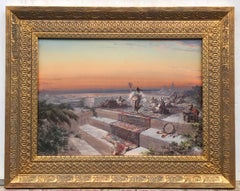
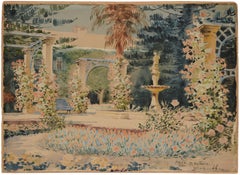
"San Anton Palace Malta" Early 20th Cent. Garden and Fountain Watercolor Russian

"San Anton Palace Malta" Early 20th Cent. Garden and Fountain Watercolor Russian

Located in Soquel, CA

A significant early 20th century landscape watercolor of the paradisical gardens at San Anton Palace in Attard, Malta by Nicholas Krasnoff, 1920 (Russian, 1864-1939). This beautiful piece is a wonderful example of the renowned Russian architect's prized watercolors, created while he was exiled to Malta in the early 1920's. Depicting a lush garden full of blooming, colorful flowers and a stately fountain at the San Anton Palace in Malta, one can see the deft hand and attention to detail rendered by the proficient artist and architect's hand. Signed "N. Krasnoff" lower right. Titled and dated "Malta, St. Antonio 1920". Unframed. Measures 10.25"H x 14.25"W. Right corner has a crease from being bent. Nikolay Petrovich Krasnov, also known as Nicholas Krasnoff or Peter Nicholas Krasnoff, was a Russian Serbian architect and painter. He served as Chief Architect of Yalta, Crimea (1887-1899). From 1922 he lived and worked in the Kingdom of Yugoslavia, and was a key figure in the architectural development of Belgrade. Attending the Moscow School of Painting, Sculpture and Architecture in 1876, aged 12. As a young artist he received patronage from Sergey Tretyakov, brother of the founder of Moscow's Tretyakov Gallery, and entrepreneur Petar Gubonyin. In 1887 Krasnov became Chief Architect in Yalta. At the age of 23, Krasnov had large responsibility for the rapid growth of the city. He expanded the promenade, which by 1913 became the city's main street, before creating a new city plan in 1889 (including a new sewer system, planning regulations, new streets, prevention of unregulated construction, a school and children's hospital, and the construction of the Pushkin Boulevard). Two concrete bridges were built over the river, and the embankment strengthened. Krasnov also ran a private practice in Yalta until 1911. Among his most famous work is the Livadia Palace, later the location of the 1945 Yalta Conference. Designed over 60 buildings in Crimea, blending a modernist style with local traditions. Also of note: Dulber Palace, Koreiz (1895-97), Alexander Nevsky Cathedral, Yalta (1902), Yusupov Palace, Koreiz (1909), Kokkoz Jami Mosque, Sokolyne (1910). In 1913, he presented a collection of illustrations he had produced of his works to the Saint Petersburg Academy of Arts, where he held the title of academician. An opponent of the Russian Revolution, he left Yalta with his family in 1919 for Malta, alongside the Dowager Empress Marie Feodorovna, sister of Queen Alexandra, and over 600 members of the Russian aristocracy. Nikolay was in a group housed in the empty Villa St Ignatius, which had been a Jesuit college and then a hospital during World War I. To earn money, Nikolay painted many scenes of Malta, signing his paintings as N. Krasnoff. He is known as Nicholas Krasnoff in Malta. In May 2016 MaltaPost issued a commemorative set of stamps in his honor. In 1922 Krasnov moved to Belgrade, then part of the Kingdom of Yugoslavia, where he became head of the Department of Monumental Architectural Developments and Monuments. His building designs in Serbia number around 60, and were created under the name Nikola Krasnov, as a mark of respect to his adopted homeland. His key works in Belgrade include: Ministry of Forestry building (now Ministry of Foreign Affairs) (1923) which bears a memorial plaque...

Category

1920s Impressionist Richard Erdoes Art

Materials

Paper, Watercolor, Illustration Board

1938 Cuban Illustration Gouache Painting Carteles Magazine Andres Garcia Benitez

1938 Cuban Illustration Gouache Painting Carteles Magazine Andres Garcia Benitez

Located in Buffalo, NY

An original illustration by Cuban artist Andres Garcia Benitez which was used for the cover of the iconic Carteles magazine in November of 1938. ...

Category

1930s Realist Richard Erdoes Art

Materials

Watercolor, Gouache, Illustration Board
Wheat Field Harvest, Early 20th Century Figurative Landscape

Wheat Field Harvest, Early 20th Century Figurative Landscape

$600Sale Price|20% Off

H 13.25 in W 19.75 in D 0.13 in

Wheat Field Harvest, Early 20th Century Figurative Landscape

Located in Soquel, CA

Early 20th century Italian figurative landscape of a traditional wheat field harvest scene, by S. Frosini (Italian, 20th Century). This figurative landscape in gouache depicts in gre...

Category

Early 20th Century Impressionist Richard Erdoes Art

Materials

Gouache, Illustration Board
Whimsical Illustration Hiking Cartoon, 1938 Mt Tremblant Ski Lodge William Steig

Whimsical Illustration Hiking Cartoon, 1938 Mt Tremblant Ski Lodge William Steig

By William Steig (b.1907)

Located in Surfside, FL

Lighthearted Illustration of Outdoor Pursuits This one being cross country hiking signed "W. Steig" Provenance: from Mrs. Joseph B. Ryan, Commissioned by Joe Ryan for the bar at his...

Category

1930s Naturalistic Richard Erdoes Art

Materials

Archival Ink, Watercolor, Illustration Board
Richard Erdoes art for sale on 1stDibs.

Find a wide variety of authentic Richard Erdoes art available for sale on 1stDibs. You can also browse by medium to find art by Richard Erdoes in board, gouache, illustration board and more. Not every interior allows for large Richard Erdoes art, so small editions measuring 13 inches across are available. Richard Erdoes art prices can differ depending upon medium, time period and other attributes. On 1stDibs, the price for these items starts at $12,500 and tops out at $12,500, while the average work can sell for $12,500.