By Robert Natkin
Located in New York, NY
Robert Natkin (American, 1930 - 2010)
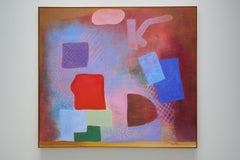
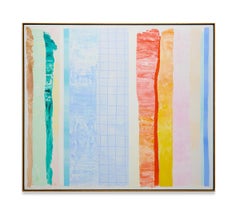
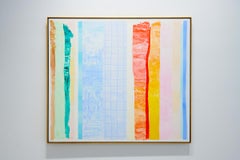
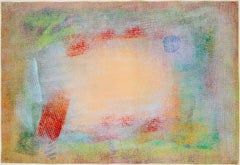
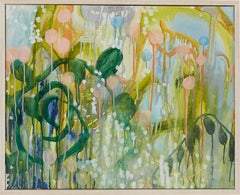
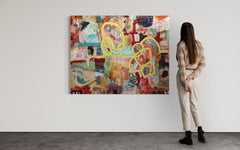
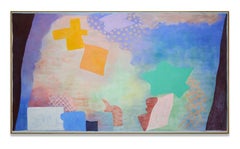
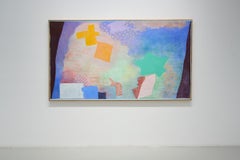
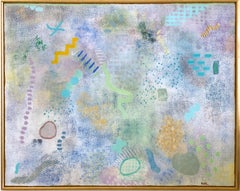
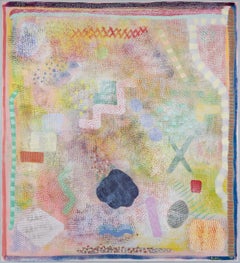
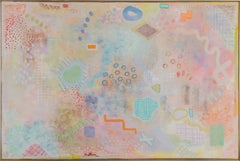
Intimate Lighting Series, 1978
Acrylic on canvas
34 x 45 inches
Signed lower left
Provenance:
Gimpel & Weitzenhoffer Gallery, New York
Private Collection, Connecticut
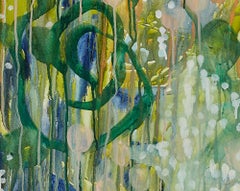
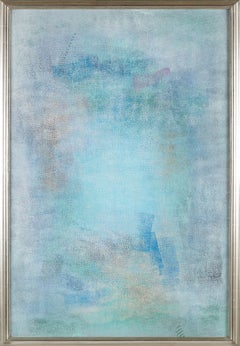
Intimate Lighting is part of a series of the same name, which is characterized by textured surfaces, modulating tonalities and floating calligraphic shapes. The work is spare and highly atmospheric.
One of the most important abstract painters of his generation, Robert Natkin was known for his innovative blending of form, pattern, color and space to create a distinctly personal and lyrical style. Born in Chicago, Illinois in 1930, Natkin began his studies at the Art Institute of Chicago in the early fifties. In 1957, Natkin and his wife, fellow painter Judith Dolnick, opened Wells Street Gallery which featured the work of artists such as Aaron Siskind, Willem de Kooning, Franz Kline, Jackson Pollock, and John Chamberlain. Seeking further opportunities to show his work, Natkin moved to New York City in 1959, and was represented by Poindexter Gallery and later André Emmerich. Natkin was the subject of solo exhibitions throughout the country and abroad, most notably at the Hirshhorn Museum & Sculpture Garden, Washington, D.C., the Foire Internationale d'Art Contemporain, Grand Palais, Paris, and the Art Institute of Chicago. Additionally, Natkin was featured in a number of prominent group shows, such as Young America at the Whitney Museum of Art, New York, in 1960.
In the crowded field of Post-War Abstraction, Robert Natkin’s lifetime exploration of color and light set him apart. His poetic paintings combine a Post-Impressionist color sensibility with the lyricism of Paul Klee, a major influence on the artist. Celebrated in his lifetime even as abstraction fell in and out of favor, Natkin remained stubbornly committed to his vision and produced cohesive and challenging work throughout his career. The high-keyed color and all-over treatment recalls the work of Pierre Bonnard, as well as American Modernist Stuart Davis. Indeed, Natkin’s work can be seen as a bridge between the flattened non-objective forms of the American Abstract Artists group of the 1930s and 40s such as Josef Albers, Suzy Frelinghuysen, A. E. Gallatin, Paul Kelpe, George L. K. Morris, and the increasing graphicness found in contemporary abstraction, by painters like Trudy Benson, Keltie Ferris, and Jonathan Lasker.
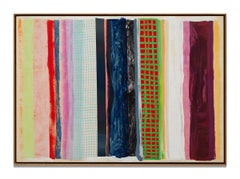
In 1963, the geography of Natkin’s paintings began to take on a different look. The tangent vertical structures of the Apollo series, with their semi-fixed framework, freed the artist from earlier compositional constraints. Within this simplified structure, Natkin could now concentrate further on paint application and surface rather than on broader structural concerns. Named for the Greek god of the sun and of poetry, the paintings of the Apollo series reflect Natkin’s preoccupation with light and with the interplay between light and color.
Paul Cézanne feared that his fellow artist Paul Gauguin would steal what he referred to as his “little sensations,” the vibrations resulting from contrasting colors. It is precisely this glowing and resonance, described by Natkin as a kind of “visual vibrato” that began to increasingly preoccupy Natkin in the mid-1960s. The vertical planes of his Apollo canvases served as pre-defined spatial strips, a set of separate yet interacting counterparts, in which the artist could safely play with hue modulation and counterpoint.
The spatial aesthetic of the Apollo paintings...
Category
1970s Abstract Expressionist Robert Natkin Abstract Paintings