Robert Sarsony Art

to
1
1
Overall Width
to
Overall Height
to
2
2
2
1
1
1
2
2
1
1
1
2
11,258
2,855
2,494
1,463
2
Artist: Robert Sarsony
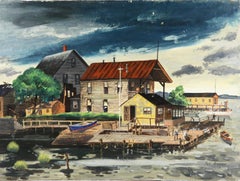
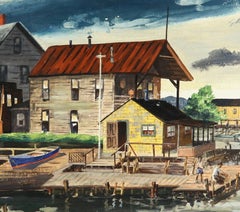
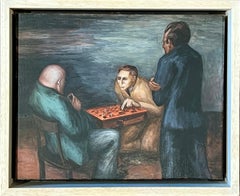
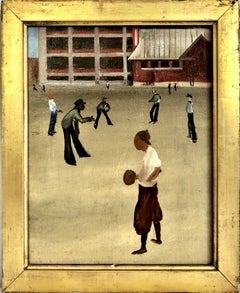
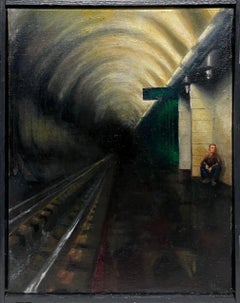
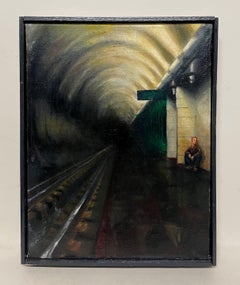
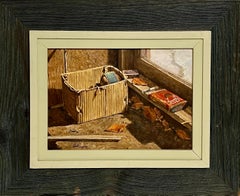
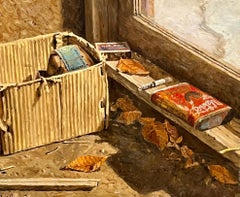
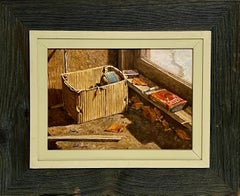
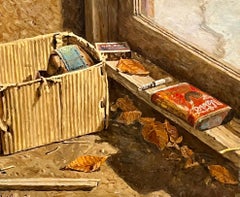
Vintage Americana Oil Painting, "Paper Box" Robert Sarsony, ACA Gallery

Vintage Americana Oil Painting, "Paper Box" Robert Sarsony, ACA Gallery

By Robert Sarsony

Located in Surfside, FL

Robert Sarsony Oil on gesso and masonite board. Hand signed lower left. Labels verso give artist, title "Paper Box", year 1971 and medium. Bears label from ACA Gallery. Dimensions...

Category

1970s American Realist Robert Sarsony Art

Materials

Gesso, Oil, Board
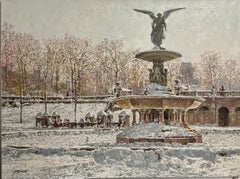
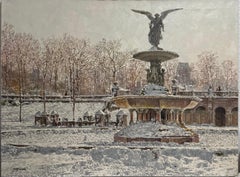
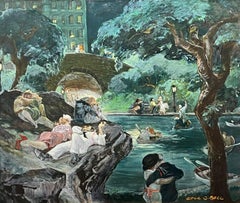
Large Oil Painting Central Park in Winter Robert Sarsony New York City in Snow

Large Oil Painting Central Park in Winter Robert Sarsony New York City in Snow

By Robert Sarsony

Located in Surfside, FL

Robert Sarsony Hand signed Oil painting on canvas Titled verso "Winter in the Park" Dimensions: 30 X 40 inches. not framed Snowy NYC park scene. It depicts the iconic Angel of the...

Category

1970s American Realist Robert Sarsony Art

Materials

Oil, Canvas

Related Items
Interior J&L Works, Pittsburgh, Pennsylvania American Industrial Scene Painting

Interior J&L Works, Pittsburgh, Pennsylvania American Industrial Scene Painting

Located in Marco Island, FL

An interior scene of industrial America where workers kept the production of steel going in Pittsburgh, Pennsylvania. This detailed and atmospheric painting shows the hard work and ...

Category

20th Century American Realist Robert Sarsony Art

Materials

Oil, Board

'Sketching Wisconsin' original oil painting, Signed

'Sketching Wisconsin' original oil painting, Signed

By John Steuart Curry

Located in Milwaukee, WI

John Steuart Curry "Sketching Wisconsin," 1946 oil on canvas 31.13 x 28 inches, canvas 39.75 x 36.75 x 2.5 inches, frame Signed and dated lower right Overall excellent condition Presented in a 24-karat gold leaf hand-carved wood frame John Steuart Curry (1897-1946) was an American regionalist painter active during the Great Depression and into World War II. He was born in Kansas on his family’s farm but went on to study art in Chicago, Paris and New York as young man. In Paris, he was exposed to the work of masters such as Peter Paul Rubens, Eugène Delacroix and Jacques-Louis David. As he matured, his work showed the influence of these masters, especially in his compositional decisions. Like the two other Midwestern regionalist artists that are most often grouped with him, Grant Wood (American, 1891-1942) and Thomas Hart Benton (American, 1889-1975), Curry was interested in representational works containing distinctly American subject matter. This was contrary to the popular art at the time, which was moving closer and closer to abstraction and individual expression. Sketching Wisconsin is an oil painting completed in 1946, the last year of John Steuart Curry’s life, during which time he was the artist-in-residence at the University of Wisconsin in Madison. The painting is significant in Curry’s body of work both as a very revealing self-portrait, and as a landscape that clearly and sensitively depicts the scenery of southern Wisconsin near Madison. It is also a portrait of the artist’s second wife, Kathleen Gould Curry, and is unique in that it contains a ‘picture within a picture,’ a compositional element that many early painting masters used to draw the eye of the viewer. This particular artwork adds a new twist to this theme: Curry’s wife is creating essentially the same painting the viewer is looking at when viewing Sketching Wisconsin. The triangular composition of the figures in the foreground immediately brings focus to a younger Curry, whose head penetrates the horizon line and whose gaze looks out towards the viewer. The eye then moves down to Mrs. Curry, who, seated on a folding stool and with her hand raised to paint the canvas on the easel before her, anchors the triangular composition. The shape is repeated in the legs of the stool and the easel. Behind the two figures, stripes of furrowed fields fall away gently down the hillside to a farmstead and small lake below. Beyond the lake, patches of field and forest rise and fall into the distance, and eventually give way to blue hills. Here, Curry has subverted the traditional artist’s self-portrait by portraying himself as a farmer first and an artist second. He rejects what he sees as an elitist art world of the East Coast and Europe. In this self-portrait he depicts himself without any pretense or the instruments of his profession and with a red tractor standing in the field behind him as if he was taking a break from the field work. Here, Curry’s wife symbolizes John Steuart Curry’s identity as an artist. Compared with a self-portrait of the artist completed a decade earlier, this work shows a marked departure from how the artist previously presented and viewed himself. In the earlier portrait, Curry depicted himself in the studio with brushes in hand, and with some of his more recognizable and successful canvases behind him. But in Sketching Wisconsin, Curry has taken himself out of the studio and into the field, indicating a shift in the artist’s self-conception. Sketching Wisconsin’s rural subject also expresses Curry’s populist ideals, that art could be relevant to anyone. This followed the broad educational objectives of UW’s artist-in-residence program. Curry was appointed to his position at the University of Wisconsin in 1937 and was the first person to hold any such position in the country, the purpose of which was to serve as an educational resource to the people of the state. He embraced his role at the University with zeal and not only opened the doors of his campus studio in the School of Agriculture to the community, but also spent a great deal of time traveling around the state of Wisconsin to visit rural artists who could benefit from his expertise. It was during his ten years in the program that Curry was able to put into practice his belief that art should be meaningful to the rural populace. However, during this time he also struggled with public criticism, as the dominant forces of the art market were moving away from representation. Perhaps it was Curry’s desire for public acceptance during the latter part of his career that caused him to portray himself as an Everyman in Sketching Wisconsin. Beyond its importance as a portrait of the artist, Sketching Wisconsin is also a detailed and sensitive landscape that shows us Curry’s deep personal connection to his environment. The landscape here can be compared to Wisconsin Landscape of 1938-39 (the Metropolitan Museum of Art), which presents a similar tableau of rolling hills with a patchwork of fields. Like Wisconsin Landscape, this is an incredibly detailed and expressive depiction of a place close to the artist’s heart. This expressive landscape is certainly the result of many hours spent sketching people, animals, weather conditions and topography of Wisconsin as Curry traveled around the state. The backdrop of undulating hills and the sweeping horizon, and the emotions evoked by it, are emphatically recognizable as the ‘driftless’ area of south-central Wisconsin. But while the Metropolitan’s Wisconsin Landscape conveys a sense of uncertainty or foreboding with its dramatic spring cloudscape and alternating bands of light and dark, Sketching Wisconsin has a warm and reflective mood. The colors of the foliage indicate that it is late summer and Curry seems to look out at the viewer approvingly, as if satisfied with the fertile ground surrounding him. The landscape in Sketching Wisconsin is also revealing of what became one of Curry’s passions while artist-in-residence at UW’s School of Agriculture – soil conservation. When Curry was a child in Kansas, he saw his father almost lose his farm and its soil to the erosion of The Dust Bowl. Therefore, he was very enthusiastic about ideas from UW’s School of Agriculture on soil conservation methods being used on Wisconsin farms. In Sketching Wisconsin, we see evidence of crop rotation methods in the terraced stripes of fields leading down the hillside away from the Curry’s and in how they alternate between cultivated and fallow fields. Overall, Sketching Wisconsin has a warm, reflective, and comfortably pastoral atmosphere, and the perceived shift in Curry’s self-image that is evident in the portrait is a positive one. After his rise to favor in the art world in the 1930’s, and then rejection from it due to the strong beliefs presented in his art, Curry is satisfied and proud to be farmer in this self-portrait. Curry suffered from high blood...

Category

1940s American Realist Robert Sarsony Art

Materials

Canvas, Oil

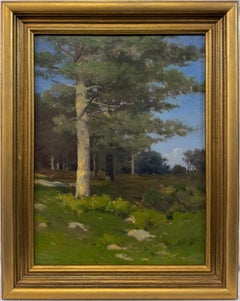
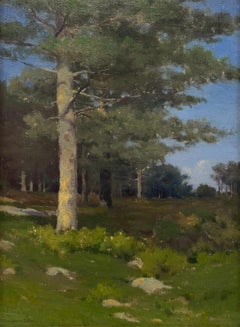
“Eastern White Pines, c. 1910”, New England Landscape, Signed Oil Painting

“Eastern White Pines, c. 1910”, New England Landscape, Signed Oil Painting

By Charles Warren Eaton

Located in Yardley, PA

“Eastern White Pines, c. 1910” by Charles Warren Eaton (American, 1857-1937). A wonderful example of Eaton’s renowned compositions of Eastern white pine trees in his mature style. A...

Category

Early 20th Century American Realist Robert Sarsony Art

Materials

Canvas, Oil, Board
"Looking for Breakfast", Oil Painting

"Looking for Breakfast", Oil Painting

By Christopher Clark

Located in Denver, CO

Christopher Clark's (US based) "Looking for Breakfast" is an original, handmade oil painting that depicts a bird perched in a flooded grassy field. Bio/artist statement: Christopher has been an artist since early childhood, when he would watch Bob Ross on PBS and mimic the famed oil painter’s art with crayons. He considers himself a self-educated artist, with his studies ranging from personal training with contemporary masters, to classical academic art technique, with much inspiration from 19th Century art and the Impressionist Movement. Christopher lived in Italy for a time, immersing himself in Italian culture and art, which continues to influence his painting. His fan base has grown considerably since his return to the US, gaining the attention of Lucasfilm and Marvel Fine Art, which both signed him as an officially licensed artist in 2016. Other clients include George Lucas, Major League Baseball, Louisville Slugger...

Category

2010s American Realist Robert Sarsony Art

Materials

Canvas, Oil

Brooklyn Bridge NYC American Scene Social Realism Mid 20th Century Modern WPA

Brooklyn Bridge NYC American Scene Social Realism Mid 20th Century Modern WPA

By Cecil Crosley Bell

Located in New York, NY

Brooklyn Bridge NYC American Scene Social Realism Mid 20th Century Modern WPA Cecil C. Bell (American, 1906-1970) Brookyn Bridge amid the NYC Waterfront 35 ½ x 23 ½ inches Oil on Bo...

Category

1930s American Realist Robert Sarsony Art

Materials

Oil, Board
Calling (study), not framed

Calling (study), not framed

By Wes Hempel

Located in Fairfield, CT

A walk through any major museum will reveal paintings that depict or legitimate only certain kinds of experience. Despite the good intentions of critical theorists questioning the va...

Category

2010s American Realist Robert Sarsony Art

Materials

Canvas, Oil

Industrial Mural Study, Veterans Memorial Building, Santa Barbara WPA American

Industrial Mural Study, Veterans Memorial Building, Santa Barbara WPA American

Located in New York, NY

Industrial Mural Study, Veterans Memorial Building, Santa Barbara WPA American Joseph Edward Knowles (1907-1980) "Study for Industry Mural, Veterans Memorial Building, Santa Barbara, CA" 19 1/2 x 50 1/2 inches Oil on board, c. 1930s. Estate stamp verso Framed: 27 x 60 inches The completed mural is currently hanging on the wall, part of the building actually, at the Veterans Memorial Building in Santa Barbara. A photo of the work insitu is included in the attached photos. BIO Joseph Edward Knowles was born in Kendall, Montana, on June 15, 1907. He grew up in San Diego, California. At age twenty, two years before the beginning of the Great Depression, he moved north to another town on the coast of California---Santa Barbara. There he began studying fine art at the Santa Barbara School of the Arts* (1927-1930), under the supervision of Frank Morley Fletcher, previously director of the Edinburgh College of Art. Fletcher, who was trained in portraiture, landscape painting, and woodblock* printing, was a great influence on young Knowles. It was there that Knowles learned the art of color woodblock printmaking, a medium in which he showed great skill. Not long after completing his studies with Fletcher, Knowles began teaching art. For a period of thirty years, from 1930 to1960, he taught at the Cate School in Carpinteria, California. In 1934-1935, Knowles traveled throughout Europe, further developing his artistic skills in England, France, and Italy. Upon his return, he continued to teach art at various schools and institutions: Cate School, Crane Country School, extension classes at the University of California at Santa Barbara (UCSB), and at the Santa Barbara Museum of Art (SBMA). Knowles also served as an art education consultant for the County of Santa Barbara. In addition, he was founding co-director and president of the Santa Barbara Fine Arts Institute (1969-1972), which later developed a specialization in photography and became the Brooks Institute of Photography. Knowles died at his home in Santa Barbara on September 8, 1980. Much of Knowles' watercolor work is associated with what has been termed the "California School*," a loose grouping of artists throughout the state that included such figures as Millard Sheets, Phil Dike, Dong Kingman, George Post, and the Santa Barbara painters Dan Lutz and Standish Backus, Jr. The California School artists, including Knowles, were known for their fresh, direct, spontaneous style of watercolor painting. Knowles and other members of the school found inspiration in nature and the built environment alike, emphasizing elements of design in their exuberant, boldly stated, colorful scenes from everyday life. While painting in a representational* manner, Knowles generally avoided photographic realism, preferring subjective interpretation of his subjects. In this, as well as in his experimental approach and vigorous brushwork, he displayed a strongly modern sensibility. Knowles often used the wet-on-wet watercolor technique as he painted seascapes and landscapes, mostly along the California coast. He also employed dry-brush* techniques in many of his paintings, often leaving some of the white of the watercolor paper exposed. Some of the latter depict trees and other forms in a broken and airy manner that recalls Cezanne. Knowles' colored woodblock prints are more reserved and exact in their draftsmanship than his paintings. Spare, clean, lyrical lines are drawn to illustrate floral motifs and boat scenes with a touch of asymmetry conjuring Japanese woodblock prints. His murals from the post-World War II period are considerably more modern in their approach and show an emphasis on design and color. PROFESSIONAL ORGANIZATIONS California Watercolor Society (1940 - 1955) Santa Barbara Art Association (Vice President - 1952) ONE-MAN EXHIBITIONS Golden Gate International Exposition (GGIE) - San Francisco, California San Diego Fine Arts Gallery (SDMA) - San Diego, California Santa Barbara Museum of Art (SBMA) - Santa Barbara, California Cowie Galleries - Los Angeles, California Gallery de Silva - Santa Barbara, California Bradley Galleries - Santa Barbara, California MURALS Westmont College - Ellen Porter Hall Mural - Santa Barbara, California Safeway Grocery (now Vons Grocery on West Victoria Street) - Exterior Tile Mosaic - Santa Barbara, California Santa Barbara Bank & Trust - Interior Mosaic Panels, Santa Barbara, California Santa Barbara Girls Club - Interior Mosaic Mural - Santa Barbara, California Ernest Righetti High School - Mosaic Mural - Santa Maria, California Shell Oil Company - Mosaic Panel - California Beckman Instruments, Corporate Headquarters - Mosaic - Fullerton, California STAINED GLASS WINDOWS, WALLS and PANELS Katherine Thayer Cate Memorial Chapel - Cate School, Carpinteria, California William S. Porter Memorial Chapel - Cottage Hospital, Santa Barbara, California La Rinconada Building - Santa Barbara, California ILLUSTRATIONS "California's Wonderful Corner: True Stories for Children from the History of the Santa Barbara Region," by Walter A. Tompkins (1962 & 1975) China Designs: Two sets of dinnerware for Winfield China...

Category

1930s American Realist Robert Sarsony Art

Materials

Oil, Board
"Study for Long Beach" WPA American Scene Social Realism Modernism Ashcan

"Study for Long Beach" WPA American Scene Social Realism Modernism Ashcan

By Daniel Celentano

Located in New York, NY

"Study for Long Beach" WPA Mid 20th Century American Scene Social Realism Modernism Ashcan Daniel Ralph Celantano (1902-1980) "Study for Long Beach" 8 x 10 inches Oil on artist bo...

Category

1930s American Realist Robert Sarsony Art

Materials

Oil, Board
Snow in the City, American Winter Scene Painting, Ornate Frame, Mid-Century Oil

Snow in the City, American Winter Scene Painting, Ornate Frame, Mid-Century Oil

By Clyde Singer

Located in Marco Island, FL

American life is captured in this Clyde Singer painting, Snow in the City (1954), where he depicts an everyday moment in the city. An ordinary scene, of a group of women making thei...

Category

1950s American Realist Robert Sarsony Art

Materials

Oil, Board

Bubbles Oil Painting on Canvas, American Realist, Mid-20th Century

Bubbles Oil Painting on Canvas, American Realist, Mid-20th Century

By John Koch

Located in Bryn Mawr, PA

Bubbles Oil on canvas, 44 1/2 x 30 inches (113 x 76.2 cm) Signed lower right: Koch Provenance Private collection, New Jersey; Thomas Colville Fine Art, Guilford, Connecticut; Privat...

Category

Mid-20th Century American Realist Robert Sarsony Art

Materials

Canvas, Oil

"Aspen Autumn II", Oil Painting

"Aspen Autumn II", Oil Painting

By Christopher Clark

Located in Denver, CO

Christopher Clark's (US based) "Aspen Autumn II" is an original, handmade oil painting that depicts a forest of Aspen trees in Fall colors of orange and yellow. Bio/artist statement: Christopher has been an artist since early childhood, when he would watch Bob Ross...

Category

2010s American Realist Robert Sarsony Art

Materials

Canvas, Oil

Previously Available Items
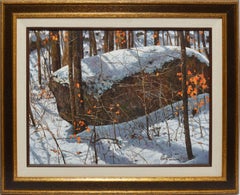
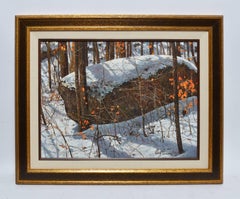
Realist Landscape of a Winter Forest by Robert Sarsony

Realist Landscape of a Winter Forest by Robert Sarsony

By Robert Sarsony

Located in Buffalo, NY

Realist landscape of a winter forest by Robert Sarsony. Oil on board, circa 1970. Signed lower right. Displayed in a giltwood frame. Image size, 18"L x 14"H, overall 20.5"L x 16.5"H

Category

1970s Realist Robert Sarsony Art

Materials

Canvas, Oil, Board

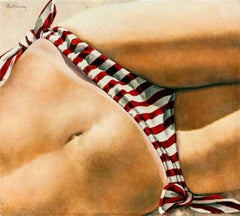
Bikini, 1975
Bikini, 1975

Bikini, 1975

By Robert Sarsony

Located in Surfside, FL

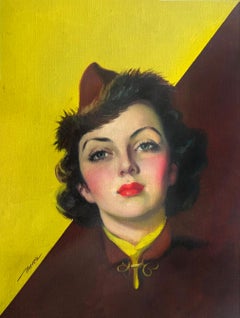
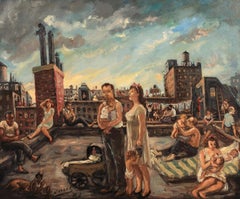
Robert Sarsony was born in 1938 and is a self taught painter. Sarsony's style is called Modern American Realism. He has been inspired by book and magazine illustrations from the 1920's through the 1940s. Subjects range from silent movie photographs and pictures of important historical events to reproductions taken from period children's books. Sarsony also portrays figure and landscape subjects with an attention to light effects that give his canvases an impressionistic air. In His Own Words "I've done quite a few model paintings. It seems I always have another idea or pose for what I call my "Model Series". The titles usually begin with "Model". Sometimes the model is taking a critical look at the work in progress on the easel. At other times I show the model dressing or undressing or just resting. In my "Deco Series" the subject is usually shown with a few objects that suggest a setting against a white background. In the "Post Card Series” I combine images of early cars, planes, ships, etc with images of old post cards, playing cards or other early collectible cards from cereal boxes or cigarette packs. Mostly I use images of girls--sometimes based on actual cards and sometimes invented. The cards are painted so they appear to be real cards tucked into the frame of the painting. Robert Sarsony's hard work has paid off. His paintings hang in many prominent collections and museums, including the Smithsonian Institution's National Museum of American Art in Washington, D.C., the Joslyn Art Museum in Omaha, Nebraska, and the American Embassy Collection in Washington, D.C. Robert Sarsony was much influenced by the Impressionists, but not so much by their brushwork as by their conceptual approach to color and structure and their interest in expressing mood. obert Sarsony is a self-taught painter and printmaker who began exhibiting in local shows in New Jersey in 1963. The following year he made his New York debut in a group show at Allied Artists. From 1969 until about 1974 he did a series of paintings based on book and magazine illustrations—“pop antiques...

Category

20th Century American Realist Robert Sarsony Art

Materials

Canvas, Oil

Robert Sarsony art for sale on 1stDibs.

Find a wide variety of authentic Robert Sarsony art available for sale on 1stDibs. You can also browse by medium to find art by Robert Sarsony in board, gesso, oil paint and more. Not every interior allows for large Robert Sarsony art, so small editions measuring 24 inches across are available. Customers who are interested in this artist might also find the work of Ben Black, Stephanie Buer, and McWillie Chambers. Robert Sarsony art prices can differ depending upon medium, time period and other attributes. On 1stDibs, the price for these items starts at $1,100 and tops out at $1,100, while the average work can sell for $1,100.

Artists Similar to Robert Sarsony