Robert Tavener Art

British, 1920-2004

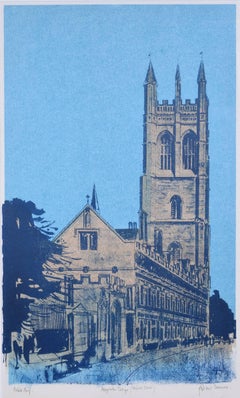
Robert Tavener was born and brought up in Hampstead, in a family of tailors and glovers. He showed his artistic talent at a young age, mostly through use of chalk on pavements. After leaving school, Tavener took a desk job to please his parents rather than following his artistic bent but was soon called up to serve in the Royal Artillery in 1940. His war service took him to the beaches of Normandy on D-Day and allowed him to study for eight months after the war ended at the University of Göttingenin the arts and crafts faculty. Studying at Hornsey College of Art specializing in lithography, he obtained a teaching diploma. Posts at the Medway College of Art in Rochester and St Martin’s School of Art in London were followed by Eastbourne College of Art and Design, where Tavener became the Head of Printmaking. Tavener’s prints were produced on his 1882 Albion Press in his studio at home and largely focused on the English countryside and architecture. “My subject matter is a personal interpretation of the richness, variety, beauty, and the underlying relationship with the past, of our landscape and building,” he said. His architectural output focused on pictures of Oxford and Cambridge, as well as the great cathedrals and Wren’s city churches. Much of his work went to public institutions, both in the UK and the USA.

to
7
7
5
3
2
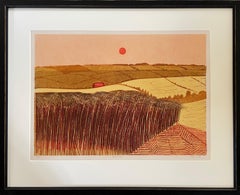
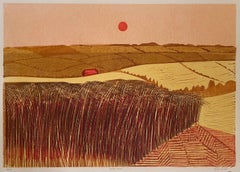
Robert Tavener - Cornfield and Downs - 20th Century British Landscape Linocut
By Robert Tavener
Located in London, GB
ROBERT TAVENER (1920-2004) Cornfield and Downs Signed, inscribed with title and numbered 45/75 Linocut Framed 40 by 55 cm., 15 ¾ by 21 ¾ in. (frame size 62 by 76.5 cm., 24 ¼ by 30...
Category

Late 20th Century Modern Robert Tavener Art

Materials

Linocut

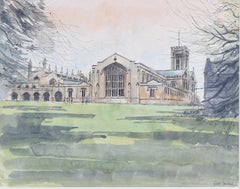
Robert Tavener: Cheltenham College architectural watercolour
By Robert Tavener
Located in London, GB
To see our other Modern British Art, scroll down to "More from this Seller" and below it click on "See all from this Seller" - or send us a message if you cannot find the artist you ...
Category

Mid-20th Century Modern Robert Tavener Art

Materials

Watercolor, Pen

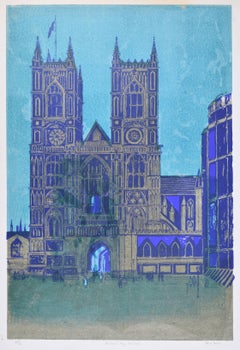
Robert Tavener Westminster Abbey London Lithograph Modern British Art
By Robert Tavener
Located in London, GB
To see our other Modern British Art and views of London, scroll down to "More from this Seller" and below it click on "See all from this Seller" - or send us a message if you cannot ...
Category

1970s Modern Robert Tavener Art

Materials

Lithograph

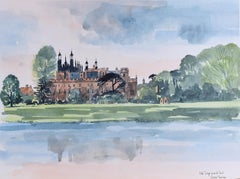
Robert Tavener Eton College from the Lock watercolour Windsor England painting
By Robert Tavener
Located in London, GB
Robert Tavener (1920-2004) Eton College from the Lock Watercolour 36x48cm Signed and inscribed Born and brought up in Hampstead, in a family of tailors and glovers, Robert Tavener s...
Category

Late 20th Century Robert Tavener Art

Materials

Watercolor

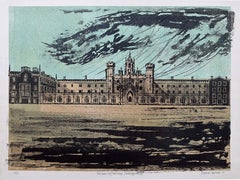
Robert Tavener New Court St John's College Cambridge University Lithograph
By Robert Tavener
Located in London, GB
To see our other Modern British Art and views of Oxford and Cambridge, scroll down to "More from this Seller" and below it click on "See all from this Seller" - or send us a message ...
Category

1970s Modern Robert Tavener Art

Materials

Lithograph

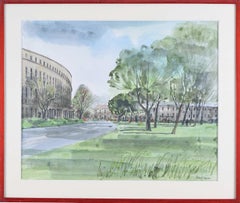
Robert Tavener: Lansdown Parade, Cheltenham architectural watercolour
By Robert Tavener
Located in London, GB
To see our other Modern British Art, scroll down to "More from this Seller" and below it click on "See all from this Seller" - or send us a message if you cannot find the artist you ...
Category

Mid-20th Century Modern Robert Tavener Art

Materials

Watercolor, Pen

Robert Tavener Magdalen College Oxford Screenprint Modern British Art
By Robert Tavener
Located in London, GB
To see our other views of Oxford and Cambridge, scroll down to "More from this Seller" and below it click on "See all from this Seller" - or send us a message if you cannot find the ...
Category

1970s Modern Robert Tavener Art

Materials

Screen

Related Items
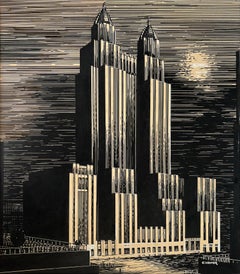
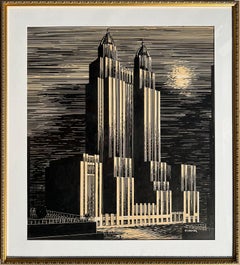
Waldorf Astoria Art Deco Illustration
Located in Miami, FL
Artist Charles Perry Weimer employs thin black horizontal lines that intersect with thin black vertical lines. The result is a triumph of design w...
Category

1930s Art Deco Robert Tavener Art

Materials

Ink, Gouache, Pen

French Watercolor of L'Hippocampe Beachfront Restaurant with Coastal Views
Located in Cirencester, Gloucestershire
Title: French Watercolor of L'Hippocampe Beachfront Restaurant with Coastal Views by Robert Lepine (French, 1929 - 2017) Signed: Yes Medium: Watercolor painting on artists paper, mou...
Category

Late 20th Century French School Robert Tavener Art

Materials

Watercolor, Pen

"Times Square" Mid 20th Century 1937 Modernism Broadway Drawing NYC Cityscape
Located in New York, NY
"Times Square" Mid 20th Century 1937 Modernism Broadway Drawing NYC Cityscape Philip Goodwin (20th Century) "Times Square," 23 ½ x 17 ¼ inches. Gouache...
Category

1930s American Modern Robert Tavener Art

Materials

Paper, Gouache

French Watercolor of Monte Carlo Gardens Set Against the Monaco Hills
Located in Cirencester, Gloucestershire
Title: French Watercolor of Monte Carlo Gardens Set Against the Monaco Hills by Robert Lepine (French, 1929 - 2017) Signed: Yes Medium: Watercolor painting on artists paper, unframed...
Category

Late 20th Century French School Robert Tavener Art

Materials

Watercolor, Pen

Avignon Bouquet, Modern Lithograph by Lloyd Lozes Goff
Located in Long Island City, NY
Lloyd Lozes Goff, American (1918 - 1982) - Avignon Bouquet, Year: 1979, Medium: Lithograph, Signed and Numbered in Pencil, Edition: 250, AP 30, Image Size: 24 x 18.5 inches, Size...
Category

1970s Modern Robert Tavener Art

Materials

Lithograph

Norwegian Pine Grove - The inner glow of the trees -
Located in Berlin, DE
Themistokles von Eckenbrecher (1842 Athens - 1921 Goslar), Norwegian pine grove, 1901. Watercolor on blue-green paper, 30 x 22 cm. Signed, dated and inscribed in his own hand "TvE. Fagermes [i.e. Fagermes]. 26.6.[19]01." - Slight crease throughout at left margin, otherwise in good condition. About the artwork Themistokles von Eckenbrecher often traveled to Norway to study the nature that fascinated him there. On June 26, 1901, near the southern Norwegian town of Fagernes, in the summer evening sun, he saw a small pine grove, which he immediately captured in a watercolor. He exposed the trees growing on a small hill in front of the background, so that the pines completely define the picture and combine to form a tense motif. The tension comes from the contrast of form and color. The trunks, growing upward, form a vertical structure that is horizontally penetrated by the spreading branches and the pine needles, which are rendered as a plane. This structural tension is further intensified by the color contrast between the brown-reddish iridescent trunks and branches and the green-toned needlework. Themistokles von Eckenbrecher, however, does not use the observed natural scene as an inspiring model for a dance of color and form that detaches itself from the motif and thus treads the path of abstracting modernism. Its inner vitality is to be brought to light and made aesthetically accessible through the work of art. It is precisely in order to depict the inner vitality of nature that von Eckenbrecher chooses the technique of watercolor, in which the individual details, such as the needles, are not meticulously worked out, but rather a flowing movement is created that unites the contrasts. The trees seem to have formed the twisted trunks out of their own inner strength as they grew, creatingthose tense lineations that the artist has put into the picture. The inner strength continues in the branches and twigs, culminating in the upward growth of the needles. At the same time, the trunks, illuminated by the setting sun, seem to glow from within, adding an almost dramatic dimension to the growing movement. Through the artwork, nature itself is revealed as art. In order to make nature visible as art in the work, von Eckenbrecher exposes the group of trees so that they are bounded from the outside by an all-encompassing contour line and merge into an areal unity that enters into a figure-ground relationship with the blue-greenish watercolor paper. The figure-ground relationship emphasizes the ornamental quality of the natural work of art, which further enforces the artwork character of the group of trees. With the presentation of Themistokles von Eckenbrecher's artistic idea and its realization, it has become clear that the present watercolor is not a study of nature in the sense of a visual note by the artist, which might then be integrated into a larger work context, but a completely independent work of art. This is why von Eckenbrecher signed the watercolor. In addition, it is marked with a place and a date, which confirms that this work of nature presented itself to him in exactly this way at this place at this time. At the same time, the date and place make it clear that the natural work of art has been transferred into the sphere of art and thus removed from the time of the place of nature. About the artist Themistocles' parents instilled a life of travel in their son, who is said to have spoken eleven languages. His father, who was interested in ancient and oriental culture, was a doctor and had married Francesca Magdalena Danelon, an Italian, daughter of the British consul in Trieste. During a stay in Athens - Gustav von Eckenbrecher was a friend of Heinrich von Schliemann and is said to have given him crucial clues as to the location of Troy - Themistokles saw the light of day in 1842. After an interlude in Berlin, where Themistokles was educated at the English-American School, the journey began again. From 1850 to 1857 the family lived in Constantinople, after which the father opened a practice in Potsdam, where Themistokles, who wanted to become a painter, was taught by the court painter Carl Gustav Wegener. In 1861 the von Eckenbrechers left Potsdam and settled in Düsseldorf. There Themistokles received two years of private tuition from Oswald Aschenbach, who greatly admired the talented young artist. After his artistic training, he undertook extensive travels, often accompanied by Prince Peter zu Sayn-Wittgenstein, which took him to northern and eastern Europe, but above all to the Middle East and even to South America. The paintings that resulted from these journeys established his artistic reputation and led to his participation in large panoramas such as the 118 x 15 metre Entry of the Mecca Caravan into Cairo, painted for the City of Hamburg in 1882. 1882 was also the start of a total of 21 study trips to Scandinavia, most of them to Norway, and the unique Norwegian landscape with its rugged fjords became a central motif in his work. Along with Anders Askevold and Adelsteen Normann...
Category

Early 1900s Naturalistic Robert Tavener Art

Materials

Watercolor

Landscape - Drawing By Reynold Arnould - 1977
Located in Roma, IT
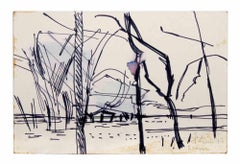
Landscape is a black Marker Drawing and Watercolour realized by Reynold Arnould (Le Havre 1919 - Parigi 1980). Good condition on a little white paper. No signature, dated on the l...
Category

1970s Modern Robert Tavener Art

Materials

Paper, Watercolor, Permanent Marker

"building up" abstract cityscape, geometric, pencil, marker, acrylic on panel
By Miriam Singer
Located in Philadelphia, PA
This piece titled "building up" is original artwork made from pencil, marker, acrylic paint on panel by Miriam Singer. This piece measures 6"h x 6"w. Miriam Singer grew up in Buffalo, New York, In 2000 she received her BA from Brandeis University, and in 2003 her MFA from Massachusetts College of Art. Since moving to Philadelphia in 2004; Miriam Singer has exhibited at James Oliver Gallery. Stanek Gallery, LG Tripp Gallery, Woodmere Art Museum, Space 1026, Friends of the Print and Picture Collection...
Category

21st Century and Contemporary Contemporary Robert Tavener Art

Materials

Watercolor, Panel, Permanent Marker, Pencil

Rowing Figure in an Eerie Landscape, 1929
Located in Stockholm, SE
Rowing Figure in an Eerie Landscape is a 1929 watercolor-and-ink illustration by Swedish artist Einar Norelius. Created for the 22nd issue of Bland tomtar och troll, the cherished an...
Category

1920s Symbolist Robert Tavener Art

Materials

Paper, Ink, Watercolor

Woodstock, Modern Lithograph by Lloyd Lozes Goff
Located in Long Island City, NY
Lloyd Lozes Goff, American (1918 - 1982) - Woodstock, Year: circa 1979, Medium: Lithograph, signed and numbered in pencil, Edition: 250, AP 30, Image Size: 19 x 23 inches, Size: ...
Category

1970s Modern Robert Tavener Art

Materials

Lithograph

Mid-Century Modern Paris: A View of the Seine
Located in Norwich, GB
Experience the romance and abstraction of 1950s Paris through this striking original mixed media drawing by the acclaimed American Modernist, Frederick E. Conway (1900–1973). This c...
Category

Mid-20th Century American Modern Robert Tavener Art

Materials

Ink, Watercolor, Gouache

Red blooming war landscape with dead soldier - Bleeding flowers -
Located in Berlin, DE
Johannes Friedrich Heinrich Hänsch (1875-1945), Red blooming war landscape with dead soldier, 1918. Watercolor and gouache on paper, 15 x 24.5 cm (image), 27 x 37 cm (sheet size / frame), monogrammed and dated "19JH18" at lower left. - Paper slightly darkened About the artwork Despite the relatively small format, the watercolor with an internal frame depicts a panoramic view of a flat landscape stretching to the horizon. As far as the eye can see, the poppies bloom in flaming red. The flowers are not rendered individually, however, creating an almost cohesive red surface. The bright red is interspersed with vegetal green. A complementary contrast that creates an intense color effect. In this color contrast, a white area breaks through from the middle ground, widening towards the foreground and surrounding a brown hole. Next to it, in blue, is the actual protagonist of the painting, the first thing that catches the eye: a dead soldier. Next to him is his helmet, revealing the empty interior. The brown, hollow shape corresponds to the hole in the ground. A shell funnel is surrounded by bright ash, which, like the inverted helmet, becomes a sign of death. The soldier's arms point to the funnel, while the empty helmet paraphrases the calotte of the skull and, like the funnel, thematizes the empty darkness of death. The soldier's body, however, is intact and not - as in Otto Dix's triptych "The War" - a dismembered corpse. Instead, Johannes Hänsch activates the landscape, especially the color, to illustrate a blooming landscape of death that extends from the shell funnel in the foreground to the rising column of smoke on the horizon. If the soldier's body is intact, the tangle of barbed wire emblematically placed over the empty helmet also appears tattered. On the right side of the picture, the barbed wire even seems to stretch its arms to the sky in horror. Against the background of this allegory, the content of the bright red also becomes clear: the landscape is drenched in blood, literally a sea of blood, and the single unknown soldier stands pars pro toto for all those who died on the battlefield. Dying in war is not dying in community, but in solitude. In order to emphasize the isolation in death, Johannes Hänsch has set the blue of the soldier in the axis given by his body in the middle ground of the picture into the red sea. A master of landscape painting, Hänsch succeeds in creating a natural-looking landscape allegory that illustrates the horror and death of war, without depicting the brutality of war itself. This singular 'war memorial' of the unknown soldier is the opposite of heroization and yet the dignity of the deceased soldier is preserved through the integrity of his body. About the artist As the son of the sculptor Adolf Haensch, the young Johannes received his first artistic training in his father's Berlin studio. However, he eventually decided to become a painter, and in 1897 he entered the Berlin Academy of Arts. He initially studied under Paul Vorgang and Eugen Bracht, and was particularly influenced by Bracht's increasingly colourful landscape painting. In 1901 he moved to the class of Friedrich Kallmorgen, with whom he spent several weeks on excursions into nature. In 1905 he became a master pupil of Albert Hertel, who taught him watercolour painting. From 1903 to 1933 he exhibited annually at the Great Berlin Art Exhibition, the exhibitions of the Berlin Artists' Association and the Munich Glaspalast. In 1905 he was awarded the Carl Blechen...
Category

1910s Realist Robert Tavener Art

Materials

Watercolor

Previously Available Items
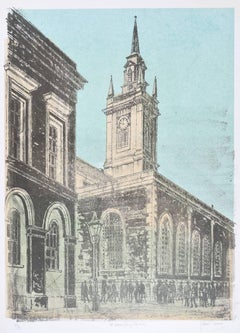
Robert Tavener St Lawrence Jewry Wren Church London Litho Modern British Art
By Robert Tavener
Located in London, GB
To see our other Modern British Art and views of London, scroll down to "More from this Seller" and below it click on "See all from this Seller" - or send us a message if you cannot find the view you want. Robert Tavener (1920-2004) St Lawrence Jewry...
Category

1970s Modern Robert Tavener Art

Materials

Lithograph

Robert Tavener King's College Cambridge Lithograph Modern British Art
By Robert Tavener
Located in London, GB
To see our other Modern British Art and views of Oxford and Cambridge, scroll down to "More from this Seller" and below it click on "See all from this Seller" - or send us a message ...
Category

1970s Modern Robert Tavener Art

Materials

Lithograph

Robert Tavener art for sale on 1stDibs.

Find a wide variety of authentic Robert Tavener art available for sale on 1stDibs. If you’re browsing the collection of art to introduce a pop of color in a neutral corner of your living room or bedroom, you can find work that includes elements of blue and other colors. You can also browse by medium to find art by Robert Tavener in paint, watercolor, lithograph and more. Much of the original work by this artist or collective was created during the 20th century and is mostly associated with the modern style. Not every interior allows for large Robert Tavener art, so small editions measuring 14 inches across are available. Customers who are interested in this artist might also find the work of Charles Paine, Harold Cohen, and Sir Frank Brangwyn. Robert Tavener art prices can differ depending upon medium, time period and other attributes. On 1stDibs, the price for these items starts at $588 and tops out at $2,867, while the average work can sell for $1,685.

Artists Similar to Robert Tavener

Still Thinking About These?

All Recently Viewed