Ruth Thomas Prints and Multiples

to
1
3
2
Overall Width
to
Overall Height
to
6
7
1,249
947
922
853
6
4
2
4
3
1
1
1
1
1
4
3
3
3
6
6
Artist: Ruth Thomas
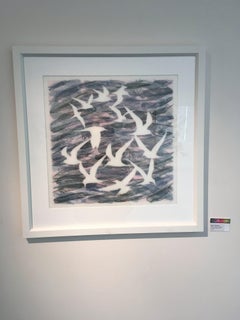
Yellow and Blue - original print feathers stencil Japanese paper

Yellow and Blue - original print feathers stencil Japanese paper

By Ruth Thomas

Located in London, GB

Original print from feathers and stencil on five layers of Japanese paper, limited edition. framed dimensions: 50 x 50 cm Artist's infromation: Ruth Thomas RCA is a contemporary pr...
Category

2010s Contemporary Ruth Thomas Prints and Multiples

Materials

Monoprint, Washi Paper

Transition - contemporary abstract collagraph relief hand-coloured print

Transition - contemporary abstract collagraph relief hand-coloured print

By Ruth Thomas

Located in London, GB

Ruth has a degree in Fine Art and a Master’s degree in Art & Design. Her work has been shown in venues all over the UK as well as overseas, including USA, France and Spain, and is re...

Category

2010s Contemporary Ruth Thomas Prints and Multiples

Materials

Color

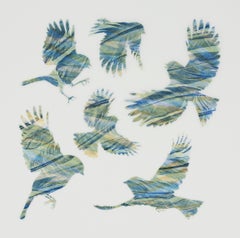
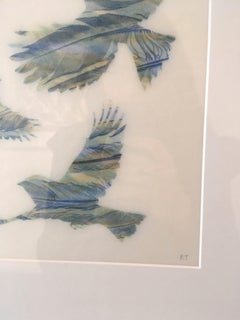
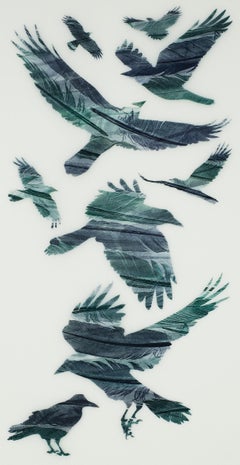
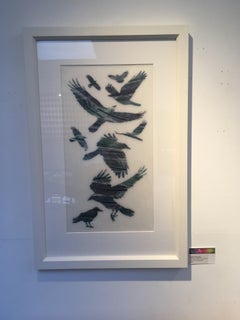
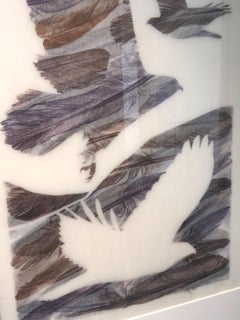
A Loosely Woven Flock of Rooks - original print feathers stencil Japanese paper

A Loosely Woven Flock of Rooks - original print feathers stencil Japanese paper

By Ruth Thomas

Located in London, GB

Original print from feathers and stencil on five layers of Japanese paper, limited edition. Framed size: 75 x 50 cm Artist's information: Ruth Thomas RCA is a contemporary printmake...

Category

2010s Contemporary Ruth Thomas Prints and Multiples

Materials

Monoprint, Washi Paper

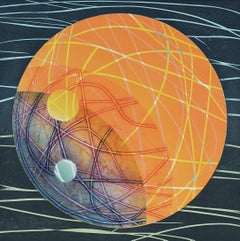
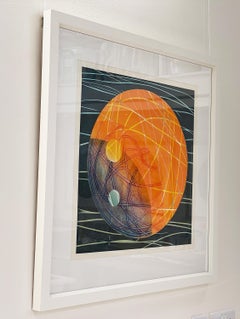
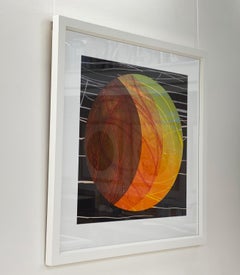
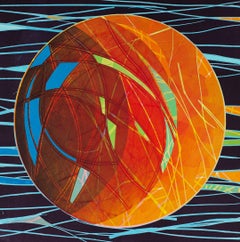
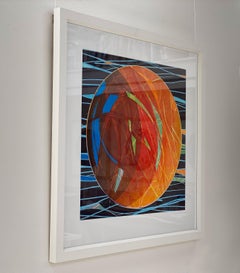
Eclipse II - contemporary abstract planet collagraph hand coloured relief print

Eclipse II - contemporary abstract planet collagraph hand coloured relief print

By Ruth Thomas

Located in London, GB

Ruth has a degree in Fine Art and a Master’s degree in Art & Design. Her work has been shown in venues all over the UK as well as overseas, including USA, France and Spain, and is re...

Category

2010s Contemporary Ruth Thomas Prints and Multiples

Materials

Color

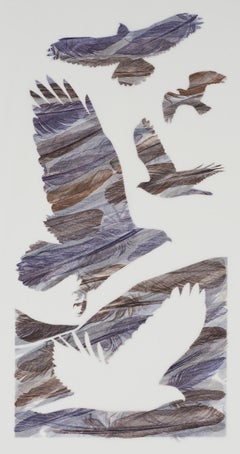
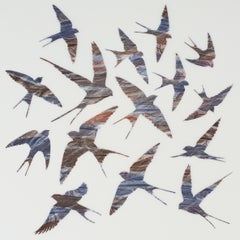
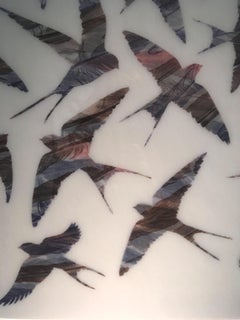
Ascend and Glide - contemporary monoprint washi paper purple birds

Ascend and Glide - contemporary monoprint washi paper purple birds

By Ruth Thomas

Located in London, GB

Original print from feathers and stencil on five layers of Japanese paper, limited edition. Framed size: 75 x 50 cm. About the artist: Ruth Thomas RCA is a contemporary printmaker b...

Category

2010s Contemporary Ruth Thomas Prints and Multiples

Materials

Monoprint, Washi Paper

Related Items
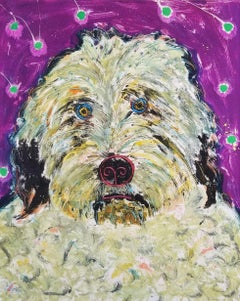
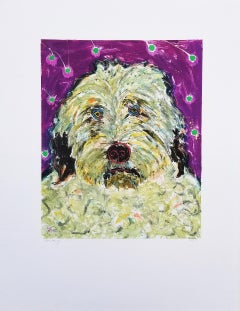
Dog Portrait II /// Contemporary Portrait Animal Face Monoprint Art

Dog Portrait II /// Contemporary Portrait Animal Face Monoprint Art

By Dan May

Located in Saint Augustine, FL

Artist: Dan May (American, 1955-) Title: "Dog Portrait II" *Signed by May in pencil lower left Year: 1997 Medium: Original Monoprint on unbranded white co...

Category

1990s Contemporary Ruth Thomas Prints and Multiples

Materials

Paint, Monoprint, Oil

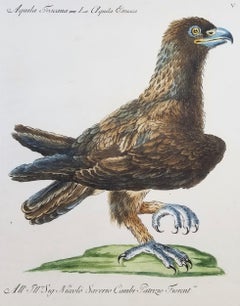
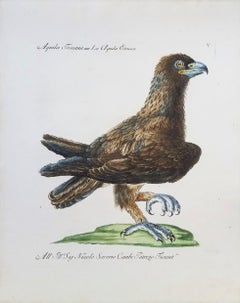
Eagle /// Antique Ornithology Bird Saverio Manetti Italian Watercolor Engraving

Eagle /// Antique Ornithology Bird Saverio Manetti Italian Watercolor Engraving

By Saverio Manetti

Located in Saint Augustine, FL

Artist: Saverio Manetti (Italian, 1723-1785) Title: "Eagle" (Plate V - 5) Portfolio: Storia Naturale Degli Uccelli (The Natural History of Birds) Year: 1767-1776 Medium: Original Han...

Category

1760s Old Masters Ruth Thomas Prints and Multiples

Materials

Watercolor, Handmade Paper, Laid Paper, Engraving, Intaglio

Vintage 1970s Alexander Calder poster (Calder prints)

Vintage 1970s Alexander Calder poster (Calder prints)

By Alexander Calder

Located in NEW YORK, NY

Alexander Calder 'La Grenouille et Cie' Vintage original 1971 poster for the exhibition Pace Columbus (Ohio) featuring a printed Calder signature. Medium: Offset lithograph Dimensions: 25 x 32 inches An original 1st printing in very good vintage condition. Plate signed on the lower right from an edition of unknown. This is an original 1970s poster and not a recent reproduction of any kind. Related Categories Calder prints. Calder Mid Century Modern. 60s. Alexander Calder and Contemporary Art. Calder figurative. Vintage Calder.

Category

1970s Contemporary Ruth Thomas Prints and Multiples

Materials

Lithograph, Offset

Two Goats, from "Daphnis & Chloe"

Two Goats, from "Daphnis & Chloe"

By Aristide Maillol

Located in Middletown, NY

Woodcut on hand made laid paper with the publisher's watermark designed by the artist, full margins. From the special suite of 53 woodcut illustrations which were laid in loose to t...

Category

Mid-20th Century French School Ruth Thomas Prints and Multiples

Materials

Handmade Paper, Laid Paper, Woodcut

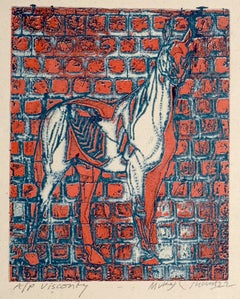
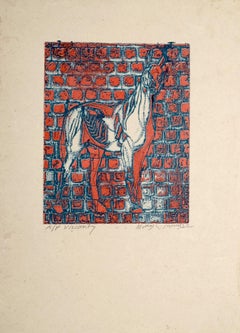
Abstract India Landscape Rajasthan Tarzan Horse Viscosity Print Nature Teracotta

Abstract India Landscape Rajasthan Tarzan Horse Viscosity Print Nature Teracotta

By Mukesh Sharma

Located in Norfolk, GB

There is a natural and raw understanding in Mukesh Sharma’s prints that depict, and are influenced by, the Rajastani communities of his home town in rura...

Category

2010s Abstract Ruth Thomas Prints and Multiples

Materials

Archival Ink, Archival Paper, Washi Paper

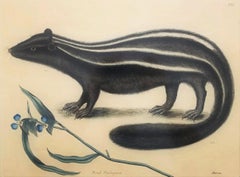
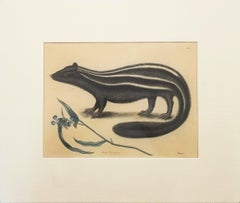
Putorius & Pseudo Phalangium (The Pole-Cat) (Skunk) /// Mark Catesby Animal Art

Putorius & Pseudo Phalangium (The Pole-Cat) (Skunk) /// Mark Catesby Animal Art

By Mark Catesby

Located in Saint Augustine, FL

Artist: Mark Catesby (English, 1638-1749) Title: "Putorius & Pseudo Phalangium (The Pole-Cat) (Skunk)" (Plate/Tab 62) Portfolio: Natural History of Carolina, Florida & the Bahama Isl...

Category

1770s Old Masters Ruth Thomas Prints and Multiples

Materials

Watercolor, Handmade Paper, Etching, Intaglio

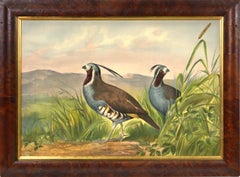
Chromolithograph of Quail

Chromolithograph of Quail

By Alexander Pope Jr.

Located in London, London

Chromolithograph of Ducks, laid on to contemporary card (as published). [Charles Scribner's Sons, New York, 1878]. Alexander Pope, Jr., was an American sculptor and painter. He’s kn...

Category

1870s Naturalistic Ruth Thomas Prints and Multiples

Materials

Handmade Paper, Lithograph

French Prawn, Woodcut Print on Rice Paper by Leonard Baskin

French Prawn, Woodcut Print on Rice Paper by Leonard Baskin

By Leonard Baskin

Located in Long Island City, NY

This woodcut print was created by American artist Leonard Baskin. Baskin is well known for his somewhat grotesque, intricate, surreal drawings and natural subject matter. This print ...

Category

1950s Surrealist Ruth Thomas Prints and Multiples

Materials

Rice Paper, Woodcut

"India, " Abstract Woodcut and Monotype signed by Carol Summers

"India, " Abstract Woodcut and Monotype signed by Carol Summers

By Carol Summers

Located in Milwaukee, WI

"India" is a woodcut and monotype signed by Carol Summers. Here, Summer's abstract language for landscape imagery is taken to its most extreme: The image offers a view of a highly stylized waterfall, with red water falling down behind green foliage below. A hint of light blue at the lower left suggests a continuation of the water's flow. Above, purples and yellows mist upward from the power of the water. The playfulness of the image is enhanced by Summers' signature printmaking technique, which allows the ink from the woodblock to seep through the paper, blurring the edges of each form. Summers' signature can be found in pencil at the bottom of the rightmost blue form, with the title and edition at the bottom of the leftmost blue form. A copy of this print can be found in the collection of the Fine Arts Museums of San Francisco. 37.25 x 24.88 inches, artwork 48.5 x 35.5 inches, frame Numbered 44 from the edition of 75 Carol Summers (1925-2016) has worked as an artist throughout the second half of the 20th century and into the first years of the next, outliving most of his mid-century modernist peers. Initially trained as a painter, Summers was drawn to color woodcuts around 1950 and it became his specialty thereafter. Over the years he has developed a process and style that is both innovative and readily recognizable. His art is known for it’s large scale, saturated fields of bold color, semi-abstract treatment of landscapes from around the world and a luminescent quality achieved through a printmaking process he invented. In a career that has extended over half a century, Summers has hand-pulled approximately 245 woodcuts in editions that have typically run from 25 to 100 in number. His talent was both inherited and learned. Born in 1925 in Kingston, a small town in upstate New York, Summers was raised in nearby Woodstock with his older sister, Mary. His parents were both artists who had met in art school in St. Louis. During the Great Depression, when Carol was growing up, his father supported the family as a medical illustrator until he could return to painting. His mother was a watercolorist and also quite knowledgeable about the different kinds of papers used for various kinds of painting. Many years later, Summers would paint or print on thinly textured paper originally collected by his mother. From 1948 to 1951, Carol Summers trained in the classical fine and studio arts at Bard College and at the Art Students League of New York. He studied painting with Steven Hirsh and printmaking with Louis Schanker. He admired the shapes and colors favored by early modernists Paul Klee (Sw: 1879-1940) and Matt Phillips (Am: b.1927- ). After graduating, Summers quit working as a part-time carpenter and cabinetmaker (which had supported his schooling and living expenses) to focus fulltime on art. That same year, an early abstract, Bridge No. 1 was selected for a Purchase Prize in a competition sponsored by the Brooklyn Museum. In 1952, his work (Cathedral, Construction and Icarus) was shown the first time at the Museum of Modern Art in New York City in an exhibition of American woodcuts. In 1954, Summers received a grant from the Italian government to study for a year in Italy. Woodcuts completed soon after his arrival there were almost all editions of only 8 to 25 prints, small in size, architectural in content and black and white in color. The most well-known are Siennese Landscape and Little Landscape, which depicted the area near where he resided. Summers extended this trip three more years, a decision which would have significant impact on choices of subject matter and color in the coming decade. After returning from Europe, Summers’ images continued to feature historical landmarks and events from Italy as well as from France, Spain and Greece. However, as evidenced in Aetna’s Dream, Worldwind and Arch of Triumph, a new look prevailed. These woodcuts were larger in size and in color. Some incorporated metal leaf in the creation of a collage and Summers even experimented with silkscreening. Editions were now between 20 and 50 prints in number. Most importantly, Summers employed his rubbing technique for the first time in the creation of Fantastic Garden in late 1957. Dark Vision of Xerxes, a benchmark for Summers, was the first woodcut where Summers experimented using mineral spirits as part of his printmaking process. A Fulbright Grant as well as Fellowships from the Louis Comfort Tiffany Foundation and the Guggenheim Foundation followed soon thereafter, as did faculty positions at colleges and universities primarily in New York and Pennsylvania. During this period he married a dancer named Elaine Smithers with whom he had one son, Kyle. Around this same time, along with fellow artist Leonard Baskin, Summers pioneered what is now referred to as the “monumental” woodcut. This term was coined in the early 1960s to denote woodcuts that were dramatically bigger than those previously created in earlier years, ones that were limited in size mostly by the size of small hand-presses. While Baskin chose figurative subject matter, serious in nature and rendered with thick, striated lines, Summers rendered much less somber images preferring to emphasize shape and color; his subject matter approached abstraction but was always firmly rooted in the landscape. In addition to working in this new, larger scale, Summers simultaneously refined a printmaking process which would eventually be called the “Carol Summers Method” or the “ Carol Summers Technique”. Summers produces his woodcuts by hand, usually from one or more blocks of quarter-inch pine, using oil-based printing inks and porous mulberry papers. His woodcuts reveal a sensitivity to wood especially its absorptive qualities and the subtleties of the grain. In several of his woodcuts throughout his career he has used the undulating, grainy patterns of a large wood plank to portray a flowing river or tumbling waterfall. The best examples of this are Dream, done in 1965 and the later Flash Flood Escalante, in 2003. In the majority of his woodcuts, Summers makes the blocks slightly larger than the paper so the image and color will bleed off the edge. Before printing, he centers a dry sheet of paper over the top of the cut wood block or blocks, securing it with giant clips. Then he rolls the ink directly on the front of the sheet of paper and pressing down onto the dry wood block or reassembled group of blocks. Summers is technically very proficient; the inks are thoroughly saturated onto the surface of the paper but they do not run into each other. The precision of the color inking in Constantine’s Dream in 1969 and Rainbow Glacier in 1970 has been referred to in various studio handbooks. Summers refers to his own printing technique as “rubbing”. In traditional woodcut printing, including the Japanese method, the ink is applied directly onto the block. However, by following his own method, Summers has avoided the mirror-reversed image of a conventional print and it has given him the control over the precise amount of ink that he wants on the paper. After the ink is applied to the front of the paper, Summers sprays it with mineral spirits, which act as a thinning agent. The absorptive fibers of the paper draw the thinned ink away from the surface softening the shapes and diffusing and muting the colors. This produces a unique glow that is a hallmark of the Summers printmaking technique. Unlike the works of other color field artists or modernists of the time, this new technique made Summers’ extreme simplification and flat color areas anything but hard-edged or coldly impersonal. By the 1960s, Summers had developed a personal way of coloring and printing and was not afraid of hard work, doing the cutting, inking and pulling himself. In 1964, at the age of 38, Summers’ work was exhibited for a second time at the Museum of Modern Art. This time his work was featured in a one-man show and then as one of MoMA’s two-year traveling exhibitions which toured throughout the United States. In subsequent years, Summers’ works would be exhibited and acquired for the permanent collections of multiple museums throughout the United States, Europe and Asia. Summers’ familiarity with landscapes throughout the world is firsthand. As a navigator-bombardier in the Marines in World War II, he toured the South Pacific and Asia. Following college, travel in Europe and subsequent teaching positions, in 1972, after 47 years on the East Coast, Carol Summers moved permanently to Bonny Doon in the Santa Cruz Mountains in Northern California. There met his second wife, Joan Ward Toth, a textile artist who died in 1998; and it was here his second son, Ethan was born. During the years that followed this relocation, Summers’ choice of subject matter became more diverse although it retained the positive, mostly life-affirming quality that had existed from the beginning. Images now included moons, comets, both sunny and starry skies, hearts and flowers, all of which, in one way or another, remained tied to the landscape. In the 1980s, from his home and studio in the Santa Cruz mountains, Summers continued to work as an artist supplementing his income by conducting classes and workshops at universities in California and Oregon as well as throughout the Mid and Southwest. He also traveled extensively during this period hiking and camping, often for weeks at a time, throughout the western United States and Canada. Throughout the decade it was not unusual for Summers to backpack alone or with a fellow artist into mountains or back country for six weeks or more at a time. Not surprisingly, the artwork created during this period rarely departed from images of the land, sea and sky. Summers rendered these landscapes in a more representational style than before, however he always kept them somewhat abstract by mixing geometric shapes with organic shapes, irregular in outline. Some of his most critically acknowledged work was created during this period including First Rain, 1985 and The Rolling Sea, 1989. Summers received an honorary doctorate from his alma mater, Bard College in 1979 and was selected by the United States Information Agency to spend a year conducting painting and printmaking workshops at universities throughout India. Since that original sabbatical, he has returned every year, spending four to eight weeks traveling throughout that country. In the 1990s, interspersed with these journeys to India have been additional treks to the back roads and high country areas of Mexico, Central America, Nepal, China and Japan. Travel to these exotic and faraway places had a profound influence on Summers’ art. Subject matter became more worldly and nonwestern as with From Humla to Dolpo, 1991 or A Former Life of Budha, 1996, for example. Architectural images, such as The Pillars of Hercules, 1990 or The Raja’s Aviary, 1992 became more common. Still life images made a reappearance with Jungle Bouquet in 1997. This was also a period when Summers began using odd-sized paper to further the impact of an image. The 1996 Night, a view of the earth and horizon as it might be seen by an astronaut, is over six feet long and only slightly more than a foot-and-a-half high. From 1999, Revuelta A Vida (Spanish for “Return to Life”) is pie-shaped and covers nearly 18 cubic feet. It was also at this juncture that Summers began to experiment with a somewhat different palette although he retained his love of saturated colors. The 2003 Far Side of Time is a superb example of the new direction taken by this colorist. At the turn of the millennium in 1999, “Carol Summers Woodcuts...

Category

1990s Contemporary Ruth Thomas Prints and Multiples

Materials

Monotype, Woodcut

Barnacle Geese Affrighted

Barnacle Geese Affrighted

Located in Middletown, NY

Etching and drypoint on cream wove paper, full margins. Signed and numbered 59/75 in pencil, lower margin. Notations in pencil along the lower sheet edge, recto, well outside of ima...

Category

Mid-20th Century Modern Ruth Thomas Prints and Multiples

Materials

Handmade Paper, Drypoint, Etching

Inset - iPhone drawing, pigment print, wall, grid

Inset - iPhone drawing, pigment print, wall, grid

By Sean Scully

Located in Köln, DE

Since Sean Scully figured out to draw on the iPhone display, these drawings are published as archival pigment prints. The depictions is the same as in his paintings and prints...

Category

2010s Contemporary Ruth Thomas Prints and Multiples

Materials

Archival Pigment

Une porte d'auberge / Inn Door

Une porte d'auberge / Inn Door

By Charles-Emile Jacque

Located in Middletown, NY

Etching on Chine collé mounted to cream wove paper, 3 7/8 x 5 7/8 inches (97 x 147 mm), full margins. With a pencil notation in the right margin on the recto (outside of image area),...

Category

Mid-19th Century Ruth Thomas Prints and Multiples

Materials

Handmade Paper, Etching

Previously Available Items
Sphere II - planet collagraph hand coloured print

Sphere II - planet collagraph hand coloured print

By Ruth Thomas

Located in London, GB

Ruth has a degree in Fine Art and a Master’s degree in Art & Design. Her work has been shown in venues all over the UK as well as overseas, including USA, France and Spain, and is re...

Category

2010s Contemporary Ruth Thomas Prints and Multiples

Materials

Color

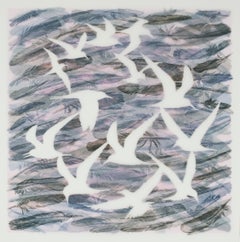
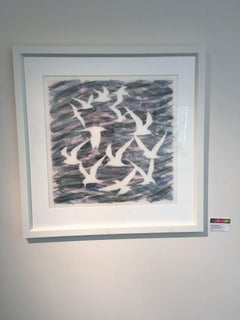
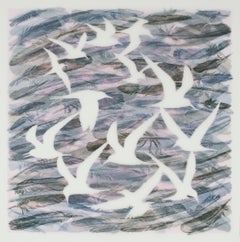
As Swift as Swallows Fly - original print feathers stencil Japanese paper

As Swift as Swallows Fly - original print feathers stencil Japanese paper

By Ruth Thomas

Located in London, GB

Original print from feathers and stencil on five layers of Japanese paper, limited edition. Framed size: 75 x 74 cm About the artist: Ruth Thomas RCA is a contemporary printmaker ba...

Category

2010s Contemporary Ruth Thomas Prints and Multiples

Materials

Monoprint

Wings Dipped in Light

Wings Dipped in Light

By Ruth Thomas

Located in London, GB

Original print from feathers and stencil on five layers of Japanese paper, limited edition. Framed size: 75 x 74 cm

Category

2010s Contemporary Ruth Thomas Prints and Multiples

Materials

Monoprint

Ruth Thomas prints and multiples for sale on 1stDibs.

Find a wide variety of authentic Ruth Thomas prints and multiples available for sale on 1stDibs. If you’re browsing the collection of prints and multiples to introduce a pop of color in a neutral corner of your living room or bedroom, you can find work that includes elements of orange and other colors. You can also browse by medium to find art by Ruth Thomas in monoprint, handmade paper, paper and more. Much of the original work by this artist or collective was created during the 21st century and contemporary and is mostly associated with the contemporary style. Not every interior allows for large Ruth Thomas prints and multiples, so small editions measuring 10 inches across are available. Customers who are interested in this artist might also find the work of German Perez, Arun Bose, and Yanieb Fabre. Ruth Thomas prints and multiples prices can differ depending upon medium, time period and other attributes. On 1stDibs, the price for these items starts at $940 and tops out at $1,378, while the average work can sell for $1,128.