Shigeru Taniguchi Art

Japanese, b. 1948
Taniguchi was born in Fukuoka in 1948. After finishing high school, he left the southern island of Kyushu and relocated to metropolitan Tokyo. He pursued art part-time while illustrating books and working at a commercial printing company. Unlike many contemporary Japanese artists, who deliberately choose and then refine one specific theme throughout their career, Taniguchi’s themes varied widely, based on whatever he was interested in at the time. This led to works of stunning imagination and creativity -- from a series on Noh, to prints inspired by his idols Man Ray and Jasper Johns, to several prints around the theme of brushes. Each new edition of his prints was a huge success with our customers and his silkscreens were accepted by a myriad of international biennales, at several of which he was awarded the top prize. Everything was grist for his creative mill, and it was always an exciting time when Taniguchi-san came to show us a new silkscreen edition. My family members often recognized items from our home that we had planned on discarding but that he found exciting – customs forms, luggage labels, discarded tags, stamps, newspapers, photographs – all were incorporated into his work. Revisiting his prints today often feels as though I am viewing a unique family memory album especially those that feature family photos or images of the first Tolman Collection of Tokyo location. In 2005, a fire destroyed the artist’s home and studio which resulted in a series of strong black and white paintings and then nothing. Taniguchi-san went to work at 7-Eleven to pay the bills while waiting for creative inspiration. At the end of 2008, he disappeared. The Tolman Collection of Tokyo was listed as his next of kin, so we were notified, and the Tokyo gallery had the arduous and depressing task of disposing of everything in Taniguchi’s home. No one has heard from him since, and no body has ever been found. Had this been an artist who I did not know, I might tell this anecdotally, as a sad cautionary tale of how artists need to learn to balance pure artistic vision with the worldliness needed to do business in the "real" world but, since Taniguchi-san was a beloved intrinsic part of my childhood, his unresolved and unnecessary end remains, to this day, profoundly saddening. Taniguchi-san was a lovely, sweet man, quiet in person and witty through his art. Fiercely independent and creative, he was extremely talented as evinced by the range of his themes. He was an enigma: a seemingly simple man with a very sophisticated view of the world, at least as expressed through his stunning art.
to
1
2
Overall Width
to
Overall Height
to
3
3
2
1
3
3
11,683
2,883
2,492
1,600
3
Artist: Shigeru Taniguchi
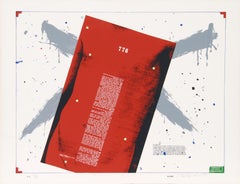
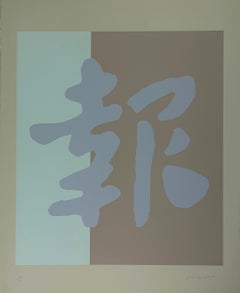
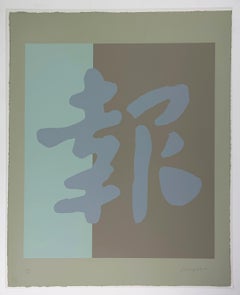
No. 776, Conceptual Geometric Screenprint by Shigeru Taniguchi

No. 776, Conceptual Geometric Screenprint by Shigeru Taniguchi

By Shigeru Taniguchi

Located in Long Island City, NY

Artist: Shigeru Taniguchi, Japanese (1948 - ) Title: No. 776 Year: 1977 Medium: Screenprint, signed and numbered in pencil Edition: 5/24 Image Size: 19 x 23 inches Size: 21 in. x 25 ...

Category

1970s Conceptual Shigeru Taniguchi Art

Materials

Screen

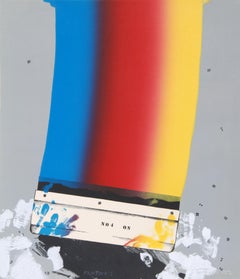
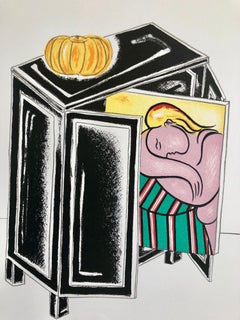
"Painting's", 1975, Silkscreen by Shigeru Taniguchi

"Painting's", 1975, Silkscreen by Shigeru Taniguchi

By Shigeru Taniguchi

Located in Long Island City, NY

Artist: Shigeru Taniguchi, Japanese (1948 - ) Title: Painting's Year: 1975 Medium: Silkscreen, signed and numbered in pencil Edition: 12/20 Size: 23 in. x 19 in. (58.42 cm x 48.26 cm)

Category

1970s Conceptual Shigeru Taniguchi Art

Materials

Screen

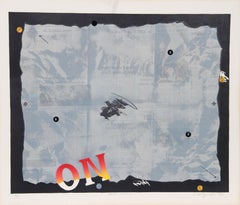
News March 7, Conceptual Art Screenprint by Shigeru Taniguchi

News March 7, Conceptual Art Screenprint by Shigeru Taniguchi

By Shigeru Taniguchi

Located in Long Island City, NY

Artist: Shigeru Taniguchi, Japanese (1948 - ) Title: News March 7th Year: 1975 Medium: Screenprint, signed and numbered in pencil Edition: 10/15 Image Size: 19.5 x 23.5 inches Size: ...

Category

1970s Conceptual Shigeru Taniguchi Art

Materials

Screen

Related Items
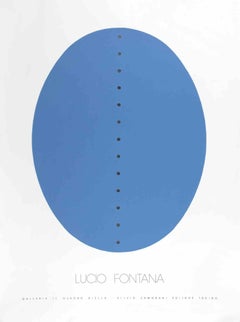
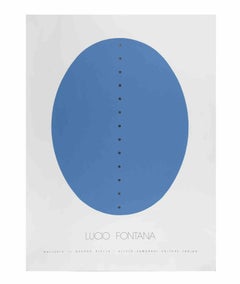
Concetto Spaziale - Screen Print by Lucio Fontana - 1967

Concetto Spaziale - Screen Print by Lucio Fontana - 1967

By Lucio Fontana

Located in Roma, IT

Screeh print with holes on BFK Rives. Realized in occasion of the exhibition at Galleria Il Quadro Biella. Published by Silvio Zamorani Editore.

Category

1960s Conceptual Shigeru Taniguchi Art

Materials

Screen

"9 Concert Tickets designed by John Cage and Earle Brown" John Cage

"9 Concert Tickets designed by John Cage and Earle Brown" John Cage

By John Cage

Located in New York, NY

John Cage 9 Concert Tickets designed by John Cage and Earle Brown, August 1953 Letterpress print without ink 11 x 8 1/2 inches Provenance Estate of Carolyn Brown, New York 2025. B...

Category

1950s Conceptual Shigeru Taniguchi Art

Materials

Newsprint

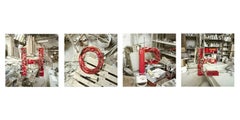
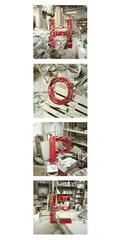
HOPE - 4 conceptual still life photographs spelling motivational word

HOPE - 4 conceptual still life photographs spelling motivational word

By Christian Stoll

Located in San Francisco, CA

large scale conceptual environmental still life photographs playing with viewer's perspective creating individual letters from found objects spelling the word HOPE H-O-P-E by Christ...

Category

21st Century and Contemporary Conceptual Shigeru Taniguchi Art

Materials

Archival Ink, Archival Paper, Photographic Paper, Archival Pigment

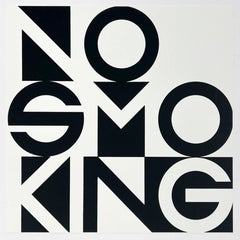
NO SMOKING, Rare historic 1970s Fluxus hand pulled silkscreen mid century design

NO SMOKING, Rare historic 1970s Fluxus hand pulled silkscreen mid century design

Located in New York, NY

Maciunas & George Brecht, George Maciunas, George Brecht No Smoking, ca. 1973 Rare, historic Hand pulled Fluxus silkscreen Limited edition and rarely found collectible (though exact number produced not known) 16 31/50 × 16 3/4 inches Black and white hand-pulled silk screen by George Maciunas of George Brecht's iconic ”No Smoking” offset wallpaper squares George Maciunas was a Lithuanian American artist, art historian, and art organizer who was the founding member and central coordinator of Fluxus, an international community of artists, architects, composers, and designers. "George Maciunas had an extreme dislike of smoking. Being an asthmatic he could not tolerate it personally and with his complete devotion to Fluxus, professionally he felt there was no time or space for such a self-indulgent act. This disdain led fellow Fluxus artist, George Brecht to suggest a “no smoking” sign...

Category

1970s Conceptual Shigeru Taniguchi Art

Materials

Screen

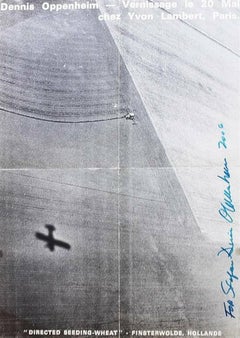
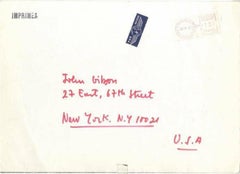
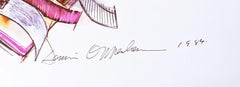
RARE Yvon Lambert Gallery mailer (Hand Signed and Addressed by Dennis Oppenheim)

RARE Yvon Lambert Gallery mailer (Hand Signed and Addressed by Dennis Oppenheim)

By Dennis A. Oppenheim

Located in New York, NY

Dennis Oppenheim Directed Seeding -Wheat, Historic Yvon Lambert Gallery Poster (Hand Signed and Addressed by Dennis Oppenheim), 1969 Offset lithograph poster. Hand signed, inscribed. Postmarked and addressed to Oppenheim's dealer, John Gibson 23 × 16 inches Hand Signed and inscribed by Dennis Oppenheim lower right in blue marker in 2006, hand addressed by Dennis Oppenheim in 1969 in red marker Unframed This is an extremely uncommon vintage poster/mailer announcing the May 20th, 1969 opening reception (Vernissage) for the exhibition of works by American conceptual art pioneer Dennis Oppenheim at the Yvon Lambert Gallery in Paris. The poster is historic in that it was originally mailed to John Gibson, the East 67th Street dealer, who famously gave Dennis Oppenheim his first New York exhibition in 1968, and it is hand addressed to Gibson, bearing the original Paris, France postmark of 1969. It is, exceptionally, hand signed and dedicated by Dennis Oppenheim to a collector who acquired the poster from John Gibson's collection, and then secured Dennis Oppenheim's autograph in 2006, making this an especially valuable collectors item. More information about the project from the Tate Gallery archives, which acquired the work: This work brings together two interventions Oppenheim created on a field owned by farmer Albert Waalken in Finsterwolde, north-eastern Holland, in 1969. It comprises four distinct elements mounted on board: a colour photograph of a wheatfield being sowed by a tractor in parallel curving lines seen from high up; a negative image in black and white of a map of the area of Finsterwolde onto which two sections of text have been collaged; and two black and white aerial photographs of the same field being traversed by a tractor cutting an X into the wheat. The first two elements relate to the action Directed Seeding. For this the field was seeded according to a line plotted by following the road from the village of Finsterwolde, the location of the field, to Nieuweschans, another village where the farmer’s storage silo for wheat was located. Oppenheim reduced this curved line by a factor of six in order to direct the trajectory of seeding. The tractor then carved a series of curved parallel lines on the surface of the field as it dug up earth and scattered seed. From an aerial perspective the patterning of parallel lines may be viewed as a form of line drawing on the landscape. The precise location of the field and the silo are indicated on the map, showing the trajectory of the road. The two sections of text collaged onto the upper portion of the map briefly describe the two interventions. Explaining the action Cancelled Crop, the artist wrote: In September the field was harvested in the form of an X. The grain was isolated in its raw state, further processing was withheld. This project poses an interaction upon media during the early stages of processing. Planting and cultivating my own material is like mining ones own pigment (for paint) – I can direct the later stages of development at will. In this case the material is planted and cultivated for the sole purpose of withholding it from a product-oriented system. Isolating this grain from further processing (production of food stuffs) becomes like stopping raw pigment from becoming an illusionistic force on canvas. The esthetic is in the raw material prior to refinement, and since no organization is imposed through refinement, the material’s destiny is bred with its origin. (Quoted from artist’s statement in Tate acquisition file.) Directed Seeding and Cancelled Crop are two separate works, brought together in several different versions of which Tate’s is one. The collage presents three ways in which human action may marks the land. For the first two, agricultural machinery is used to create straight lines, in the process of harvesting as in the X of Cancelled Crop, or curved lines, during the process of planting seed in the contours photographed for Directed Seeding. The map shows a third (and more ancient) way of marking the land, through the construction of roads. The use of the landscape – natural, industrial or urban – as a canvas on which to act is typical of Oppenheim’s work in the late 1960s and early 1970s. In a related action, Directed Harvest, 1966 (Tate T07590) and Directed Harvest 1968 (Kröller-Müller Museum, Otterlo, Netherlands), the artist caused a field to be harvested in linear patterns which he then had photographed in its progressive stages. In Reverse Processing: Cement Transplant, East River, NY, 1970, 1978 (Tate T07591) Oppenheim drew large crosses on the roofs of barges transporting raw cement that he found moored on the New York East River banks. All these works centre on process as an agent of change and utilise materials, elements and locations on which the artist can have no permanent claim, making them deliberately ephemeral. Such actions as seeding a crop and harvesting it several months later operate within time parameters dependent on the cycles of the seasons rather than the will of man, mixing human processes with those of nature. Oppenheim’s analogy between the prevention of a crop from entering the food chain and the halting of the expressive, ‘illusionistic’ force of paint deconstructs the sophisticated processes of art-making and the food industry to the elemental notion of making simple marks on the environment. In this way, the artist highlights contemporary man’s dependency on complex chains...

Category

1960s Conceptual Shigeru Taniguchi Art

Materials

Offset, Lithograph
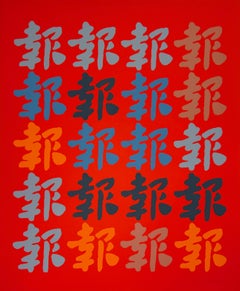
Chinatown Portfolio #1, 97/250

Chryssa Vardea-MavromichaliChinatown Portfolio #1, 97/250, 1978

$900Sale Price|50% Off

H 38.25 in W 31.25 in

Chinatown Portfolio #1, 97/250

By Chryssa Vardea-Mavromichali

Located in Austin, TX

Artist: Chryssa (Greek, born 1933) Chinatown Portfolio #1 Year: 1978 Medium: Screenprint on wove paper Signed in pencil and numbered 97/250 Edition: 250 Dimension: 38 1/4 x 31 1/4i...

Category

1970s Conceptual Shigeru Taniguchi Art

Materials

Screen

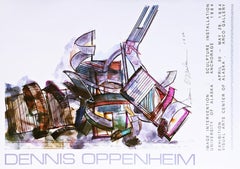
Image Intervention project in Alaska poster (Hand Signed by Dennis Oppenheim)

Image Intervention project in Alaska poster (Hand Signed by Dennis Oppenheim)

By Dennis Oppenheim

Located in New York, NY

Dennis Oppenheim Image Intervention (Hand Signed), 1984 Offset Lithograph (hand signed and dated by Dennis Oppenheim) Hand signed and dated on the middle front 28 × 20 inches Unframe...

Category

1980s Conceptual Shigeru Taniguchi Art

Materials

Ink, Lithograph, Offset

Blankless Tone, lithograph & silkscreen with embossing & folded corner. Signed/N

Blankless Tone, lithograph & silkscreen with embossing & folded corner. Signed/N

By Shusaku Arakawa

Located in New York, NY

Shusaku Arakawa Blankless Tone, 1979 Color lithograph and silkscreen with embossing on Arches paper with deckled edges and folded collage upper left Hand-signed by artist, Titled "Bl...

Category

1970s Conceptual Shigeru Taniguchi Art

Materials

Lithograph, Screen

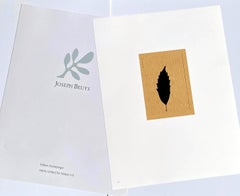
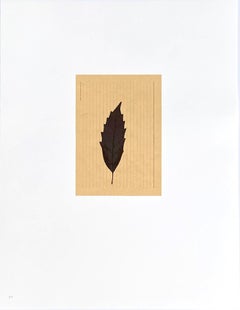
Joseph Beuys, Blatt auf Karteikarte, from Columbus: In Search of a New Tomorrow

Joseph Beuys, Blatt auf Karteikarte, from Columbus: In Search of a New Tomorrow

By Joseph Beuys

Located in New York, NY

Joseph Beuys Blatt auf Karteikarte (from Columbus: In Search of a New Tomorrow), 1992 Color silkscreen on vellum parchment paper, held in original portfolio sleeve Signed by Eva Beuy...

Category

1990s Conceptual Shigeru Taniguchi Art

Materials

Vellum, Screen

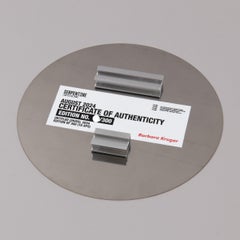
Barbara Kruger, Untitled (2Kiss)

Barbara Kruger, Untitled (2Kiss)

By Barbara Kruger

Located in Hamburg, DE

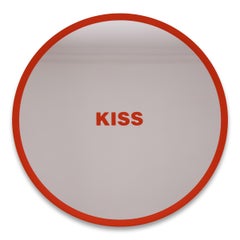
Barbara Kruger (1945, American) Untitled (2Kiss), 2024 Medium: Screenprint on mirrored polished steel Dimensions: 30 x 30 cm Edition of 300 + 10 APs: Artist stamp, numbered Condition...

Category

21st Century and Contemporary Conceptual Shigeru Taniguchi Art

Materials

Steel

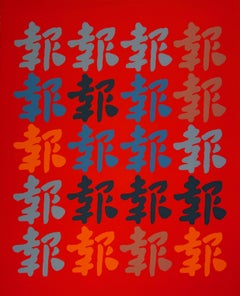
Chinatown Portfolio #9, 97/250

Chryssa Vardea-MavromichaliChinatown Portfolio #9, 97/250, 1978

$900Sale Price|50% Off

H 38.25 in W 31.25 in

Chinatown Portfolio #9, 97/250

By Chryssa Vardea-Mavromichali

Located in Austin, TX

Artist: Chryssa (Greek, born 1933) Chinatown Portfolio #9 Year: 1978 Medium: Screenprint on wove paper Signed in pencil and numbered 97/250 Edition: 250 Dimension: 38 1/4 x 31 1/4i...

Category

1970s Conceptual Shigeru Taniguchi Art

Materials

Screen

Shigeru Taniguchi art for sale on 1stDibs.

Find a wide variety of authentic Shigeru Taniguchi art available for sale on 1stDibs. You can also browse by medium to find art by Shigeru Taniguchi in screen print and more. Not every interior allows for large Shigeru Taniguchi art, so small editions measuring 19 inches across are available. Customers who are interested in this artist might also find the work of John Russell Clift, Ian Hamilton Finlay, and Todd Gray. Shigeru Taniguchi art prices can differ depending upon medium, time period and other attributes. On 1stDibs, the price for these items starts at $720 and tops out at $2,500, while the average work can sell for $1,200.

Artists Similar to Shigeru Taniguchi