Simon François Ravenet Art

to
2
1
Overall Width
to
Overall Height
to
3
3
2
3
3
2
1
1
1
1
1
1
1
1
2
1
3
11,123
2,854
2,494
1,437
1
2
3
Artist: Simon François Ravenet
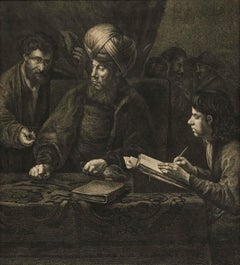
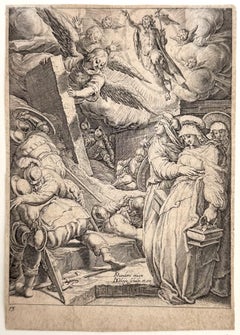
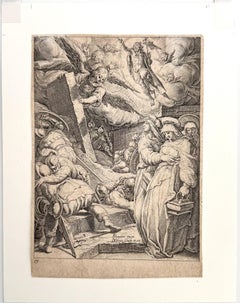
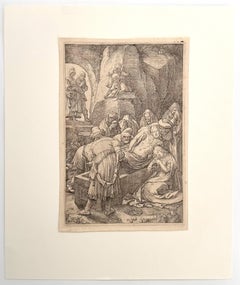
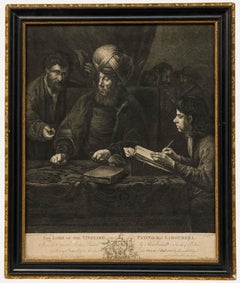
Ravenet after Rembrandt - 1767 Engraving, The Lord of the Vineyard

Ravenet after Rembrandt - 1767 Engraving, The Lord of the Vineyard

By Simon François Ravenet

Located in Corsham, GB

A finely detailed eighteenth-century engraving by Simon Francois Ravenet (1706-1774) after The Parable of the Workers in the Vineyard, which was believed to be by Rembrandt (1606-166...

Category

Early 18th Century Simon François Ravenet Art

Materials

Engraving

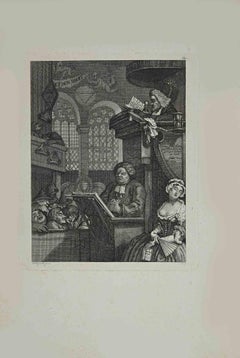
The Sleepy Congregation - Etching by Simon François Ravenet - 1736

The Sleepy Congregation - Etching by Simon François Ravenet - 1736

By Simon François Ravenet

Located in Roma, IT

The Sleepy Congregation is an artwok realized in 1736, by the French Artist Simon François Ravenet, after a print by William Hogarth. Etching on paper. Monogrammed in plate on  the ...

Category

1730s Modern Simon François Ravenet Art

Materials

Etching

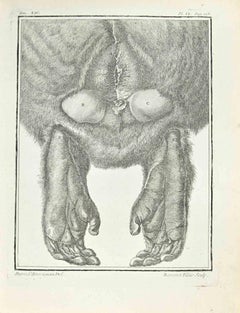
Anatomy of a Monkey - Etching by Simon François Ravenet - 1771

Anatomy of a Monkey - Etching by Simon François Ravenet - 1771

By Simon François Ravenet

Located in Roma, IT

Anatomy of a Monkey is an etching realized in 1771 by Simon François Ravenet (1706-1774). Signed in plate. The artwork Belongs to the suite "Histoire naturelle, générale et particu...

Category

1770s Modern Simon François Ravenet Art

Materials

Etching

Related Items
"King of the Friendly Islands" (Tonga); Engraving from Captain Cook's 3rd Voyage

"King of the Friendly Islands" (Tonga); Engraving from Captain Cook's 3rd Voyage

By John Webber

Located in Alamo, CA

"Poulaho, King of the Friendly Islands, Drinking Kava" is an engraving created by William Sharp (1749-1824), from a drawing by John Webber (1752-1793), who was the artist on Captain James Cook's 3rd and final voyage of discovery. It was published in the atlas of "A Voyage to the Pacific Ocean Undertaken by the Command of His Majesty, for Making Discoveries in the Northern Hemisphere", the official British Admirality sanctioned journal published upon completion of the voyage in London in 1784 by Strahan & Cadell. Captain Cook visited Tonga on his 3rd voyage, which he named The Friendly Islands because of the warm welcome he and his crew received, unlike some of the other more hostile Pacific islands. The engraving depicts Cook and his men observed a kava ceremony at the village of Mu’a on Tongatapu. King Paulaho sits in the centre foreground, his back to the spectator with a man kneeling before him. The ceremonial mat depicted behind Paulaho indicates that nobody was allowed to sit behind him. The figure in the centre holds a single cup, referring to the Tongan custom of offering the cup to the king first. Kava is native to the islands of the South Pacific and was first described for English readers in 1768 by Captain James Cook. The kava root has been used for centuries as a central feature of ceremonies and celebrations because it was able to bring about a calming and pleasant social atmosphere. The root was crushed and processed into coconut milk to become the focal ceremonial beverage, simply referred to as kava. This engraving is presented in a Koa wood frame and a white mat. Koa wood is legendary in Hawaii. There are occasional faint spots, but the print is otherwise in very good condition. This amazing Koa wood is native to Hawaii and it is known for the deep rich colors and varied grain pattern. Koa has an honored heritage in Hawaii and is highly revered and sacred. The word “koa” means “warrior” in Hawaiian. The warriors of King Kamehameha the Great, created canoes and weapons from a wood plentiful on the Big Island of Hawaii. This wood became synonymous with the warriors themselves, and it became known as koa. There are three other engravings listed from the official journal of Captain Cook's 3rd voyage available that are presented in identical Koa wood frames and mats (LU117324682422, LU117324684052, LU117324684032). They would make a wonderful grouping for a display of 2, 3 or 4 prints. A discount is available for a grouping depending on the number of items included. Captain Cook is remembered as one of the greatest explorers and navigators in history. His explorations included Australia, New Zealand and islands of the South Pacific and the northwest coast of North America. Hawaii was discovered by Captain Cook during this voyage. Hawaii was originally called The Sandwich Islands in honor of The Earl of Sandwich...

Category

1780s Realist Simon François Ravenet Art

Materials

Engraving

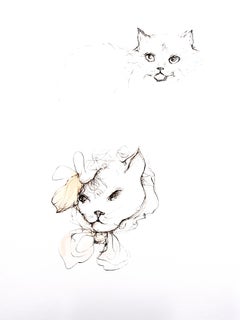
Leonor Fini - Cats - Original Etching

Leonor FiniLeonor Fini - Cats - Original Etching, 1985

$1,396

H 17.33 in W 11.03 in D 0.04 in

Leonor Fini - Cats - Original Etching

By Leonor Fini

Located in Collonge Bellerive, Geneve, CH

Leonor Fini - Cats - Original Engraving Mme.Helvetius' Cats Original etching created in 1985, Printed Signature (LF). Conditions: excellent Edition: 100 Support: Arches paper. Dimensions: Paper dimensions: 44 x 28 cm Editions: Moret, Paris. Leonor Fini is considered one of the most important women artists of the mid-twentieth century, along with Leonora Carrington, Frida Kahlo, Meret Oppenheim, Remedios Varo, and Dorothea Tanning – most of whom Fini knew well. Her career, which spanned some six decades, included painting, graphic design, book illustration, product design (the renowned torso-shaped perfume bottle for Schiaparelli’s Shocking), and set and costume design for theatre, ballet, opera, and film. In this compellingly readable, exhaustively researched account, author Peter Webb brings Fini’s provocative art and unconventional personal life, as well as the vibrant avant-garde world in which she revolved, vividly in life. Born in Buenos Aires in 1907 (August 30 – January 18, 1996, Paris) to Italian and Argentine parents, Leonor grew up in Trieste, Italy, raised by her strong-willed, independent mother, Malvina. She was a virtually self-taught artist, learing anatomy directly from studying cadavers in the local morgue and absorbing composition and technique from the Old Masters through books and visits to museums. Fini’s fledging attempts at painting in Trieste let her to Milan, where she participated in her first group exhibition in 1929, and then to Paris in 1931. Her vivacious personality and flamboyant attire instantly garnered her a spotlight in the Parisian art world and she soon developed close relationships with the leading surrealist writers and painters, including Paul Eluard, Salvador Dali, Man Ray, and Max Ernst, who became her lover for a time. The only surrealist she could not abide because of his misogyny was André Breton. Although she repeatedly exhibited with them, she never considered herself a surrealist. The American dealer Julien Levy, very much impressed by Fini’s painting and smitten by her eccentric charms, invited her to New York in 1936, where she took part in a joint gallery exhibition with Max Ernst and met many American surrealists, including Joseph Cornell and Pavel Tchelitchew. Her work was included in MoMA’s pivotal Fantastic Art, Dada and Surrealism exhibition, along with De Chirico, Dali, Ernst, and Yves Tanguy. In 1939 in Paris she curated an exhibition of surrealist furniture for her childhood friend Leo Castelli for the opening of his first gallery. Introductions to her exhibition catalogues were written by De Chirico, Ernst, and Jean Cocteau. A predominant theme of Fini’s art is the complex relationship between the sexes, primarily the interplay between the dominant female and the passive, androgynous male. In many of her most powerful works, the female takes the form of a sphinx, often with the face of the artist. Fini was also an accomplished portraitist; among her subjects were Stanislao Lepri...

Category

1980s Modern Simon François Ravenet Art
Materials

Etching

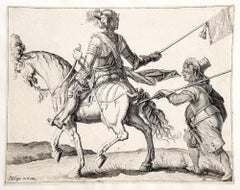
20th century drypoint etching figurative animal print horses sketch signed

20th century drypoint etching figurative animal print horses sketch signed

By Claude Weisbuch

Located in Milwaukee, WI

"Combat Equestre" is an original lithograph by Claude Weisbuch. The artist signed the piece lower right and wrote the edition number (24/100) in the lower left. This piece depicts mu...

Category

1970s Modern Simon François Ravenet Art
Materials

Drypoint, Etching

Ethel Magafan “Corralled Horse” 1940s WPA-Era Modernist Etching, Artist’s Proof

Ethel Magafan “Corralled Horse” 1940s WPA-Era Modernist Etching, Artist’s Proof

By Ethel Magafan

Located in Denver, CO

Corralled Horse is a rare WPA-era modernist etching by acclaimed American artist Ethel Magafan, created in the 1940s. This artist’s proof depicts a lone dark horse within a wooden co...

Category

1940s American Modern Simon François Ravenet Art

Materials

Etching

Buttercup Flowers: A Besler 18th Century Hand-colored Botanical Engraving

Buttercup Flowers: A Besler 18th Century Hand-colored Botanical Engraving

By Basilius Besler 1

Located in Alamo, CA

This is a hand-colored copper plate engraving depicting Ranunculus (Persian Buttercup) flowers from Basilius Besler's landmark work, Hortus Eystettensis (Garden at Eichstatt), first published in 1613 in Eichstatt, Germany near Nuremberg and later in 1640 and 1713. This beautiful colorful engraving is printed on thick laid chain-linked paper. There is latin text on the verso. There are central horizontal creases and two small holes on the right and another in the left lower corner. It is otherwise in excellent condition. Basilius Besler (1561–1629) was an apothecary and botanist. He was curator of the Willibaldsburg Castle garden of Johann Konrad von Gemmingen, prince bishop...

Category

Early 18th Century Academic Simon François Ravenet Art

Materials

Engraving

Camille Pissarro Etching on Paper, Modern, Unsigned, 1906, Framed, Les Faneuses

Camille Pissarro Etching on Paper, Modern, Unsigned, 1906, Framed, Les Faneuses

By Camille Pissarro

Located in Washington, DC

Artist: Camille Pissarro Title: Les Faneuses Portfolio: l'Histoire des Peintres Impressionistes Medium: Etching on cream laid paper Date: 1906 Edition: 1000 Frame Size: 19 1/2" x 17"...

Category

Early 1900s Modern Simon François Ravenet Art
Materials

Etching

Flowering Peppermint Plants: A 17th C. Besler Hand-colored Botanical Engraving

Flowering Peppermint Plants: A 17th C. Besler Hand-colored Botanical Engraving

By Basilius Besler 1

Located in Alamo, CA

This is a hand-colored copper plate engraving entitled "Pulegium Cervinum, Pseudo Pulegium Struthium, Pulegium Regium", depicting flowering Peppermint, Weld and Pennyroyal plants respectively from Basilius Besler's landmark work, Hortus Eystettensis (Garden at Eichstatt), first published in 1613 in Eichstatt, Germany near Nuremberg and later in 1640 and 1713. This beautiful colorful engraving is printed on thin laid chain-linked paper. There are subtle creases in the right upper corner, very common with Besler's relating to the drying of the paper during its production. The right margin is thinner than the others. The print is otherwise in excellent condition with striking hand-coloring. Basilius Besler (1561–1629) was an apothecary and botanist. He was curator of the Willibaldsburg Castle garden of Johann Konrad von Gemmingen, prince bishop...

Category

1640s Academic Simon François Ravenet Art
Materials

Engraving

Limon Lavrae: A 17th C. Hand-colored Engraving of Lemon Anatomy by G. Ferrari

Limon Lavrae: A 17th C. Hand-colored Engraving of Lemon Anatomy by G. Ferrari

By Giovanni Battista Ferrari

Located in Alamo, CA

This 17th century hand-colored engraving of a lemon entitled "Limon Lavrae", plate 219 from Giovanni Baptista Ferrari's publication "Hesperides, sive, De Malorum Aureorum Cultura Etu...

Category

17th Century Old Masters Simon François Ravenet Art
Materials

Engraving

"Inspection Tour in the Wine Vaults", 1876 Philadelphia Centennial Exposition

"Inspection Tour in the Wine Vaults", 1876 Philadelphia Centennial Exposition

Located in Alamo, CA

This engraving is entitled "Philadelphia, PA- The Centennial Exposition - the Jury of Award on an Inspection Tour in the Wine Vaults of Agricultural Hall", ...

Category

Late 19th Century Naturalistic Simon François Ravenet Art
Materials

Engraving

Ancient Roman Architecture: Original Framed 18th C. Etching by G. Piranesi

Ancient Roman Architecture: Original Framed 18th C. Etching by G. Piranesi

By Giovanni Battista Piranesi

Located in Alamo, CA

"Veduta del Sepolcro della Famiglia Plauzia per la Strada Che Conduce da Roma a Tivoli vicino a Ponte Lugano" from "Le Antichità Romane" (Roman Antiquities), one of the most famous works by Piranesi. "Antichita" illustrates the tombs along the Appian Way...

Category

Early 18th Century Old Masters Simon François Ravenet Art
Materials

Etching, Engraving, Drypoint

Simon François Ravenet art for sale on 1stDibs.

Find a wide variety of authentic Simon François Ravenet art available for sale on 1stDibs. You can also browse by medium to find art by Simon François Ravenet in etching and more. Much of the original work by this artist or collective was created during the 18th century and is mostly associated with the modern style. Not every interior allows for large Simon François Ravenet art, so small editions measuring 8 inches across are available. Customers who are interested in this artist might also find the work of Louis Legrand, Robert De Launay, and Auguste Lançon. Simon François Ravenet art prices can differ depending upon medium, time period and other attributes. On 1stDibs, the price for these items starts at $99 and tops out at $99, while the average work can sell for $99.