Theodore R. Davis Art

to
1
1
Overall Width
to
Overall Height
to
2
2
1
1
1
1
1
1
1
1
2
10,164
2,784
2,504
1,381
1
2
Artist: Theodore R. Davis
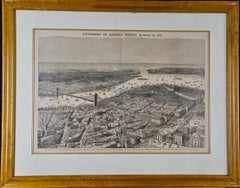
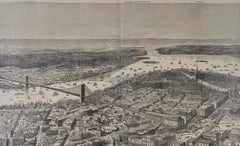
1870 View of Proposed Brooklyn Bridge and New York City
By Theodore R. Davis
Located in Alamo, CA
This framed engraving entitled "Birds-eye View of the Southern End of New York and Brooklyn, Showing the Projected Suspension-Bridge Over the East River, From the Western Terminus in Printing-House Square, New York" by Theodore R. Davis (1840–1894) was published as a supplement of Harper's Weekly, November 19, 1870. The print is presented in a maple frame and a double mat. The frame measures 23.5" high, 29" wide and 0.75" deep. There is a vertical center fold and additional vertical lines, where wood engraving blocks were joined for the printing process. It is in excellent condition. This framed image depicting New York in 1870 was a centerfold for the November 19, 1870 issue of Harper's Weekly. It includes the site and eventual appearance of the East River New York-Brooklyn Bridge; the name later shortened to the Brooklyn Bridge. The print was issued eleven months after the start of construction of the bridge on January 2, 1870, which would take another 12.5 years to complete. When this view was drawn, work on the bridge was all below ground, constructing the supports for the bridge’s towers. Labels in the upper portion of the print identify locations in the background including "Light Ship...
Category

Late 19th Century Naturalistic Theodore R. Davis Art

Materials

Woodcut

Late 19th century color cityscape Milwaukee trees figures lake churches
By Theodore R. Davis
Located in Milwaukee, WI
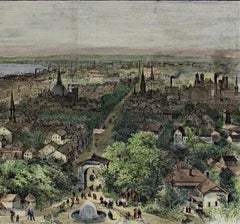
"View of the City of Milwaukee" from "Harper's Weekly" is an original hand-colored wood engraving by Theodore R. Davis. It depicts an aerial view of the Wisconsin lakeside city in 1882. 9" x 13 3/8" art 17 5/8" x 21 3/4" frame Theodore R. Davis (1840–1894) was a 19th-century American artist, who made numerous drawings of significant military and political events during the American Civil War and its aftermath. As a child, Theodore R. Davis was taken to Washington D.C. where he graduated from Rittenhouse Academy. When he was fifteen, he moved to New York where studied art under Henry W. Herrick and James Walker. The Training Theodore Davis received under James Walker was informal. Davis typified certain artists as "special artists" was hired by popular magazines and newspapers. He was hired by them to illustrate the Civil War. He was hired by Harpers Weekly in 1861.[ During the Civil War, he served as a captain in the 15th Connecticut Volunteer Infantry. After the war, he became a companion of the New York Commandery of the Military Order of the Loyal Legion of the United States. Some of these drawings include the Battle of Champion Hill, and the most significant sketch of General Joseph E. Johnston and General William T. Sherman meeting at the Bennett Farm near Durham Station to discuss the surrender terms of the remaining Confederate armies in the Southeast. After the war when the Cyclorama in Atlanta was being painted, Davis was asked for his ideas having traveled with Sherman's army. He was later added to the painting. Theodore Davis was a staff artist at Harper's Weekly. Many of his drawings were published as wood engravings in Harper's Weekly. Theodore R. Davis was chosen to create the Haye's China with a chance meeting. Mr. Davis suggested using flora and fauna of the American decor...
Category

1880s Other Art Style Theodore R. Davis Art

Materials

Engraving

Related Items
West Africa: A 17th Century Hand-Colored Map by Mercator/Hondius
By Gerard Mercator
Located in Alamo, CA
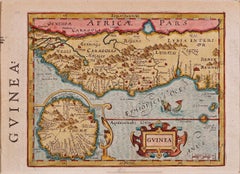
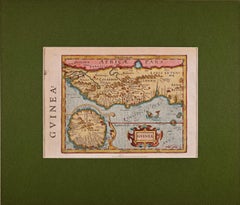
A 17th century hand-colored map entitled "Guineae Nova Descriptio" by Gerard Mercator and Jodocus Hondius, published in their 'Atlas Minor' in Amsterdam in 1635. It is focused on the...
Category

1630s Theodore R. Davis Art

Materials

Engraving

Spider Lily: An Original 18th C. Hand-colored Botanical Engraving by J. Weinmann
By Johann Wilhelm Weinmann
Located in Alamo, CA
This colored botanical mezzotint and line engraving finished with hand coloring by Johann Wilhelm Weinmann (1683-1741) is entitled "A. Ephemerum Virginianu flore Purpureo, B. Ephemer...
Category

Mid-18th Century Naturalistic Theodore R. Davis Art

Materials

Engraving, Mezzotint

"A Dance in Otaheite" (Tahiti), Engraving from Captain Cook's 3rd Voyage
By John Webber
Located in Alamo, CA
"A Dance in Otaheite" (Tahiti) is an engraving created by William Sharp (1749-1824), from a drawing by John Webber (1752-1793), who was the artist on Captain James Cook's 3rd and final voyage of discovery. It is a plate in the atlas of "A Voyage to the Pacific Ocean Undertaken by the Command of His Majesty, for Making Discoveries in the Northern Hemisphere", the official British Admirality sanctioned journal published upon completion of the voyage in London in 1784 by Strahan & Cadell. Two women and two men wearing ceremonial costumes, performing a dance outdoors standing on a mat. Three men are playing the drums in the background, in front of a thatched roof building. An audience of men are sitting on both sides of the stage. By the time Webber arrived in Tahiti, 'south sea' imagery had become familiar. Webber gave concentrated attention to dance. He had the opportunity to distinguish the Tahitian dance from the more formalized dancing of Tonga. Whereas they seem to have called to mind the more formal dances of antiquity, the Tahitian dancing aroused memories of peasant and folk dancing. This engraving is professionally framed in Koa wood. Koa wood is legendary in Hawaii. Not only is this amazing wood native to Hawaii, but it is known for the deep rich colors and varied grain pattern. Koa has an honored heritage in Hawaii and is highly revered and sacred. The word “koa” means “warrior” in Hawaiian. The warriors of King Kamehameha the Great, created canoes and weapons from a wood plentiful on the Big Island of Hawaii. This wood became synonymous with the warriors themselves, and it became known as koa. The print is in excellent condition. There are three other engravings listed from the official journal of Captain Cook's 3rd voyage available that are presented in identical Koa wood frames and double mats (LU117324682432, LU117324684052, LU117324684062). They would make a wonderful grouping for a display of 2, 3 or 4 prints. A discount is available for a grouping depending on the number of items included. Hawaii was discovered by Captain Cook during this voyage. Hawaii was originally called The Sandwich Islands in honor of The Earl of Sandwich...
Category

1780s Realist Theodore R. Davis Art

Materials

Engraving

Engraving of a British Fox Hunting Scene "The Pink Of Condition"
By George Wright
Located in Alamo, CA
The engraving "The Pink Of Condition" by George Wright was published in London in 1909. It depicts the beginning of a British fox hunting scene. The ...
Category

Early 1900s Naturalistic Theodore R. Davis Art

Materials

Engraving

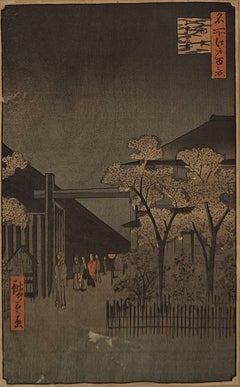
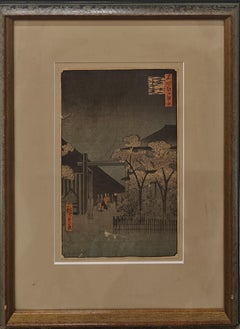
"Dawn Inside the Yoshiwara" Utagawa Hiroshige, Japanese Landscape, Ukiyo-e
By Utagawa Hiroshige
Located in New York, NY
Utagawa Hiroshige Dawn Inside the Yoshiwara, circa 1857 Woodblock print 11 x 7 inches Utagawa Hiroshige is recognized as a master of the ukiyo-e woodblock printing tradition, havin...
Category

1850s Naturalistic Theodore R. Davis Art

Materials

Paper, Ink, Woodcut

La Meuse - Etching by R.P. Grouillet - 1911
Located in Roma, IT
Original etching by Robert Pierre Grouiller after a painting by Johan Barthold Jongkind. Signed and dated on plate by Jongkind. Edition of 600 prints. Etching and aquatint print on v...
Category

1910s Naturalistic Theodore R. Davis Art

Materials

Etching

Sandwich Islands Canoe (Hawaii): Framed 18th C. Engraving Captain Cook's Journal
By John Webber
Located in Alamo, CA
"A Canoe of the Sandwich Islands, the Rowers Masked" is an engraving created by Charles Grignion, from a drawing by John Webber (1752-1793), who was the artist on Captain James Cook's 3rd and final voyage of discovery. It is Plate 65 in the atlas of "A Voyage to the Pacific Ocean Undertaken by the Command of His Majesty, for Making Discoveries in the Northern Hemisphere", the official British Admiralty sanctioned journal published upon completion of the voyage in London in 1784 by Strahan & Cadell. This famous image of ten Hawaiian rowers transporting a priest who is carrying a feather-covered image of Kukailimoku, the Hawaiian god of war. The priests and paddlers are all wearing gourd masks in their double-hulled canoe with an upright lateen woven sail. Each hull was shaped from a single large Koa log harvested from island rainforests, where they were carved before being transported to the coast. This engraving is presented in a Koa wood frame and a white mat. There are occasional faint spots, but the print is otherwise in very good condition. Koa is the same wood as was used to make the canoe. Koa wood is legendary in Hawaii. Not only is this amazing wood native to Hawaii, but it is known for the deep rich colors and varied grain pattern. Koa has an honored heritage in Hawaii and is highly revered and sacred. The word “koa” means “warrior” in Hawaiian. The warriors of King Kamehameha the Great, created canoes and weapons from a wood plentiful on the Big Island of Hawaii. This wood became synonymous with the warriors themselves, and it became known as koa. The frame measures 20.75" high, 26.75" wide and 0.88" deep. There are three other engravings listed from the official journal of Captain Cook's 3rd voyage available that are presented in identical Koa wood frames and mat (LU117324682022, LU117324684052, LU117324684062). They would make a wonderful grouping for a display of 2, 3 or 4 prints. A discount is available for a grouping depending on the number of items included. Hawaii was discovered by Captain Cook (1728-1779) during this voyage. Hawaii was originally called The Sandwich Islands in honor of The Earl of Sandwich...
Category

1780s Theodore R. Davis Art

Materials

Engraving

California: 18th Century Hand-colored Map by de Vaugondy
By Didier Robert de Vaugondy
Located in Alamo, CA
This is an 18th century hand-colored map of the western portions of North America entitled "Carte de la Californie et des Pays Nord-Ouest separés de l'Asie par le détroit d'Anian, ex...
Category

1770s Theodore R. Davis Art

Materials

Engraving

Captain Cook's Exploration of Tahiti: 18th C. Hand-colored Map by Bellin
By Jacques-Nicolas Bellin
Located in Alamo, CA
This beautiful 18th century hand-colored copper plate engraved map is entitled "Carte de l'Isle de Taiti, par le Lieutenant J. Cook" was created by Jacques Nicolas Bellin and publish...
Category

Late 18th Century Theodore R. Davis Art

Materials

Engraving

"Esquimaux Curlew": A Framed Original Audubon Hand-colored Folio Engraving
By John James Audubon
Located in Alamo, CA
This is an original hand-colored folio edition John James Audubon engraving entitled "Esquimaux Curlew", Folio, Pl. CCVIII", No. 42, Plate 208, from Audubon's "Birds of America". It was engraved, printed and colored in London by Robert Havell, Jr. in 1834. It depicts a male and a female Esquimaux Curlew birds...
Category

Mid-19th Century Naturalistic Theodore R. Davis Art

Materials

Engraving

The Twin Rocks of Capri; I Faraglioni a Capri
Located in Middletown, NY
London: Gebbie & Husson Co., 1879 Héliogravure and engraving on cream wove paper, 10 1/4 x 12 1/4 inches (258 x 310 mm), full margins. In good condition with some very minor margina...
Category

Late 19th Century English School Theodore R. Davis Art

Materials

Engraving, Photogravure

Frankfort, Germany: A 16th Century Hand-colored Map by Braun & Hogenberg
By Franz Hogenberg
Located in Alamo, CA
This is a 16th century original hand-colored copperplate engraved map of Frankfort, Germany entitled "Francenbergum, vel ut alij Francoburgum Hassiae Opp" by Georg Braun & Franz Hogenberg, from their famous city atlas "Civitates Orbis Terrarum", published in Cologne, Germany in 1595. This is an English translation of an excerpt from the original text in the atlas: "Frankenberg or, according to others, Francoburgum, a town in Hesse. Charlemagne vested the town of Frankenberg with many freedoms and privileges, which it still enjoys to this day, and on account of its valiant and victorious soldiers awarded a signet, upon which there formerly appeared a golden castle with a tower, together with the letter F and a golden crown. Frankenberg, seen here from the northeast, lies on a hill above the River Eder. The hillside is covered with fields neatly separated by bushes and fences. Soaring above the town is the massive Liebfrauenkirche, which was modelled on St Elizabeth's church in Marburg. The New Town was founded in 1335 at the foot of the hill (right) and merged with the Old Town as late as 1556. Frankenberg was founded by Conrad of Thuringia in 1233/34 to prevent the archbishops of Mainz from expanding their sphere of influence...
Category

16th Century Old Masters Theodore R. Davis Art

Materials

Engraving

Theodore R. Davis art for sale on 1stDibs.

Find a wide variety of authentic Theodore R. Davis art available for sale on 1stDibs. You can also browse by medium to find art by Theodore R. Davis in engraving, woodcut print and more. Not every interior allows for large Theodore R. Davis art, so small editions measuring 22 inches across are available. Customers who are interested in this artist might also find the work of William Curtis, Paul-Adolphe Rajon, and Paul Sandby. Theodore R. Davis art prices can differ depending upon medium, time period and other attributes. On 1stDibs, the price for these items starts at $460 and tops out at $950, while the average work can sell for $705.

Artists Similar to Theodore R. Davis