Thomas Hudson Art

British, 1701-1779
Thomas Hudson (1701–1779) was an English painter, almost exclusively of portraits. Hudson was born in Devonshire in 1701. His exact birthplace is unknown. He studied under Jonathan Richardson in London and, against the latter's wishes, married Richardson's daughter at some point before 1725. Hudson was most prolific between 1740 and 1760 and, from 1745 until 1755 was the most successful London portraitist. He had many assistants, and employed the specialist drapery painter Joseph Van Aken. Joshua Reynolds, Joseph Wright and the drapery painter Peter Toms were his students. Hudson visited the Low Countries in 1748 and Italy in 1752. In 1753 he bought a house at Cross Deep, Twickenham, just upstream from Pope's Villa. He retired toward the end of the 1750s. William Hickey described the elderly Hudson, "His figure was rather grotesque, being uncommonly low in stature, with a prodigious belly, and constantly wearing a large white bushy periwig. He was remarkably good tempered, and one of my first-rate favourites, notwithstanding that he often told me I should certainly be hanged.". He died at Twickenham in 1779. His extensive private art collection was sold off in three separate sales. Many of Hudson's works may be seen in art galleries throughout the United Kingdom. They include the National Portrait Gallery, the National Maritime Museum, Tate, Barnstaple Guildhall, Foundling Museum and the Bristol City Museum and Art Gallery.
to
3
2
Overall Width
to
Overall Height
to
5
5
2
3
2
3
3
2
2
5
5
3
3
5
10,164
2,784
2,504
1,382
4
5
Artist: Thomas Hudson
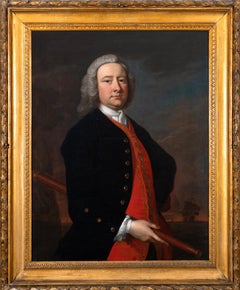
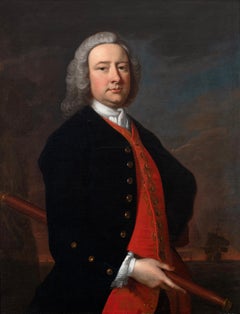
Portrait of a senior naval officer, c. 1750s
By Thomas Hudson
Located in Henley-on-Thames, England
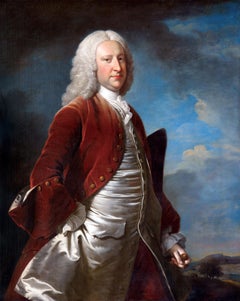
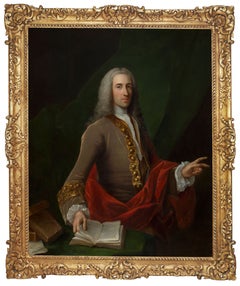
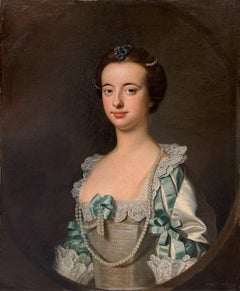
Thomas Hudson (Devon 1701 - London 1779) Portrait of a senior naval officer, c. 1750s Probably a captain or admiral; half-length, holding a telescope, with a warship beyond Oil on canvas 91.3 x 71.1 cm.; (within frame) 114.3 x 93.8 cm. (Unsigned) Provenance: Christie’s, London, 22 November 1985, lot 105 (as Thomas Hudson); Private collection, United Kingdom; Haynes Fine Art, Broadway, Worcestershire; Where acquired, private collection, United States, 16 August 1988; Neal Auction, New Orleans, 14 September 2025, lot 302 (as Attributed to Thomas Hudson); Where acquired by Haveron Fine Art. Literature: Bridgeman Art Library, The Bridgeman Art Library (London: The Library, 1995), p. 89 Christie’s, London, Important English Pictures (London: Christie’s, 22 November 1985) Archival: Witt Library, Courtauld Institute of Art (no. 061487); Heinz Archive and Library, National Portrait Gallery, 1725-50, Thomas Hudson: Men Authentic (1) (Box) This attractive and quintessential half-length is exemplary of Hudson’s leading portrait practice, produced at the height of his decade-long dominance over the London market beginning in 1749. Typical of Hudson's 1750s output, the portrait was likely made after his five-week visit to Rome and Naples, and bares the stylistic merits of this continental excursion. Indeed, the trip seemed to fortify a gradual refinement of Hudson’s technique: namely the emphasis of directional brushstrokes, which sensitively follow the contours of the facial features. The resulting feathery quality is combined here with a striking chiaroscuro effect, which Hudson borrowed directly from Rembrandt. Amalgamating the rich colouring of the Rococo with a mannered Baroque posing, Hudson renders the senior naval officer with a characteristic presence. Resting one hand assuredly at his hip, the finely worked telescope illustrates the officer’s seniority; the warship sailing on the horizon beyond provides further indication of his commanding rank. The telescope is held by a hand modelled with sculptural poise, and the typically Van Dyck manner (seen elsewhere, e.g. Princess Amelia Sophia Eleonore of Great Britain, YCBA B2001.2.246) further illustrates Hudson's studied grounding. Despite the apparent stylistic placement of the work, an earlier date is possible, since the officer wears civilian clothes and not the naval officer’s uniform first introduced in 1747 (which officers afterwards invariably chose to be shown in). The officer has previously been suggested as Edward Henry Sartorius, of the prominent naval Sartorius family; however, this identification is improbable on biographical and documentary grounds. Hudson was regularly commissioned by leading naval officers, and produced highly satisfactory portraits praised for their great likeness and genteel swagger. He charged 24 guineas for a standard 50 x 40 inch half-length in the 1750s period, and the present work (somewhat smaller in size) would have cost not much less. Comparable works include those of Admirals of the Fleet George Anson, 1st Baron Anson, and Sir John Norris; Admiral Sir George Pocock; Admiral Sir Peter Warren; Vice-Admiral The Honourable John Byng; and Rear-Admiral Richard Tyrrell. The present portrait is particularly similar in composition to Hudson’s Portrait of a Flag Officer of The White Squadron, which similarly employs the narrative device of a telescope held at a dynamic angle across the composition, with a warship to the left side of the officer’s retracted arm. Thomas Hudson (Devon 1701 - London 1799) Thomas Hudson rose to become the leading British portraitist of the mid-18th century, albeit in close competition with his Scottish counterpart Allan Ramsay. Born in Devon, Hudson studied alongside George Knapton under Jonathan Richardson the Elder (marrying his daughter in 1725, expressly against Richardson’s wishes), and inherited a dignified formality jointly derived from Van Loo. His work is first recorded in 1728, and between 1730-40 he practised in Bath and the West Country, where in addition to portrait commissions, he was employed to retouch and reline old pictures. He returned permanently to London thereafter, and devised a series of stock poses to which he would return with variation throughout his career. Beginning in 1745 with the death of Richardson and the departure of Van Loo, Hudson became the city’s most successful portraitist, and embarked on ambitious defining works such as his Portrait of Theodore Jacobsen ‒ not drastically unlike the continental heights of Pompeo Batoni in conception. Profiting from his success, he relocated from Lincoln’s Inn Fields to a house in Great Queen Street previously inhabited by Van Loo, and one door down from Kneller’s old rooms. An exceptionally productive period began in 1749 which lasted until the late 1750s. Among this output were highly praised portraits of the Prince and Princess of Wales, commissions for most of the preeminent aristocrats, and superlative group portraits including Benn’s Club of Aldermen, and those of the Thistlethwayte, Marlborough and Radcliffe families. Hudson relocated to King Street, Covent Garden, operating a prolific studio operation which resulted in some four hundred paintings ‒ of which at least eighty were engraved. A prodigious assembly of young pupils included Sir Joshua Reynolds (1740-3), Joseph Wright of Derby (1751-3, 1756), Richard Cosway, John Hamilton Mortimer, and the drapery painters Joseph and Alexander van Aken (also employed by Ramsay). As one later reviewer expressed: ‘Hudson, his art may well display to sight / Who gave Mankind a Reynolds and a Wright’ (Miles, ‘Introduction’). The ambitious young Reynolds made many drawings from classical statuary under Hudson’s instruction, and wrote home that, ‘While doing this I am the happiest creature Alive (sic.)’ (Sweetser, p.12). However, he was later dismissed from his pupilage some two years prematurely for refusing to carry a painting to Van Aken’s studio in the rain. It was at this point that Reynolds returned to Plymouth (Devonport), and produced some thirty portraits of the local gentry (including one example presently owned by Haveron Fine Art). Hudson was one of a number of artists who congregated in Old Slaughter’s Coffee House, alongside Hogarth, Ramsay, Hayman, and Rysbrack. Together they supported Thomas Coram’s Foundling Hospital, of which they each belonged to the 600 governors (in whom Hudson met many of his future clients), and promoted the building as London’s first public space of artistic exhibition. He visited the Netherlands and France for five weeks in 1748 accompanied by St Martin’s Lane colleagues, and was arrested with Hogarth for making drawings of the Bastille fortifications. He afterwards stayed in Rome and Naples in 1752 with Roubiliac, meeting Reynolds twice on the return journey. He returned to England and bought a house at Cross Deep, Twickenham (upstream from Pope’s villa), and made an effective museum of the space. He lived there with his second wife, a wealthy widow named Mrs Fynes. Having been involved with early attempts to establish a royal academy of the arts, Hudson exhibited at the Society of Arts in 1761 and 1766, although he had effectively retired from painting by the latter date. His last painting was in 1767, and he died at Twickenham in January 1779 aged seventy-eight. Hudson was also exceptional for the extensive collection of artworks which he amassed during his lifetime. The collection was thoroughly impressive in extent, and included outstanding Old Masters: Breughel, Canaletto, van Dyck, Hals, Holbein, Kneller, Lely, Michelangelo, Parmigianino, Poussin, Raphael, Rembrandt, Rubens, Tintoretto, Titian, Vasari, and Velázquez. His earliest recorded purchase was in 1741, and he spent heavily at the sale of his father-in-law, even buying works jointly with Van Aken. Likewise, at the posthumous 1750 sale of Van Aken, Hudson spent £215 on the second day (nearly half that day’s sale total). As a pupil, Reynolds had been sent to bid for Hudson in Lord Oxford’s sale of 1742, and proudly recalled having been greeted with a handshake by Hudson’s friend Pope at another picture sale. Hudson also collected extensively from within his own generation, acquiring works by contemporaries including Gainsborough, Reynolds, Richardson, Rysbrack, Vanderbank, and his predecessor Van Loo. Following his death, the works were dispersed in two sales at Messrs. Langford, with the finer works sold at Christie’s in 1785 after the death of his second wife. However, his connoisseurship was not without flaw ‒ having outbid Benjamin Wilson for a Rembrandt drawing, Wilson etched and printed a new ‘Rembrandt’ plate...
Category

1750s Old Masters Thomas Hudson Art
Materials

Oil

Portrait of Edward Southwell, three quarter length
By Thomas Hudson
Located in Taunton, GB
Portrait of Edward Southwell, three quarter length standing in a landscape, wearing a rust coat and a white satin waistcoat holding his cane Inscribed Oil on canvas in a carved woo...
Category

18th Century Thomas Hudson Art

Materials

Oil

Portrait of Lady Mansfield of Ringwood
By Thomas Hudson
Located in London, GB
Portrait of Lady Mansfield of Ringwood Oil on Canvas, unsigned Image size: 25 x 30 inches (63 x 76 cm) Original carved & gilded frame Provenance Descended through the Family Estate ...
Category

18th Century English School Thomas Hudson Art

Materials

Canvas, Oil

Portrait of Lady Mansfield of Ringwood
By Thomas Hudson
Located in London, GB
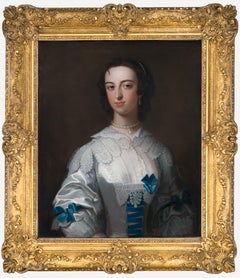
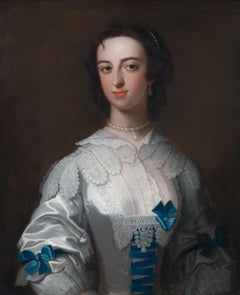
Portrait of Lady Mansfield of Ringwood Oil on Canvas, unsigned Image size: 25 x 30 inches (63 x 76 cm) Original carved & gilded frame Provenance Descended through the Family Estate Born in Poland in 1760 to the 2nd Earl of Mansfield and his wife, Elizabeth Mary Murray would later come under the care of her uncle, William Murray (1st Earl of Mansfield) at Kenwood House in Hampstead. David Murray (2nd Earl of Mansfield) was set to inherit the title and full wealth of his uncle, including Kenwood House. Lady Mansfield’s second cousin would soon join her at Kenwood, where they would be raised together and featured in multiple portraits of the time. Her younger sister, Henrietta, is seen in a separate portrait done by Thomas Hudson as well. At the age of 25 she married George Finch-Hatton, an English aristocrat and politician who sat in the House of Commons from 1772-1784. Gazing out at the viewer, Lady Mansfield wears a decorated dress, with an abundance of pearls and lace, and a transparent gold lined veil surrounding her right shoulder. The excess of luxurious fabric matches another Hudson portrait of another Lady Mansfield, with the lace detailing and complementary bodice. The depiction of this Lady Mansfield epitomizes the style of portraiture in the 18th century, such as the styles Hudson’s pupils Joshua Reynolds, Joseph Wright, and Peter Toms. From Hudson’s travels to the Low Countries and Italy, he no doubt brought back artistic inspiration from the international pieces he encountered. Thomas Hudson Hudson was a celebrated 18th century portrait painter. Born in Devon in 1701 he studied under the artist Jonathan Richardson and married his daughter, against Richardson’s wishes. He had many artistic friends including William Hogarth and Francis Hayman and travelled with them in Europe in 1748. He also visited Italy with the sculptor Louis-François Roubiliac in 1752. Hudson’s style of portraiture proved so successful that for a decade from 1745 to 1755 he was London’s most popular portrait painter and made a fortune painting the cream of London society and members of the Royal Family. He was also a talented teacher, perhaps too good, as subsequently a number of his former assistants overtook him in popularity including the artist Joshua Reynolds. Hudson retired in the late 1750’s and died in Twickenham in 1779. His most notable works include portraits of King George II and George Friedrich Handel and his “Portrait of a Nobleman in Van Dyck dress.” Many of Hudson’s works may be seen in art galleries. These include the National Portrait Gallery, the National Maritime Museum, the Tate Gallery, the Foundling Museum and the Bristol City Museum and Art Gallery. His works are also in Museums across the world...
Category

18th Century English School Thomas Hudson Art

Materials

Canvas, Oil

Portrait of a Lady, Old Masters 18th Century Oil
By Thomas Hudson
Located in London, GB
Thomas Hudson 1701 – 1779 Portrait of a Lady Oil on canvas Image size: 30 x 25 inches Original carved giltwood frame Hudson had many assistants, and employed the specialist drapery ...
Category

18th Century Old Masters Thomas Hudson Art

Materials

Canvas, Oil

Related Items
Madonna Child Del Sarto Paint Oil on table 16th Century Old master
Located in Riva del Garda, IT
Madonna and Child Workshop of Andrea del Sarto, pseudonym of Andrea d'Agnolo di Francesco (Florence 1486 - 1530) Attributable to Jacopo di Giovanni di Francesco, known as Jacone (...
Category

16th Century Old Masters Thomas Hudson Art

Materials

Oil

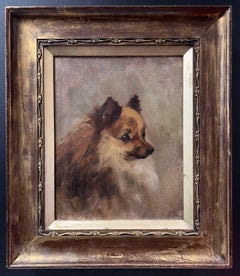
Antique English Oil Painting Portrait of Pomeranian Dog 19th Century framed
Located in Cirencester, Gloucestershire
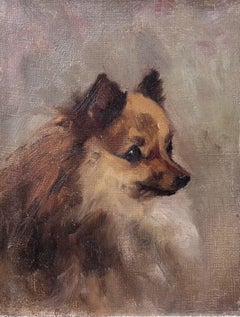
Portrait of a Pomeranian Dog English artist, late 19th century oil on canvas, framed Framed: 14.5 x 12.5 inches Canvas: 10 x 8 inches Provenance: Private collection, Surrey, England ...
Category

Late 19th Century English School Thomas Hudson Art

Materials

Oil, Canvas

Two royal portraits (the Duc d'Angoulême and the Duc de Berry) by H.P. Danloux
Located in PARIS, FR
These two royal portraits are a major historical testimony to the stay of the Comte d'Artois (the future Charles X) and his family in Edinburgh in 1796-1797. Given by the sitters to Lord Adam Gordon, the Governor of Edinburgh, and kept by family descent to this day, these two portraits provide us with a vivid and spontaneous image of the Duc d’Angoulême and his brother the Duc de Berry. Danloux, who had emigrated to London a few years before, demonstrate his full assimilation of the art of British portrait painters in the brilliant execution of these portraits. 1. Henri-Pierre Danloux, a portraitist in the revolutionary turmoil Born in Paris in 1753, Henri-Pierre Danloux was first a pupil of the painter Nicolas-Bernard Lépicié (1735 - 1784) and then, in 1773, of Joseph-Marie Vien (1716 - 1809), whom he followed to Rome when, at the end of 1775, Vien became Director of the Académie de France. In Rome he became friends with the painter Jacques-Louis David (1748 - 1825). Returning to France around 1782, he settled in Lyon for a few years before returning to Paris in 1785. One of his first portraits was commissioned by the Baroness d'Etigny, the widow of the former Intendant of the Provinces of Gascony, Bearn and Navarre Antoine Mégret d'Etigny (1719 – 1767). He then became close to his two sons, Mégret de Sérilly and Mégret d'Etigny, who in turn became his patrons. In 1787, this close relationship with the d'Etigny family was further strengthened by his marriage to Antoinette de Saint-Redan, a relative of Madame d'Etigny. After his marriage, he left for Rome and did not return to France until 1789. It was during the winter of 1790-1791 that he painted one of his masterpieces, the portrait of Baron de Besenval. Set in a twilight atmosphere, this portrait of an aristocrat who knows that his death is imminent symbolizes the disappearance of an erudite and refined society which would be swept away by the French Revolution. The Jacobin excesses led Danloux to emigrate to England in 1792; many members of his family-in-law who remained in France were guillotined on 10 May 1794. Danloux enjoyed great success as a portrait painter in England before returning to France in 1801. During his stay in England, Danloux was deeply under the influence of English portraitists: his colors became warmer (as shown by the portrait of the Duc d'Angoulême that we are presenting), and his execution broader. 2. Description of the two portraits and biographical details of the sitters The Duc d'Angoulême (1775-1844) was the eldest son of the Comte d'Artois, the younger brother of King Louis XVI (the future King Charles X), and his wife Marie-Thérèse of Savoie. He is shown here, in the freshness of his youth, wearing the uniform of colonel-general of the "Angoulême-Dragons" regiment. He is wearing the blue cordon of the Order of the Holy Spirit, which was awarded to him in 1787, and two decorations: the Cross of Saint-Louis and the Maltese Cross, as he was also Grand Prior of the Order of Malta. Born on 16 August 1775 in Versailles, Louis-Antoine d'Artois followed his parents into emigration on 16 July 1789. In 1792, he joined the émigrés’ army led by the Prince de Condé. After his stay in Edinburgh (which will be further discussed), he went to the court of the future King Louis XVIII, who was in exile at the time, and in 1799 married his first cousin Marie-Thérèse Charlotte of France, the daughter of Louis XVI and the sole survivor of the royal family. The couple had no descendants. He became Dauphin of France in 1824, upon the accession to the throne of his father but played only a minor political role, preferring his military position as Grand Admiral. Enlisted in Spain on the side of Ferdinand VII, he returned home crowned with glory after his victory at Trocadero in 1823. He reigned for a very short time at the abdication of Charles X in 1830, before relinquishing his rights in favor of his nephew Henri d'Artois, the Duc de Bordeaux. He then followed his father into exile and died on 3 June 1844 in Gorizia (now in Italy). His younger brother, the Duc de Berry, is shown in the uniform of the noble cavalry of the émigrés’ Army. He is wearing the blue cordon of the Order of the Holy Spirit, awarded to him in May 1789, and the Cross of Saint-Louis (partly hidden by his blue cordon). Born on 24 January 1778 in Versailles, Charles-Ferdinand d'Artois also followed his parents into emigration and joined the émigrés’ army in 1792. After his stay in Edinburgh, he remained in Great Britain, where he had an affair with Amy Brown...
Category

1790s Old Masters Thomas Hudson Art
Materials

Canvas, Oil, Wood Panel

English 17th century portrait of James Thynne as a young boy by a fountain
By Johann Kerseboom
Located in Bath, Somerset
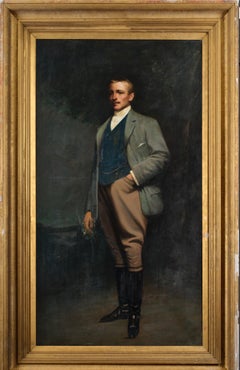
Portrait of the Hon. James Thynne (c. 1680-1704), full-length, in the gardens of Longleat House, seated beside a fountain, holding a shell beneath water spouting from a horn blown by a cherub on a dolphin. A glimpse of part of Longleat House can be seen upper left. Oil on canvas in a period giltwood frame, decorated with leaves and acorns. C. 1682. Dimensions: 145 x 123cm (57 x 48in) in frame Provenance: Ex Longleat House, Wiltshire Private collection, Bath James Thynne was the youngest son of Thomas Thynne, 1st Viscount Weymouth and Frances Finch of Longleat House, Wiltshire. He died in his youth and his Aunt, Anne Kingsmill Finch, Countess of Winchilsea (1661-1720), wrote a moving poem on his death. He was buried in the family vault at Longbridge Deverill, Wiltshire. A mezzotint of this painting by William Faithorne the Younger is held in the Royal Collection. Johann Kerseboom (d.1708) was the nephew of Frederick Kerseboom and first worked in Germany before coming to England in the 1680's where his sitters included the 'Electress Sophia Dorothea' (known from a mezzotint by William Faithorne). His early works were influenced by William Wissing...
Category

17th Century Old Masters Thomas Hudson Art

Materials

Oil, Canvas

C19th Portrait Princesse de Joinville of Brazil - Spectacular fit for a palace
By Henri d'Ainecy Montpezat
Located in London, GB
Portrait of Princess de Joinville riding a Bay Horse Henri d’Aincy, Le Comte Monpezat (French 1817-1859) Painted circa 1837-9 oil on canvas 113 x 92 inches (including frame) 92 x 70 inches (unframed) Provenance – from a private royal collection This magnificent portrait depicts Princess de Joinville, the daughter of Pedro I, Emperor of Brazil and the King of Portugal. Through her illustrious family she was directly related Alexander III and Nicholas II of Russia and the Russian royal family, as well as to many of the great ruling families of Europe. The work clearly confirms Monpezat as one of the most accomplished equestrian portrait painters in France in the early nineteenth century. In terms of scale, quality and dramatic power, it must surely be considered amongst his finest works. The stance of the powerful thoroughbred - in half rear - emphasises the calm nature and courage of the Princess. Francisca of Brazil (1824-98) married a son of Louis Philippe I, the King of the French, and had three children. Born at the Imperial Palace of Saint Christopher, her youngest brother was the future Pedro II...
Category

1830s Old Masters Thomas Hudson Art
Materials

Oil

18th century antique portrait Edmund Hoyle Circle of James Latham, Edmund Hoyle
Located in York, GB
18th century Bust portrait of a gentleman in a blue coat with gold buttons (Said to be Edmund Hoyle, inventor of Whist) oil on canvas circle of James Latham. Housed in a gilt frame the size overall is 71 x 84 cm (28 x 33 inches approx) whilst the painting is 56 x 69 cm ( 22 x 27 inches approx) unsigned The overall condition is very good having had some restoration. The painting has been relined, cleaned and re varnished. There has been some strengthening/overpainting. There is a Rectangular patch repair along lower edge, centre, reverse approximately 5 x 7cm with associated retouching to front,all essentially done sympathetically. some fine stable craquelure throughout. Some minor self coloured losses to frame. None of the above detracting from a very attractive portrait. Edmond Hoyle Edmond Hoyle English card game authority, "the Father of whist" Born 1672 England Died 29 August 1769 (aged 96–97) London, England Edmond Hoyle (1672 – 29 August 1769)[1] was a writer best known for his works on the rules and play of card games. The phrase "according to Hoyle" came into the language as a reflection of his generally perceived authority on the subject James Latham James Latham was born in Thurles, County Tipperary, Ireland and possibly related to the family of Lathams of Meldrum and Ballysheehan. After some practice of his art, Latham studied for an academic year in Antwerp (1724–25) where he became a Master of the Guild of St Luke. He returned to Dublin by 1725, and may have visited England in the 1740s, as the influence of Joseph Highmore, as well as Charles Jervas and William Hogarth, is evident in his work of this period. Anthony Pasquin memorably dubbed Latham "Ireland's Van Dyck". Latham died in Dublin on 26 January 1747. Several of James Latham's portraits are in the National Gallery of Ireland collection in Dublin; one is of the famous MP Charles Tottenham (1694–1758) of New Ross, Co. Wexford, "Tottenham in his Boots" (Cat. No.411) and a second is a portrait of Bishop...
Category

Mid-18th Century Old Masters Thomas Hudson Art
Materials

Oil

19th century Portrait of a Lady, Attributed to Sir Frank Dicksee
Located in York, GB
Portrait of a very attractive Lady, head-and-shoulders in length monogrammed FD, inscribed to verso, oil on canvas, 50cm x 40cm whilst overall is 59 x 69 cm . In overall good condition some craquelure. Has been relined and cleaned. original frame some minor losses (self coloured) Frank...
Category

19th Century Old Masters Thomas Hudson Art
Materials

Oil

19th century Portrait of a Lady, Attributed to Sir Frank Dicksee
$3,149 Sale Price
34% Off
H 27.17 in W 23.23 in D 1.97 in
ALLEGORICAL SCENE - Giovanni Faliero - Italy Oil on Canvas Painting
By Giovanni Faliero
Located in Napoli, IT
Allegorical Scene - Giovanni Faliero Italia 2009 - Oil on canvas cm. 90x110. This beautiful oil on canvas is the personal reinterpretation of the magnificent painting “Bacchant playing the Cymbals” by Jean-Simon Berthélemy, a French painter of the 18th century. Here we admire a mythological scene showing a naked bacchant playing cymbals next to a wooded stream, with a small sleeping faun...
Category

Early 2000s Old Masters Thomas Hudson Art
Materials

Canvas, Oil

"The Orange Voltaire II" by Linda Delahaye, Original Oil Painting, Female Nude
By Linda Delahaye
Located in Denver, CO
"The Orange Voltaire II" by Linda Delahaye (France based) is an original oil on panel depicting a graceful female nude bathed in sunlight. Born: 1980, Cana...
Category

21st Century and Contemporary Thomas Hudson Art

Materials

Oil, Panel

17th century portrait of Lady Sarah Cowper, Circle of Michael Dahl
By (Circle of) Michael Dahl
Located in York, GB
Portrait of Lady Sarah Cowper, nee Holled [1644-1720]-Circle of Michael Dahl (unsigned)17th century,Oil painting on canvas oval,bust-length . She has dar...
Category

17th Century Old Masters Thomas Hudson Art
Materials

Oil

19th Century Portrait of Pensive Madonna Blue Veil Pre-Raphaelite Oil Painting
Located in Cirencester, Gloucestershire
The Madonna in Pensive Thought English 19th Century, Pre-Raphaelite artist, unsigned Oil painting on board, framed Framed: 15 x 10.5 inches Board: 13 x 9 inches Condition: The painti...
Category

Late 19th Century Pre-Raphaelite Thomas Hudson Art

Materials

Oil

17th/18th century portrait , Circle Godfrey Kneller, wife, Earl of westmorland
By (Circle of) Godfrey Kneller
Located in York, GB
Portrait Circle of Sir Godfrey Kneller Bt. unsigned (British, 1646-1723) of Katharine, wife of Thomas, 6th Earl of Westmorland, oil on canvas late 17th early 18th century in date. The sitter Katharine is facing dexter and is wearing a cream dress, blue and gold cloak and lace mantilla...
Category

18th Century Old Masters Thomas Hudson Art
Materials

Oil

Previously Available Items
18th century portrait of Miss Furneaux-Pelham
By Thomas Hudson
Located in Bath, Somerset
Portrait of a Miss Furneaux Pelham, in a 'Van Dyck' style black gown with white sleeves trimmed with pink ribbon, the bodice adorned with jewels and pearls, resting her arm on a stone pedestal. Bears a Christie's stencil on the reverse 629HT and a Sotheby's auction chalk mark. Oil on canvas housed in a period giltwood frame. Canvas size: 92 x 71cm In frame: 109 x 89cm Provenance: Property of Edward Hockley when sold at Christie's London, 3 May 1946, lot 79 (as by Allan Ramsay), bt. by 'Nicholl' Sotheby's London sale, 'British Paintings 1500-1805', 10 July 1991, lot 22 (as by Thomas Hudson) Private collection, Sussex From 1740 to about 1760 Thomas Hudson was one of the most successful portrait painters in England. Having come to London in the mid-1720's, shortly after the death of Sir Godfrey Kneller in 1723, Hudson gradually rose to a position of prominence, which he held until the 1750's. Hudson painted only portraits, working first under the influence of his teacher Jonathan Richardson, and then turning in the 1740's to the baroque portrait compositions of Sir Anthony Van Dyck and Sir Peter Lely. From this time, with the assistance of drapery painters such as Joseph Van Aken, Hudson produced large numbers of portraits of ladies, gentlemen, judges and clergymen. He married his teacher's daughter Mary...
Category

18th Century English School Thomas Hudson Art

Materials

Canvas, Oil

English 18th century portrait of Walter Edwards Freeman (c.1725-1747)
By Thomas Hudson
Located in Bath, Somerset
Walter Edwards Freeman, three-quarter length, standing in a landscape (probably the grounds of Batsford Park) wearing a dark green velvet jacket with gold buttons and a white cravat, an ivory silk waistcoat with his hat tucked under his arm, his hair worn 'en queue'. Oil on canvas. Walter Edwards Freeman (born circa 1725) was the son of Mary (nee Freeman) and Walter Edwards Senior whose family came from Bristol. Mary's father was Richard Freeman (Senior), a landowner with extensive properties in several counties and was appointed Lord Chancellor of Ireland in 1702. After the death of his uncle, Richard Freeman (the Younger) in 1745, he inherited the estate of Batsford Park, Gloucestershire, and he and his family took the surname Freeman. Sadly Walter died two years later and his brother Thomas then inherited the Batsford Estate. When Thomas died without a direct heir in 1808, the estate passed on to his wife's nephew John Mitford and so on through the Mitford family. In 1916 it was inherited by the eccentric David Freeman-Mitford, 2nd Baron Redesdale and father of the famous Mitford sisters. His eldest daughter, Nancy Mitford, based part of her novels 'The Pursuit of Love' and 'Love in a Cold Climate' on their time living at Batsford. Provenance: The property of a Mrs E. Redburn when sold with Sotheby's London, 23 November 1977 With Lane Fine Art, London The property of Eric Dare, Melbourne, Australia when sold with Sotheby's, 13 November 1995. Christie's London, British Pictures, 24 November, 1998, lot 27 From 1740 to about 1760 Thomas Hudson was one of the most successful portrait painters in England. Having come to London in the mid-1720's, shortly after the death of Sir Godfrey Kneller in 1723, Hudson gradually rose to a position of prominence, which he held until the 1750's. Hudson painted only portraits, working first under the influence of his teacher Jonathan Richardson, and then turning in the 1740's to the baroque portrait compositions of Sir Anthony Van Dyck and Sir Peter Lely. From this time, with the assistance of drapery painters such as Joseph Van Aken, Hudson produced large numbers of portraits of ladies, gentlemen, judges and clergymen. He married his teacher's daughter Mary Richardson...
Category

Mid-18th Century English School Thomas Hudson Art

Materials

Canvas, Oil

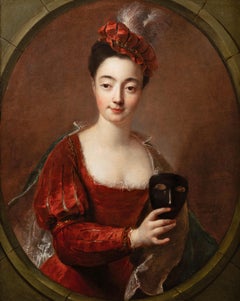
Portrait of an Aristocratic Gentleman in Crimson Velvet Jacket Oil Painting
By Thomas Hudson
Located in Cirencester, Gloucestershire
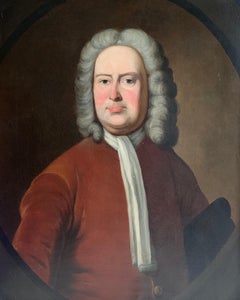
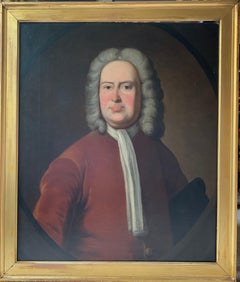
Portrait of an Aristocratic Gentleman attributed to Thomas Hudson (British 1701-1779) oil painting on canvas, framed canvas: 30 x 25 inches framed: 33 x 28 inches provenance: private collection, England Fine 18th century English oil painting...
Category

18th Century Old Masters Thomas Hudson Art
Materials

Canvas, Oil

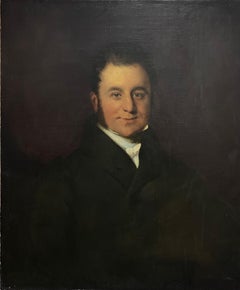
English 18th century Portrait of a Lady wearing blue silk
By Thomas Hudson
Located in Bath, Somerset
A rare signed portrait of a young lady by Thomas Hudson (1701-1779) circa 1736. Inscribed lower right 'D.G. 18 years' and signed 'Hudson'. Size 41½” x 31” (105.5 x 79 cms) Oil on c...
Category

Early 18th Century Old Masters Thomas Hudson Art
Materials

Oil, Canvas

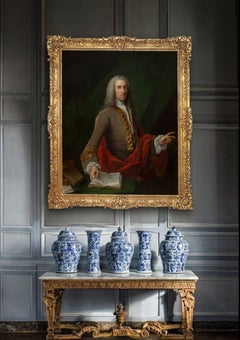
Thomas Hudson - Pair of portraits - 4th Duke of Beauforts children
By Thomas Hudson
Located in Stoke, Hampshire
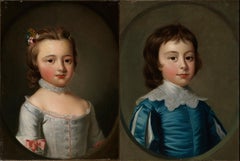
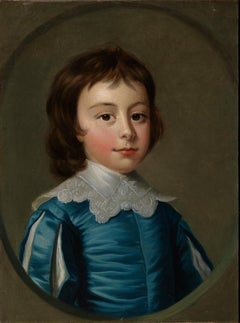
Thomas Hudson 1701-1779 The eldest children of Charles Noel, 4th Duke of Beaufort: Head and shoulders portraits of Henry (1744-1803; later 5th Duke) a little boy dressed in blue Van Dyck costume, and his sister Lady Anne Somerset, (1741-1763) in a white dress set with pink ribbons, and a lace ruff. Oil paintings on canvas each 20 x 15 inches in carved and giltwood frames Painted circa 1747/8 Thomas Hudson, a native of Devon, was by far the leading portrait painter in London for two decades in the middle years of the 18th century. He had arrived in London in the 1720’s after the death of Sir Godfrey Kneller, who had dominated London society portraiture for decades. He was taught to paint portraits by the redoubtable Jonathan Richardson, the artist, connoisseur, collector and theoretician of the arts. His portrait practice by 1740 was substantial and highly successful, and numerous paintings by him survive. He continued the tradition of Van Dyck and Lely, and maintained a large studio with numerous talented young artists whom he taught: Henry Pickering, Joseph Wright of Derby, Sir Joshua Reynolds and others. He usually employed Joseph Van Aken as his drapery painter, and the consequence is that many of the works of these artists in these two decades are often difficult to distinguish one from another. His quality, though, is consistent, and his likenesses truthful: they are the sound Georgian Prose and may be contrasted with the feathery rococo poetry of painters of the next generation, most notably Gainsborough. The present paintings illustrate the high fashion of the 1750-60's, when the “Van Dyck” falling lace collar enjoyed a substantial, if rather brief, popularity. Hudson used the style on numerous occasions for both male and female sitters. The present pictures are autograph replicas of two of the group of portraits by Hudson of the 4th Duke's children painted towards the end of the 1740's, and which remain at Badminton House...
Category

18th Century Thomas Hudson Art
Materials

Oil

Thomas Hudson art for sale on 1stDibs.

Find a wide variety of authentic Thomas Hudson art available for sale on 1stDibs. You can also browse by medium to find art by Thomas Hudson in canvas, fabric, oil paint and more. Much of the original work by this artist or collective was created during the 18th century and earlier and is mostly associated with the Old Masters style. Not every interior allows for large Thomas Hudson art, so small editions measuring 25 inches across are available. Customers who are interested in this artist might also find the work of John Emms, W. Smithson Broadhead, and John Horace Hooper. Thomas Hudson art prices can differ depending upon medium, time period and other attributes. On 1stDibs, the price for these items starts at $24,293 and tops out at $25,307, while the average work can sell for $24,540.

Artists Similar to Thomas Hudson