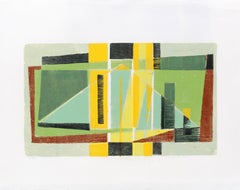
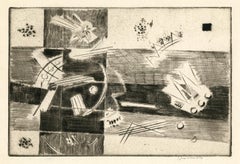
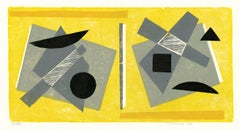
Werner Drewes Art

American, 1899-1985

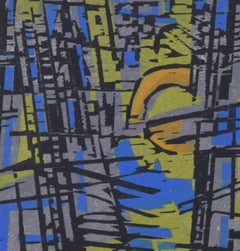
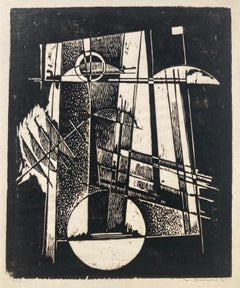
Werner Drewes was a painter, printmaker, and teacher, who was born in Canig, Germany, in 1899. His father, a Lutheran Minister, hoped he would become an architect, but Werner chose the life of an artist. After he served on the front line in France during the war, Werner was admitted to the Bauhaus in 1921, where he studied under Klee, Itten, and Muche. Later, he traveled through Europe to study such old masters as Tintoretto, Velasquez and El Greco. After marrying Margaret Schrobsdorff, they traveled throughout South America, North America and Asia. In 1930, Werner immigrated to New York City with his family. In New York City, despite the Depression, Werner joined other Bauhaus artists such as Piet Mondrian and Lyonel Feininger to make a living as an artist. This group became the core of the American Abstract Artists group. Werner taught at Columbia University, worked on the design of the 1939 World's Fair building, and had shows at the Museum of Modern Art, Kleeman Gallery, and elsewhere. In 1946, he accepted a tenured position at the Washington University in St. Louis. In his later years, he moved to Virginia and continued to show at galleries in Germany, Turkey, and in the United States. The Smithsonian held a show attributing his 65 years as a printmaker at the Museum for American Artists.

to
1
24
23
15
7
5
3
3
2
2
1
1
1
1
1
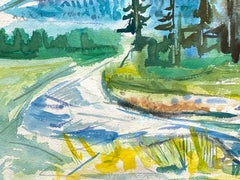
“Rocky Mountain Meadow”

“Rocky Mountain Meadow”

By Werner Drewes

Located in Southampton, NY

Original watercolor on archival paper of a Rocky Mountain Meadow by the well known American artist, Werner Drewes. Signed lower right. Titled and dated 1956 on verso of sheet. Con...

Category

1950s American Modern Werner Drewes Art

Materials

Watercolor, Archival Paper

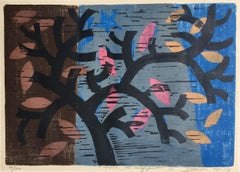
Tree at Night
Tree at Night

Tree at Night

By Werner Drewes

Located in Santa Monica, CA

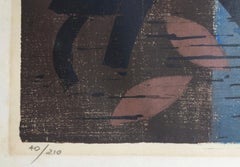
WERNER DREWES (German-American 1899-1985) TREE AT NIGHT, 1964 (Rose 241) Color woodcut Signed titled, dated and numbered 40 /210 all in pencil below image. Image 11 1/8 x 15 7/8 inc...

Category

1960s Abstract Expressionist Werner Drewes Art

Materials

Woodcut

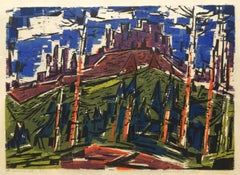
Huge  - CASTLE ROCK WYOMING (Jackson Hole),

Huge - CASTLE ROCK WYOMING (Jackson Hole),

By Werner Drewes

Located in Santa Monica, CA

WERNER DREWES (1899 - 1985) CASTLE ROCK WYOMING (Jackson Hole), (Rose RIII 194) Color woodcut Total edition XXX, Signed, annotated AP and dated '58 in...

Category

1950s Abstract Expressionist Werner Drewes Art

Materials

Woodcut

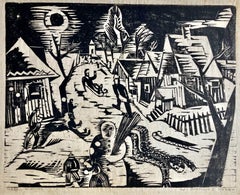
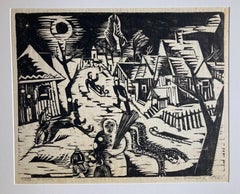
Werner Drewes, Winter, 1933, modernist woodcut

Werner Drewes, Winter, 1933, modernist woodcut

By Werner Drewes

Located in New York, NY

A modernist fantasy winter scene created by Werner Drewes, this print brings key aspects of the period together. His cubist-inspired woodcut technique is utilized here to bring the s...

Category

1930s American Modern Werner Drewes Art

Materials

Woodcut

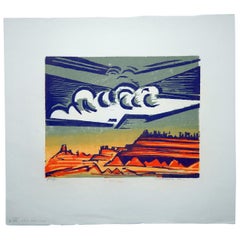
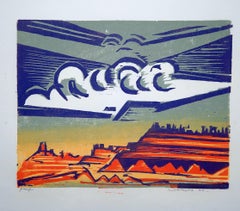
Werner Drewes Bauhaus Artist Color Woodblock, 1977, White Storm Cloud

Werner Drewes Bauhaus Artist Color Woodblock, 1977, White Storm Cloud

By Werner Drewes

Located in Phoenix, AZ

Original color woodblock print by Werner Drewes. In excellent condition. Unframed. Image measures 11 1/4 x 14 1/4 inches. Pencil Signed and Dated: Proof (15) R-364. Werner Drewes (1899-1985) Werner Drewes, painter, printmaker, and teacher was born in Canig, Germany in 1899. His father, a Lutheran Minister, hoped he would become and architect but Werner chose the life of an artist. After he served on the front line in France during the war, Werner was admitted to the Bauhaus in 1921 where he studied under Klee, Itten, and Muche. Later, he traveled through Europe to study such old masters as Tintoretto, Velasque, and El Greco. After marrying Margaret Schrobsdorff, they traveled throughout South America, North America, and Asia. In 1930, Werner immigrated to New York City with his family. In New York City, despite the Depression, Werner joined other Bauhaus artists such as Mondrian and Feininger to make a living as an artist. This group became the core of the American Abstract Artists group. Werner taught at Columbia University, worked on the design of the 1939 Worlds Fair building...

Category

Late 20th Century Werner Drewes Art

Materials

Paper

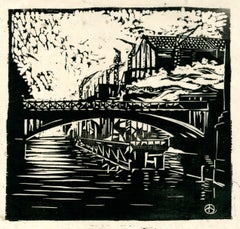
Werner Drewes, woodcut, 1919, early pre Bauhaus, small edition

Werner Drewes, woodcut, 1919, early pre Bauhaus, small edition

By Werner Drewes

Located in Fairlawn, OH

Werner Drewes (1899-1985) Berlin Elevated Linocut on Japanese paper, 1919 Unsigned Provnenance: Gift of the artist Bauhaus Art Professor Jorg Maass Kunsthandel, Berlin ...

Category

1910s Bauhaus Werner Drewes Art

Materials

Woodcut

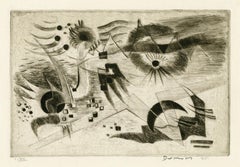
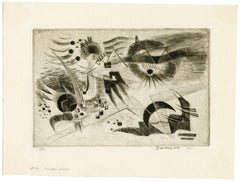
Pointed Shapes and Black Half Moon

Pointed Shapes and Black Half Moon

By Werner Drewes

Located in Myrtle Beach, SC

Werner Drewes, 'Pointed Shapes and Black Half Moon', etching, 1935, edition 20, Rose l.198. Signed, dated, and numbered 'I-XX' in pencil. A fine, rich impression, in warm black ink...

Category

1930s Bauhaus Werner Drewes Art

Materials

Etching

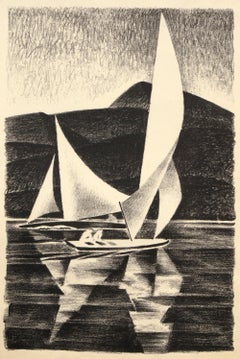
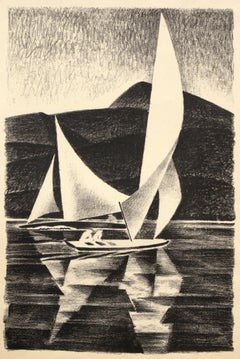
New Rochelle - Before the Wind

New Rochelle - Before the Wind

By Werner Drewes

Located in Myrtle Beach, SC

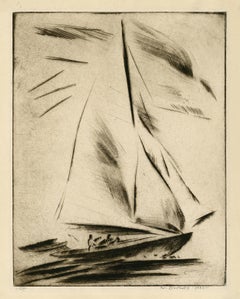
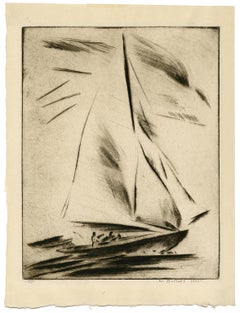
'New Rochelle - Before the Wind', drypoint, 1931, edition 30 (only a few impressions printed), Rose l.163. Signed, dated '1932' and numbered '1 – XXX' in ...

Category

1930s Modern Werner Drewes Art

Materials

Drypoint

Untitled Mid Century Modern Abstract Woodcut

Untitled Mid Century Modern Abstract Woodcut

By Werner Drewes

Located in New York, NY

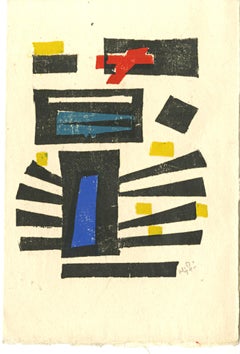
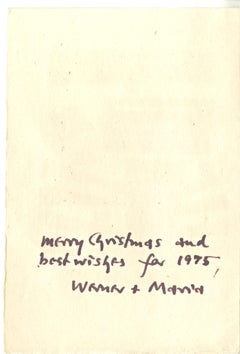
Werner Drewes Untitled Mid Century Modern Abstract Woodcut, 1974 Woodcut fold-out card on Rives BFK paper with deckled edges 9 1/5 × 6 1/4 inches Unframed Rarely seen, this twice sig...

Category

Mid-20th Century Abstract Werner Drewes Art

Materials

Woodcut

Twin Formation in Gray

Twin Formation in Gray

By Werner Drewes

Located in Myrtle Beach, SC

Twin Formation in Gray, color woodcut, 1982, edition 30, Rose III.400. Signed, dated and numbered I7/XXX in pencil, annotated 415 and titled in the bottom left sheet edge. A fine impression with fresh, rich colors, on heavy off-white Japan paper; the full sheet with wide margins (1 3/4 to 3 1/4 inches), in good condition. Printed in black, dark gray, medium gray, yellow/orange, and lemon yellow. Matted to museum standards, unframed. An impression of this work is included in the permanent collection of the Smithsonian American Art Museum. ABOUT THE ARTIST Painter, printmaker, and art teacher, Werner Drewes (1899–1985) was among the founding fathers of American abstraction. A student at the famed Bauhaus in the 1920s, he studied under Lyonel Feininger, Paul Klee, Laszlo Moholy-Nagy and Wassily Kandinsky. Following his emigration to the United States in 1930, he was instrumental in introducing modernist Bauhaus concepts and esthetics to America. Drewes’ boldly dynamic and emotionally expressive work, which encompassed both non-objective and figurative genres, brought him critical acclaim and numerous gallery and institutional exhibitions throughout his artistic career. Drewes' graphic work can be found in most major American art museums including, the Ackland Art Museum, The Art Institute of Chicago, Bauhaus Archive...

Category

Late 20th Century Bauhaus Werner Drewes Art

Materials

Woodcut

Bauhaus, Werner Drewes, woodcut, 1921, unrecorded proof

Bauhaus, Werner Drewes, woodcut, 1921, unrecorded proof

By Werner Drewes

Located in Fairlawn, OH

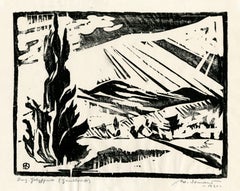
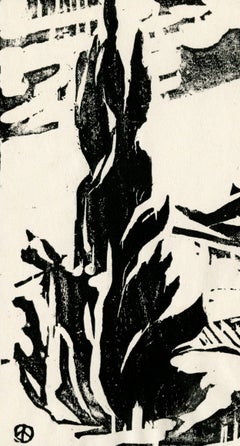
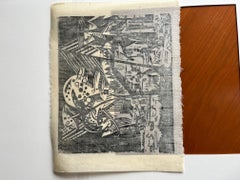
Werner Drewes (1899-1985) Mountainous Landscape with Cypress, 1921 Woodcut on wove paper Original paper folder serving as overmatting of the image, signed and titled a second time by...

Category

1920s Bauhaus Werner Drewes Art

Materials

Woodcut

Werner Drewes Modernist American Painting, Southwest Subject, 1947

Werner Drewes Modernist American Painting, Southwest Subject, 1947

By Werner Drewes

Located in Phoenix, AZ

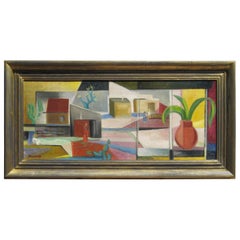
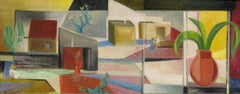
Werner Drewes (1899-1985) oil on canvas, 1947 Titled: “Adobe Village” Measures: 15 ½ x 36 Frame: 21 x 42 Signed lower left and also on the verso In excellent condition. Born in Nie...

Category

1940s Werner Drewes Art

Materials

Paint

Ecce Homo VII
Ecce Homo VII

Ecce Homo VII

By Werner Drewes

Located in Fairlawn, OH

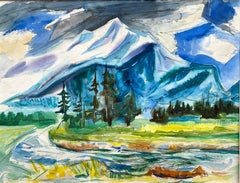
Ecce Homo VII Woodcut, 1921 Signed, titled, and dated in pencil by the artist One of only three known impressions Created while the artist was studying at the Bauhaus in Weimar, Germany. Extreme rarity-One of three know impressions Note: In 1921 Drewes went to the Bauhaus in Weimar, where, after completing the compulsory preliminary course with Johannes Itten, he continued to study with Paul Klee, Oskar Schlemmer and Georg Muche and initially went to the wall painting workshop. He then traveled extensively through Europe, North America and Asia. After returning to Germany in 1927, he went back to the Bauhaus, this time to his new location in Dessau, where he studied in the classes of László Moholy-Nagy and Wassily Kandinsky. He was one of the first artists to introduce the groundbreaking concepts of the Bauhaus School in the United States through his painting, printmaking, and teaching. Condition: Excellent Missing small voids in the upper margin from removal of the original hinges. Image size: 9 7/8 x 8 3/16 inches Reference: Rose 30 Provenance: From the estate of Drewes's teacher at the Bauhaus. During the post WW2 the professor lived in East Germany. WERNER DREWES 1899-1985 Werner Drewes initially studied architecture before enrolling, in 1921-22, at the Bauhaus in Weimar under Klee, Kandinsky, Itten and Feininger. For four years - 1923 to 1927 - he travelled the world with his bride, before completing his Bauhaus training in Dessau in 1929. He immigrated to the United States in 1930, documenting that move to New York through series of woodcuts. In 1936/37 he was an active founder of the American Abstract Artists and participated in the Federal Arts Project in New York before moving on to a teaching career at Washington University in St. Louis. As an artist for over sixty five years, he employed various media from drawing and watercolor, through woodcut and etching, to painting and collage. Translating an early interest in subjective cubistic forms, his work evolved into nonobjective abstraction. He was creative until the day of his death. Courtesy: Toby C. Moss Werner Drewes (1899–1985) was a painter, printmaker, and art teacher. Considered to be one of the founding fathers of American abstraction, he was one of the first artists to introduce concepts of the Bauhaus school within the United States. His mature style encompassed both nonobjective and figurative work and the emotional content of this work was consistently more expressive than formal. Drewes was as highly regarded for his printmaking as for his painting. In his role as teacher as well as artist he was largely responsible for bringing the Bauhaus aesthetic to America. Early life and education Drewes was born in 1899 to Georg Drewes, a Lutheran pastor, and Martha Schaefer Drewes. The family lived in the village of Canig within Lower Lusatia, Germany. From age eight to eighteen he attended the Saldria Gymnasium, a boarding school in Brandenburg an der Havel. There, he showed talent both for painting and woodblock printing. Graduating from Saldria in 1917, he was drafted by the German army and served in France from then until the close of the war. About this period of his life he is reported to have said that the horrors of life at the front were only made tolerable by his sketchbook, a copy of Goethe's Faust and a volume of Nietzsche. For a decade following the close of the war he studied, made paintings and prints, and traveled widely. His friend, Herwarth Walden, helped shape his appreciation for expressionist literature and art. Walden produced the quarterly magazine, Der Sturm and ran a gallery of contemporary art, Galerie Der Sturm, from which, in 1919, Drewes purchased an expressionist painting by William Wauer titled Blutrausch (Bloodlust). In the same year he made the acquaintance of Heinrich Vogeler and participated in Vogeler's socialist utopian artists' commune, Barkenhoff, at Worpswede, Lower Saxony. In 1919 Drewes also enrolled at the Königlich Technischen Hochschule Charlottenburg to study architecture and the following year he studied the same subject at the Technischen Hochschule Stuttgart. Preferring art over architecture, he then enrolled in Stuttgart's school of applied arts (Kunstgewerbeschule) where he studied life drawing and learned to work with colored glass. At this time he joined a group of artists and architects associated with the newly formed Merz Akademie, a college of design, art, and media in Stuttgart. In 1921 his friendship with a French artist, Sébastien Laurent, led him to begin studies in Weimar at Bauhaus, then a new school which taught an integrated approach to the fine and applied arts. His instructors were Johannes Itten and Lyonel Feininger, whose paintings were expressionist and abstract, and Paul Klee, who taught bookbinding, stained glass, and murals. While at Bauhaus Drewes produced a portfolio of ten woodblock prints entitled "Ecce Homo." In 1923 and 1924 he studied art during travels throughout Italy, Spain, the United States, and Central America and in 1926 he traveled to San Francisco, Japan, and Korea, thence taking the Trans-Siberian railway to Manchuria, Moscow, and Warsaw. He later said the El Grecos he saw proved to be most influential in his work. While traveling, he exhibited: (1) etchings in Madrid (1923) and Montevideo (1924), oils and etchings in Buenos Aires and St. Louis (1925), and (3) etchings in San Francisco (1926). He paid his way by the sales these exhibits produced and by taking commissions to paint portraits. While in San Francisco he set up a shop from which he sold prints he had made in Spain and South America. After his return to Germany in 1927 he resumed study at Bauhaus, which had been forced to relocate in Dessau, Saxony-Anhalt. His instructors at that time were László Moholy-Nagy (metal work), Wassily Kandinsky, and (painting), and Lyonel Feininger (prints). At this time he also worked and exhibited in Frankfurt. With the rise of Nazism abstract artists found it increasingly difficult to sell their work and, in 1930, Drewes, finding the political pressure unbearable, emigrated to the United States. There, despite the world economic crisis, Drewes was able to earn a living as a professional artist. Mature style After Drewes moved to New York, Kandinsky, who was both friend and mentor, continued to exert a strong influence over his style. Later in life he said he had a hard time getting away from Kandinsky's influence as he developed his own style. In time he was able to bring a more emotional approach to his work and to base it, more than Kandinsky did, on natural forms. In 1930 Drewes had a solo exhibition at the 135th Street Branch of the New York Public Library and a two-person show at the S.P.R. Penthouse Gallery...

Category

1920s Expressionist Werner Drewes Art
Materials

Woodcut

Werner Drewes, 125th Street at Broadway, NYC

Werner Drewes, 125th Street at Broadway, NYC

By Werner Drewes

Located in New York, NY

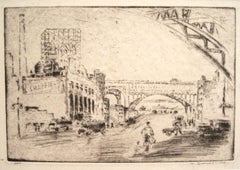
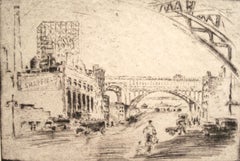
Werner Drewes brought his modernist vision to this subject but created, in my opinion, a great work of the Etching Revival. The reference is Rose 183. It...

Category

1930s American Modern Werner Drewes Art

Materials

Drypoint

Untitled. Still Life.

Untitled. Still Life.

By Werner Drewes

Located in New York, NY

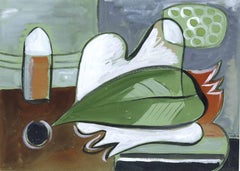
This gouache painting by Werner Drewes was created in 1942. Signed with a pen in the lower right. Cypher and date are just under the signature. Painted to the papers edge - the pap...

Category

1940s Abstract Expressionist Werner Drewes Art

Materials

Gouache

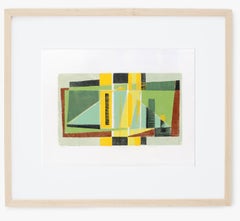
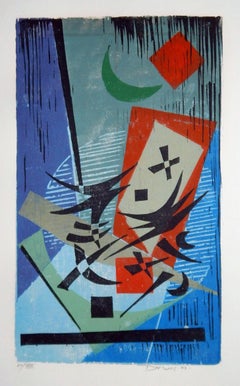
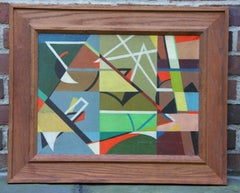
Werner Drewes Woodblock Print Cubist Colorful Rare Framed Green Black Red 1982

Werner Drewes Woodblock Print Cubist Colorful Rare Framed Green Black Red 1982

By Werner Drewes

Located in Buffalo, NY

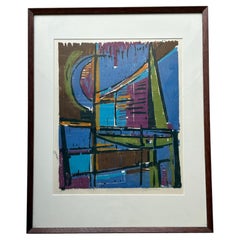
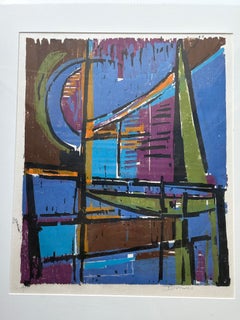
An original woodblock print by American artist Werner Drews. This composition comes in an archival frame presentation which measures 26 x 30 on the wall. Werner Drewes (1899-1985) Werner Drewes, painter, printmaker, and teacher was born in Canig, Germany in 1899. His father, a Lutheran Minister, hoped he would become and architect but Werner chose the life of an artist. After he served on the front line in France during the war, Werner was admitted to the Bauhaus in 1921 where he studied under Klee, Itten, and Muche. Later, he traveled through Europe to study such old masters as Tintoretto, Velasque, and El Greco. After marrying Margaret Schrobsdorff, they traveled throughout South America, North America, and Asia. In 1930, Werner immigrated to New York City with his family. In New York City, despite the Depression, Werner joined other Bauhaus artists such as Mondrian and Feininger to make a living as an artist. This group became the core of the American Abstract Artists group. Werner taught at Columbia University, worked on the design of the 1939 Worlds Fair building...

Category

1980s Cubist Werner Drewes Art

Materials

Paper, Woodcut

Farm in the Woods
Farm in the Woods

Farm in the Woods

By Werner Drewes

Located in New York, NY

Werner Drewes (1899-1983), Farm in the Woods, woodcut, 1933, signed and dated in pencil lower right (also numbered 1-xxx and titled lower left). Reference: Rose 83. In very good cond...

Category

1930s American Realist Werner Drewes Art

Materials

Woodcut

Small Forms On Crossing Bands

Small Forms On Crossing Bands

By Werner Drewes

Located in Myrtle Beach, SC

Werner Drewes, 'Small Forms on Crossing Bands', drypoint and roulette, 1935, edition 20, Rose 1.197. Signed in pencil. A fine, rich impression, in warm black ink, on cream wove paper...

Category

1930s Bauhaus Werner Drewes Art

Materials

Drypoint

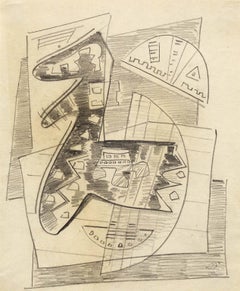
Untitled Form in Space, Abstract Expressionist Pencil Drawing, 1944

Untitled Form in Space, Abstract Expressionist Pencil Drawing, 1944

By Werner Drewes

Located in New York, NY

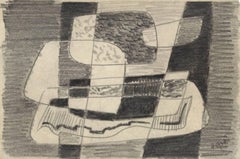
Pencil drawing on paper from 1944. Signed and dated with cypher. Paper size 4 x 6" (10 x 15.1 cm). Werner Drewes (1899-1985), painter, printmaker, educator and lecturer, was...

Category

1940s Abstract Expressionist Werner Drewes Art

Materials

Pencil

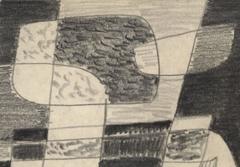
Dancing Motion Pencil Drawing, Abstract Expressionist, Signed, 1938

Dancing Motion Pencil Drawing, Abstract Expressionist, Signed, 1938

By Werner Drewes

Located in New York, NY

Drawing, 1938. Signed and dated with the artist cypher. Paper size 7 9/16 x 6 1/4" (19.3 x 15.8 cm). Werner Drewes (1899-1985), painter, printmaker, educator and lecturer, wa...

Category

1930s Abstract Expressionist Werner Drewes Art

Materials

Pencil

Werner Drewes Bauhaus Artist Color Woodblock, 1973, The Green Moon

Werner Drewes Bauhaus Artist Color Woodblock, 1973, The Green Moon

By Werner Drewes

Located in Phoenix, AZ

Original color woodblock print by Werner Drewes. In excellent condition. Unframed. Image measures 18 7/8 x 11 1/4 inches. Pencil signed and dated lower right. Edition size in pencil lower left: #24 of 30. (11) R-308. Werner Drewes (1899-1985) Werner Drewes, painter, printmaker, and teacher was born in Canig, Germany in 1899. His father, a Lutheran Minister, hoped he would become and architect but Werner chose the life of an artist. After he served on the front line in France during the war, Werner was admitted to the Bauhaus in 1921 where he studied under Klee, Itten, and Muche. Later, he traveled through Europe to study such old masters as Tintoretto, Velasque, and El Greco. After marrying Margaret Schrobsdorff, they traveled throughout South America, North America, and Asia. In 1930, Werner immigrated to New York City with his family. In New York City, despite the Depression, Werner joined other Bauhaus artists such as Mondrian and Feininger to make a living as an artist. This group became the core of the American Abstract Artists group. Werner taught at Columbia University, worked on the design of the 1939 Worlds Fair building...

Category

Late 19th Century Werner Drewes Art

Materials

Paper

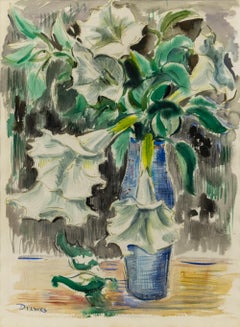
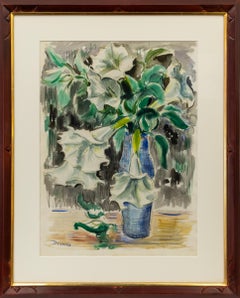
Werner Drewes Datura Stramonii Modernist Botanical Watercolor Painting

Werner Drewes Datura Stramonii Modernist Botanical Watercolor Painting

By Werner Drewes

Located in Denver, CO

“Datura Stramonii” is a striking original watercolor by renowned Bauhaus-trained modernist Werner Drewes. This elegant still life depicts the dramatic Datura (Jimsonweed) plant, also...

Category

Mid-20th Century American Impressionist Werner Drewes Art

Materials

Watercolor

Werner Drewes Bauhaus Artist Color Woodblock, 1975, Enterlocked Forms

Werner Drewes Bauhaus Artist Color Woodblock, 1975, Enterlocked Forms

By Werner Drewes

Located in Phoenix, AZ

Original color woodblock print by Werner Drewes. In excellent condition. Unframed. Image measures 9 1/8 x 21 inches. Pencil signed and dated lower right. Edition size in pencil lower left: #3 of 30. (13) R-341 Werner Drewes (1899-1985) Werner Drewes, painter, printmaker, and teacher was born in Canig, Germany in 1899. His father, a Lutheran Minister, hoped he would become and architect but Werner chose the life of an artist. After he served on the front line in France during the war, Werner was admitted to the Bauhaus in 1921 where he studied under Klee, Itten, and Muche. Later, he traveled through Europe to study such old masters as Tintoretto, Velasque, and El Greco. After marrying Margaret Schrobsdorff, they traveled throughout South America, North America, and Asia. In 1930, Werner immigrated to New York City with his family. In New York City, despite the Depression, Werner joined other Bauhaus artists such as Mondrian and Feininger to make a living as an artist. This group became the core of the American Abstract Artists group. Werner taught at Columbia University, worked on the design of the 1939 Worlds Fair building...

Category

Late 20th Century Werner Drewes Art

Materials

Paper

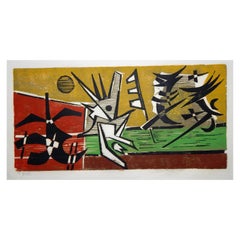
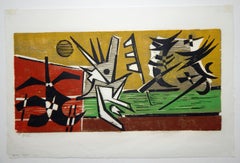
Werner Drewes Bauhaus Artist Color Woodblock, 1973, At Play No. 3 'Fight'

Werner Drewes Bauhaus Artist Color Woodblock, 1973, At Play No. 3 'Fight'

By Werner Drewes

Located in Phoenix, AZ

Original color woodblock print by Werner Drewes. In excellent condition. Unframed. Image measures 11 x 22 3/4 inches. Pencil signed and dated lower right. Numbered in pencil lower left: 16 of the edition of 30. R-307. Werner Drewes (1899-1985) Werner Drewes, painter, printmaker, and teacher was born in Canig, Germany in 1899. His father, a Lutheran Minister, hoped he would become and architect but Werner chose the life of an artist. After he served on the front line in France during the war, Werner was admitted to the Bauhaus in 1921 where he studied under Klee, Itten, and Muche. Later, he traveled through Europe to study such old masters as Tintoretto, Velasque, and El Greco. After marrying Margaret Schrobsdorff, they traveled throughout South America, North America, and Asia. In 1930, Werner immigrated to New York City with his family. In New York City, despite the Depression, Werner joined other Bauhaus artists such as Mondrian and Feininger to make a living as an artist. This group became the core of the American Abstract Artists group. Werner taught at Columbia University, worked on the design of the 1939 Worlds Fair building...

Category

Late 20th Century Werner Drewes Art

Materials

Paper

Related Items
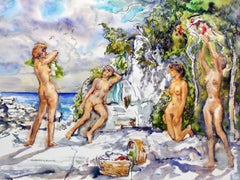
Nude Picnic Virgin Islands

Nude Picnic Virgin Islands

By Robert Noel Blair

Located in Buffalo, NY

Robert Noel Blair (American, 1912-2003) was an American artist, painter, sculptor, printmaker and teacher. He is best known for his rural life & desert landscapes and World War II sc...

Category

1960s American Modern Werner Drewes Art

Materials

Archival Paper, Watercolor

Gustave Baumann Color Woodblock - Rancho de Taos

Gustave Baumann Color Woodblock - Rancho de Taos

By Gustave Baumann

Located in Phoenix, AZ

“Rancho de Taos” by well-known woodblock artist Gustave Baumann (1881-1971). The medium is color woodblock. It's a beautiful print in excellent condition. Baumann's personal Hand and...

Category

Mid-20th Century Werner Drewes Art

Materials

Woodcut

'Taos Placita' — American Southwest Masterwork, Signed Color Woodcut

'Taos Placita' — American Southwest Masterwork, Signed Color Woodcut

By Gustave Baumann

Located in Myrtle Beach, SC

Gustave Baumann, 'Taos Placita', color woodcut, 1947, edition 125. Baumann 132. Signed, titled, and numbered '20-125' in pencil; with the artist’s Hand-in-Heart chop. A superb, richly-inked impression, with fresh colors, on fibrous oatmeal wove paper; the full sheet with margins (2 to 3 1/8 inches); slight rippling at the left sheet edge, in excellent condition. Matted to museum standards, unframed. Image size 9 5/8 x 11 1/4 inches (244 x 286 mm); sheet size 13 1/4 x 17 inches (337 x 432 mm). Collections: Harwood Museum of Art, New Mexico Museum of Art, Phoenix Art Museum, Scottsdale Art Museum, Wichita Art Museum. ABOUT THE ARTIST Gustave Baumann (1881-1971) was a renowned printmaker and a leading figure of the American color woodcut revival whose exquisite craftsmanship and vibrant imagery captured the essence of the Southwest. "A brilliant printmaker, Baumann brought to the medium a full mastery of the craft of woodworking that he acquired from his father, a German cabinetmaker. This craftsmanship was coupled with a strong artistic training that resulted in the handsome objects we see in the exhibition today. After discovering New Mexico in 1918, Baumann began to explore in his woodblock prints of this period the light. color, and architectural forms of that landscape. His prints of this period are among the most beautiful and poetic images of the American West." —Lewis I. Sharp, Director, Denver Art Museum Baumann, the son of a craftsman, immigrated to the United States from Germany with his family when he was ten, settling in Chicago. From 1897 to 1904, he studied in the evenings at the Art Institute of Chicago, working in a commercial printmaking shop during the day. In 1905, he returned to Germany to attend the Kunstwerbe Schule in Munich, where he decided on a career in printmaking. He returned to Chicago in 1906 and worked for a few years as a graphic designer of labels. Baumann made his first prints in 1909 and exhibited them at the Art Institute of Chicago the following year. In 1910, he moved to the artists’ colony in Nashville, Indiana, where he explored the creative and commercial possibilities of a career as a printmaker. In 1915, he exhibited his color woodcuts at the Panama-Pacific International Exposition in San Francisco, winning the gold medal. Among Baumann’s ongoing commercial activities was his work for the Packard Motor Car Company from 1914 to 1920 where he produced designs, illustrations, and color woodcuts until 1923. In 1919, Baumann’s printmaking work dominated the important exhibition of American color woodcuts at the Detroit Institute of Arts. Twenty-six of his prints were included, far more than the works of any other artist. A set of his blocks, a preparatory drawing, and seven progressive proofs complemented the exhibition. That same year, Baumann worked in New York and, over the summer, in Provincetown, Massachusetts. His airy images of Cape Cod employed soft, pastel colors and occasionally showed the influence of the white-line woodcut technique. Many of his Chicago artist friends had traveled to the southwest, and Baumann became intrigued by their paintings, souvenirs, and stories of an exotic place named Taos, New Mexico. In the summer of 1918, he spent the summer in Taos sketching and painting before visiting Santa Fe. Paul Walter, the director of the Museum of New Mexico, offered him a studio in the museum's basement. Inspired by the rugged beauty of the Southwest—the vibrant colors and dramatic landscapes of the region became a central theme in his work, influencing his artistic style and subject matter for the remainder of his career. Later in the decade, he traveled to the West Coast and made prints of California landscape. Baumann's prints became synonymous with the Southwest, capturing the spirit of its place in America's identity with a unique sense of authenticity and reverence. His iconic images of desert vistas, pueblo villages, and indigenous cultures served as visual tributes to the region's rich cultural heritage, earning him a dedicated following among collectors and curators alike. A true craftsman and artist, Baumann completed every step of the printmaking process himself, cutting each block, mixing the inks, and printing every impression on the handmade paper he selected. His dedication to true craftsmanship and his commitment to preserving the integrity of his artistic vision earned him widespread acclaim and recognition within the art world. About the vibrant colors he produced, Baumann stated, “A knowledge of color needs to be acquired since they don’t all behave the same way when ground or mixed...careful chemistry goes into the making of colors, with meticulous testing for permanence. While complicated formulae evolve new colors, those derived from Earth and metal bases are still the most reliable.” In the 1930s, Baumann became interested in puppet theater. He designed and carved his own marionettes and established a little traveling company. From 1943 to 1945, the artist carved an altarpiece for the Episcopal Church of the Holy Faith in Santa Fe. In 1952, a retrospective exhibition of his prints was mounted at the New Mexico Museum of Fine Arts. Throughout his prolific career, Baumann executed nearly four hundred color woodcuts. Baumann’s woodcuts...

Category

1940s American Modern Werner Drewes Art

Materials

Woodcut

Le Cerisier  - Woodcut by Paul Emile Colin - 1902

Le Cerisier  - Woodcut by Paul Emile Colin - 1902

By Paul Emile Coli

Located in Roma, IT

Le Cerisier is an artwok realized in  1902  by the French Artist  Paul Emile Colin . Black and white woodcut on paper. Hand Signed on the left corner. The artwork is attached on pa...

Category

1920s Modern Werner Drewes Art

Materials

Woodcut

NYC Watercolor Drawing American Modern 20th Century Modernism Mid-Century WPA

NYC Watercolor Drawing American Modern 20th Century Modernism Mid-Century WPA

By David Fredenthal

Located in New York, NY

NYC Watercolor Drawing American Modern 20th Century Modernism Mid-Century WPA. David Fredenthal (1914-1958) "View of New York from New Jersey,"7 x 10 inches. Watercolor on Paper, c. 1948. Signed lower right. David Fredenthal (1914 - 1958) was one ot America's most respected watercolor artists. He was famous for his bold, intensely vigorous and complex paintings and drawings that expressed his deep feeling for excitement with life and living. He was a draftsman with seemingly a special gift for catching anything, physically and emotionally on the spot, and he never went anywhere without three or four loaded pens and a sketchbook in his pocket. As part of the WPA project he executed a number of murals including the Sports Pavilion on the Heinz Building of the New York World's Fair 1939. Some of his fresco and mural techniques were inspired by his friendship with Diego Rivera who had admired and encouraged him in the early 1930's. After he won a traveling scholarship to Europe from The Museum of Modern Art at age 19, he was the recipient of two Guggenheim grants in Painting. He had his first solo exhibition at the Downtown Gallery in New York in 1937 at age 23, and many others after that including the Whitney Museum of American Art in 1947. Because of Fredenthal's prodigious drawing gifts, he was chosen by Erskine Caldwell to illustrate his novel "Tobacco Road...

Category

1940s American Modern Werner Drewes Art

Materials

Paper, Watercolor

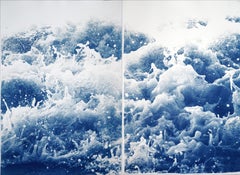
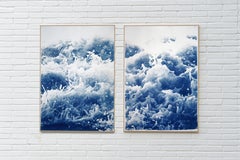
Tempestuous Tidal in Blue, Stormy Seascape Diptych, Cyanotype Print, Duo, Blue

Tempestuous Tidal in Blue, Stormy Seascape Diptych, Cyanotype Print, Duo, Blue

By Kind of Cyan

Located in Barcelona, ES

This is an exclusive handprinted limited edition cyanotype. "Tempestuous Tidal in Blue" is an original cyanotype diptych portraying the tidal behavior during a storm. Details: + T...

Category

2010s Abstract Expressionist Werner Drewes Art

Materials

Lithograph

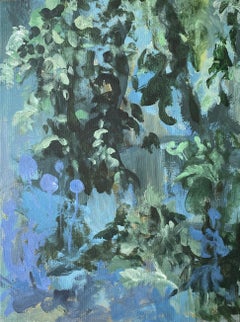
Hand-painted Aluminium Limited Edition#3-Summer Night-British Awarded Artist

Hand-painted Aluminium Limited Edition#3-Summer Night-British Awarded Artist

By Shizico Yi

Located in London, GB

This is a rare hand-painted Limited Edition by contemporary artist Shizico Yi, created on a deluxe matte-finish giclée aluminium panel. Each edition is 90% hand-painted with Shizico’...

Category

2010s Abstract Expressionist Werner Drewes Art

Materials

Giclée, Archival Pigment, Digital Pigment

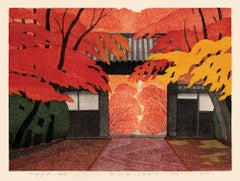
'The Beach at Kaiganji in Sanuki Province'  — Lifetime Impression

'The Beach at Kaiganji in Sanuki Province' — Lifetime Impression

By Kawase Hasui

Located in Myrtle Beach, SC

Kawase Hasui, 'The Beach at Kaiganji in Sanuki Province (Sanuki Kaiganji no hama),' from the series Collected Views of Japan II, Kansai Edition (Nihon fûkei shû II Kansai hen), woodblock print, 1934. A very fine, atmospheric impression, with fresh colors; the full sheet, in excellent condition. Signed 'Hasui' with the artist’s seal 'Kawase', lower left. Published by Watanabe Shozaburo with the Watanabe ‘D’ seal indicating an early impression printed between 1931 - 1941. Stamped faintly 'Made in Japan' in the bottom center margin, verso. Horizontal ôban; image size 9 3/8 x 14 1/4 inches (238 x 362 mm); sheet size approximately 10 5/16 x 15 1/2 inches ( 262 x 394 mm). Collections: Art Institute of Chicago; Austrian Museum of Applied Arts (Vienna); Honolulu Museum of Art; Museum of Fine Arts, Boston; National Museum in Warsaw; University of Wisconsin-Madison. ABOUT THE ARTIST “I do not paint subjective impressions. My work is based on reality...I can not falsify...(but) I can simplify…I make mental impressions of the light and color at the time of sketching. While coloring the sketch, I am already imagining the effects in a woodblock print.” — Kawase Hasui Hasui Kawase...

Category

1930s Showa Werner Drewes Art

Materials

Woodcut

Hand-Gilded-Constant Gardener-the last Artist Proof-Rare X-Large-Awarded Artist

Hand-Gilded-Constant Gardener-the last Artist Proof-Rare X-Large-Awarded Artist

By Shizico Yi

Located in London, GB

This is an unique one-off Artist Proof, in a rare Extra-Large square format. A special Proof that only 3 have been made with hand gilded Gold Leaf. The outstanding hand-painted qual...

Category

2010s Abstract Expressionist Werner Drewes Art

Materials

Gold Leaf

Three Turns - Surfing Art By Marc Zimmerman

Three Turns - Surfing Art By Marc Zimmerman

By Marc Zimmerman

Located in Carmel, CA

Three Turns - Surfing Art - Figurative - Woodcut Print By Marc Zimmerman Limited Edition 01/04 This masterwork is exhibited in the Zimmerman Gallery, Carmel CA. Immerse yourself i...

Category

2010s Contemporary Werner Drewes Art

Materials

Woodcut

After Turner-One Off, Proof No 1-British Awarded Artist-Seascape-river Thames

After Turner-One Off, Proof No 1-British Awarded Artist-Seascape-river Thames

By Shizico Yi

Located in London, GB

This is a large Artist's Proof with original oil and gesso paint highlighting; it is the No 1 of the only 3 Proofs; the colours of the painting and Shizico's expressive brushstrokes ...

Category

2010s Abstract Expressionist Werner Drewes Art

Materials

Archival Ink, Archival Paper, Giclée, Gesso, Oil, Acrylic

Previously Available Items
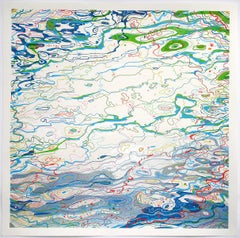
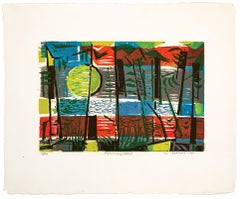
'Shimmering Waters' — Mid-Century Modernist Signed Abstract Woodcut

'Shimmering Waters' — Mid-Century Modernist Signed Abstract Woodcut

By Werner Drewes

Located in Myrtle Beach, SC

Werner Drewes, 'Shimmering Waters', color woodcut, 1960, edition 16 in 1960, and 210 in 1962, Rose III.209. Signed, dated, and numbered I2/210 in pencil. Annotated 415 (the artist's ...

Category

1960s American Modern Werner Drewes Art

Materials

Woodcut

Werner Drewes Bauhaus Artist Color Woodblock, 1956, Mysterious Forest

Werner Drewes Bauhaus Artist Color Woodblock, 1956, Mysterious Forest

By Werner Drewes

Located in Phoenix, AZ

Original color woodblock print by Werner Drewes. In excellent condition. Unframed. Image measures: 9 3/4 x 23 3/4 inches. Pencil signed and dated. Numbered 2/X St. IV full color. Rose catalog #176 Werner Drewes (1899-1985) Werner Drewes, painter, printmaker, and teacher was born in Canig, Germany in 1899. His father, a Lutheran Minister, hoped he would become and architect but Werner chose the life of an artist. After he served on the front line in France during the war, Werner was admitted to the Bauhaus in 1921 where he studied under Klee, Itten, and Muche. Later, he travelled through Europe to study such old masters as Tintoretto, Velasque, and El Greco. After marrying Margaret Schrobsdorff, they travelled throughout South America, North America, and Asia. In 1930, Werner immigrated to New York City with his family. In New York City, despite the Depression, Werner joined other Bauhaus artists such as Mondrian and Feininger to make a living as an artist. This group became the core of the American Abstract Artists group. Werner taught at Columbia University, worked on the design of the 1939 World’s Fair...

Category

Mid-20th Century Werner Drewes Art

Materials

Paper

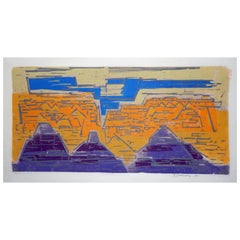
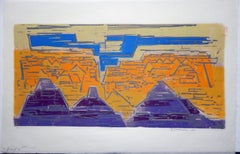
Werner Drewes Bauhaus Artist Color Woodblock, 1964, Grand Canyon

Werner Drewes Bauhaus Artist Color Woodblock, 1964, Grand Canyon

By Werner Drewes

Located in Phoenix, AZ

Original color woodblock print by Werner Drewes. In excellent condition. Unframed. Image measures: 11 1/8 x 22 7/8 inches. Pencil signed and dated lower right. Numbered in pencil lower left: Proof 3 R-232. Werner Drewes (1899-1985) Werner Drewes, painter, printmaker, and teacher was born in Canig, Germany in 1899. His father, a Lutheran Minister, hoped he would become and architect but Werner chose the life of an artist. After he served on the front line in France during the war, Werner was admitted to the Bauhaus in 1921 where he studied under Klee, Itten, and Muche. Later, he traveled through Europe to study such old masters as Tintoretto, Velasque, and El Greco. After marrying Margaret Schrobsdorff, they traveled throughout South America, North America, and Asia. In 1930, Werner immigrated to New York City with his family. In New York City, despite the Depression, Werner joined other Bauhaus artists such as Mondrian and Feininger to make a living as an artist. This group became the core of the American Abstract Artists group. Werner taught at Columbia University, worked on the design of the 1939 Worlds Fair building...

Category

Late 20th Century Werner Drewes Art

Materials

Paper

Ecce Homo Plate X
Ecce Homo Plate X

Ecce Homo Plate X

By Werner Drewes

Located in Fairlawn, OH

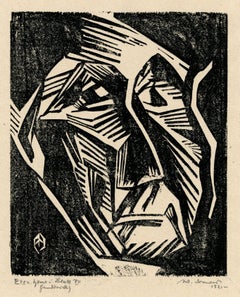
Ecce Homo Plate X Woodcut, 1921 Signed, titled, and dated in pencil by the artist (see photos) Edition: One of two known impressions This image wwas unknown to the catloger Ingrid Rose in 1984 when she published the catalog raisonne of Drewes prints. Done while Drewes was studying at the Bauhaus. Reference: Ingrid Rose, Werner Drewes: A Catalogue Raisonne of His Prints (Munich: Verlag Kunstgalerie Esslingen, 1984), 33, one of two known impressions. Provenance: Gift of the artist to one of his Bauhaus professors. Held in East Germany until the opening of the wall Jorg Maas Kunsthandel, Berlin Other image from the suite of Ecce Homo images are available. Extremely early, rare Bauhaus works. n 1921 Drewes went to the Bauhaus in Weimar, where, after completing the compulsory preliminary course with Johannes Itten, he continued to study with Paul Klee, Oskar Schlemmer and Georg Muche and initially went to the wall painting workshop. He then traveled extensively through Europe, North America and Asia. After returning to Germany in 1927, he went back to the Bauhaus, this time to his new location in Dessau, where he studied in the classes of László Moholy-Nagy and Wassily Kandinsky. He was one of the first artists to introduce the groundbreaking concepts of the Bauhaus School in the United States through his painting, printmaking, and teaching. Werner Drewes (1899–1985) was a painter, printmaker, and art teacher. Considered to be one of the founding fathers of American abstraction, he was one of the first artists to introduce concepts of the Bauhaus school within the United States. His mature style encompassed both nonobjective and figurative work and the emotional content of this work was consistently more expressive than formal. Drewes was as highly regarded for his printmaking as for his painting. In his role as teacher as well as artist he was largely responsible for bringing the Bauhaus aesthetic to America. Early life and education Drewes was born in 1899 to Georg Drewes, a Lutheran pastor, and Martha Schaefer Drewes. The family lived in the village of Canig within Lower Lusatia, Germany. From age eight to eighteen he attended the Saldria Gymnasium, a boarding school in Brandenburg an der Havel. There, he showed talent both for painting and woodblock printing. Graduating from Saldria in 1917, he was drafted by the German army and served in France from then until the close of the war. About this period of his life he is reported to have said that the horrors of life at the front were only made tolerable by his sketchbook, a copy of Goethe's Faust and a volume of Nietzsche. For a decade following the close of the war he studied, made paintings and prints, and traveled widely. His friend, Herwarth Walden, helped shape his appreciation for expressionist literature and art. Walden produced the quarterly magazine, Der Sturm and ran a gallery of contemporary art, Galerie Der Sturm, from which, in 1919, Drewes purchased an expressionist painting by William Wauer titled Blutrausch (Bloodlust). In the same year he made the acquaintance of Heinrich Vogeler and participated in Vogeler's socialist utopian artists' commune, Barkenhoff, at Worpswede, Lower Saxony. In 1919 Drewes also enrolled at the Königlich Technischen Hochschule Charlottenburg to study architecture and the following year he studied the same subject at the Technischen Hochschule Stuttgart. Preferring art over architecture, he then enrolled in Stuttgart's school of applied arts (Kunstgewerbeschule) where he studied life drawing and learned to work with colored glass. At this time he joined a group of artists and architects associated with the newly formed Merz Akademie, a college of design, art, and media in Stuttgart. In 1921 his friendship with a French artist, Sébastien Laurent, led him to begin studies in Weimar at Bauhaus, then a new school which taught an integrated approach to the fine and applied arts. His instructors were Johannes Itten and Lyonel Feininger, whose paintings were expressionist and abstract, and Paul Klee, who taught bookbinding, stained glass, and murals. While at Bauhaus Drewes produced a portfolio of ten woodblock prints entitled "Ecce Homo." In 1923 and 1924 he studied art during travels throughout Italy, Spain, the United States, and Central America and in 1926 he traveled to San Francisco, Japan, and Korea, thence taking the Trans-Siberian railway to Manchuria, Moscow, and Warsaw. He later said the El Grecos he saw proved to be most influential in his work. While traveling, he exhibited: (1) etchings in Madrid (1923) and Montevideo (1924), oils and etchings in Buenos Aires and St. Louis (1925), and (3) etchings in San Francisco (1926). He paid his way by the sales these exhibits produced and by taking commissions to paint portraits. While in San Francisco he set up a shop from which he sold prints he had made in Spain and South America. After his return to Germany in 1927 he resumed study at Bauhaus, which had been forced to relocate in Dessau, Saxony-Anhalt. His instructors at that time were László Moholy-Nagy (metal work), Wassily Kandinsky, and (painting), and Lyonel Feininger (prints). At this time he also worked and exhibited in Frankfurt. With the rise of Nazism abstract artists found it increasingly difficult to sell their work and, in 1930, Drewes, finding the political pressure unbearable, emigrated to the United States. There, despite the world economic crisis, Drewes was able to earn a living as a professional artist. Mature style After Drewes moved to New York, Kandinsky, who was both friend and mentor, continued to exert a strong influence over his style. Later in life he said he had a hard time getting away from Kandinsky's influence as he developed his own style. In time he was able to bring a more emotional approach to his work and to base it, more than Kandinsky did, on natural forms. In 1930 Drewes had a solo exhibition at the 135th Street Branch of the New York Public Library and a two-person show at the S.P.R. Penthouse Gallery...

Category

1920s Bauhaus Werner Drewes Art

Materials

Woodcut

Forest or Blue Forest

Forest or Blue Forest

By Werner Drewes

Located in Fairlawn, OH

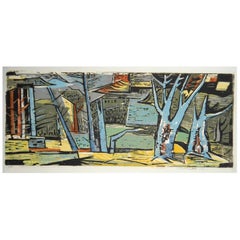
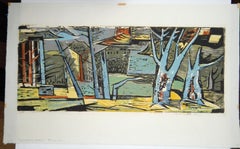
Forest or Blue Forest Color woodcut, 1958 Signed in pencil lower right Edition: 260 The Print Club of Cleveland Publication No. 39 for 1961 (see photo of their label) Note: The Cleveland Museum of Art retains the original sketches, color separations and cancelled plate(s) in their collection under accession numbers 1961.59-1961.75 Printed by the Artist Condition: Very good Image size: 11-1/4 x 24-1/2" Werner Drewes (1899–1985) was a painter, printmaker, and art teacher. Considered to be one of the founding fathers of American abstraction, he was one of the first artists to introduce concepts of the Bauhaus school within the United States. His mature style encompassed both nonobjective and figurative work and the emotional content of this work was consistently more expressive than formal. Drewes was as highly regarded for his printmaking as for his painting. In his role as teacher as well as artist he was largely responsible for bringing the Bauhaus aesthetic to America. Early life and education Drewes was born in 1899 to Georg Drewes, a Lutheran pastor, and Martha Schaefer Drewes. The family lived in the village of Canig within Lower Lusatia, Germany. From age eight to eighteen he attended the Saldria Gymnasium, a boarding school in Brandenburg an der Havel. There, he showed talent both for painting and woodblock printing. Graduating from Saldria in 1917, he was drafted by the German army and served in France from then until the close of the war. About this period of his life he is reported to have said that the horrors of life at the front were only made tolerable by his sketchbook, a copy of Goethe's Faust and a volume of Nietzsche. For a decade following the close of the war he studied, made paintings and prints, and traveled widely. His friend, Herwarth Walden, helped shape his appreciation for expressionist literature and art. Walden produced the quarterly magazine, Der Sturm and ran a gallery of contemporary art, Galerie Der Sturm, from which, in 1919, Drewes purchased an expressionist painting by William Wauer titled Blutrausch (Bloodlust). In the same year he made the acquaintance of Heinrich Vogeler and participated in Vogeler's socialist utopian artists' commune, Barkenhoff, at Worpswede, Lower Saxony. In 1919 Drewes also enrolled at the Königlich Technischen Hochschule Charlottenburg to study architecture and the following year he studied the same subject at the Technischen Hochschule Stuttgart. Preferring art over architecture, he then enrolled in Stuttgart's school of applied arts (Kunstgewerbeschule) where he studied life drawing and learned to work with colored glass. At this time he joined a group of artists and architects associated with the newly formed Merz Akademie, a college of design, art, and media in Stuttgart. In 1921 his friendship with a French artist, Sébastien Laurent, led him to begin studies in Weimar at Bauhaus, then a new school which taught an integrated approach to the fine and applied arts. His instructors were Johannes Itten and Lyonel Feininger, whose paintings were expressionist and abstract, and Paul Klee, who taught bookbinding, stained glass, and murals. While at Bauhaus Drewes produced a portfolio of ten woodblock prints entitled "Ecce Homo." In 1923 and 1924 he studied art during travels throughout Italy, Spain, the United States, and Central America and in 1926 he traveled to San Francisco, Japan, and Korea, thence taking the Trans-Siberian railway to Manchuria, Moscow, and Warsaw. He later said the El Grecos he saw proved to be most influential in his work. While traveling, he exhibited: (1) etchings in Madrid (1923) and Montevideo (1924), oils and etchings in Buenos Aires and St. Louis (1925), and (3) etchings in San Francisco (1926). He paid his way by the sales these exhibits produced and by taking commissions to paint portraits. While in San Francisco he set up a shop from which he sold prints he had made in Spain and South America. After his return to Germany in 1927 he resumed study at Bauhaus, which had been forced to relocate in Dessau, Saxony-Anhalt. His instructors at that time were László Moholy-Nagy (metal work), Wassily Kandinsky, and (painting), and Lyonel Feininger (prints). At this time he also worked and exhibited in Frankfurt. With the rise of Nazism abstract artists found it increasingly difficult to sell their work and, in 1930, Drewes, finding the political pressure unbearable, emigrated to the United States. There, despite the world economic crisis, Drewes was able to earn a living as a professional artist. Mature style After Drewes moved to New York, Kandinsky, who was both friend and mentor, continued to exert a strong influence over his style. Later in life he said he had a hard time getting away from Kandinsky's influence as he developed his own style. In time he was able to bring a more emotional approach to his work and to base it, more than Kandinsky did, on natural forms. In 1930 Drewes had a solo exhibition at the 135th Street Branch of the New York Public Library and a two-person show at the S.P.R. Penthouse Gallery...

Category

1950s American Modern Werner Drewes Art

Materials

Woodcut

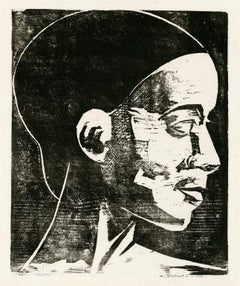
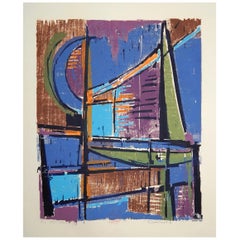
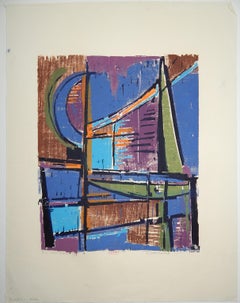
UNTITLED
UNTITLED

Werner DrewesUNTITLED, 1934

Sold

H 13.375 in W 11.125 in

UNTITLED

By Werner Drewes

Located in Santa Monica, CA

WERNE DREWES (1899-1985) UNTITLED, 1934 Woodcut on paper, Signed, numbered, and dated in pencil Ed. 15/20. Image 13 3/8 x 11 1/8 inches. Full sheet, 17 x 12 1/8 inches deckle edge o...

Category

1930s Abstract Werner Drewes Art

Materials

Woodcut

1944 Abstract Oil Painting by Werner Drewes, Mid-Century Modern Masterpiece

1944 Abstract Oil Painting by Werner Drewes, Mid-Century Modern Masterpiece

By Werner Drewes

Located in Denver, CO

This captivating 1944 abstract oil on canvas by renowned artist Werner Drewes exemplifies mid-century modern art at its finest. Featuring bold, vibrant hues of green, blue, and red, ...

Category

20th Century Abstract Expressionist Werner Drewes Art

Materials

Oil

Harlem Beauty (Negress, Negro Girl, Black Girl)

Harlem Beauty (Negress, Negro Girl, Black Girl)

By Werner Drewes

Located in Myrtle Beach, SC

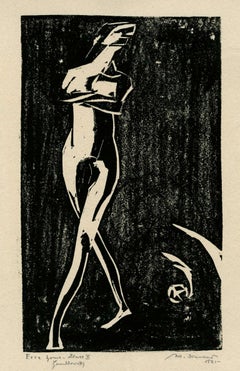
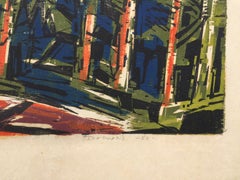
'Harlem Beauty' ('Negress', 'Negro Girl', 'Black Girl'), woodcut, 1930, edition 30, Rose lll.42. Signed, dated, numbered '1 - XXX', and titled 'Negress' in ...

Category

1930s Expressionist Werner Drewes Art
Materials

Woodcut

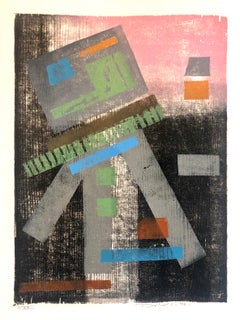
Bauhaus Abstract Color Woodcut Mechanical Ballet Woodblock Print

Bauhaus Abstract Color Woodcut Mechanical Ballet Woodblock Print

By Werner Drewes

Located in Surfside, FL

Mechanical Ballet Signed and dated Medium: Relief Print - Color Woodcut Substrate: Japanese Paper Size: Sheet 24 X 19. image 15 X 11 inches Subject: Abstract Year: 1978 Werner Drewes (1899–1985) was a painter, printmaker, and art teacher. Considered to be one of the founding fathers of American abstraction, he was one of the first artists to introduce concepts of the Bauhaus school within the United States. His mature style encompassed both nonobjective and figurative work and the emotional content of this work was consistently more expressive than formal. Drewes was as highly regarded for his printmaking as for his painting. His friend, Herwarth Walden, helped shape his appreciation for expressionist literature and art. Walden produced the quarterly magazine, Der Sturm and ran a gallery of contemporary art, Galerie Der Sturm, from which, in 1919, Drewes purchased an expressionist painting by William Wauer titled Blutrausch (Bloodlust). In the same year he made the acquaintance of Heinrich Vogeler and participated in Vogeler's socialist utopian artists' commune, Barkenhoff, at Worpswede, Lower Saxony. In 1919 Drewes also enrolled at the Königlich Technischen Hochschule Charlottenburg to study architecture and the following year he studied the same subject at the Technischen Hochschule Stuttgart. Preferring art over architecture, he then enrolled in Stuttgart's school of applied arts (Kunstgewerbeschule) where he studied life drawing and learned to work with colored stained glass. At this time he joined a group of artists and architects associated with the newly formed Merz Akademie, a college of design, art, and media in Stuttgart. In 1921 his friendship with a French artist, Sébastien Laurent, led him to begin studies in Weimar at Bauhaus, His instructors were Johannes Itten and Lyonel Feininger, whose paintings were expressionist and abstract, and Paul Klee, who taught bookbinding, stained glass, and murals. While at Bauhaus Drewes produced a portfolio of ten woodblock prints entitled "Ecce Homo." After his return to Germany in 1927 he resumed study at Bauhaus, which had been forced to relocate in Dessau, Saxony-Anhalt. His instructors at that time were László Moholy-Nagy (metal work), Wassily Kandinsky, and (painting), and Lyonel Feininger (prints). At this time he also worked and exhibited in Frankfurt. With the rise of Nazism abstract artists found it increasingly difficult to sell their work and, in 1930, Drewes, finding the political pressure unbearable, emigrated to the United States. In 1930 Drewes had a solo exhibition at the 135th Street Branch of the New York Public Library and a two-person show at the S.P.R. Penthouse Gallery (with Carl Sprinchorn...

Category

1970s Bauhaus Werner Drewes Art
Materials

Color, Woodcut

Werner Drewes Bauhaus Artist Color Woodblock, 1965, Calm Night

Werner Drewes Bauhaus Artist Color Woodblock, 1965, Calm Night

By Werner Drewes

Located in Phoenix, AZ

Original color woodblock print by Werner Drewes. In excellent condition. Unframed. Image measures 13 3/4 x 11 1/4 inches. Pencil signed and dated. Nu...

Category

Mid-20th Century Werner Drewes Art
Materials

Paper

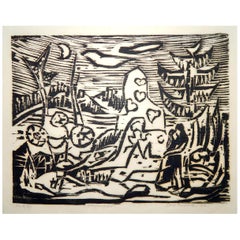
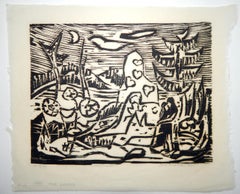
Werner Drewes Bauhaus Artist Woodblock, 1956, the Lovers

Werner Drewes Bauhaus Artist Woodblock, 1956, the Lovers

By Werner Drewes

Located in Phoenix, AZ

Original woodblock print by Werner Drewes. In excellent condition. Unframed. Image measures: 7 7/8 x 10 inches. Pencil signed and dated. Nr 9/XX Rose ...

Category

Mid-20th Century Werner Drewes Art
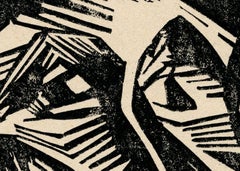
Materials

Paper

Werner Drewes art for sale on 1stDibs.
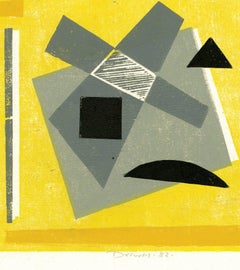
Find a wide variety of authentic Werner Drewes art available for sale on 1stDibs. If you’re browsing the collection of art to introduce a pop of color in a neutral corner of your living room or bedroom, you can find work that includes elements of yellow and other colors. You can also browse by medium to find art by Werner Drewes in woodcut print, paint, watercolor and more. Much of the original work by this artist or collective was created during the 20th century and is mostly associated with the abstract style. Not every interior allows for large Werner Drewes art, so small editions measuring 6 inches across are available. Customers who are interested in this artist might also find the work of Adolph Gottlieb, Charles Hinman, and Catherine Howe. Werner Drewes art prices can differ depending upon medium, time period and other attributes. On 1stDibs, the price for these items starts at $1,000 and tops out at $70,000, while the average work can sell for $2,800.
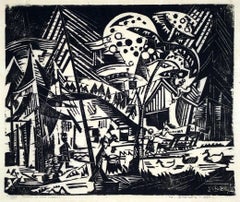
Artists Similar to Werner Drewes