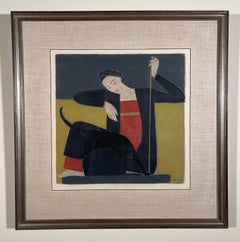
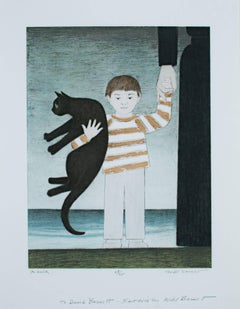
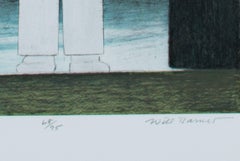
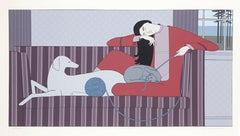
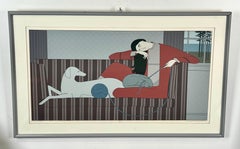
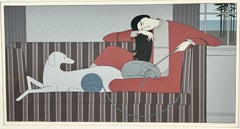
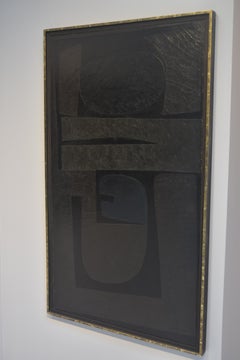
By Will Barnet
Located in Fairlawn, OH
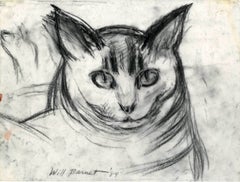
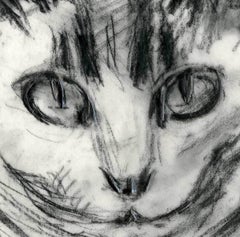
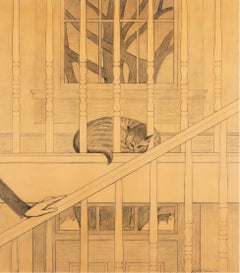
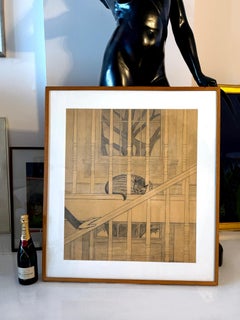
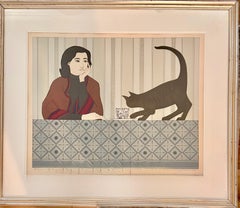
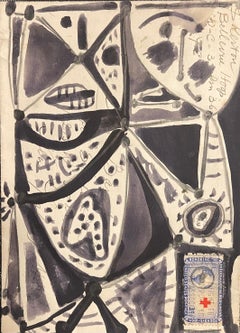
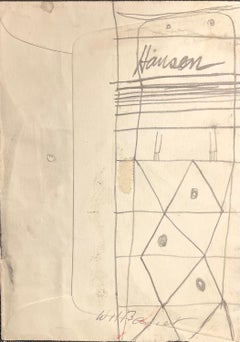
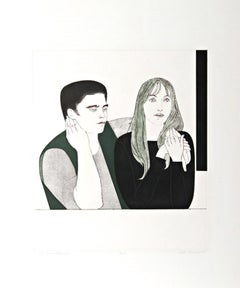
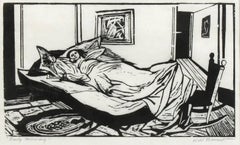
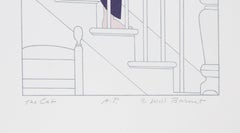
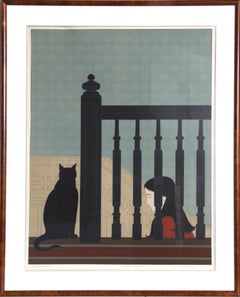
Minou-Study of Head
Charcoal and pencil on vellum, 1984
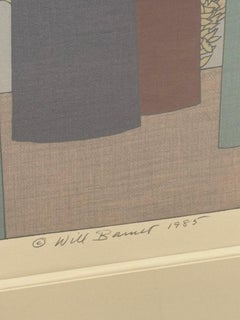
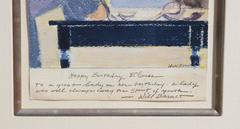
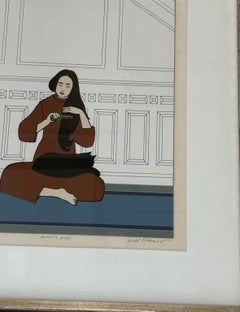
Signed and dated in pencil by the artist
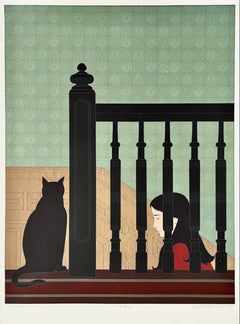
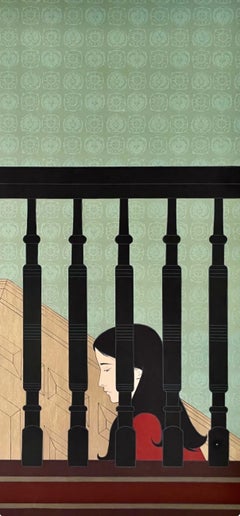
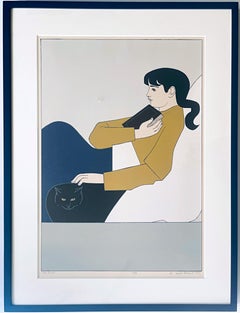
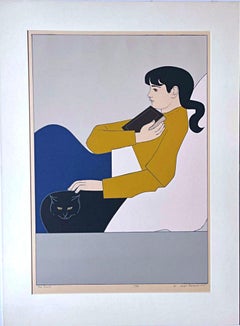
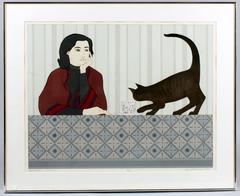
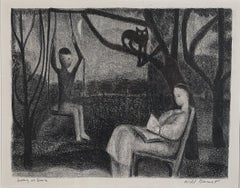
Minou was Barnet's feline companion throughout many of his most prolific years. It has been said that if you entered Barnet's studio and Minou did not like you Barnet lost interest and dismissed you almost immediately.
Provenance:
Susan Teller Gallery, prior to 2005 (one of Barnet's friends and dealers)
Babcock Galleries, 2005-2008
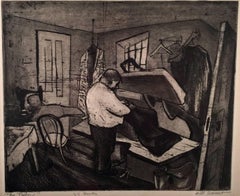
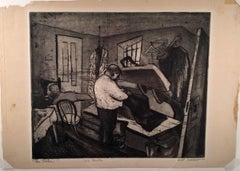
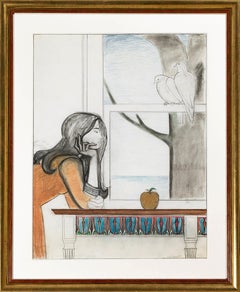
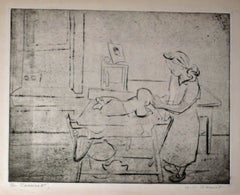
This drawing is related to a similar composition reproduced in the Richard Boyle catalog for Babcock Galleries.
References:
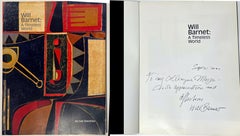
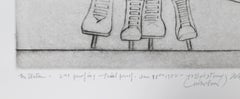
Boyle, Will Barnet Drawings, related to works reproduced on pp. 21, 41 (see photo of page 41)
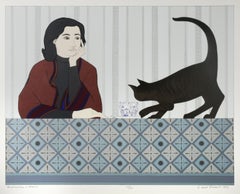
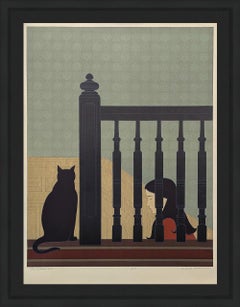
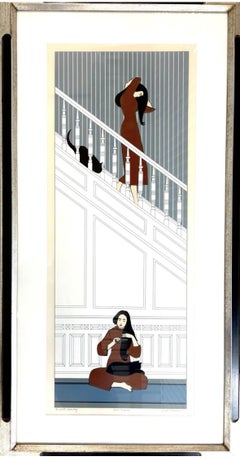
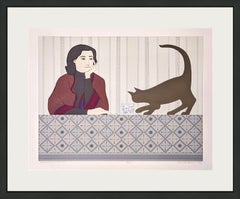
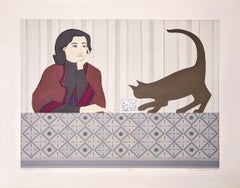
Minou is the cat on the back right.
Condition: Excellent
Stray ink and paint consistent with a working studio drawing
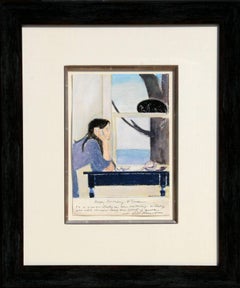
Archival framing with DEN Glass (see photo)
Image size: 9 x 11 7/8 inches
Frame size: 17 x 19 inches
Will Barnet
Born May 25, 1911, Beverly, Massachusetts, US
Died November 13, 2012 (aged 101), New York City, US
Will Barnet (May 25, 1911 – November 13, 2012) was an American artist known for his paintings, watercolors, drawings, and prints depicting the human figure and animals, both in casual scenes of daily life and in transcendent dreamlike worlds.
Biography
Born in 1911 in Beverly, Massachusetts, Barnet knew by the age of ten that he wanted to be an artist. As a student, he studied with Philip Leslie Hale at the School of the Museum of Fine Arts, Boston and viewed first-hand John Singer Sargent at work on the murals of the Boston Public Library. In 1930, Barnet studied at the Art Students League of New York, with Stuart Davis and Charles Locke, beginning his long association with the school. Here he concentrated on painting as well as printmaking, and, in 1936, he became the official printer for the Art Students League. There, he later instructed students in the graphic arts at the school and taught alongside the likes of Yasuo Kuniyoshi, Robert Beverly Hale and Richard Pousette-Dart. Barnet influenced a generation of artists, including James Rosenquist, Knox Martin, Emil Milan, Paul Jenkins, Ethel Fisher and Cy Twombly. Barnet continued his love of teaching with positions at the Cooper Union, at Yale University, and at the Pennsylvania Academy of Fine Arts. He was represented by the Bertha Schaefer Gallery in New York City. Barnet had three sons, Peter, Richard, and Todd Barnet, by his first wife Mary Sinclair. Barnet later married Elena Barnet, with whom he had a daughter, Ona Barnet.
Death
A longtime resident of the National Arts Club, Barnet died in New York City on November 13, 2012, at the age of 101.
Works
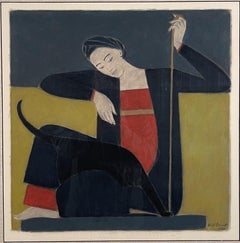
Barnett's works span the various "movements" of their era, from his early social realist work to his final signature style of clean lines and carefully placed volumes of solid color in a kind of minimalist representational approach. His work is concerned with humanity, yet at his core he always remained a formalist, cerebral in his approach to the elements that make up a good picture. In his interviews he articulated his well thought out principles regarding color use, composition and subject matter, in a professorial manner reflecting the theoretical acumen he brought to his teaching. Like many American painters of his generation he was digesting the evolving trends in Europe and integrating the new visual vocabulary into his American style while remaining universal, referencing his own personal history with images of his wife, his daughter, and their family pets. As James Thomas Flexner wrote, Barnet's work "makes us experience the interplay between the personal and the universal." While remaining representational, the simple elegance of the figures and their flat surfaces reflect his exploration with abstraction.
Will's artistic output spans eighty years. Few artists, other than Picasso or Monet, can claim such a long continuous period of inspired art making, nor the logical progression of moving through artistic phases: in the 1930s he was a social realist, in the 1940s a Modernist, in the 1950s an Abstract Expressionist and in the 1960s and onward he settled on a representational minimalism honed from the refinement of his earlier explorations. His early work is decidedly social realist, with sullen portraits done in dark tonalities that suggest both the struggle of the depression era and the hope in the simple love of family life. He moves out of this phase with the improving economy and in the 1940s adds vibrant color and more abstract figures, suggesting a lifting of the depression era malaise. He was a key figure in the 1940s New York movement called Indian Space Painting, artists who based their abstract and semi-abstract work on Native American art; a striking movement which had a handful of practitioners (notably Steve Wheeler...
Category
1980s American Modern Will Barnet Art