William Ward Prints and Multiples

to
1
Overall Width
to
Overall Height
to
1
1,438
1,055
908
903
1
1
1
1
1
1
1
1
1
Artist: William Ward
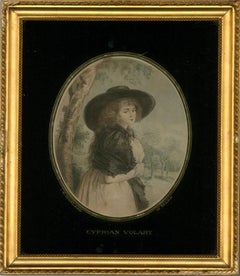
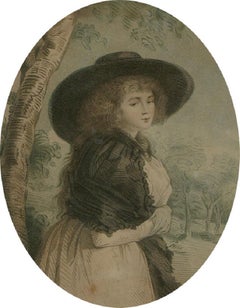
W. Ward (1766-1826) after G. Morland - Framed Stipple Engraving, Cyprian Volary

W. Ward (1766-1826) after G. Morland - Framed Stipple Engraving, Cyprian Volary

By William Ward

Located in Corsham, GB

A fine early 19th century coloured stipple engraving, titled Cyprian Volary by William Ward after George Morland. The engraving is exquisitely presented in a verre eglomise mount and...

Category

Early 19th Century William Ward Prints and Multiples

Materials

Engraving

Related Items
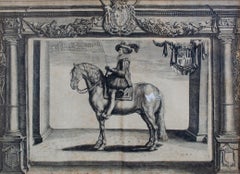
Old Master Royal Stallion Engraving by Crispin de Passe

Old Master Royal Stallion Engraving by Crispin de Passe

By Crispin De Passe

Located in New York, NY

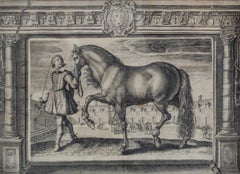
Crispin van de Passe The Younger (c. 1594-1670) Untitled (Royal Stallion), c. 1620-1660 Engraving Sight: 11 3/4 x 15 3/4 in. Framed: 18 3/4 x 22 5/8 in. Inscribed in plate: Le Bonit...

Category

17th Century Old Masters William Ward Prints and Multiples

Materials

Engraving

Kampf dreier Männer (Man fighting with two couples on horseback)

Kampf dreier Männer (Man fighting with two couples on horseback)

By Hans Sebald Beham

Located in Middletown, NY

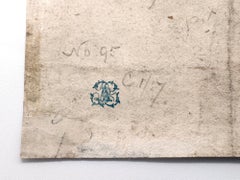
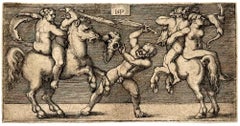
Frankfurt: c1550. Engraving on laid paper, 1 7/8 x 3 5/8 inches (47 x 92 mm), thread margins. Ex-collection D.G. de Arozarena (Lugt 109) with his collector's mark in blue ink on ver...

Category

16th Century Old Masters William Ward Prints and Multiples

Materials

Handmade Paper, Laid Paper, Engraving

Original Jean Francois Raffaelli Etching of a Hat Salesman

Original Jean Francois Raffaelli Etching of a Hat Salesman

By Jean Francois Raffaëlli

Located in New York, NY

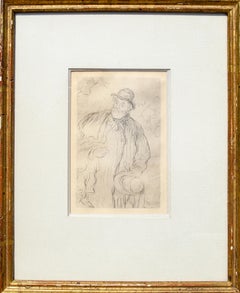
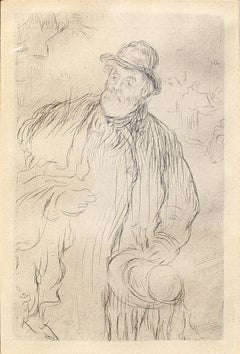
Jean-François Raffaëlli (French, 1850-1924) Le Marchand de Habits, 1895 Etching and drypoint Sight: 6 x 4 in. Framed: 12 x 9 3/4 x 3/4 in. Initialed lower left in plate: R This etc...

Category

1890s French School William Ward Prints and Multiples

Materials

Drypoint, Etching

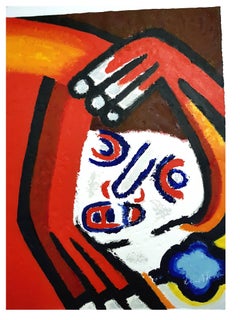
Bengt Lindstrom - Original Handsigned Engraving

Bengt Lindstrom - Original Handsigned Engraving

By Bengt Lindström

Located in Collonge Bellerive, Geneve, CH

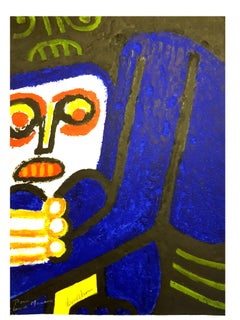
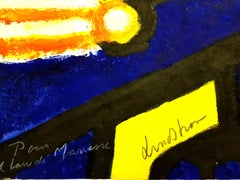
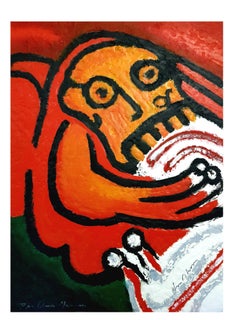
Bengt Lindström - Original Handsigned Engraving The Seven Deadly Sins. 76 x 56 cm Signed in pencil by Bengt Lindström Paris, ABCD, 1976. Original etching in color Limited edition 90 ex. This is the unique copy offered to Claude Manesse, The story of B. Lindström was collected by Frederick Towarnicki, assisted by Agathe Malet-Buisson. The engravings were drawn on the presses of Claude Manesse. Bengt Lindström (1925-2008) Bengt Lindström was born on September 3rd, 1925 in Storsjökapell, a small isolated village in the Swedish province of Norrland. The young child thus grew up in that vast, mythical and harsh expanse of mounts, glistening lakes and endless forests known as Lapland. His father was a primary school teacher who was fond of Lapps and who showed great interest in their ethnic group and culture. The child was only three days old when Lapp King Kroik, his godfather, administered the Baptism of the Earth, where the child is conveyed between two roots of a tree to grant him protection from the Gods. Lapps as well as local lumberjacks would occasionally abandon their silent ways to tell him and reveal the tales, legends and mysteries of the Great White North. 1935-1945 : He left Storsjökapell and headed to Härnösand, where he wrote short science-fiction novellas, became a renowned athlete and began to paint. 1944-1946 : Isaac Grünewald Art School in Stockholm, Sweden. Study drawing with Aksel Jörgensen at the Copenhagen Fine Arts School in Denmark. He realized his first two lithographs, Meditation and Le Modèle Etendu (The Stretched Model). 1947-1952 : He arrived in Paris. He travelled to Italy, where he visited Florence and Assisi, developing a deep fascination for Giotto and Cimabue. He was granted a scholarship by Swedish magazine Aftontidningen, which helped him move into a workshop in Arcueil, France. He began working on mosaics. 1953-1967 : He returned to Paris, once again taking up lithography and engraving, which holds a vital position in his work. He moved into a workshop in Rueil-Malmaison. This was the start of his collaboration with the Rive Gauche Gallery in Paris. London Tooth & Sons Gallery Director M. Cochrane purchased a large number of his works. He left the workshop in Rueil-Malmaison to settle in Savigny-sur-Orge, France. He began taking to figurative art with Masks, Gods and Monsters. He exhibited with the Nouvelle Figuration Group at the Mathias Feld Gallery. He also began working with the Ariel Gallery in Paris. 1968-1978 : Lindström completed a series of 10 lithographs about Scandinavian mythology. He also completed a series of drypoint works. An association with the Protée Gallery in Toulouse, France, led to exhibitions at the Protée Gallery II in Paris starting in 1984. He executed a large mural painting the Grand Hotel in Härnösand, Sweden. He also made two large frescoes for the Nacksta-Sundsvall covered market in Sweden. He took to sharing his working time between the workshop in Savigny-sur-Orge and the one in Sundsvall. He began collaboration that was to last several years with the ABCD Gallery in Paris, which provided exclusive publication for his engravings and strong ink work. Les Hommes du Nord (Men of the North) was the first of the major tapestries. He published a boxed set album, Eddan, Eddan, Eddan, illustrating Scandinavian mythology. Together with Jacques Putman, he completed two editions of bronze sculptures, Les Enfants Sauvages (The Wild Children). 1979-1982 : He worked on glass, making thirty dishes and goblets for renowned Swedish glassmaker Kosta Boda. He painted a car for Volvo, Sweden’s leading car manufacturer. Then, close to his birthplace, he painted gigantic tarpaulins over forty metres high, covering the slopes of the neighbouring Våladalen Mountain, as a protest against the building of a dam. This action caused a sensation and provoked fierce reactions. He also created small painted papier mâché sculptures, Têtes (Heads), as well as some gold and silver jewellery. 1983 : He exhibited seven monumental 3x2.5m works at the Art and History Museum in Stockholm: Les Grands Dieux Ase (The Great Aesir Gods), depicting the gods from Scandinavian mythology: Thor, Odin, Frej, Balder, Ymer, Loki and Unknown God, as well as acrylic paintings about the Valkyries. Les Grands Dieux was ultimately exhibited in a purpose-built chapel adjoining the Midlanda Contemporary Arts Centre in 1996. He completed Thor’s Hammer, a monumental sculpture. 1985-1990 : He lived also in the Alicante region, where Spanish friends found him a new workshop. While there he completed Novelda, an album of lithographs featuring poems by Spanish poet Paco Pastor. He completed a new mural, 5mx5m, for the Västeras Science Institute in Sweden. He then started working with the San Carlo Gallery in Milan, Italy, which coordinated all of the Italian events. Major exhibitions and retrospectives were held in Italy, Belgium, Luxembourg, Germany and Spain. He created two boxed set albums, containing series of 10 aquatints, Monde Autre et Chamanes (Otherworld and Shamans), featuring poems by Michel Perrin. 1991-1994 : He went back to working in black and white, completing some very-large-format works. In Murano, in association with the San Carlo Gallery, he created Grands Verres (Large Glasses), a series of large vases and sculptures made of crystal. He painted Kåtan Mimi, an 8x9m Lapp tent, for the town of Arjeplog in Swedish Lapland. He completed a couple of 2m-high painted polyester sculptures, Lui et Elle (Him and Her). He then made a new series of crystal glasses and sculptures in Murano, Italy. He completed Présence (Presence), a new 3.5x2.7m tapestry for the municipality of Timrå, Sweden. He started on the Grands Initiés (Great Insiders) series, all large format and mixed black and white techniques. He finished the strong series about Norse gods. 1995-1996 : He moved into a new workshop in Paris. A retrospective was held at the Sundsvall Museum in Sweden, and on that occasion he painted a monumental 700-m² canvass, Le Géant sur la montagne (The Giant on the Mountain), which was hung all summer long on the mountain slope facing the town. He went on to complete a suite of six silkscreen prints on the same theme. Then he inaugurated the Y, a monumental sculpture. Lindström then completed Temps Zéro (Zero Time), a watch made for Swatch. One of his works, L’hiver (Winter), made the cover of the first 1996 issue of Telerama, the leading French weekly. In association with Sydkraft Sweden, he painted a fresco for the municipality of Örebro on a 17m-high tank with a surface area of 3,000 m², located at the crossroads of major Swedish motorways, by the entrance to the Åbyverket industrial estate. He also created a 6.5m-high Tången sculpture made of painted concrete in Ånge, which was inaugurated on September 3rd in the presence of their Majesties the King and Queen of Sweden. 1997-1999 : He began working on ceramics in Albisolla, Italy. He also completed a new 30m-high fresco for the town of Örebro, located close to the tank he had painted in 1996 near Åbyverket. The year saw the inauguration of the Midlanda Contemporary Arts Centre in Sweden, which harbours the collection of the Bengt and Michèle Lindström Foundation, featuring the entire engravings collection (about 800 works), as well as a selection of paintings and sculptures. He completed a 4x10m mural in the lobby of the University of Eskilstuna, Sweden, and also completed two monumental frescoes on the Akkats dam and a mural on the power station facing Jokkmokk in Swedish Lapland. 2000-2003 : He painted all of the sides of a semi-articulated lorry for Scania, Sweden’s main truck manufacturer. In Italy, he completed a new series of crystal sculptures with Adriano Bérengo. He finished the Great Prophets, a series of 2x2m oil on canvass works. Swiss publisher Ides et Calendes published a small but luxurious monograph, with text by Françoise Monnin. A notebook was also published, Le Visage dans l’Art de Bengt Lindström (Faces in the Art of Bengt Lindström). He completed a substantial series of large blue acrylic paintings, Femmes (Women). 2003 : Bengt fell ill and was unable to paint, but the exhibitions went on. 2004 : Saw the release of the film by Dag Jonzon and Hans Östbom, produced by Dell’arte AB and Östbom Filmbild, about the life of Bengt Lindström. Entitled Lindström - Le Diable de la couleur et de la forme (Lindström – The Colour and Form Devil), the film was produced thanks to support from Film Västernorrland, Länsstyrelsen Västernorrland and Sveriges Television. It was broadcast on Swedish television channels. That same year, the Midlanda Contemporary Arts Centre was closed as a result of municipal policy. 2005-2007 : The 6m-high sculpture Le Loup (The Wolf), made for PEAB, was inaugurated in Botkyrka-Stockholm. Lindström – The Colour and Form Devil was screened at the Paris Swedish Cultural Centre and released on DVD. The Michèle and Bengt Lindström Foundation was donated and transferred to the Länsmuseet i Västernorrland in Härnösand, Sweden, where a special room was prepared to host Les Grands Dieux Ase. Edition of the 1998 Ceramics, created in association with Francis Dellile’s ”La Tuilerie” workshop. The Bengt Lindström Collection was inaugurated at, Murberget, the Länsmuseet i Västernorrland in Härnösand, Sweden. He illustrated Sinfonietta för Juliana, a collection of poems by Italian poet and art critic Sebastiano Grasso. On January 29th, 2008, Bengt Lindström passed away at his home in Sweden. 2008-2012 : The Fondation Krimaro presents the first volume of the works of Bengt Lindström in his collection. Numerous exhibitions-tribute to the work are presented in major cities in Europe. 2012 : Retrospective - Black and White in the engravings - Museum of Härnösand, Murberget, Sweden. Main exhibitions 1952 Fair Réalités Nouvelles – New realities, Paris, France. 1953 Craven Gallery, Paris, France. 1954 Gummeson Gallery, Stockholm, Sweden. Fair Salon d’Octobre, Paris, France. 1958 Breteau Gallery, Paris, France. 1959 Autour du Spontanéisme – Around the sontaneity, Stockholm, Sweden. L’Europe Nouvelle – The new Europe, LaUnited Statesnne, Switzerland. 1960 Rive Gauche Gallery, Paris, France. 1961 Tooth Gallery, London, England. Le Zodiaque Gallery, Brussels, Belgium. Fair Salon de Mai, Paris, France. 1962 Nouvelle Figuration – New Figuration , Mathias Fels Gallery, Paris, France, 1964 Nord-Sud – North-South, in several cities in Sweden. Ariel Gallery, Paris, France, 15 artists of my generation. Museum of Fine Arts in Gent, Belgium, Figuration-Défiguration – Figuration – Disfigurement. 1965 Rive Gauche Gallery. Paris, France. Nord Gallery, Lille, France. Birch Gallery, Copenhagen, Denmark. 1966 Museum of Modern Art, Gothenburg, Sweden. 1967 Veranneman Gallery, Brussels, Belgium. Carnegie Institute, Pittsburgh, United States. Seibu Gallery, Tokyo, Japan, 23 peintres in Paris. 1968 Ariel Gallery, Paris, France, followed by six exhibitions until 1976. 1969 La Pochade Gallery, Paris, France. Protée Gallery, Toulouse, France, who exhibited him in Paris, Gallery Protée II, from 1984. 1973 Galliera Museum, Paris, France. 1974 Gallery 111, Lisbon, Portugal. 1982 Gallery Protée-Arco, Madrid, Spain and Fair Foire de Cologne, Germany. 1983 Historia Museum, Stockholm, Sweden, The Ase gods and the Valkyries. 1984 Gallery Arcano XXI, Lisbon, Portugal. Gallery Christian Cheneau, Paris, France. Museum Château comtal, Carcassonne, France. 1985 Gallery Italia, Alicante, Spain. 1986 Gallery Sala Gaspar, Barcelona, Spain. Gallery Juan Mordo-Arco, Madrid, Spain. Gallery Italia, Alicante, Spain. Museum of Salamanca, Salamanca, Spain. Gallery Three Continents, New-York, United States. Gallery Protée, Toulouse France, Autour du Roi Lear – Around King Lear. 1987 Gallery Kostel, Paris, France. Gallery Zwirner, Cologne, Germany. Gallery Leu, Rottach-Egern, Germany. 1988 Maison du Lot, Figeac, France. Gallery Protée, Paris, France. Gallery Michèle Sadoun, Paris, France 1989 Gallery Michèle Sadoun, Paris, France, La terre des ancêtres - The Land pf the ancestors. Gallery Protée, Paris, France, Nomads. Gallery Raab, London, England. 1990 Gallery Michèle Sadoun, Paris, France. Centre Culturel de Brest, France. 1991 Gallery Michèle Sadoun, Paris, France. 1992 Archotèque, Saint-Denis, La Réunion, France. Museum of Vesoul, Vesoul, France. Gallery San Carlo, Milan, Italy. 1993 Gallery 111, Lisbon, Portugal. Tonnellerie du Cognac Monnet...

Category

1970s Modern William Ward Prints and Multiples
Materials

Engraving

Bengt Lindstrom - Original Handsigned Engraving

Bengt Lindstrom - Original Handsigned Engraving

By Bengt Lindström

Located in Collonge Bellerive, Geneve, CH

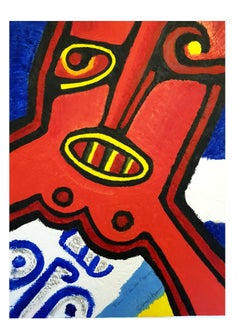
Bengt Lindström - Original Handsigned Engraving The Seven Deadly Sins. 76 x 56 cm Signed in pencil by Bengt Lindström Paris, ABCD, 1976. Original etching in color Limited edition 90 ex. This is the unique copy offered to Claude Manesse, The story of B. Lindström was collected by Frederick Towarnicki, assisted by Agathe Malet-Buisson. The engravings were drawn on the presses of Claude Manesse. Bengt Lindström (1925-2008) Bengt Lindström was born on September 3rd, 1925 in Storsjökapell, a small isolated village in the Swedish province of Norrland. The young child thus grew up in that vast, mythical and harsh expanse of mounts, glistening lakes and endless forests known as Lapland. His father was a primary school teacher who was fond of Lapps and who showed great interest in their ethnic group and culture. The child was only three days old when Lapp King Kroik, his godfather, administered the Baptism of the Earth, where the child is conveyed between two roots of a tree to grant him protection from the Gods. Lapps as well as local lumberjacks would occasionally abandon their silent ways to tell him and reveal the tales, legends and mysteries of the Great White North. 1935-1945 : He left Storsjökapell and headed to Härnösand, where he wrote short science-fiction novellas, became a renowned athlete and began to paint. 1944-1946 : Isaac Grünewald Art School in Stockholm, Sweden. Study drawing with Aksel Jörgensen at the Copenhagen Fine Arts School in Denmark. He realized his first two lithographs, Meditation and Le Modèle Etendu (The Stretched Model). 1947-1952 : He arrived in Paris. He travelled to Italy, where he visited Florence and Assisi, developing a deep fascination for Giotto and Cimabue. He was granted a scholarship by Swedish magazine Aftontidningen, which helped him move into a workshop in Arcueil, France. He began working on mosaics. 1953-1967 : He returned to Paris, once again taking up lithography and engraving, which holds a vital position in his work. He moved into a workshop in Rueil-Malmaison. This was the start of his collaboration with the Rive Gauche Gallery in Paris. London Tooth & Sons Gallery Director M. Cochrane purchased a large number of his works. He left the workshop in Rueil-Malmaison to settle in Savigny-sur-Orge, France. He began taking to figurative art with Masks, Gods and Monsters. He exhibited with the Nouvelle Figuration Group at the Mathias Feld Gallery. He also began working with the Ariel Gallery in Paris. 1968-1978 : Lindström completed a series of 10 lithographs about Scandinavian mythology. He also completed a series of drypoint works. An association with the Protée Gallery in Toulouse, France, led to exhibitions at the Protée Gallery II in Paris starting in 1984. He executed a large mural painting the Grand Hotel in Härnösand, Sweden. He also made two large frescoes for the Nacksta-Sundsvall covered market in Sweden. He took to sharing his working time between the workshop in Savigny-sur-Orge and the one in Sundsvall. He began collaboration that was to last several years with the ABCD Gallery in Paris, which provided exclusive publication for his engravings and strong ink work. Les Hommes du Nord (Men of the North) was the first of the major tapestries. He published a boxed set album, Eddan, Eddan, Eddan, illustrating Scandinavian mythology. Together with Jacques Putman, he completed two editions of bronze sculptures, Les Enfants Sauvages (The Wild Children). 1979-1982 : He worked on glass, making thirty dishes and goblets for renowned Swedish glassmaker Kosta Boda. He painted a car for Volvo, Sweden’s leading car manufacturer. Then, close to his birthplace, he painted gigantic tarpaulins over forty metres high, covering the slopes of the neighbouring Våladalen Mountain, as a protest against the building of a dam. This action caused a sensation and provoked fierce reactions. He also created small painted papier mâché sculptures, Têtes (Heads), as well as some gold and silver jewellery. 1983 : He exhibited seven monumental 3x2.5m works at the Art and History Museum in Stockholm: Les Grands Dieux Ase (The Great Aesir Gods), depicting the gods from Scandinavian mythology: Thor, Odin, Frej, Balder, Ymer, Loki and Unknown God, as well as acrylic paintings about the Valkyries. Les Grands Dieux was ultimately exhibited in a purpose-built chapel adjoining the Midlanda Contemporary Arts Centre in 1996. He completed Thor’s Hammer, a monumental sculpture. 1985-1990 : He lived also in the Alicante region, where Spanish friends found him a new workshop. While there he completed Novelda, an album of lithographs featuring poems by Spanish poet Paco Pastor. He completed a new mural, 5mx5m, for the Västeras Science Institute in Sweden. He then started working with the San Carlo Gallery in Milan, Italy, which coordinated all of the Italian events. Major exhibitions and retrospectives were held in Italy, Belgium, Luxembourg, Germany and Spain. He created two boxed set albums, containing series of 10 aquatints, Monde Autre et Chamanes (Otherworld and Shamans), featuring poems by Michel Perrin. 1991-1994 : He went back to working in black and white, completing some very-large-format works. In Murano, in association with the San Carlo Gallery, he created Grands Verres (Large Glasses), a series of large vases and sculptures made of crystal. He painted Kåtan Mimi, an 8x9m Lapp tent, for the town of Arjeplog in Swedish Lapland. He completed a couple of 2m-high painted polyester sculptures, Lui et Elle (Him and Her). He then made a new series of crystal glasses and sculptures in Murano, Italy. He completed Présence (Presence), a new 3.5x2.7m tapestry for the municipality of Timrå, Sweden. He started on the Grands Initiés (Great Insiders) series, all large format and mixed black and white techniques. He finished the strong series about Norse gods. 1995-1996 : He moved into a new workshop in Paris. A retrospective was held at the Sundsvall Museum in Sweden, and on that occasion he painted a monumental 700-m² canvass, Le Géant sur la montagne (The Giant on the Mountain), which was hung all summer long on the mountain slope facing the town. He went on to complete a suite of six silkscreen prints on the same theme. Then he inaugurated the Y, a monumental sculpture. Lindström then completed Temps Zéro (Zero Time), a watch made for Swatch. One of his works, L’hiver (Winter), made the cover of the first 1996 issue of Telerama, the leading French weekly. In association with Sydkraft Sweden, he painted a fresco for the municipality of Örebro on a 17m-high tank with a surface area of 3,000 m², located at the crossroads of major Swedish motorways, by the entrance to the Åbyverket industrial estate. He also created a 6.5m-high Tången sculpture made of painted concrete in Ånge, which was inaugurated on September 3rd in the presence of their Majesties the King and Queen of Sweden. 1997-1999 : He began working on ceramics in Albisolla, Italy. He also completed a new 30m-high fresco for the town of Örebro, located close to the tank he had painted in 1996 near Åbyverket. The year saw the inauguration of the Midlanda Contemporary Arts Centre in Sweden, which harbours the collection of the Bengt and Michèle Lindström Foundation, featuring the entire engravings collection (about 800 works), as well as a selection of paintings and sculptures. He completed a 4x10m mural in the lobby of the University of Eskilstuna, Sweden, and also completed two monumental frescoes on the Akkats dam and a mural on the power station facing Jokkmokk in Swedish Lapland. 2000-2003 : He painted all of the sides of a semi-articulated lorry for Scania, Sweden’s main truck manufacturer. In Italy, he completed a new series of crystal sculptures with Adriano Bérengo. He finished the Great Prophets, a series of 2x2m oil on canvass works. Swiss publisher Ides et Calendes published a small but luxurious monograph, with text by Françoise Monnin. A notebook was also published, Le Visage dans l’Art de Bengt Lindström (Faces in the Art of Bengt Lindström). He completed a substantial series of large blue acrylic paintings, Femmes (Women). 2003 : Bengt fell ill and was unable to paint, but the exhibitions went on. 2004 : Saw the release of the film by Dag Jonzon and Hans Östbom, produced by Dell’arte AB and Östbom Filmbild, about the life of Bengt Lindström. Entitled Lindström - Le Diable de la couleur et de la forme (Lindström – The Colour and Form Devil), the film was produced thanks to support from Film Västernorrland, Länsstyrelsen Västernorrland and Sveriges Television. It was broadcast on Swedish television channels. That same year, the Midlanda Contemporary Arts Centre was closed as a result of municipal policy. 2005-2007 : The 6m-high sculpture Le Loup (The Wolf), made for PEAB, was inaugurated in Botkyrka-Stockholm. Lindström – The Colour and Form Devil was screened at the Paris Swedish Cultural Centre and released on DVD. The Michèle and Bengt Lindström Foundation was donated and transferred to the Länsmuseet i Västernorrland in Härnösand, Sweden, where a special room was prepared to host Les Grands Dieux Ase. Edition of the 1998 Ceramics, created in association with Francis Dellile’s ”La Tuilerie” workshop. The Bengt Lindström Collection was inaugurated at, Murberget, the Länsmuseet i Västernorrland in Härnösand, Sweden. He illustrated Sinfonietta för Juliana, a collection of poems by Italian poet and art critic Sebastiano Grasso. On January 29th, 2008, Bengt Lindström passed away at his home in Sweden. 2008-2012 : The Fondation Krimaro presents the first volume of the works of Bengt Lindström in his collection. Numerous exhibitions-tribute to the work are presented in major cities in Europe. 2012 : Retrospective - Black and White in the engravings - Museum of Härnösand, Murberget, Sweden. Main exhibitions 1952 Fair Réalités Nouvelles – New realities, Paris, France. 1953 Craven Gallery, Paris, France. 1954 Gummeson Gallery, Stockholm, Sweden. Fair Salon d’Octobre, Paris, France. 1958 Breteau Gallery, Paris, France. 1959 Autour du Spontanéisme – Around the sontaneity, Stockholm, Sweden. L’Europe Nouvelle – The new Europe, LaUnited Statesnne, Switzerland. 1960 Rive Gauche Gallery, Paris, France. 1961 Tooth Gallery, London, England. Le Zodiaque Gallery, Brussels, Belgium. Fair Salon de Mai, Paris, France. 1962 Nouvelle Figuration – New Figuration , Mathias Fels Gallery, Paris, France, 1964 Nord-Sud – North-South, in several cities in Sweden. Ariel Gallery, Paris, France, 15 artists of my generation. Museum of Fine Arts in Gent, Belgium, Figuration-Défiguration – Figuration – Disfigurement. 1965 Rive Gauche Gallery. Paris, France. Nord Gallery, Lille, France. Birch Gallery, Copenhagen, Denmark. 1966 Museum of Modern Art, Gothenburg, Sweden. 1967 Veranneman Gallery, Brussels, Belgium. Carnegie Institute, Pittsburgh, United States. Seibu Gallery, Tokyo, Japan, 23 peintres in Paris. 1968 Ariel Gallery, Paris, France, followed by six exhibitions until 1976. 1969 La Pochade Gallery, Paris, France. Protée Gallery, Toulouse, France, who exhibited him in Paris, Gallery Protée II, from 1984. 1973 Galliera Museum, Paris, France. 1974 Gallery 111, Lisbon, Portugal. 1982 Gallery Protée-Arco, Madrid, Spain and Fair Foire de Cologne, Germany. 1983 Historia Museum, Stockholm, Sweden, The Ase gods and the Valkyries. 1984 Gallery Arcano XXI, Lisbon, Portugal. Gallery Christian Cheneau, Paris, France. Museum Château comtal, Carcassonne, France. 1985 Gallery Italia, Alicante, Spain. 1986 Gallery Sala Gaspar, Barcelona, Spain. Gallery Juan Mordo-Arco, Madrid, Spain. Gallery Italia, Alicante, Spain. Museum of Salamanca, Salamanca, Spain. Gallery Three Continents, New-York, United States. Gallery Protée, Toulouse France, Autour du Roi Lear – Around King Lear. 1987 Gallery Kostel, Paris, France. Gallery Zwirner, Cologne, Germany. Gallery Leu, Rottach-Egern, Germany. 1988 Maison du Lot, Figeac, France. Gallery Protée, Paris, France. Gallery Michèle Sadoun, Paris, France 1989 Gallery Michèle Sadoun, Paris, France, La terre des ancêtres - The Land pf the ancestors. Gallery Protée, Paris, France, Nomads. Gallery Raab, London, England. 1990 Gallery Michèle Sadoun, Paris, France. Centre Culturel de Brest, France. 1991 Gallery Michèle Sadoun, Paris, France. 1992 Archotèque, Saint-Denis, La Réunion, France. Museum of Vesoul, Vesoul, France. Gallery San Carlo, Milan, Italy. 1993 Gallery 111, Lisbon, Portugal. Tonnellerie du Cognac Monnet...

Category

1970s Modern William Ward Prints and Multiples
Materials

Engraving

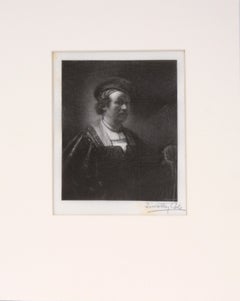
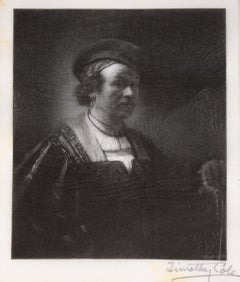
1910 Master Wood Engraving after Rembrandt with Cap, Signed

1910 Master Wood Engraving after Rembrandt with Cap, Signed

By Timothy Cole

Located in Soquel, CA

1910 Master Wood Engraving after Rembrandt with Cap, Signed Beautifully rendered print after Rembrandt by master engraver Timothy Cole (British/American b. 1852 d. 1931.) Rembrandt ...

Category

1910s Old Masters William Ward Prints and Multiples

Materials

Ink, Tissue Paper, Pencil, Engraving

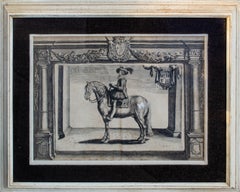
The Earl of Montbar, famous French horseman, Crispin de Passe Engraving

The Earl of Montbar, famous French horseman, Crispin de Passe Engraving

By Crispin De Passe

Located in New York, NY

Crispin van de Passe The Younger (c. 1594-1670) Caesar August de Bellegarde Conte de Montbar Marquis de Termes grand Ecuyer de France, c. 1660 Engraving Sight: 11 3/4 x 15 3/4 in. Fr...

Category

17th Century Old Masters William Ward Prints and Multiples

Materials

Engraving

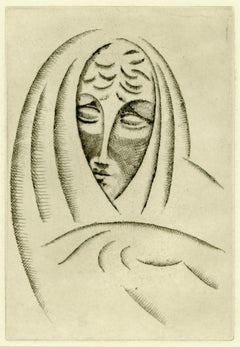
Woman's Head
Woman's Head

Elie NadelmanWoman's Head, 1920

$2,500

H 7.125 in W 5.375 in

Woman's Head

By Elie Nadelman

Located in Fairlawn, OH

Edition of 50 printed by Charles White in 1951 for the estate Bibliography: Lincoln Kirstein, Elie Nademan (New York: The Eakins Press, 1973),, 20 Elie Nadelman Born 1882, Warsaw...

Category

1920s American Modern William Ward Prints and Multiples

Materials

Drypoint

"Mes Petites Amies, Les Deux Sœurs" signed by Jacques Villon

"Mes Petites Amies, Les Deux Sœurs" signed by Jacques Villon

By Jacques Villon

Located in Milwaukee, WI

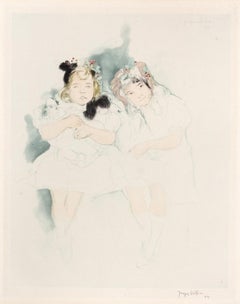
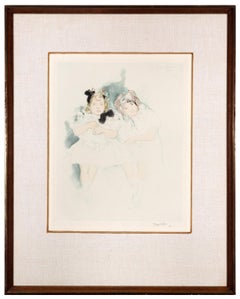
This is a drypoint and aquatint artwork by Jacques Villon. The artist signed in pencil on the lower right. As well as signed in plate at the top right of the image. This is a wonderful artwork of different intaglio processes being brought together in a beautiful almost seamless harmony. The thin pencil like markings and hair detailing are made using the Drypoint printmaking method. Whilst the color details around the girls are made using the Aquatint etching method. Jacques Villon shows his skills as a printmaker with the way these pieces line up perfectly and with how clean the rest of the plate is around the girls. An unnumbered impression, apart from the numbered edition of 50. Catalogue Raisonne E101, pg. 66-67 (Ginestet & Pouillon. It depicts two young girls. 15" x 11 1/2" art 25 1/8" x 20" frame French painter, printmaker and illustrator. The oldest of three brothers who became major 20th-century artists, including Raymond Duchamp-Villon and Marcel Duchamp, he learnt engraving at the age of 16 from his maternal grandfather, Emile-Frédéric Nicolle (1830-94), a ship-broker who was also a much appreciated amateur artist. In January 1894, having completed his studies at the Lycée Corneille in Rouen, he was sent to study at the Faculty of Law of the University of Paris, but within a year he was devoting most of his time to art, already contributing lithographs to Parisian illustrated newspapers such as Assiette au beurre. At this time he chose his pseudonym: Jack (subsequently Jacques) in homage to Alphonse Daudet’s novel Jack (1876) and Villon in appreciation of the 15th-century French poet François Villon...

Category

Early 1900s Modern William Ward Prints and Multiples

Materials

Drypoint, Aquatint, Etching, Intaglio

Bengt Lindstrom - Original Handsigned Engraving

Bengt Lindstrom - Original Handsigned Engraving

By Bengt Lindström

Located in Collonge Bellerive, Geneve, CH

Bengt Lindström - Original Handsigned Engraving The Seven Deadly Sins. 76 x 56 cm Signed in pencil by Bengt Lindström Paris, ABCD, 1976. Original etching in color Limited edition 90 ex. This is the unique copy offered to Claude Manesse, The story of B. Lindström was collected by Frederick Towarnicki, assisted by Agathe Malet-Buisson. The engravings were drawn on the presses of Claude Manesse. Bengt Lindström (1925-2008) Bengt Lindström was born on September 3rd, 1925 in Storsjökapell, a small isolated village in the Swedish province of Norrland. The young child thus grew up in that vast, mythical and harsh expanse of mounts, glistening lakes and endless forests known as Lapland. His father was a primary school teacher who was fond of Lapps and who showed great interest in their ethnic group and culture. The child was only three days old when Lapp King Kroik, his godfather, administered the Baptism of the Earth, where the child is conveyed between two roots of a tree to grant him protection from the Gods. Lapps as well as local lumberjacks would occasionally abandon their silent ways to tell him and reveal the tales, legends and mysteries of the Great White North. 1935-1945 : He left Storsjökapell and headed to Härnösand, where he wrote short science-fiction novellas, became a renowned athlete and began to paint. 1944-1946 : Isaac Grünewald Art School in Stockholm, Sweden. Study drawing with Aksel Jörgensen at the Copenhagen Fine Arts School in Denmark. He realized his first two lithographs, Meditation and Le Modèle Etendu (The Stretched Model). 1947-1952 : He arrived in Paris. He travelled to Italy, where he visited Florence and Assisi, developing a deep fascination for Giotto and Cimabue. He was granted a scholarship by Swedish magazine Aftontidningen, which helped him move into a workshop in Arcueil, France. He began working on mosaics. 1953-1967 : He returned to Paris, once again taking up lithography and engraving, which holds a vital position in his work. He moved into a workshop in Rueil-Malmaison. This was the start of his collaboration with the Rive Gauche Gallery in Paris. London Tooth & Sons Gallery Director M. Cochrane purchased a large number of his works. He left the workshop in Rueil-Malmaison to settle in Savigny-sur-Orge, France. He began taking to figurative art with Masks, Gods and Monsters. He exhibited with the Nouvelle Figuration Group at the Mathias Feld Gallery. He also began working with the Ariel Gallery in Paris. 1968-1978 : Lindström completed a series of 10 lithographs about Scandinavian mythology. He also completed a series of drypoint works. An association with the Protée Gallery in Toulouse, France, led to exhibitions at the Protée Gallery II in Paris starting in 1984. He executed a large mural painting the Grand Hotel in Härnösand, Sweden. He also made two large frescoes for the Nacksta-Sundsvall covered market in Sweden. He took to sharing his working time between the workshop in Savigny-sur-Orge and the one in Sundsvall. He began collaboration that was to last several years with the ABCD Gallery in Paris, which provided exclusive publication for his engravings and strong ink work. Les Hommes du Nord (Men of the North) was the first of the major tapestries. He published a boxed set album, Eddan, Eddan, Eddan, illustrating Scandinavian mythology. Together with Jacques Putman, he completed two editions of bronze sculptures, Les Enfants Sauvages (The Wild Children). 1979-1982 : He worked on glass, making thirty dishes and goblets for renowned Swedish glassmaker Kosta Boda. He painted a car for Volvo, Sweden’s leading car manufacturer. Then, close to his birthplace, he painted gigantic tarpaulins over forty metres high, covering the slopes of the neighbouring Våladalen Mountain, as a protest against the building of a dam. This action caused a sensation and provoked fierce reactions. He also created small painted papier mâché sculptures, Têtes (Heads), as well as some gold and silver jewellery. 1983 : He exhibited seven monumental 3x2.5m works at the Art and History Museum in Stockholm: Les Grands Dieux Ase (The Great Aesir Gods), depicting the gods from Scandinavian mythology: Thor, Odin, Frej, Balder, Ymer, Loki and Unknown God, as well as acrylic paintings about the Valkyries. Les Grands Dieux was ultimately exhibited in a purpose-built chapel adjoining the Midlanda Contemporary Arts Centre in 1996. He completed Thor’s Hammer, a monumental sculpture. 1985-1990 : He lived also in the Alicante region, where Spanish friends found him a new workshop. While there he completed Novelda, an album of lithographs featuring poems by Spanish poet Paco Pastor. He completed a new mural, 5mx5m, for the Västeras Science Institute in Sweden. He then started working with the San Carlo Gallery in Milan, Italy, which coordinated all of the Italian events. Major exhibitions and retrospectives were held in Italy, Belgium, Luxembourg, Germany and Spain. He created two boxed set albums, containing series of 10 aquatints, Monde Autre et Chamanes (Otherworld and Shamans), featuring poems by Michel Perrin. 1991-1994 : He went back to working in black and white, completing some very-large-format works. In Murano, in association with the San Carlo Gallery, he created Grands Verres (Large Glasses), a series of large vases and sculptures made of crystal. He painted Kåtan Mimi, an 8x9m Lapp tent, for the town of Arjeplog in Swedish Lapland. He completed a couple of 2m-high painted polyester sculptures, Lui et Elle (Him and Her). He then made a new series of crystal glasses and sculptures in Murano, Italy. He completed Présence (Presence), a new 3.5x2.7m tapestry for the municipality of Timrå, Sweden. He started on the Grands Initiés (Great Insiders) series, all large format and mixed black and white techniques. He finished the strong series about Norse gods. 1995-1996 : He moved into a new workshop in Paris. A retrospective was held at the Sundsvall Museum in Sweden, and on that occasion he painted a monumental 700-m² canvass, Le Géant sur la montagne (The Giant on the Mountain), which was hung all summer long on the mountain slope facing the town. He went on to complete a suite of six silkscreen prints on the same theme. Then he inaugurated the Y, a monumental sculpture. Lindström then completed Temps Zéro (Zero Time), a watch made for Swatch. One of his works, L’hiver (Winter), made the cover of the first 1996 issue of Telerama, the leading French weekly. In association with Sydkraft Sweden, he painted a fresco for the municipality of Örebro on a 17m-high tank with a surface area of 3,000 m², located at the crossroads of major Swedish motorways, by the entrance to the Åbyverket industrial estate. He also created a 6.5m-high Tången sculpture made of painted concrete in Ånge, which was inaugurated on September 3rd in the presence of their Majesties the King and Queen of Sweden. 1997-1999 : He began working on ceramics in Albisolla, Italy. He also completed a new 30m-high fresco for the town of Örebro, located close to the tank he had painted in 1996 near Åbyverket. The year saw the inauguration of the Midlanda Contemporary Arts Centre in Sweden, which harbours the collection of the Bengt and Michèle Lindström Foundation, featuring the entire engravings collection (about 800 works), as well as a selection of paintings and sculptures. He completed a 4x10m mural in the lobby of the University of Eskilstuna, Sweden, and also completed two monumental frescoes on the Akkats dam and a mural on the power station facing Jokkmokk in Swedish Lapland. 2000-2003 : He painted all of the sides of a semi-articulated lorry for Scania, Sweden’s main truck manufacturer. In Italy, he completed a new series of crystal sculptures with Adriano Bérengo. He finished the Great Prophets, a series of 2x2m oil on canvass works. Swiss publisher Ides et Calendes published a small but luxurious monograph, with text by Françoise Monnin. A notebook was also published, Le Visage dans l’Art de Bengt Lindström (Faces in the Art of Bengt Lindström). He completed a substantial series of large blue acrylic paintings, Femmes (Women). 2003 : Bengt fell ill and was unable to paint, but the exhibitions went on. 2004 : Saw the release of the film by Dag Jonzon and Hans Östbom, produced by Dell’arte AB and Östbom Filmbild, about the life of Bengt Lindström. Entitled Lindström - Le Diable de la couleur et de la forme (Lindström – The Colour and Form Devil), the film was produced thanks to support from Film Västernorrland, Länsstyrelsen Västernorrland and Sveriges Television. It was broadcast on Swedish television channels. That same year, the Midlanda Contemporary Arts Centre was closed as a result of municipal policy. 2005-2007 : The 6m-high sculpture Le Loup (The Wolf), made for PEAB, was inaugurated in Botkyrka-Stockholm. Lindström – The Colour and Form Devil was screened at the Paris Swedish Cultural Centre and released on DVD. The Michèle and Bengt Lindström Foundation was donated and transferred to the Länsmuseet i Västernorrland in Härnösand, Sweden, where a special room was prepared to host Les Grands Dieux Ase. Edition of the 1998 Ceramics, created in association with Francis Dellile’s ”La Tuilerie” workshop. The Bengt Lindström Collection was inaugurated at, Murberget, the Länsmuseet i Västernorrland in Härnösand, Sweden. He illustrated Sinfonietta för Juliana, a collection of poems by Italian poet and art critic Sebastiano Grasso. On January 29th, 2008, Bengt Lindström passed away at his home in Sweden. 2008-2012 : The Fondation Krimaro presents the first volume of the works of Bengt Lindström in his collection. Numerous exhibitions-tribute to the work are presented in major cities in Europe. 2012 : Retrospective - Black and White in the engravings - Museum of Härnösand, Murberget, Sweden. Main exhibitions 1952 Fair Réalités Nouvelles – New realities, Paris, France. 1953 Craven Gallery, Paris, France. 1954 Gummeson Gallery, Stockholm, Sweden. Fair Salon d’Octobre, Paris, France. 1958 Breteau Gallery, Paris, France. 1959 Autour du Spontanéisme – Around the sontaneity, Stockholm, Sweden. L’Europe Nouvelle – The new Europe, LaUnited Statesnne, Switzerland. 1960 Rive Gauche Gallery, Paris, France. 1961 Tooth Gallery, London, England. Le Zodiaque Gallery, Brussels, Belgium. Fair Salon de Mai, Paris, France. 1962 Nouvelle Figuration – New Figuration , Mathias Fels Gallery, Paris, France, 1964 Nord-Sud – North-South, in several cities in Sweden. Ariel Gallery, Paris, France, 15 artists of my generation. Museum of Fine Arts in Gent, Belgium, Figuration-Défiguration – Figuration – Disfigurement. 1965 Rive Gauche Gallery. Paris, France. Nord Gallery, Lille, France. Birch Gallery, Copenhagen, Denmark. 1966 Museum of Modern Art, Gothenburg, Sweden. 1967 Veranneman Gallery, Brussels, Belgium. Carnegie Institute, Pittsburgh, United States. Seibu Gallery, Tokyo, Japan, 23 peintres in Paris. 1968 Ariel Gallery, Paris, France, followed by six exhibitions until 1976. 1969 La Pochade Gallery, Paris, France. Protée Gallery, Toulouse, France, who exhibited him in Paris, Gallery Protée II, from 1984. 1973 Galliera Museum, Paris, France. 1974 Gallery 111, Lisbon, Portugal. 1982 Gallery Protée-Arco, Madrid, Spain and Fair Foire de Cologne, Germany. 1983 Historia Museum, Stockholm, Sweden, The Ase gods and the Valkyries. 1984 Gallery Arcano XXI, Lisbon, Portugal. Gallery Christian Cheneau, Paris, France. Museum Château comtal, Carcassonne, France. 1985 Gallery Italia, Alicante, Spain. 1986 Gallery Sala Gaspar, Barcelona, Spain. Gallery Juan Mordo-Arco, Madrid, Spain. Gallery Italia, Alicante, Spain. Museum of Salamanca, Salamanca, Spain. Gallery Three Continents, New-York, United States. Gallery Protée, Toulouse France, Autour du Roi Lear – Around King Lear. 1987 Gallery Kostel, Paris, France. Gallery Zwirner, Cologne, Germany. Gallery Leu, Rottach-Egern, Germany. 1988 Maison du Lot, Figeac, France. Gallery Protée, Paris, France. Gallery Michèle Sadoun, Paris, France 1989 Gallery Michèle Sadoun, Paris, France, La terre des ancêtres - The Land pf the ancestors. Gallery Protée, Paris, France, Nomads. Gallery Raab, London, England. 1990 Gallery Michèle Sadoun, Paris, France. Centre Culturel de Brest, France. 1991 Gallery Michèle Sadoun, Paris, France. 1992 Archotèque, Saint-Denis, La Réunion, France. Museum of Vesoul, Vesoul, France. Gallery San Carlo, Milan, Italy. 1993 Gallery 111, Lisbon, Portugal. Tonnellerie du Cognac Monnet...

Category

1970s Modern William Ward Prints and Multiples
Materials

Engraving

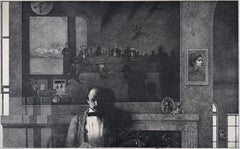
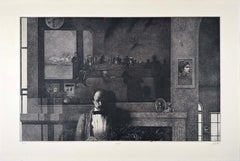
Daylilies, by Peter Milton

Daylilies, by Peter Milton

By Peter Milton

Located in Palm Springs, CA

Peter Milton’s Daylilies is a haunting meditation on memory, mortality, and the layered complexity of personal and cultural history. Like much of Milton’s work, the print operates le...

Category

1990s Contemporary William Ward Prints and Multiples

Materials

Engraving, Etching

Bengt Lindstrom - Original Handsigned Engraving

Bengt Lindstrom - Original Handsigned Engraving

By Bengt Lindström

Located in Collonge Bellerive, Geneve, CH

Bengt Lindström - Original Handsigned Engraving The Seven Deadly Sins. 76 x 56 cm Signed in pencil by Bengt Lindström Paris, ABCD, 1976. Original etching in color Limited edition 90 ex. This is the unique copy offered to Claude Manesse, The story of B. Lindström was collected by Frederick Towarnicki, assisted by Agathe Malet-Buisson. The engravings were drawn on the presses of Claude Manesse. Bengt Lindström (1925-2008) Bengt Lindström was born on September 3rd, 1925 in Storsjökapell, a small isolated village in the Swedish province of Norrland. The young child thus grew up in that vast, mythical and harsh expanse of mounts, glistening lakes and endless forests known as Lapland. His father was a primary school teacher who was fond of Lapps and who showed great interest in their ethnic group and culture. The child was only three days old when Lapp King Kroik, his godfather, administered the Baptism of the Earth, where the child is conveyed between two roots of a tree to grant him protection from the Gods. Lapps as well as local lumberjacks would occasionally abandon their silent ways to tell him and reveal the tales, legends and mysteries of the Great White North. 1935-1945 : He left Storsjökapell and headed to Härnösand, where he wrote short science-fiction novellas, became a renowned athlete and began to paint. 1944-1946 : Isaac Grünewald Art School in Stockholm, Sweden. Study drawing with Aksel Jörgensen at the Copenhagen Fine Arts School in Denmark. He realized his first two lithographs, Meditation and Le Modèle Etendu (The Stretched Model). 1947-1952 : He arrived in Paris. He travelled to Italy, where he visited Florence and Assisi, developing a deep fascination for Giotto and Cimabue. He was granted a scholarship by Swedish magazine Aftontidningen, which helped him move into a workshop in Arcueil, France. He began working on mosaics. 1953-1967 : He returned to Paris, once again taking up lithography and engraving, which holds a vital position in his work. He moved into a workshop in Rueil-Malmaison. This was the start of his collaboration with the Rive Gauche Gallery in Paris. London Tooth & Sons Gallery Director M. Cochrane purchased a large number of his works. He left the workshop in Rueil-Malmaison to settle in Savigny-sur-Orge, France. He began taking to figurative art with Masks, Gods and Monsters. He exhibited with the Nouvelle Figuration Group at the Mathias Feld Gallery. He also began working with the Ariel Gallery in Paris. 1968-1978 : Lindström completed a series of 10 lithographs about Scandinavian mythology. He also completed a series of drypoint works. An association with the Protée Gallery in Toulouse, France, led to exhibitions at the Protée Gallery II in Paris starting in 1984. He executed a large mural painting the Grand Hotel in Härnösand, Sweden. He also made two large frescoes for the Nacksta-Sundsvall covered market in Sweden. He took to sharing his working time between the workshop in Savigny-sur-Orge and the one in Sundsvall. He began collaboration that was to last several years with the ABCD Gallery in Paris, which provided exclusive publication for his engravings and strong ink work. Les Hommes du Nord (Men of the North) was the first of the major tapestries. He published a boxed set album, Eddan, Eddan, Eddan, illustrating Scandinavian mythology. Together with Jacques Putman, he completed two editions of bronze sculptures, Les Enfants Sauvages (The Wild Children). 1979-1982 : He worked on glass, making thirty dishes and goblets for renowned Swedish glassmaker Kosta Boda. He painted a car for Volvo, Sweden’s leading car manufacturer. Then, close to his birthplace, he painted gigantic tarpaulins over forty metres high, covering the slopes of the neighbouring Våladalen Mountain, as a protest against the building of a dam. This action caused a sensation and provoked fierce reactions. He also created small painted papier mâché sculptures, Têtes (Heads), as well as some gold and silver jewellery. 1983 : He exhibited seven monumental 3x2.5m works at the Art and History Museum in Stockholm: Les Grands Dieux Ase (The Great Aesir Gods), depicting the gods from Scandinavian mythology: Thor, Odin, Frej, Balder, Ymer, Loki and Unknown God, as well as acrylic paintings about the Valkyries. Les Grands Dieux was ultimately exhibited in a purpose-built chapel adjoining the Midlanda Contemporary Arts Centre in 1996. He completed Thor’s Hammer, a monumental sculpture. 1985-1990 : He lived also in the Alicante region, where Spanish friends found him a new workshop. While there he completed Novelda, an album of lithographs featuring poems by Spanish poet Paco Pastor. He completed a new mural, 5mx5m, for the Västeras Science Institute in Sweden. He then started working with the San Carlo Gallery in Milan, Italy, which coordinated all of the Italian events. Major exhibitions and retrospectives were held in Italy, Belgium, Luxembourg, Germany and Spain. He created two boxed set albums, containing series of 10 aquatints, Monde Autre et Chamanes (Otherworld and Shamans), featuring poems by Michel Perrin. 1991-1994 : He went back to working in black and white, completing some very-large-format works. In Murano, in association with the San Carlo Gallery, he created Grands Verres (Large Glasses), a series of large vases and sculptures made of crystal. He painted Kåtan Mimi, an 8x9m Lapp tent, for the town of Arjeplog in Swedish Lapland. He completed a couple of 2m-high painted polyester sculptures, Lui et Elle (Him and Her). He then made a new series of crystal glasses and sculptures in Murano, Italy. He completed Présence (Presence), a new 3.5x2.7m tapestry for the municipality of Timrå, Sweden. He started on the Grands Initiés (Great Insiders) series, all large format and mixed black and white techniques. He finished the strong series about Norse gods. 1995-1996 : He moved into a new workshop in Paris. A retrospective was held at the Sundsvall Museum in Sweden, and on that occasion he painted a monumental 700-m² canvass, Le Géant sur la montagne (The Giant on the Mountain), which was hung all summer long on the mountain slope facing the town. He went on to complete a suite of six silkscreen prints on the same theme. Then he inaugurated the Y, a monumental sculpture. Lindström then completed Temps Zéro (Zero Time), a watch made for Swatch. One of his works, L’hiver (Winter), made the cover of the first 1996 issue of Telerama, the leading French weekly. In association with Sydkraft Sweden, he painted a fresco for the municipality of Örebro on a 17m-high tank with a surface area of 3,000 m², located at the crossroads of major Swedish motorways, by the entrance to the Åbyverket industrial estate. He also created a 6.5m-high Tången sculpture made of painted concrete in Ånge, which was inaugurated on September 3rd in the presence of their Majesties the King and Queen of Sweden. 1997-1999 : He began working on ceramics in Albisolla, Italy. He also completed a new 30m-high fresco for the town of Örebro, located close to the tank he had painted in 1996 near Åbyverket. The year saw the inauguration of the Midlanda Contemporary Arts Centre in Sweden, which harbours the collection of the Bengt and Michèle Lindström Foundation, featuring the entire engravings collection (about 800 works), as well as a selection of paintings and sculptures. He completed a 4x10m mural in the lobby of the University of Eskilstuna, Sweden, and also completed two monumental frescoes on the Akkats dam and a mural on the power station facing Jokkmokk in Swedish Lapland. 2000-2003 : He painted all of the sides of a semi-articulated lorry for Scania, Sweden’s main truck manufacturer. In Italy, he completed a new series of crystal sculptures with Adriano Bérengo. He finished the Great Prophets, a series of 2x2m oil on canvass works. Swiss publisher Ides et Calendes published a small but luxurious monograph, with text by Françoise Monnin. A notebook was also published, Le Visage dans l’Art de Bengt Lindström (Faces in the Art of Bengt Lindström). He completed a substantial series of large blue acrylic paintings, Femmes (Women). 2003 : Bengt fell ill and was unable to paint, but the exhibitions went on. 2004 : Saw the release of the film by Dag Jonzon and Hans Östbom, produced by Dell’arte AB and Östbom Filmbild, about the life of Bengt Lindström. Entitled Lindström - Le Diable de la couleur et de la forme (Lindström – The Colour and Form Devil), the film was produced thanks to support from Film Västernorrland, Länsstyrelsen Västernorrland and Sveriges Television. It was broadcast on Swedish television channels. That same year, the Midlanda Contemporary Arts Centre was closed as a result of municipal policy. 2005-2007 : The 6m-high sculpture Le Loup (The Wolf), made for PEAB, was inaugurated in Botkyrka-Stockholm. Lindström – The Colour and Form Devil was screened at the Paris Swedish Cultural Centre and released on DVD. The Michèle and Bengt Lindström Foundation was donated and transferred to the Länsmuseet i Västernorrland in Härnösand, Sweden, where a special room was prepared to host Les Grands Dieux Ase. Edition of the 1998 Ceramics, created in association with Francis Dellile’s ”La Tuilerie” workshop. The Bengt Lindström Collection was inaugurated at, Murberget, the Länsmuseet i Västernorrland in Härnösand, Sweden. He illustrated Sinfonietta för Juliana, a collection of poems by Italian poet and art critic Sebastiano Grasso. On January 29th, 2008, Bengt Lindström passed away at his home in Sweden. 2008-2012 : The Fondation Krimaro presents the first volume of the works of Bengt Lindström in his collection. Numerous exhibitions-tribute to the work are presented in major cities in Europe. 2012 : Retrospective - Black and White in the engravings - Museum of Härnösand, Murberget, Sweden. Main exhibitions 1952 Fair Réalités Nouvelles – New realities, Paris, France. 1953 Craven Gallery, Paris, France. 1954 Gummeson Gallery, Stockholm, Sweden. Fair Salon d’Octobre, Paris, France. 1958 Breteau Gallery, Paris, France. 1959 Autour du Spontanéisme – Around the sontaneity, Stockholm, Sweden. L’Europe Nouvelle – The new Europe, LaUnited Statesnne, Switzerland. 1960 Rive Gauche Gallery, Paris, France. 1961 Tooth Gallery, London, England. Le Zodiaque Gallery, Brussels, Belgium. Fair Salon de Mai, Paris, France. 1962 Nouvelle Figuration – New Figuration , Mathias Fels Gallery, Paris, France, 1964 Nord-Sud – North-South, in several cities in Sweden. Ariel Gallery, Paris, France, 15 artists of my generation. Museum of Fine Arts in Gent, Belgium, Figuration-Défiguration – Figuration – Disfigurement. 1965 Rive Gauche Gallery. Paris, France. Nord Gallery, Lille, France. Birch Gallery, Copenhagen, Denmark. 1966 Museum of Modern Art, Gothenburg, Sweden. 1967 Veranneman Gallery, Brussels, Belgium. Carnegie Institute, Pittsburgh, United States. Seibu Gallery, Tokyo, Japan, 23 peintres in Paris. 1968 Ariel Gallery, Paris, France, followed by six exhibitions until 1976. 1969 La Pochade Gallery, Paris, France. Protée Gallery, Toulouse, France, who exhibited him in Paris, Gallery Protée II, from 1984. 1973 Galliera Museum, Paris, France. 1974 Gallery 111, Lisbon, Portugal. 1982 Gallery Protée-Arco, Madrid, Spain and Fair Foire de Cologne, Germany. 1983 Historia Museum, Stockholm, Sweden, The Ase gods and the Valkyries. 1984 Gallery Arcano XXI, Lisbon, Portugal. Gallery Christian Cheneau, Paris, France. Museum Château comtal, Carcassonne, France. 1985 Gallery Italia, Alicante, Spain. 1986 Gallery Sala Gaspar, Barcelona, Spain. Gallery Juan Mordo-Arco, Madrid, Spain. Gallery Italia, Alicante, Spain. Museum of Salamanca, Salamanca, Spain. Gallery Three Continents, New-York, United States. Gallery Protée, Toulouse France, Autour du Roi Lear – Around King Lear. 1987 Gallery Kostel, Paris, France. Gallery Zwirner, Cologne, Germany. Gallery Leu, Rottach-Egern, Germany. 1988 Maison du Lot, Figeac, France. Gallery Protée, Paris, France. Gallery Michèle Sadoun, Paris, France 1989 Gallery Michèle Sadoun, Paris, France, La terre des ancêtres - The Land pf the ancestors. Gallery Protée, Paris, France, Nomads. Gallery Raab, London, England. 1990 Gallery Michèle Sadoun, Paris, France. Centre Culturel de Brest, France. 1991 Gallery Michèle Sadoun, Paris, France. 1992 Archotèque, Saint-Denis, La Réunion, France. Museum of Vesoul, Vesoul, France. Gallery San Carlo, Milan, Italy. 1993 Gallery 111, Lisbon, Portugal. Tonnellerie du Cognac Monnet...

Category

1970s Modern William Ward Prints and Multiples
Materials

Engraving

Previously Available Items
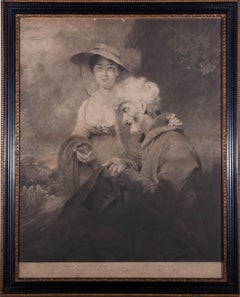
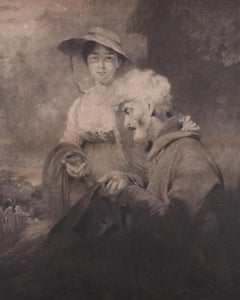
William Ward (1766-1826) after William Owen - 1804 Mezzotint, The Blind Beggar

William Ward (1766-1826) after William Owen - 1804 Mezzotint, The Blind Beggar

By William Ward

Located in Corsham, GB

A striking mezzotint after the original painting by William Owen (1769-1825), showing the blind beggar of Bednall Green and a woman, with one hand on his shoulder, the other open and outstretched. The dedication and titular inscription is at the lower edge, completed with the artist's names and a short poem about the beggar in both French and English. The mezzotint has been presented in a fine late 19th Century Hogarth frame...

Category

Early 19th Century William Ward Prints and Multiples
Materials

Mezzotint

William Ward prints and multiples for sale on 1stDibs.

Find a wide variety of authentic William Ward prints and multiples available for sale on 1stDibs. You can also browse by medium to find art by William Ward in engraving, mezzotint and more. Not every interior allows for large William Ward prints and multiples, so small editions measuring 14 inches across are available. Customers who are interested in this artist might also find the work of John Wilkes, David Hollier, and Samuel Howitt. William Ward prints and multiples prices can differ depending upon medium, time period and other attributes. On 1stDibs, the price for these items starts at $339 and tops out at $377, while the average work can sell for $358.