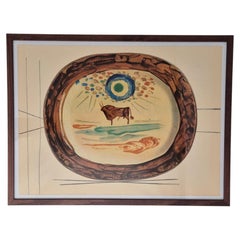
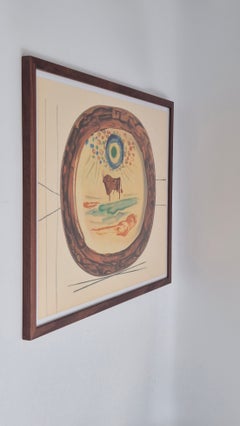
Zao Wou-Ki, Lithograph, 1968
$15,934
Zao Wou-Ki, Lithograph, 1968
By Zao Wou-Ki
Located in SAINT-OUEN-SUR-SEINE, FR
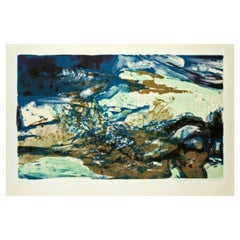
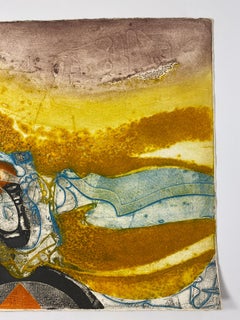
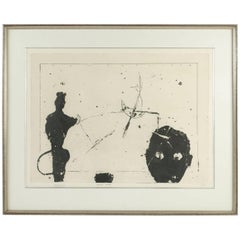
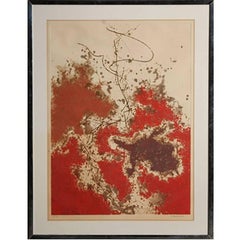
ZAO WOU-KI (趙無極, 1920–2013) 1. INFORMATION Artist: ZAO WOU-KI (趙無極, 1920–2013) Title: Untitled (Agerup 183) Date: 1968 Medium: Colour lithograph printed in 6 colours on BFK Rives wove paper Dimensions: Image: 43.5 X 56.0 cm Sheet: 50.0 X 65.0 cm Markings: Signed in Chinese and Pinyin and dated '68' in pencil lower right margin; numbered '82/90' in pencil lower left margin Edition: 90 numbered copies on Rives paper (plus 10 artist's proofs) Printer: Imprimerie E. & J. Desjobert, Paris Publisher: Galerie de France, Paris Catalogue Raisonné / Reference: Jørgen Ågerup, Zao Wou-Ki: The Graphic Work, A Catalogue Raisonné 1937–1995, Skørping: Heede & Moestrup, 1994, cat. no. 183, p. 108 (illustrated). 2. VISUAL & COMPOSITIONAL ANALYSIS Created in 1968 during the apex of Zao Wou-Ki's "Hurricane" period, Untitled (Agerup 183) exemplifies the artist’s mature command of planographic printmaking through his work with the master Parisian lithographic workshop of Edmond and Jacques Desjobert. Unlike the intaglio bite of his etchings, lithography allowed Zao to translate the fluid properties of wash (shuimo) directly onto limestone, achieving complex chromatic layering through six distinct colour separations. The composition is conceived as an asymmetric, horizontal expanse defined by a dramatic lateral convergence. The right third of the field is anchored by a dense, saturated mass of deep indigo, Prussian blue, and near-black ink marks that sheer sharply along the upper-right edge. From this vortex, a horizontal band of fractured, calligraphic gestures extends leftward across the upper-middle ground. This turbulent band divides the sheet into two atmospheric zones: a broad, light-filled foreground reminiscent of a misty river surface, and a pale, vaporous upper register. Zao's palette juxtaposes aqueous mineral tones with deep aquatic blues. Olive green, stone ochre, and mossy earth washes provide the ground across which cerulean and turquoise tints expand. The brushwork alternates between rapid, dry tusche scumbling—producing splintered, staccato marks akin to ancient bronze script or wind-whipped brushwood—and diluted washes that settle organically into the grain of the paper. Along the base of the central void, delicate, brushed ink striations suggest reflections across calm water, balancing the kinetic turbulence above. In Untitled (Agerup 183), Zao engages directly with the Southern Song dynasty canon of monumental landscape painting—specifically the "one-corner" asymmetric compositions of Ma Yuan and Xia Gui—while employing the physical scale and gestural velocity of European lyrical abstraction and American Abstract Expressionism. The void (le vide) is not merely negative space, but an active, breathing atmosphere charged with ambient light, emerging as the spatial center of gravity between competing pictorial forces. 3. PROVENANCE & AUTHENTICITY NOTE Authenticity Note: Original lithographs and prints by Zao Wou-Ki are catalogued according to Jørgen Ågerup’s definitive catalogue raisonné of the graphic work. For unique works on canvas and paper, the Zao Wou-Ki Foundation (Fondation Zao Wou-Ki, Geneva) serves as the sole certifying body for authentications, certificates, and inclusion in the forthcoming catalogue raisonné of paintings. Provenance: Galerie de France, Paris (Original Publisher, 1968) Moufflet & C° – Paris Fine Arts, Saint-Ouen Literature: J. Ågerup, Zao Wou-Ki: The Graphic Work, A Catalogue Raisonné 1937–1995, Skørping, 1994, no. 183, p. 108 (another example illustrated). 4. ARTIST BIOGRAPHY ZAO WOU-KI (1920–2013): BIOGRAPHICAL PROFILE Born in Beijing into a distinguished family dating back to the Song Dynasty, Zao Wou-Ki (趙無極, meaning 'ad infinitum') studied at the National School of Fine Arts in Hangzhou under Lin Fengmian...
20th Century French Modern Zao Wou-Ki Wall Decorations
Paper