Leroy Setziol Monumental 1963 Yellow Cedar Wall Mural U.S. National Bank Oregon
By Leroy Setziol
Located in Camden, ME
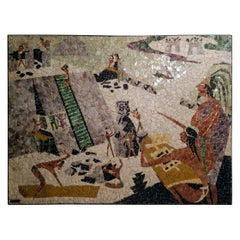
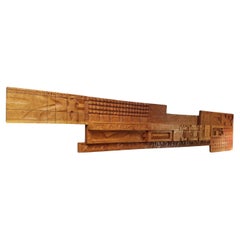
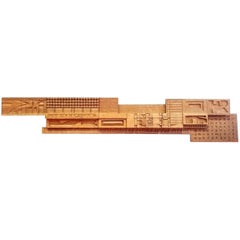
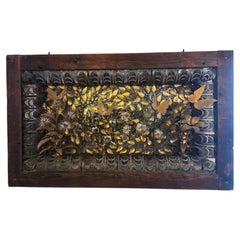
Leroy Setziol Monumental Carved Yellow Cedar/ Wall Sculpture for United States National Bank of Portland, 1963
Beginning in 1949, the United States National Bank of Portland embarked on a long-term program of acquiring and commissioning works by Oregon artists for installation throughout its growing network of branches. Working with artists, architects, landscape designers, and craftsmen, the bank sought to create public spaces that reflected the culture, economy, and character of Oregon communities. The program included paintings, sculpture, stained glass, ceramics, and architectural commissions and was celebrated in the 1963 exhibition A Bank As Art Patron at the Museum of Art, University of Oregon.
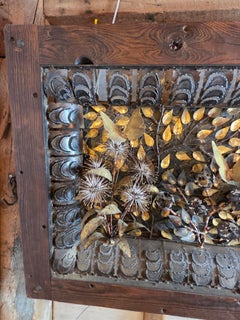
This monumental wall mural by Leroy Setziol (1915–2005) was commissioned in 1963 as part of that initiative. Measuring nearly sixteen feet in length and just over three feet in height (191" x 37" x 7"), the work is composed of multiple hand-carved yellow cedar panels and represents an early large-scale architectural commission created during a formative period in Setziol's career.
Composed of multiple hand-carved yellow cedar panels, the sculpture demonstrates Setziol's ability to create a unified visual statement from deeply incised geometric forms, rhythmic patterns, and abstract imagery. Individual sections of the mural vary dramatically in character, ranging from tightly ordered geometric passages to more organic and intuitive carving. Together they create a composition that rewards prolonged viewing and reflects the artist's belief that wood itself could serve as both material and subject.
Particularly notable is the panel at the far right of the mural, which incorporates a series of carved livestock brands. Research conducted with the Oregon Department of Agriculture has identified these as registered Oregon cattle brands associated with ranching operations in the Junction City area. Their inclusion provides a rare documentary element within Setziol's otherwise abstract carving and establishes a direct connection between the artwork and the community in which it was installed.
More than decorative motifs, the brands appear to acknowledge the agricultural families, ranches, and businesses that formed an important part of the local economy. In doing so, the mural transcends pure abstraction and becomes a reflection of community identity. The carving recognizes an important aspect of the region's agricultural heritage and establishes a direct connection between the artwork and the local community in which it was installed.
Born in Portland in 1915, Leroy Setziol followed an unlikely path to becoming one of the Pacific Northwest's most respected sculptors. After service in the United States Army during World War II, he spent time in New York before returning to Oregon. Drawn to carving but lacking formal artistic training, he established a small studio behind the Portland home of his father, a Lutheran minister. During his first year as a professional sculptor he reportedly earned only fifteen dollars from the sale of his work.
Working largely in isolation, Setziol developed a highly personal approach to carving that relied on intuition rather than academic training. His sculptures combined deeply incised geometric structures with forms inspired by nature, mythology, and the inherent character of wood itself. By the early 1960s his work had attracted the attention of architects and corporate patrons seeking original works that could be integrated into modern buildings. Commissions such as this mural for United States National Bank marked the beginning of a period that would lead to some of the most significant architectural projects of his career.
The following year, architect John Storrs commissioned Setziol to create a series of monumental relief panels for Salishan Lodge in Gleneden Beach...
Category
Mid-20th Century American Mid-Century Modern Wall-mounted Sculptures