Want more images or videos?
Request additional images or videos from the seller
1 of 13

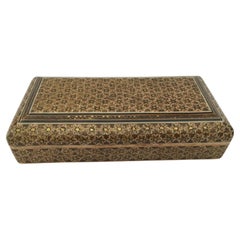
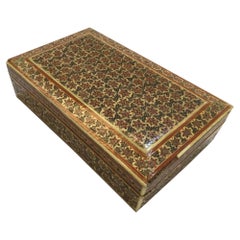
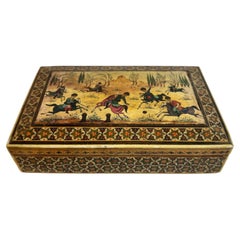
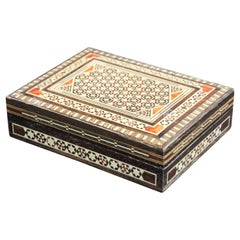
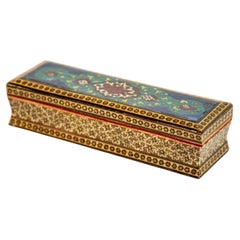
Persian Micro Mosaic Box

$250List Price

You May Also Like

Moroccan Moorish Middle Eastern Large Inlaid Wood Micro Mosaic Jewelry Box

Moroccan Moorish Middle Eastern Large Inlaid Wood Micro Mosaic Jewelry Box

Located in Studio City, CA

Stunning mosaic design, this intricate wood box is made from multiple micro pieces of wood with some possible bone inlays. Gorgeous craftsmanship. A true work of art. Would be a g...

Category

20th Century Moorish Jewelry Boxes

Materials

Wood

Moorish Inlaid Marquetry Mosaic Jewelry Box with Geometric and Floral Patterns

Moorish Inlaid Marquetry Mosaic Jewelry Box with Geometric and Floral Patterns

Located in Bad Säckingen, DE

This is a Moorish-style jewelry box adorned with inlaid marquetry work, featuring a mosaic of geometric and floral patterns. The design is highly detailed, with small pieces of wood ...

Category

Vintage 1940s Moroccan Moorish Jewelry Boxes

Materials

Wood, Fruitwood

Moroccan Moorish Middle Eastern Large Inlaid Wood Micro Mosaic Jewelry Box

Moroccan Moorish Middle Eastern Large Inlaid Wood Micro Mosaic Jewelry Box

Located in Studio City, CA

Stunning mosaic design, this intricate wood box is made from multiple micro pieces of wood with some possible bone inlays. Gorgeous craftsmanship. A true work of art. Would be a ...

Category

20th Century Moorish Jewelry Boxes

Materials

Wood

Vintage Rectangular Moroccan Inlaid Decorative Box

Vintage Rectangular Moroccan Inlaid Decorative Box

Located in Houston, TX

Vintage rectangular Moroccan inlaid decorative box. This unusual Moroccan or Middle Eastern Arabesque box of mixed inlaid woods in a mosaic pattern is th...

Category

20th Century Moroccan Moorish Decorative Boxes

Materials

Wood

Anglo-Indian Sandalwood Trinket Box with Traditional Mosaic Inlay

Anglo-Indian Sandalwood Trinket Box with Traditional Mosaic Inlay

Located in Nottingham, GB

This attractive Anglo-Indian sandalwood box dates to the late 19th century and was likely produced in the workshops of Bombay or Surat, two of Western India's most important centres ...

Category

Antique Late 19th Century Decorative Boxes

Materials

Wood

1970s Khatam Persian Marquetry Box with Hand-Painted Scene

1970s Khatam Persian Marquetry Box with Hand-Painted Scene

Located in Marbella, ES

A delicate, handcrafted Persian box decorated with intricate Khatam marquetry and a hand-painted scene on the lid. The upper composition depicts traditional Oriental figures in a gar...

Category

Late 20th Century Turkish Decorative Boxes

Materials

Wood

19C Anglo Indian Bombay MOP Sadeli Mosaic Trinket Box

19C Anglo Indian Bombay MOP Sadeli Mosaic Trinket Box

Located in Dallas, TX

PRESENTING a LOVELY 19C Anglo Indian Bombay MOP (Mother of Pearl) Sadeli Mosaic Trinket Box from circa 1875-85. Gorgeously detailed and hand-crafted ‘sadeli mosaic’ inlay, from the Bombay Area, with deep greens with silver, pewter, mother of pearl, bone and ebony in geometric patterns. The box case, is made of sandalwood but completely covered in MOP, bone, faux ivory, ebony and mosaic inlay. Edged with faux ivory and banded with a different pattern of sadeli mosaic. Some minor damage to the top (repair is obvious in pics) and ivorine replacements to some edging, but it still a BEAUTIFUL BOX and of real QUALITY! The mosaic work is FABULOUS! Box opens to reveal its original blue velvet lining. It sits on 4 (recently added) silvered button feet. SADELI MOSAIC: “Anglo Indian boxes were made in India for the English residents from the early part of the 18th century. They were brought back or sent back to England usually by the people who had commissioned them. From the beginning of the nineteenth century they were imported more commercially, although not in any significant numbers until the middle decades. They were very highly valued, especially the early ones, to the extent that the designs were copied on late 19th and early 20th century tins. The ancient art of Sadeli Mosaic is said to have been introduced from Shiraz in Persia via Sind to Bombay, a long time before the Anglo Indian boxes were made. It was a technique, which required a high degree of skill and patience. It was executed very lavishly, in that the frequent cuts wasted a great amount of the precious materials used. The workmanship was however more than commensurable to the value of the materials. Ivory, silver, pewter (or other metals), wood and horn were cut into faceted rods which were bound together to form geometric patterns. When the glue has set, the rods were sliced in transverse sections. This gave the maker a number of angled circular pieces in the original pattern. Several variations of patterns could be achieved by combining the materials in different ways. The ivory was sometimes dyed green to give an extra color. The mosaic pieces in a combination of patterns, often separated by ivory, ebony, horn or silver stringing were used to veneer sandalwood boxes. In the early boxes, which date from the turn of the 18th to the 19th century, there are large panels of mosaic covering tops and sides of boxes. It took incredible skill to cover such large areas without any shakes or wavering of the pattern. The corners and joins on these boxes are impeccably matched. The makers (reputed to be Persian) of Sadeli mosaic made in the first two decades of the 19th century displayed a total understanding of the qualities of the different materials they used. They combined substances, which can expand and contract according to atmospheric conditions with others, which are hard and unyielding. The result was a sharp definition of the lines and patterns, which made up the whole design. On the early boxes the designs look deceptively simple. The fact is, they emerged from a culture, which had mastered geometry and understood how to generate a pattern from a set number of points. The patterns are so harmoniously combined that their incredible complexity is not immediately apparent. The earliest Sadeli boxes...

Category

Antique Late 19th Century Indian Anglo-Indian Jewelry Boxes

Materials

Silver

Moorish Jewelry Box, Inlaid Mother-of-Pearl & Sandalwood, 1960, Syria

Moorish Jewelry Box, Inlaid Mother-of-Pearl & Sandalwood, 1960, Syria

Located in Delray Beach, FL

exquisite middle Eastern Moorish Syrian inlay jewelry box. This box is intricately inlaid with Moorish motif designs which have been uniquely inlaid with bone, mother of pearl and f...

Category

20th Century Asian Islamic Jewelry Boxes

Materials

Mother-of-Pearl, Sandalwood

More From This Seller

View All
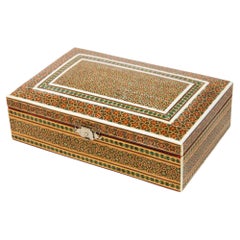
Middle Eastern Persian Micro Mosaic Khatam Inlaid Jewelry Box

Middle Eastern Persian Micro Mosaic Khatam Inlaid Jewelry Box

Located in Moreno Valley, CA

Large Middle Eastern Indo-Persian Micro Mosaic Khatam Inlaid Wooden Jewelry Box. Middle Eastern Persian Sadeli micro mosaic marquetry inlaid box with geometric Moorish design. Handcrafted Khatam wooden box with very delicate micro mosaic marquetry from the ancient Middle Eastern technique of inlaying from arrangements of so many delicate pieces of precious hand painted wood, with bone around the edges. This beautiful Middle Eastern Persian, Indian Wooden box is covered with fine Moorish micro mosaic marquetry and is used as a jewelry, trinket box. Lined in deep red velvet. Dimensions: 6.5in.D x 3in.H x 10 wide. Nice Indian Mughal, Indo Persian Box...

Category

Mid-20th Century Indian Moorish Jewelry Boxes

Materials

Fruitwood

Indo-Persian Khatam Jewelry Box, Handcrafted Wood & Moorish Mosaic

Indo-Persian Khatam Jewelry Box, Handcrafted Wood & Moorish Mosaic

Located in Moreno Valley, CA

Handcrafted Khatam wooden box with very delicate micro mosaic marquetry from the ancient Persian technique of inlaying from arrangements of so many delicate pieces of wood, precious wood, and delicate miniatures paintings. This beautiful Middle Eastern Persian style box is covered inside and out with fine Moorish micro mosaic marquetry. Indo Persian Moorish style micro mosaic inlaid jewelry box with lid. Intricate inlaid Asian Indian box with floral and geometric Islamic Moorish Sadeli design in a square shape form with inlay marquetry, very fine artwork, lined in red velvet. Museum collector piece like the one in Doris Duke Islamic Art Museum. The repeating geometric patterns of Sadeli Mosaic are what give it beauty and richness. This decorative technique is a type of micro mosaic featuring repeating geometric patterns. A highly skilled craft, it has had a long history in India and the Middle East with early examples dating back to the 16th century. In the 1800s, it became popular as a decoration on a variety of boxes, card cases, and chess boards imported from India. Since Bombay became a center of making them, they became known as Bombay boxes...

Category

Mid-20th Century Asian Moorish Decorative Boxes

Materials

Wood

Antique Persian Khatam Micro Mosaic Inlaid Jewelry Box circa 1940s

Antique Persian Khatam Micro Mosaic Inlaid Jewelry Box circa 1940s

Located in Moreno Valley, CA

Antique Persian Khatam Micro Mosaic Inlaid Jewelry Box with Miniature Polo Scene, circa 1940s This exquisite Persian Khatam Kari trinket box is a rare example of masterful micro mosaic marquetry, handcrafted in the 1940s using the ancient Persian art of inlay. Featuring an intricately detailed geometric design and a miniature hand-painted equestrian scene on the lid, this museum-quality piece is a stunning representation of Indo-Persian and Moorish craftsmanship. Khatam Kari, or Persian marquetry, is a centuries-old decorative art that flourished during the Safavid dynasty. It involves the meticulous inlay of thousands of tiny pieces of wood and bone into intricate, repeating geometric patterns—each symbolic of harmony and cosmic order. The top of this box is adorned with a finely rendered painting of royal figures on horseback, possibly princes engaged in a ceremonial game of polo, echoing the refined court culture of the 19th-century Persian and Mughal aristocracy. The box’s micro mosaic surface is covered in richly detailed star and polygon motifs typical of Khatam and Sadeli mosaic traditions. These patterns require precise mathematical planning and exceptional artisanal skill, resulting in a surface that is as intellectually complex as it is visually stunning. Details: * Origin: Asia Indo-Persian * Date: Circa 1940s * Materials: Inlaid woods, camel bone, hand-painted miniature * Style: Islamic Art, Moorish, Anglo-Indian, Micro Mosaic * Dimensions: Height 1.5 in. x Width 6.5 in. x Depth 4.25 in. * Condition: antique condition with minor wear consistent with age These boxes were traditionally used to store writing instruments or jewelry, and today they serve as timeless collectors' pieces, suitable for display or thoughtful gifting. Comparable examples can be found in major Islamic art collections, including the Doris Duke Museum of Islamic Art. Keywords: Persian Khatam Box...

Category

Mid-20th Century Indian Anglo-Indian Jewelry Boxes
Materials

Bone, Fruitwood

Middle Eastern Moorish Handcrafted Mosaic Decorative Trinket Box

Middle Eastern Moorish Handcrafted Mosaic Decorative Trinket Box

Located in Moreno Valley, CA

Exquisite handcrafted Middle Eastern mosaic marquetry inlaid walnut wood box. vintage small trinket box intricately decorated with Moorish motif des...

Category

Mid-20th Century Lebanese Moorish Decorative Boxes

Materials

Shell, Mother-of-Pearl, Fruitwood