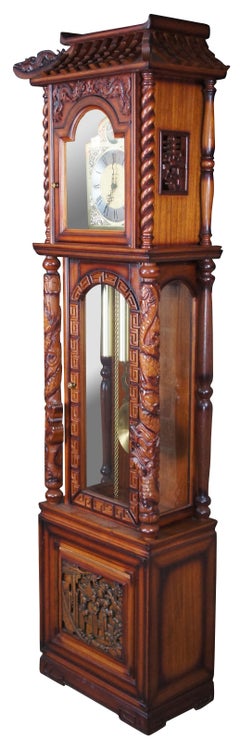
Japonisme More Clocks

JAPONISME STYLE

In the late 19th and early 20th century, France developed an enduring passion for Japanese aesthetics and craftsmanship. Not only did this interpretation of Japanese culture — which became known as Japonisme — infuse fresh energy into French art and design, but it also radically transformed how Europeans, and subsequently the world, would come to understand visual culture. 

Until 1853, Japan had been closely guarded against foreign visitors for over two centuries. However, American Commodore Matthew C. Perry sailed into Japan that year and initiated the first of its treaties with the United States and Europe, thereby opening its borders and giving the West its first-ever look at Japanese design. 

For the next few decades, taken with Japonisme, sophisticated collectors in Paris, New York and elsewhere gorged themselves on lacquered screens, celadon ceramics and netsuke ornaments, along with artworks depicting various aspects of Japanese life. The East Asian country’s influence on Europe, particularly France, contributed to one of the most creatively prosperous periods in history, leaving an imprint on the Impressionist, Art Nouveau and Art Deco movements, and inspiring artists like Edgar Degas, Mary Cassatt, Vincent van Gogh as well as luxury houses such as Louis Vuitton and Hermès. Japonisme emerged at the time when the ornate Renaissance Revival style was the most prominent mode of decorating in Europe, and Japanese aesthetics seemed strikingly modern and elegant in comparison. 

In addition to everyday practical objects from Japan, such as vases, tableware and decorative boxes, Japanese art, especially Japanese woodblock prints by masters of the ukiyo-e school, caught the eye of many artists — particularly those in the Art Nouveau poster community in 1880s Paris. The luscious organic colors associated with traditional Japanese design, motifs like cherry blossoms and carp and the vivid patterns found in woodblock prints, silks and more were adopted and appropriated by painters as well as ceramicists and those working in other fields of the decorative arts. Today, demand for Japanese lacquerware — furniture, trays, writing boxes, screens, incense burners — from the Edo period (1615–1868) and the late 19th century continues to be very strong among collectors.

Find a collection of antique Japonisme furniture and decorative objects on 1stDibs.

to
2
2
33
27
26
14
14
11
10
9
8
7
6
4
3
2
1
2
1
1
1
1
1
1
2
2
Height
to
Width
to
2
2
2
1
Style: Japonisme
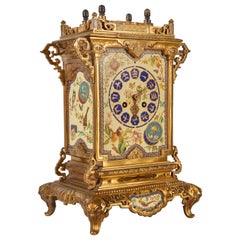
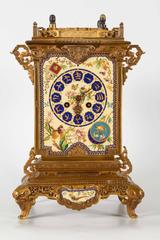
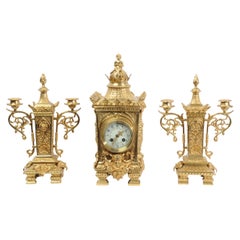
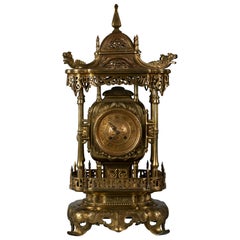
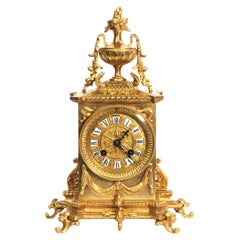
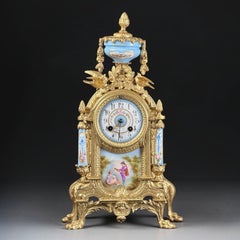
Japanese Style Gilt Bronze and Enamel Clock Set

Japanese Style Gilt Bronze and Enamel Clock Set

By Japy Frères

Located in London, GB

This beautiful clock set is designed in a fanciful Japanese style, known in France in the 19th Century as ‘Japonisme’. The style became highly fashionable in Europe after 1853, when ...

Category

19th Century French Antique Japonisme More Clocks

Materials

Bronze, Enamel

Related Items
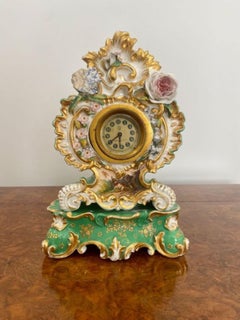
Antique Edwardian Quality Hand Painted Porcelain Mantle Clock

Antique Edwardian Quality Hand Painted Porcelain Mantle Clock

Located in Ipswich, GB

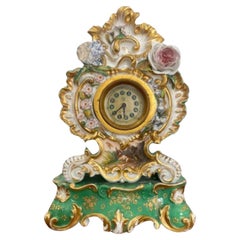
Antique Edwardian quality hand painted porcelain mantle clock having a quality hand painted decorated porcelain clock case with flowers, leaves an...

Category

Early 20th Century Japonisme More Clocks

Materials

Porcelain, Glass

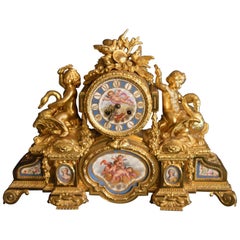
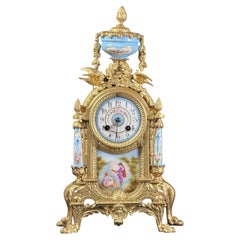
Sèvres Porcelain with Doré Bronze Clock

Sèvres Porcelain with Doré Bronze Clock

$7,200

H 14 in W 19 in D 4.5 in

Sèvres Porcelain with Doré Bronze Clock

Located in Los Angeles, CA

Sèvres Porcelain with doré bronze clock. Clock is not running.

Category

19th Century French Antique Japonisme More Clocks

Materials

Bronze

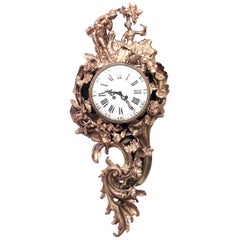
Japy Freres Rococo Gilt Bronze Antique French Cartel Wall Clock

Japy Freres Rococo Gilt Bronze Antique French Cartel Wall Clock

By Japy Frères

Located in Belper, Derbyshire

A superb Rococo gilt-bronze cartel clock, the asymmetrical rocaille cartouche conceived as a cloud-borne trophy after the celebrated painted ceiling of the Salon d’Hercule, Palace of...

Category

19th Century European Antique Japonisme More Clocks

Materials

Bronze

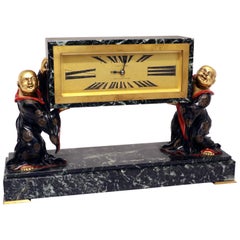
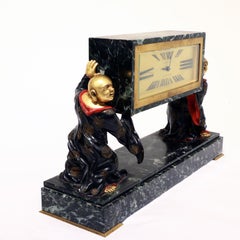
French Cold-Painted Bronze and Marble Art Deco Chinoiserie Mantel Clock

French Cold-Painted Bronze and Marble Art Deco Chinoiserie Mantel Clock

Located in Montreal, QC

This rare timepiece, made in France but retailed by the British silversmith Mappin and Webb is the only one of its type we have found. It may be unique. The rectangular dial has Roma...

Category

1920s French Vintage Japonisme More Clocks

Materials

Marble, Bronze

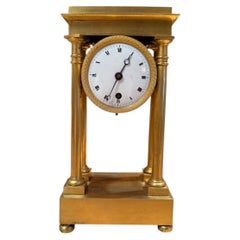
Rare Louis XVI Period Enamel and Gilt Bronze Clock

Rare Louis XVI Period Enamel and Gilt Bronze Clock

Located in Montreal, QC

Rare Louis XVI period enamel and gilt bronze clock on a black marble base.

Category

18th Century and Earlier French Antique Japonisme More Clocks

Materials

Bronze

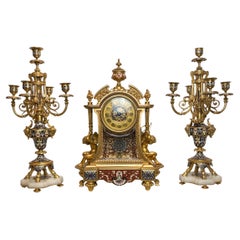
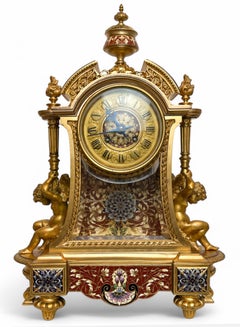
Louis XVI Style Champlevé Enamel and Gilt-Bronze Mantel Clock, circa 1880

Louis XVI Style Champlevé Enamel and Gilt-Bronze Mantel Clock, circa 1880

By LeRoy

Located in Brighton, West Sussex

An exceptional Louis XVI style champlevé enamel and gilt-bronze mantel clock with finely painted neoclassical scenes by Leroy & Fils. French, circa 1880. Stamped to the movement ‘LEROY & FILS A PARIS, 823’. This fine gilt-bronze and champlevé enamel clock has an arched case with outset bulbous columns to the angles, it is surmounted by a drum top with a pierced scroll and ball finial and applied with expressive cherub mounts. The front and sides of the clock are all exceptionally finely painted with neoclassical scenes of figures in an architectural setting and the top and base enriched with fine polychrome champlevé enamel. The clock has an enamelled chapter ring with Roman numerals interspersed with anthemion devices and a twin barrelled, eight-day movement striking on a bell. The firm of Leroy et Fils was founded by Bazile Charles Leroy in 1789. He was a clockmaker to the Emperor Napoléon, The Duke of Orleans, The Duke of Bourbon and Princess Pauline. In 1823, he filed a patent for self-winding atmospheric clock operated by weathervane and in 1840 a patent for wind clocks. When Charles Louis died in 1865 his son Louis Leroy...

Category

Late 19th Century French Antique Japonisme More Clocks

Materials

Bronze, Enamel

Outstanding Quality Large French Antique Hand Painted Porcelain Mantel Clock

Outstanding Quality Large French Antique Hand Painted Porcelain Mantel Clock

Located in Suffolk, GB

Outstanding quality large French antique Victorian hand painted porcelain urn shaped mantle clock having a magnificent quality hand painted porcelain case in the shape of an urn with...

Category

19th Century French Antique Japonisme More Clocks

Materials

Ceramic

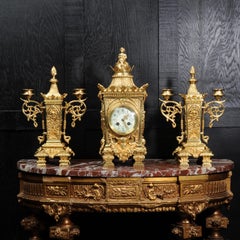
Large French Japonisme Ormolu Garniture Clock Set Attributed to Edouard Lievre

Large French Japonisme Ormolu Garniture Clock Set Attributed to Edouard Lievre

By Edouard Lievre

Located in New York, NY

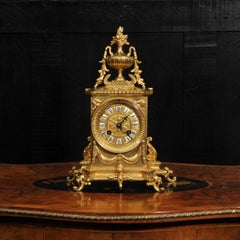
A magnificent and finely cast palatial and very large French 19th century Japonisme three-piece ormolu garniture clock set attributed to Edouard Lievre. This striking and extremely u...

Category

19th Century French Antique Japonisme More Clocks

Materials

Bronze

Previously Available Items

Japonisme more clocks for sale on 1stDibs.

Find a broad range of unique Japonisme more clocks for sale on 1stDibs. Many of these items were first offered in the 19th Century, but contemporary artisans have continued to produce works inspired by this style. If you’re looking to add vintage more clocks created in this style to your space, the works available on 1stDibs include decorative objects and other home furnishings, frequently crafted with metal, bronze and other materials. If you’re shopping for used Japonisme more clocks made in a specific country, there are Europe, and France pieces for sale on 1stDibs. While there are many designers and brands associated with original more clocks, popular names associated with this style include and Japy Frères. It’s true that these talented designers have at times inspired knockoffs, but our experienced specialists have partnered with only top vetted sellers to offer authentic pieces that come with a buyer protection guarantee. Prices for more clocks differ depending upon multiple factors, including designer, materials, construction methods, condition and provenance. On 1stDibs, the price for these items starts at $9,291 and tops out at $21,000 while the average work can sell for $18,240.