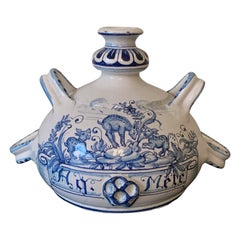
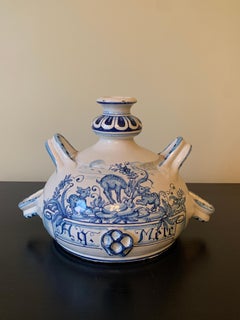
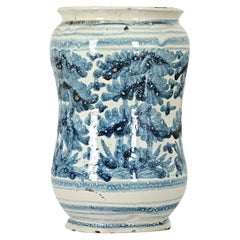
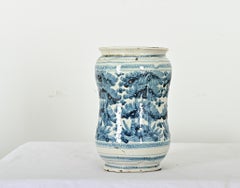
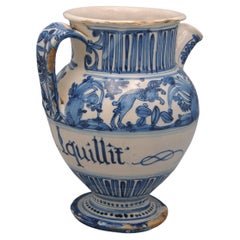
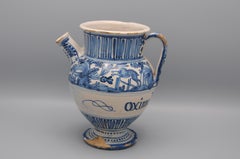
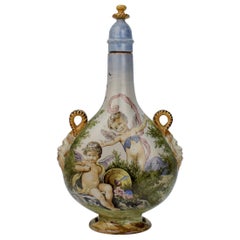
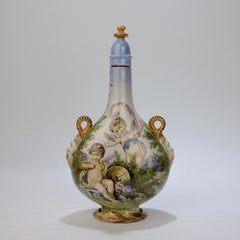
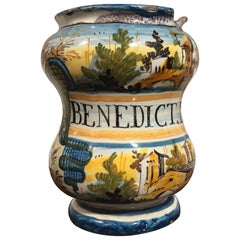
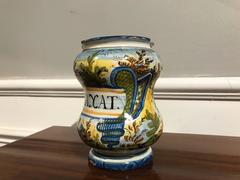
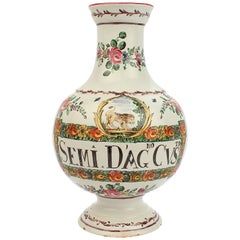
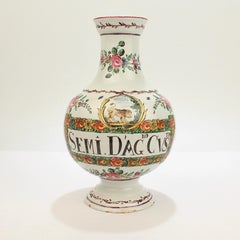
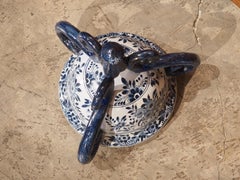
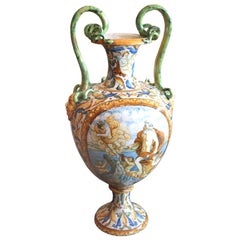
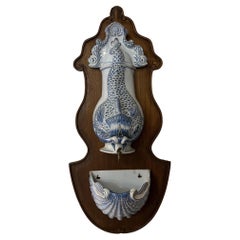
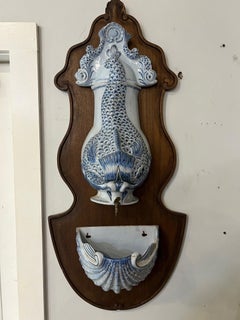
This stunning lidded urn might have once been found in a 19th century Italian apothecary. The front of the shaped urn body has the hand-painted phrase “C. Violaru”, which is the heavily abbreviated form of the Latin word for violet (violaceum). Up until the mid-1700’s, apothecaries would make syrups from violets and use it to treat kidney ailments.
Above the Latin wording is a whimsical musical scene with a man blowing a horn leading a couple who is holding hands over rocky terrain lined with shrubbery. A large house and trees can be seen behind the trio with a pair of mountains in the distance. On the opposite side of the urn is a floral display with a bird perched on a rock. Beneath the bird is a geometric design, possibly a stylized sun with radiating beams of light. Both scenes are segmented by a pair of thin quarter round moldings that encircle the entire vase.
Other hand-painted motifs include floral and foliate margents, geometric patterns, and Vitruvian waves that are infilled with horizontal fluting. The sides of the urn have a fish-scale background beneath two mustachioed mascarons. Both men have been styled in grotesque fashion, with a pair of spiraled horns emanating from their heads. In between the horns is a looping handle that is affixed to the body in similar tight spirals. The domed lid has three scrolled arms that merge in a geometric finial.
The base color of the urn is white, with illustrations in a monochromatic cobalt oxide blue, reminiscent of Delft blue pottery...
Category
19th Century Antique Italian Delft and Faience