By Berndorfer Metallwarenfabrik
Located in Los Angeles, CA
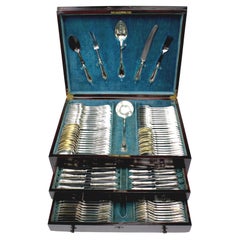
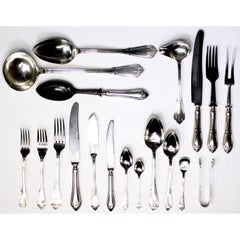
A Fine Early 20th Century 152 Piece Austrian Dinnerware Flatware Set by Berndorfer Metallwaaren-Fabrik, stamped 'Berndorf Alpacca', The Neoclassical Revival style set of Alpacca flatware comprising of:
12 Fish knives
12 Salad forks
12 Salad knives
12 Pasta spoons
12 Dessert spoons
12 Coffee spoons
12 Tea spoons
12 Ice-cream spoons
1 Ice thong
1 Soup ladle
1 Serving spoon
1 Salad spoon
1 Sauce/Gravy ladle
1 Meat carving knife
1 Meat carving fork
1 Salad fork
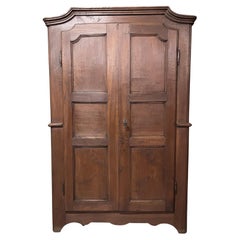
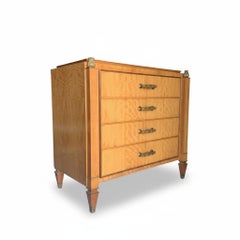
All inside its original lined wooden storage-traveling cabinet. (See all images). Circa: Vienna, 1900-1930.
The Alpacca alloy was developed in 1823 by the German chemist Dr. Ernst August Geitner (1783-1852). It was very similar in its appearance to silver, therefore, this new alloy was first called "Argentan". It consisted of 20% nickel, 55% copper and 25% zinc. The new silver-imitating alloy soon became very popular. The Gebrueder Henninger (Henninger Bros.) proposed a similar alloy (5-30% nickel, 45-70% copper and 8-45% zinc with trace amounts of lead, tin and iron) which they called "Neusilber". Later both Argentan and Neusilber were used under the trade name of Alpacca (or Alpakka). The great advantage of the use of Alpacca alloy as the base metal for silver plating is that the appearance of the objects does not change significantly with the wearing away of the silver layer and, unlike sterling silver, it does not require frequent polishing or cleaning due to tarnishing.
The earliest known Berndorf Alpacca mark (No.1) was introduced around 1880 and used until 1891. I found it on the bottom of a 30 cl teapot bearing the inscription KRIEAU, which corresponds to the "Wiener Krieau", the famous race course in Vienna. The mark No.1 represents an oval of 3.0 x 3.6 mm size bearing the lettering "BMF ALPACCA" (which means Berndorfer Metallwaaren Fabrik or Berndorf Metalware Factory) with the "M" and "F" letters being fused. Inside the oval there is a profile of a walking bear looking down. This mark is quite rare.
BIBLIOGRAPHY
- Ingrid Haslinger, Tafelkultur Marke Berndorf, Das Niederoesterreichische Erfolgsunternehmen Arthur Krupps (Ketterl Verlag, Wien, 1998), pp.1-174, (in German).
- Dedo von Kerssenbrock-Krosigk and Claudia Kanowski, Modern Art of Metallwork (Berlin: Broehan Museum, 2001), 1-598.
- Musterbuch ueber Tafelgeraete in Alpacca-Silber I, Alpacca-Silber II und Alpacca, Unversilbert (Berndorfer Haus, Berlin, 1928), pp.1-53, (in German).
- Waltraud Neuwirth, Bluehender Jugendstil Oesterreich, Band 2: Firmen und Marken [Art Nouveau in Blossom - Austria, Vol. 2: Companies and Marks]. Vienna: Selbstverlag Dr. Waltraud Neuwirth, 1991, 1-288 (in German).
- David N. Nikogosyan, 2008, Marks of Silverplated Hollowware...
Category
Early 1900s Austrian Antique Neoclassical Revival Furniture