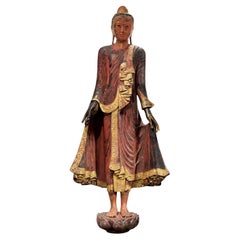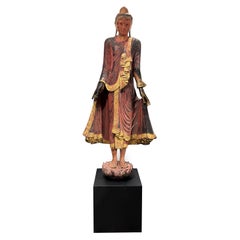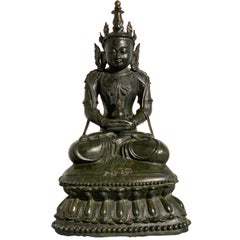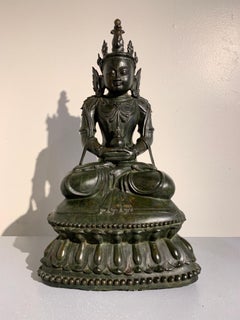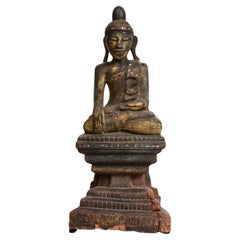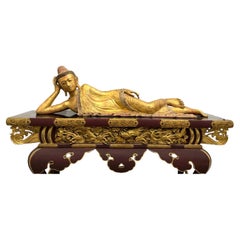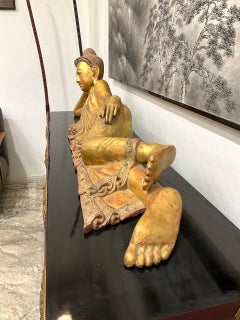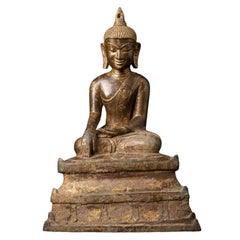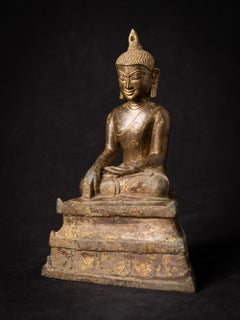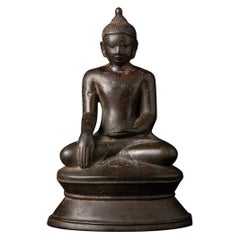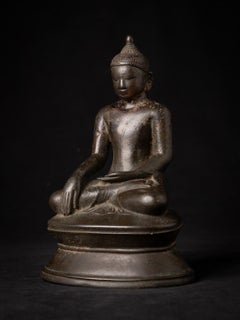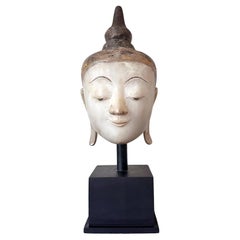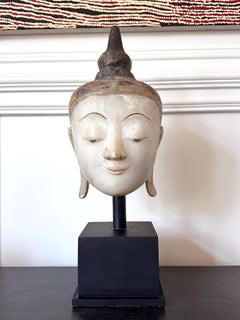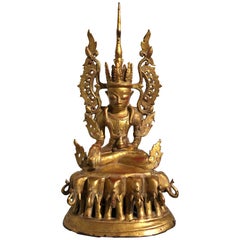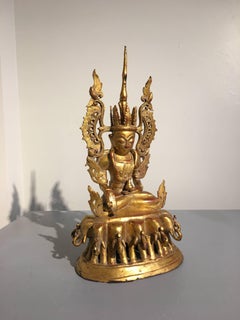
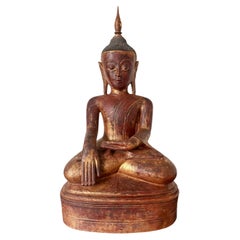
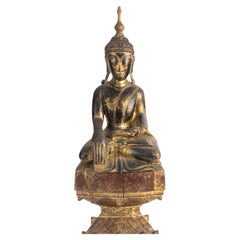
A large and magnificent cast bronze image of the Medicine Buddha, Bhaisajyaguru, rendered in the Burmese Pagan style, and most likely based on a period example that was either damaged or lost, 19th century, Burma or Thailand.
He can be identified as the Medicine Buddha by the hand that rests in his lap, with his middle finger touching the thumb. A medicine pot or fruit stem would originally have been placed in his upturned palm.
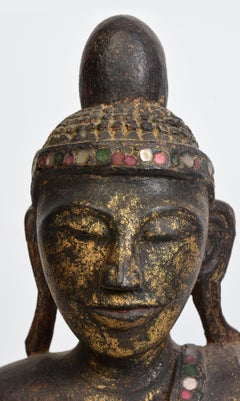
The face of this Buddha has been sculpted masterfully. He has a beautiful heart shaped face topped by hair neatly arranged in the typical "snail shell curls", and surmounted by a high ushnisha. Long, pendulous earlobes frame his face, a symbol of his princely past. He gazes serenely outwards from heavily lidded, downcast eyes, a content smile upon his full, lush lips.
The Buddha is portrayed seated in vajrasana (full lotus position), his elegant hands displayed in varada mudra, the gesture of granting favors and fulfilling wishes. Long, exquisite fingers extended, the thumb and middle finger touching in a gesture of compassion.
He is clothed in a simple kasaya wrapped around his body and over one shoulder, leaving the shoulder and part of his chest bare. The diaphanous garment clings to his body, outlining his well proportioned and graceful, almost sensuous, form. The excess material pooled in neat pleats in front of him. A sash thrown over his shoulder.
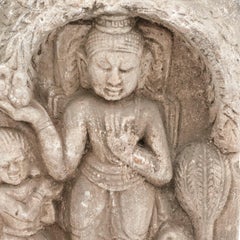
He sits upon a double lotus base upon a raised platform. The platform features two kneeling attendants, usually interpreted as the monks Ananda and Kasyapa. Between them is a circular disc representing the Wheel of Dharma. Contained in the disk is a flower with eight petals, symbolizing the eightfold path, one of the principle teachings of the Buddha.
The sides and back of the platform featuring a series of singha, or lions, representative of the Buddha's royal past.
An applied lacquer patina covers the entirety of the image. Large deposits of ash (from incense) are present between the curls of the hair, as well as some the other crevices, indicating this image was the subject of worship for many years.
Bhaisajyaguru, also called the Medicine Buddha, or Buddha of Healing, is a revered figure in the Buddhist pantheon as a master able to cure suffering, both physical and spiritual, through his teachings.
The Pagan Empire ruled most of present day Burma (Myanmar) from 849 to 1297. The capital, Bagan, served as a both the center of government and religion, where Buddhism reigned supreme. Bagan was also at a crossroads of the Buddhist world, with influence from India, Nepal, Tibet, China, and even Indonesia shaping their culture. As such, Pagan Buddha...
Category
Late 19th Century Antique Burmese Furniture