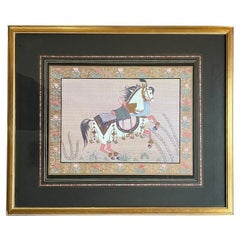
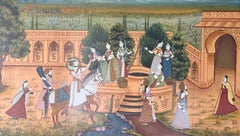
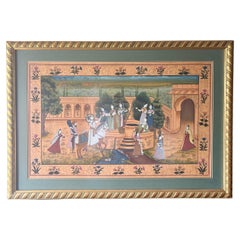
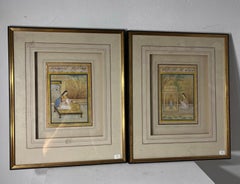
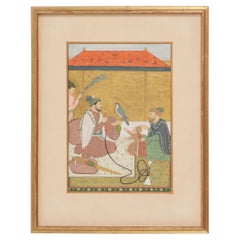
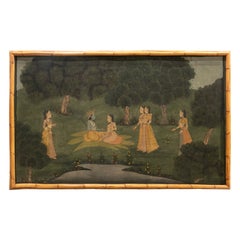
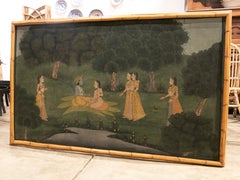
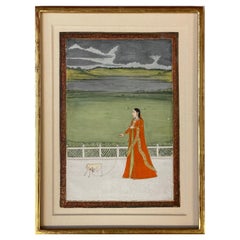
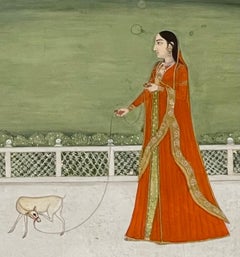
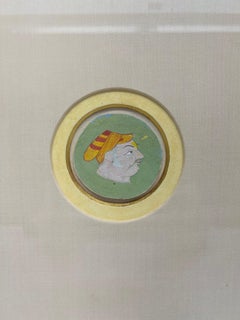
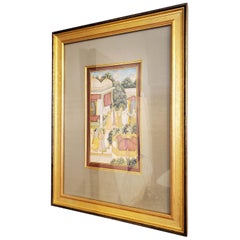
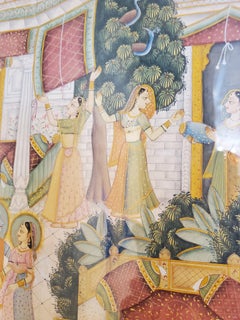
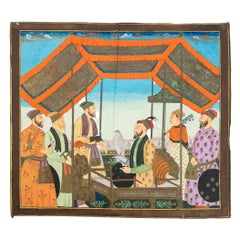
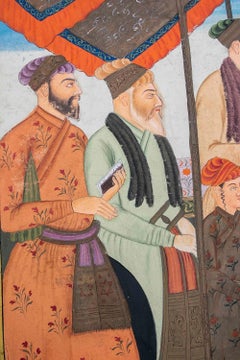
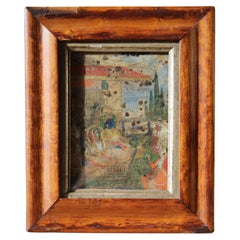
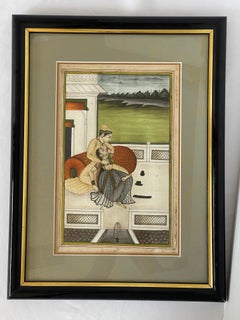
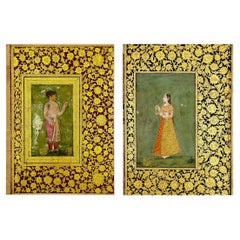
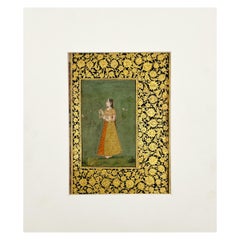
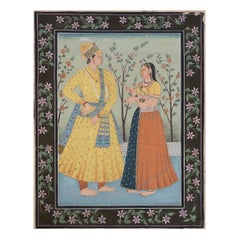
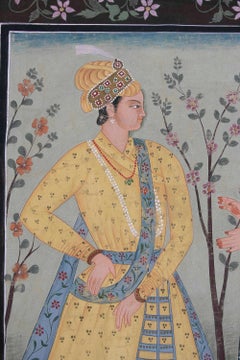
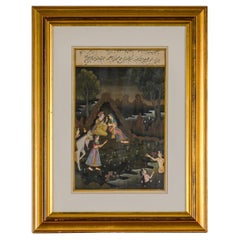
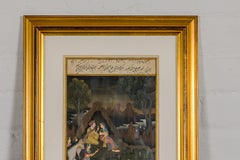
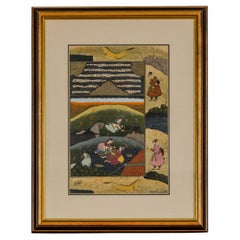
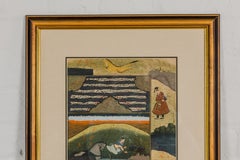
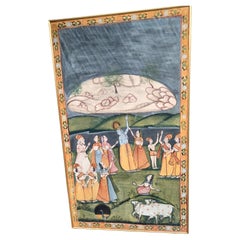
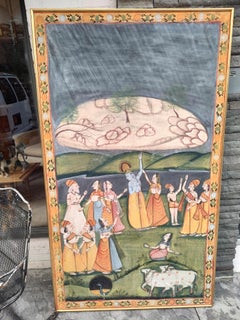
This Mughal miniature was painted at one of the princely courts of India. It depicts a raven-haired princess in a gold-trimmed saffron-colored silk sari. Under a glowering evening sky she dawdles on a white marble terrace, with a pet fawn on a leash, before a landscape dotted with buildings nestled amongst trees beyond a river. Her hair, falling loosely about her shoulders, rather than carefully dressed on her head, indicates that she is a maiden. The overall mood is one of expectancy. Perhaps walking a pet and catching an evening breeze is a pretext to escape palace scrutiny for a lovers’ assignation. In Mughal India tender sentiments were a bridge to the erotic – and if this seems contradictory, so too is the balance of realism and caricature, and naturalism with the schematic. Both are hallmarks of miniatures painted in this place and time.
The earliest Mughal Indian miniatures date to the 16th century. They were inspired by those painted at the refined Moslem courts of the neighboring Persian empire. They incorporated figures in spite of the Moslem faith’s proscription against depicting the human form. Such was the nature of sophisticated courtly life everywhere that beauty and pleasure trumped systems of morality. This was no less the case at the provincial Indian courts, where our miniature, marked by a charming pictorial naiveté, was most likely painted. Yet the artist was undeniably accomplished. His command of perspective, introduced by Jesuit missionaries in the 17th century, is seen in the landscape, which rolls back to a distant horizon, contrary to the flat two-dimensional ones following Indian-painting traditions. And if Mughal artists were influenced by Western art, the compliment was returned by Rembrandt and Sir Joshua Reynolds, among others, who collected Indian miniatures (as did, perhaps, Giovanni Bellini who painted in Mughal style the famous miniature of a Persian man...
Category
18th Century Anglo-Indian Antique Indian Paintings