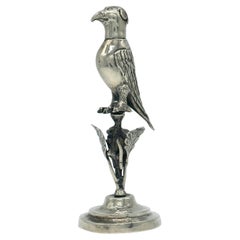
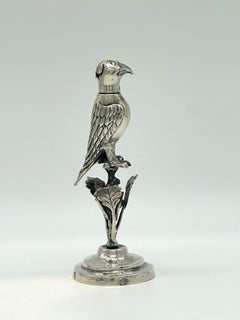
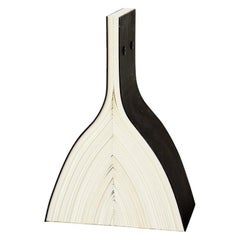
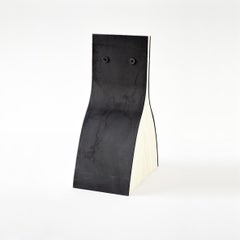
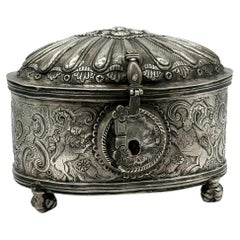
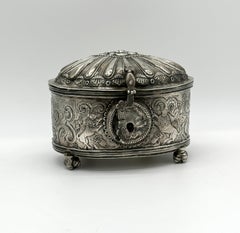
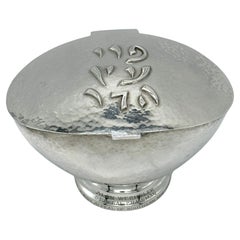
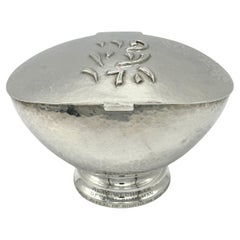
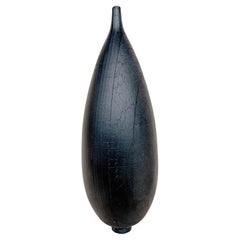
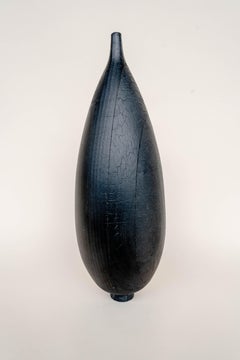
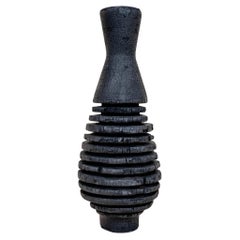
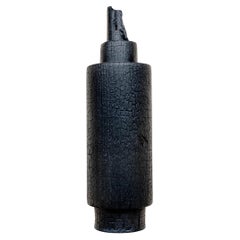
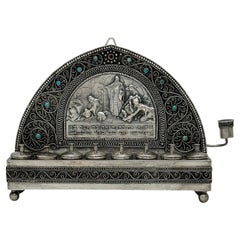
JUDAICA SILVER ETROG BOX DESIGNED BY LUDWIG WOLPERT. New York, 20th century
Located in Tel Aviv - Jaffa, IL
This charming piece of jewish history in front of you is a one of kind modern Judaica object,
This box used to hold the Etrog To protect the it during the holiday of Sukkot, it is traditionally Wrapped in silky flax fibers and stored in a special decorative box, mostly made from silver.
Wolpert designed this amazing hand hammered Bauhaus style box in 1963-1964 while he was Working in New York. all of the boxes we could found from this design made by Wolpert have The upper part inscribed in a simple engraving with the phrase "Pri Etz Hadar"
In Hebrew ״פרי עץ הדר״. the box in front of you is the only example in existence as far as we Know where the letters are also repoussé and also engraved, such a beautiful and hard to get Combination, the rest of the box is shaped as a modernistic Etrog, all the body of the box is Skillfully hand hammered in a way it reflects the light in a warm and calm way, a true Masterpiece of modern judaica by the great and important artist Ludwig Yehuda Wolpert.
One of the the two great masters of 20th century Judaica.
the Box is marked "WOLPERT" AND "STERLING" and the base has the engraved inscription :
"ALAN WECHSLER GENERAL CHAIRMAN, ALLIED JEWISH APPEAL OF SOUTHERN NEW JERSEY 1978"
Similar boxes can be find in museum collections around the world
In the Jewish Museum New York
In the North Carolina Museum of Art
In The Derfner Judaica Museum
Another similar box was featured in the Israel Museum exhibition
"Forging Ahead, Wolpert and Gumbel, Israeli Silversmiths for the Modern Age"
Ludwig Yehuda Wolpert was born in Hildesheim, Germany, to an Orthodox family. In 1916-1920, He began his studies in sculpture at the Frankfurt School of Art. In 1925-1928, he studied Goldsmithing at the Frankfurt School of Art.
Following the presentation of the works in the 1930 exhibition "Kult und Form" ("Ritual and Form") at the Jewish Museum in Berlin, his works became well known in the German Jewish World. His works were greatly influenced by Modernist design, especially the Bauhaus Movement. Wolpert's works avoid decoration, relying on clean, geometric shapes. In 1933, Following the Nazi rise to power in Germany, he immigrated to the Mandatory Palestine with His family. There he worked for two years in the workshop of Bernhard Friedländer, where he Designed and produced silverware and Jewish ceremonial art.Together with Victor Solomon...
Category
1960s Vintage Israel - Decorative Objects