Located in Stockholm, Stockholm
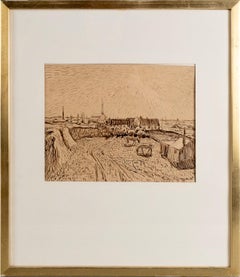
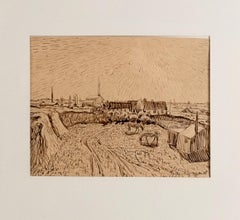
This summer landscape with horses grazing in a paddock under the rays of the sun beside a rural farmstead is a finely executed drawing in brown, signed lower right by Swedish female artist Ester Almqvist (1869-1934). A winding path leads the viewer into the composition, where buildings, fences, and vegetation define a cultivated countryside. Two horses stand quietly within the enclosed field, their forms rendered with spare yet assured lines. Above them, the sun shines from a clear sky, its rays spreading outward in rhythmic, hand-drawn strokes that cover all of the sky. The composition is built through a lively and vibrating pen line, where hatching and linear repetition create both texture and luminosity. The warm sepia tone unifies the scene, while the expressive draughtsmanship conveys a sense of immediacy and presence. The motif is elevated through a distinctly personal interpretation of landscape and light.
Ester Dorothea Almqvist was born in 1869 in Bromma, Stockholm and died in 1934 in Lund, south Sweden. She emerged as a significant figure in Swedish art at the turn of the twentieth century, initially associated with the National Romantic movement, before later contributing to the introduction of modernist tendencies in Sweden through a highly individual synthesis of Neo Impressionist and Expressionist elements. Her early life was shaped by a religious and intellectually engaged environment. Almqvist lived her entire life with a physical disability caused by a spinal deformity, which limited her mobility but did not prevent her from pursuing an artistic career.
Following her mother’s death, Almqvist broke with her earlier environment and relocated to Skåne, where she would spend the greater part of her professional life. The landscapes of southern Sweden became central to her artistic production and provided the basis for many of her most characteristic works.
Her artistic education began at Tekniska skolan in Stockholm (1888–1891), where she received foundational training in drawing and design. She continued her studies through private lessons with the history painter Gustaf Cederström, but chose not to apply to the Royal Academy of Fine Arts. Instead, she pursued further training at Valand Art School in Gothenburg, where instruction was led by prominent artists such as Carl Larsson and Richard Bergh. She also studied for a period at the Konstnärsförbundet’s school (Artists' Association), under the guidance of Per Hasselberg and Bruno Liljefors...
Category
Early 20th Century Impressionist Landscape Drawings and Watercolors