Art by Medium: Offset

to
1,426
1,355
862
1,186
1,123
338
Overall Width
to
Overall Height
to
1
14
3,834
1,015
14
4
54
29
111
118
361
984
1,189
581
1,309
1,088
766
295
87
60
46
43
40
26
24
5
1
3,367
1,077
350
1,929
931
866
789
772
634
537
473
375
362
303
258
169
163
152
152
140
138
136
116
4,864
186,714
98,860
81,987
80,445
181
130
86
46
39
526
2,356
3,253
1,456
Medium: Offset
Original Concours Automobiles Classiques et Louis Vuitton original signed poster

Original Concours Automobiles Classiques et Louis Vuitton original signed poster

Original poster: Parc de Bagatelle et Louis Vuitton 1999 Hand-signed by the artist Razzia in black marker on the left side. In plate right side. Linen backed, ready to frame. Excellent condition. Linen-backed Parc de Bagatelle. Concours Automobiles et Louis Vuitton. September 1999. Hand-signed by the artist in black marker in the lower left. The signature on the plate is in the lower right. This original poster is also archivally linen-backed and ready to frame. This was the merger of Mercedes Benz and Chrysler with an automobile from each company represented. The Louis Vuitton house...

Category

1990s American Modern Art by Medium: Offset

Materials

Offset

Study for Baseball Offset Print, Pop Art, 1976, Edition of 1000

Study for Baseball Offset Print, Pop Art, 1976, Edition of 1000

By Claes Oldenburg

Located in Brooklyn, NY

Paper Size: 37.5 x 24 inches ( 95.25 x 60.96 cm ) Image Size: 37.5 x 24 inches ( 95.25 x 60.96 cm ) Framed: No Condition: A-: Near Mint, very light signs of handling Additional Details: Offset lithograph in five colors on white, moderately thick, slightly textured paper. Edition of 1000. 100 copies signed and unnumbered, 900 copies unsigned and unnumbered. Published by the Institute of Contemporary Art, Boston; and the Massachusett's Institute of Technology, Cambridge. Published on the occasion of the one-man exhibition Claes Oldenburg: Six Themes at the Institute of Contemporary Art, Boston, and the Hayden Gallery...

Category

1970s Pop Art Art by Medium: Offset

Materials

Offset

Bird in the Tree
Bird in the Tree

Bird in the Tree

By Thomas Quinn

Located in San Francisco, CA

This artwork "Birds in the Tree" 1976 is a color offset lithograph by American wildlife artist Thomas Quinn, born 1938. It is hand signed, inscribed Arti...

Category

Late 20th Century American Realist Art by Medium: Offset

Materials

Offset

Original 'Dr. Goldfoot and the Bikini Machine' US 1-sheet vintage movie poster

Original 'Dr. Goldfoot and the Bikini Machine' US 1-sheet vintage movie poster

Located in Spokane, WA

Dr. Goldfoot and the Bikini Machine. This is a bikini machine ... Order your '66 model now. US 1 sheet, linen backed with original fold marks restored, ready to frame. Excellent condition. NSS: 65/364 Starring Vincent Price, Frankie Avalon, Dwayne Hickman, Susan Hart...

Category

1960s American Realist Art by Medium: Offset

Materials

Offset

Original 1941 "World Premier" US 1-sheet vintage movie poster

Original 1941 "World Premier" US 1-sheet vintage movie poster

Located in Spokane, WA

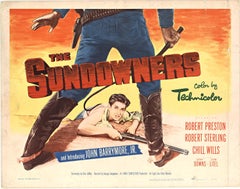
Original "World Premiere." Vintage movie poster. Linen-backed and in good condition for a poster created during World War 2. NSS: 41/347. Certificate of Authenticity. This is an original, theater-used US 1-sheet to the comedy starring John Barrymore...

Category

1940s American Modern Art by Medium: Offset

Materials

Offset

John Chamberlain - Signed Western Union cable re: sculpture show at Leo Castelli

John Chamberlain - Signed Western Union cable re: sculpture show at Leo Castelli

By John Chamberlain

Located in New York, NY

John Chamberlain Hand Signed Letter re: Leo Castelli Exhibition, 1982 Typewriter on paper (hand signed) 6 1/2 × 8 1/2 inches Hand-signed by artist, Signed in purple felt tip marker Hand signed telegraph/letter refers to Chamberlain's exhibition at the legendary Leo Castell Gallery. John Chamberlain Biography John Chamberlain (1927 – 2011) was a quintessentially American artist, channeling the innovative power of the postwar years into a relentlessly inventive practice spanning six decades. He first achieved renown for sculptures made in the late 1950s through 1960s from automobile parts—these were path-breaking works that effectively transformed the gestural energy of Abstract Expressionist painting into three dimensions. Ranging in scale from miniature to monumental, Chamberlain’s compositions of twisted, crushed, and forged metal also bridged the divide between Process Art and Minimalism, drawing tenets of both into a new kinship. These singular works established him as one of the first American artists to determine color as a natural component of abstract sculpture. From the late 1960s until the end of his life, Chamberlain harnessed the expressive potential of an astonishing array of materials, which varied from Plexiglas, resin, and paint, to foam, aluminum foil, and paper bags. After spending three years in the United States Navy during World War II, Chamberlain enrolled in the Art Institute of Chicago and Black Mountain College, where he developed the critical underpinnings of his work. Chamberlain lived and worked in many parts of the United States, moving between New York City, Long Island, Los Angeles, Santa Fe, Connecticut, and Sarasota, before finally settling on Shelter Island. In many ways, each location provoked a distinct material sensibility, often defined by the availability of that material or the limitations of physical space. In New York City, Chamberlain pulled scrap metal and twelve-inch acoustic tiles from the ceiling of his studio apartment. He chose urethane in Los Angeles in 1965 (a material he had been considering for many years), and film in Mexico in 1968. He eventually returned to metal in 1972, and, in Sarasota, he expanded the scale of his works to make his iconic Gondolas (1981 – 1982). The movement of the artist and the subsequent evolution of the work is indicative not only of a kind of American restlessness but also of Chamberlain’s own personal evolution: he sometimes described his use of automobile materials as sculptural self-portraits, infused with balance and rhythm characteristic of the artist himself. Chamberlain refused to separate color from his practice, saying, ‘I never thought of sculpture without color. Do you see anything around that has no color? Do you live in a world with no color?’. He both honored and assigned value to color in his practice—in his early sculptures color was not added, but composed from the preexisting palette of his chosen automobile parts. Chamberlain later began adding color to metal in 1974, dripping and spraying—and sometimes sandblasting—paint and lacquer onto his metal components prior to their integration. With his polyurethane foam works, color was a variable of light: ultraviolet rays or sunlight turned the material from white to amber. It was this profound visual effect that brought the artist’s personal Abstract Expressionist hand into industrial three-dimensional sculpture. Chamberlain moved seamlessly through scale and volume, creating material explorations in monumental, heavy-gauge painted aluminum foil in the 1970s, and later in the 1980s and 1990s, miniatures in colorful aluminum foil and chromium painted steel. Central to Chamberlain’s works is the notion that sculpture denotes a great deal of weight and physicality, disrupting whatever space it occupies. In the Barges series (1971 – 1983) he made immense foam couches, inviting spectators to lounge upon the cushioned landscape. At the end of his career, Chamberlain shifted his practice outdoors, and through a series of determined experiments, finally created brilliant, candy-colored sculptures in twisted aluminum foil. In 2012, four of these sculptures were shown outside the Seagram Building in New York, accompanied by playful titles such as ‘PINEAPPLESURPRISE’ (2010) and ‘MERMAIDSMISCHIEF’ (2009). These final works exemplify Chamberlain’s lifelong dedication to change—of his materials, of his practice, and, consequently, of American Art. Chamberlain has been the subject of numerous solo exhibitions, including two major Retrospectives at the Solomon R. Guggenheim Museum in New York NY in 2012 and 1971; ‘John Chamberlain, Squeezed and Tied. Foam and Paper Sculptures 1969-70,’ Dan Flavin Art Institute, Dia Center for the Arts, Bridgehampton NY (2007); ‘John Chamberlain. Foam Sculptures 1966–1981, Photographs 1989–2004,’ Chinati Foundation, Marfa TX (2005); ‘John Chamberlain. Current Work and Fond Memories, Sculptures and Photographs 1967–1995,’ Stedelijk Museum, Amsterdam, Netherlands (Traveling Exhibition) (1996); and ‘John Chamberlain. Sculpture, 1954–1985,’ Museum of Contemporary Art, Los Angeles CA (1986). Chamberlain’s sculptures are part of permanent exhibitions at the Chinati Foundation in Marfa TX and at Dia:Beacon in upstate New York. In 1964, Chamberlain represented the United States in the American Pavilion at the 32nd International Exhibition of the Venice Biennale. He received many awards during his life, including a Doctor of Fine Arts, honoris causa, from the College for Creative Studies, Detroit (2010); the Distinction in Sculpture Honor from the Sculpture Center, New York (1999); the Gold Medal from The National Arts Club Award, New York (1997); the Lifetime Achievement Award in Contemporary Sculpture by the International Sculpture Center, Washington D.C. (1993); and the Skowhegan Medal for Sculpture, New York NY (1993). -Courtesy Hauser & Wirth Leo Castelli Leo Castelli was born in 1907 in Trieste, a city on the Adriatic sea, which, at the time, was the main port of the Austro-Hungarian Empire. Leo’s father, Ernest Kraus, was the regional director for Austria-Hungary’s largest bank, the Kreditandstalt; his mother, Bianca Castelli, was the daughter of a Triesten coffee merchant. With the outbreak of World War I in 1914 the Kraus family relocated to Vienna where Leo continued his education. A particularly memorable moment for Leo during this period of his life was the funeral of Emperor Francis Joseph which he witnessed in November of 1916. Leo and his family returned to Trieste when the war ended in 1918. With the fall of the Austro-Hungarian Empire Trieste embraced its new Italian identity. Motivated by this shift Ernest decided to adopt his wife's more Italian-sounding maiden name, Castelli, which his children also assumed. In many ways the Castelli’s return Trieste after the war marked an optimistic new beginning for the family. Ernest was made director of the Banca Commerciale Italiana, which had replaced the Kreditandstalt as the top bank in Trieste. This elevated position allowed Ernest and Bianca to cultivate a cosmopolitan life-style. Together they hosted frequent parties which brought them in contact with a spectrum of political, financial, and cultural luminaries. Growing up in such an environment fostered in Leo and his two siblings, Silvia and Giorgio, a strong appreciation of high culture. During this time Leo developed a passion for Modern literature and perfected his fluency in German, French, Italian, and English. After earning his law degree at the University of Milan in 1932, Leo began his adult life as an insurance agent in Bucharest. Although Leo found the job unfulfilling and tedious, the people he met in Bucharest made up for this deficiency. Among the most significant of Leo’s acquaintances during this time was the eminent businessman, Mihail Shapira. Leo eventually became friendly with the rest of the Shapira family and in 1933 he married Mihail's youngest daughter, Ileana. In 1934 Leo and Ileana moved to Paris where, thanks to his step-father’s influence, Leo was able to get a job in the Paris branch of the Banca d'Italia. In the same year, Leo met the interior designer René Drouin, who became his close friend. In the spring of 1938, while walking through the Place Vendôme, Leo and René came across a storefront for rent between the Ritz hotel and a Schiaparelli boutique. The space immediately impressed them as an ideal location for an art gallery, a plan which became reality the following spring in 1939. The Drouin Gallery opened with an exhibition featuring painting and furniture by Surrealist artists including Léonor Fini, Augene Berman, Meret Oppenheim, Max Ernst, and Salvador Dali. Despite the success of this initial exhibition, the gallery proved short-lived. Germany invaded Poland on September 1, 1939 marking the start of World War II and consequently the temporary end of the Drouin gallery. René was called to serve in the French army, while Leo, Ileana, and their three-year-old daughter Nina moved to the relative safety of Cannes, where Ileana’s family owned a summer house. As the war escalated, it became evident that Europe was no longer safe for the Castelli family—Leo and Ileana were both Jewish. In March of 1941, Leo, Ileana and Nina fled to New York bringing with them Nina’s nurse Frances and their dog, Noodle. After a year of moving around the city, the family took up permanent residence at 4 East 77 Street in a townhouse Mihail had bought. Nine months after his arrival in New York, in December of 1943, Leo volunteered for the US army, expediting his naturalization as a US citizen. Owing to his facility with languages, Leo was assigned to serve in the U.S. Army Intelligence Corp, a position which he held for two years, until February 1946. While on military leave in 1945 Leo visited Paris and stopped by Place Vendôme gallery where René had once more set up business selling work by European avant-garde artists such as Jean Dubuffet and Jean Fautrier. The meeting not only rekindled René and Leo’s friendship but also the latter’s interest in art dealing, a pursuit which Leo began to view as more than a mere hobby but as a potential career. After reconnecting, the two friends decided to go back into partnership with Leo acting as the New York representative for the Drouin Gallery. Working in this capacity, Leo began to form relationships with some of the New York art world’s most influential figures, including Peggy Guggenhiem, Sydney Janis, Willem De Kooning, and Jackson Pollock. By the late 40s Leo’s ties with René Drouin had begun to slacken, while his alliance with the dealer Sydney Janis became closer. Janis opened his New York gallery in 1948 and in 1950 invited Leo to curate an exhibition of contemporary French and American artists. The show drew a significant connection between the venerable tradition of European Modernism and the emerging artists of the New York School. Not long after this, in 1951, Leo was asked by these same New York School artists to organize the groundbreaking Ninth Street Show. This exhibition was instrumental in establishing Abstract Expressionism as the preeminent art movement of the post-war era. Leo founded his own gallery in 1957, transforming the living room on the fourth floor of the 77th Street townhouse into an exhibition space. Perhaps the most critical moment of Leo’s career occurred later that year, when he first visited the studios of Robert Rauschenberg and Jasper Johns. In 1958 Leo gave Johns and Rauschenberg solo shows, in January and March respectively. For Johns, this was the first solo show of his career. These exhibitions received wide critical acclaim, solidifying Leo’s reputation not only as a dealer but as the arbiter of a new and important art movement. Over the course of the 1960s Leo played a formative role in launching the careers of many of the most significant artists of the twentieth century including Roy Lichtenstein, Andy Warhol, Claes Oldenberg, Cy Twombly, Donald Judd, Dan Flavin, Robert Morris, Bruce Nauman, Richard Serra, Joseph Kosuth and Lawrence Weiner. Through his support of these artists Leo likewise helped cultivate and define the movements of Pop, Minimalism, Conceptual Art, and Post-Minimalism. As business expanded over the course of the 60s and artistic trends shifted in favor of larger artworks, Leo realized that his townhouse gallery was not sufficient to meet these new demands. Indicative of the trend toward maximal art...

Category

1980s Abstract Expressionist Art by Medium: Offset

Materials

Ink, Lithograph, Offset

The Clocktower Exhibition signed & inscribed, Rare 1970s poster, 108 Leonard St.

The Clocktower Exhibition signed & inscribed, Rare 1970s poster, 108 Leonard St.

By Robert Petersen 1

Located in New York, NY

Robert Petersen The Clocktower Exhibition (Hand signed and inscribed), 1979 Offset lithograph poster (hand signed and warmly inscribed) Warmly signed and inscribed "For Marilyn Love ...

Category

1970s Abstract Art by Medium: Offset

Materials

Lithograph, Offset

Sean Scully Estampes (Graphic Works) exhibition poster (Hand Signed by Scully)

Sean Scully Estampes (Graphic Works) exhibition poster (Hand Signed by Scully)

By Sean Scully

Located in New York, NY

Sean Scully Estampes, France (Hand Signed), 2006 Offset Lithograph poster Boldly signed in black marker on the front by Sean Scully for the present owner Unframed This is a wonderful piece for true Scully fans. It's a rare 2006 poster from the European exhibition entitled "Sean Scully Estampes" (Sean Scully Prints...
Category

Early 2000s Abstract Art by Medium: Offset

Materials

Lithograph, Offset

Ferdinand Bauer 'Illustrations of the Flora of New Holland' 1990

Ferdinand Bauer 'Illustrations of the Flora of New Holland' 1990

Located in Brooklyn, NY

Paper Size: 30 x 20 inches ( 76.2 x 50.8 cm ) Image Size: 15.5 x 10 inches ( 39.37 x 25.4 cm ) Framed: No Condition: B: Very Good Condition, with signs of handling or age Supplem...

Category

1990s Art by Medium: Offset

Materials

Offset

Two Flags Offset Lithograph Print, Abstract Expressionist, 1969

Two Flags Offset Lithograph Print, Abstract Expressionist, 1969
By Jasper Johns

Located in Brooklyn, NY

The first edition poster created by Jasper Johns for the exhibition at Leo Castelli's gallery, held from April 19 to May 17, 1969, is a notable piece of art history. This offset lith...

Category

1960s Abstract Expressionist Art by Medium: Offset

Materials

Offset

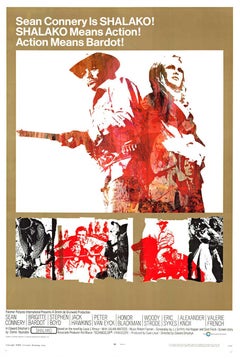
Original "Shalako" vintage 1968 movie poster, Sean Connery  Bridgitte Bardot

Original "Shalako" vintage 1968 movie poster, Sean Connery Bridgitte Bardot

Located in Spokane, WA

Original SHALAKO vintage movie poster, 1sheet, 1968 great art of Sean Connery as Shalako, sexy Brigitte Bardot! This collectible poster, printed in 1968 to promote the theatrical re...

Category

1960s American Modern Art by Medium: Offset

Materials

Offset

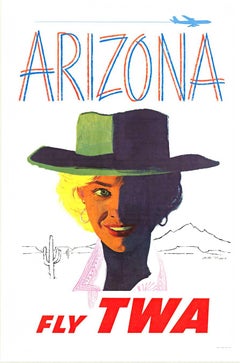
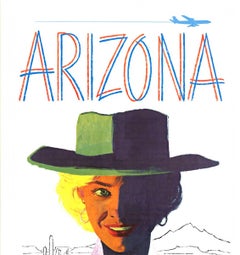
Original Arizona, Oak Creek Canyon, vintage Constellation aircraft vintage poste

Original Arizona, Oak Creek Canyon, vintage Constellation aircraft vintage poste

Located in Spokane, WA

Original Arizona Oak Creek Canyon TWA Constellation aircraft vintage travel poster. Archival linen backed from the 1950s Excellent condition, ready to frame. Although a few of these posters for Oak Creek Canyon have survived, few if any survived in such fabulous condition. Just south of Flagstaff...

Category

1950s American Realist Art by Medium: Offset

Materials

Offset

2002 Giant Anemone Tentacles Offset Print, Limited Edition Art

2002 Giant Anemone Tentacles Offset Print, Limited Edition Art

By Leni Riefenstahl

Located in Brooklyn, NY

This is an original, limited edition exhibition poster by Leni Riefenstahl, hand-numbered out of 250 in pencil. The poster is a rare collectible due to its limited print run and hist...

Category

Early 2000s Contemporary Art by Medium: Offset

Materials

Offset

Cindy Sherman 'Untitled #413' 2004- Offset Lithograph
Cindy Sherman 'Untitled #413' 2004- Offset Lithograph
By Cindy Sherman

Located in Brooklyn, NY

Paper Size: 8.5 x 5.5 inches ( 21.59 x 13.97 cm ) Image Size: 8.5 x 5.5 inches ( 21.59 x 13.97 cm ) Framed: Yes Frame Size: Condition: A-: Near Mint, very light signs of handling A...

Category

Early 2000s Art by Medium: Offset

Materials

Offset

Lt. Ed. Artist Book: Business Cards (Signed by Ed Ruscha and Billy Al Bengston)

Lt. Ed. Artist Book: Business Cards (Signed by Ed Ruscha and Billy Al Bengston)

Located in New York, NY

Ed Ruscha, Billy Al Bengston Business Cards (hand signed by Ed Ruscha and Billy Al Bengston), 1968 Mixed Media Artist's Book: Softback monograph with a latigo leather thong, silver g...
Category

1960s Pop Art Art by Medium: Offset

Materials

Leather, Paper, Ink, Mixed Media, Lithograph, Offset, Silver Gelatin

Botero Posters First Edition, Offset Print, Contemporary, 1990s

Botero Posters First Edition, Offset Print, Contemporary, 1990s

By Fernando Botero

Located in Brooklyn, NY

Published in 1994 by Enrique Michelsen Ediciones, Bogotá, Colombia, this first edition hardcover showcases the posters of Fernando Botero created between 1968 and 1994. Bound in green cloth, the book is in excellent condition, while its dust jacket shows some wear and small tears, typical of its age and use. Spanning 119 pages, the book features a striking collection of color and black & white illustrations of Botero’s poster...

Category

1990s Contemporary Art by Medium: Offset

Materials

Offset

Original "Quale Capri?" vintage Italian travel poster

Original "Quale Capri?" vintage Italian travel poster

Located in Spokane, WA

Original Quale Capri? Original Italian vintage travel poster. Conservation archival linen backed in very good condition, ready to frame. Quale Capri? Is which Capri? in Italian. The image is the outline of the island of Capri, off the coast of Naples, Italy. The poster has two different sides, which Capri do you like or want? One side represents progress with large commercial skyscrapers and the other side the small homes and businesses on the island. The question is do you want to allow development on this beautiful Mediterranean island. Capri was first “discovered” by emperor Augustus in the early years of the Roman Empire. He often resided there and built many temples, villas and gardens as a way of having his own private paradise. The meaning of the name Capri can be traced to the ancient Greeks, where the ancient Greek word 'kapros' means 'wild boar'. The island of Capri has had dozens of famous vintage posters...

Category

1980s Modern Art by Medium: Offset

Materials

Offset

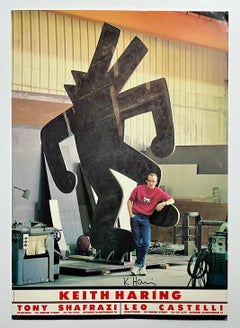
Keith Haring 1982 (Keith Haring Tony Shafrazi spiral catalog)

Keith Haring 1982 (Keith Haring Tony Shafrazi spiral catalog)

By Keith Haring

Located in NEW YORK, NY

Keith Haring 1982 1st edition (Keith Haring Tony Shafrazi Gallery): The much seminal & highly collectible, limited edition catalog featuring the iconic neon Haring Three Eyed Smiling Face cover & 15 sought-after double-sided lithographic inserts intact and in excellent vintage condition. An extensive early survey of Haring’s work leading into his breakout year. The finest example we have ever come across. Rarely comes to market as such. Not to be passed upon. Medium: Softcover metal-wire bound artist monograph; approximately 144 pages. 1st edition 1982. 9.25 x 9 inches (folded closed). Very good to excellent overall vintage condition. Protected by bound-in original clear plastic front sheet. Hardly touched. Unsigned from a limited edition of 2000 (see image 4). Includes a forward by publisher Tony Shafrazi, as well as text by Keith Haring, Jeffrey Deitch, Robert Pincus-Witten, and David Shapiro. Designed by Dan Friedman with photographs of Haring's subway drawings by Haring’s close friend, Tseng Kwong Chi. Keith Haring was an American artist and social activist known for his illustrative depictions of figures and symbols. His white chalk drawings could often been found on the blank poster marquees in New York’s public spaces and subways. “I don't think art is propaganda,” he once stated. “It should be something that liberates the soul, provokes the imagination and encourages people to go further. It celebrates humanity instead of manipulating it.” Born on May 4, 1958 in Reading, PA, he grew up in neighboring Kutztown, where he was inspired to draw from an early age by Walt Disney cartoons and his father who was an amateur cartoonist. After briefly studying commercial art in Pittsburgh, Haring came across a show of the works of Pierre Alechinksy and decided to pursue a career in fine art instead. He moved to New York in the late 1970s to attend the School of Visual Arts, and soon immersed himself in the city’s graffiti culture. By the mid-1980s, he had befriended fellow artists Andy Warhol, Kenny Scharf, and Jean-Michel Basquiat, and collaborated with celebrities like the singer Grace Jones. Diagnosed with HIV/AIDS in 1988, Haring’s prodigious career was brief, and he died of AIDS-related complications on February 16, 1990 at the age of 31. Before his death, Haring established the Keith Haring Foundation, a non-profit committed to raising awareness of the illness through art programing and community outreach. Throughout his career, Haring made his art widely available through the location of his murals, as well as through the Pop Shop—Haring's own storefront which he used to sell his memorabilia.The artist’s mural Crack is Wack (1986), can still be seen today on a retaining wall along FDR Drive in Manhattan. Haring’s works can be found in the collections of The Museum of Modern Art in New York, the Los Angeles County Museum of Art, the Art Institute of Chicago, and the Smithsonian American Art Museum in Washington, D.C. Related Categories: Keith Haring prints. Keith Haring Three Eyes...

Category

1980s Pop Art Art by Medium: Offset

Materials

Metal

Original Matterhorn, , Along the way of TWA ... Switzerland, vintage poster

Original Matterhorn, , Along the way of TWA ... Switzerland, vintage poster

Located in Spokane, WA

Original vintage poster ZERMATT MATTERHORN SWITZERLAND TWA c.1950. Along the way of TWA. Professional acid-free archival linen backed in fine condition. Ready to frame. Early Trans World Airline poster that features the Constellation aircraft. This is before the artwork of David Klein for TWA. TWA (Trans World Airlines) was formed in 1924 as Transcontinental & Western Air. The airline's first route was New York to Los Angeles, soon followed by multiple National routes. The airline expanded to serve Europe, the Middle East, and Asia after WWII when the company was under Howard Hughes's owner's control from 1939 until 1961. Hughes was a dominant force in expanding and promoting the routes flown by his company. The economy was vastly improving and travels through the air for business and pleasure...

Category

1950s American Realist Art by Medium: Offset

Materials

Offset

Red Vest Offset Print by Paul Klee, Modern Art, Unframed, 15.75x19.75

Red Vest Offset Print by Paul Klee, Modern Art, Unframed, 15.75x19.75

By Paul Klee

Located in Brooklyn, NY

Paper Size: 15.75 x 19.75 inches ( 40.005 x 50.165 cm ) Image Size: 11.25 x 15.25 inches ( 28.575 x 38.735 cm ) Framed: No Red Vest by Paul Klee is a vibrant and expressive work that...

Category

1990s Modern Art by Medium: Offset

Materials

Offset

Original Avenge December 7th vintage poster

Original Avenge December 7th vintage poster

Located in Spokane, WA

Original Avenge December 7th vintage poster. Linen backed; excellent condition. Artist: Bernard Perlin. Office of War Information, Washington, D.C., U.S. Government Printing Office: 1942-O-491978 Dramatic original World War II poster depicting a sailor with his fist raised, standing above a scene of an exploding battleship, with the words “Avenge December 7” in red across the middle of the poster. The striking image on OWI “Poster No. 15,” memorializing the events of December 7, 1941, was created by artist Bernard Perlin. U. S. Government Printing Office. Year: 1942 As a Life Magazine war art correspondent living in Europe during the 1940s and 1950s, Perlin continued to document social change uniquely. An American painter primarily known for creating many American posters during WWII and for magic realism...

Category

1940s American Modern Art by Medium: Offset

Materials

Offset

East-West/West-East in Brouq Nature Reserve Qatar (Hand Signed by Richard Serra)

East-West/West-East in Brouq Nature Reserve Qatar (Hand Signed by Richard Serra)

By Richard Serra

Located in New York, NY

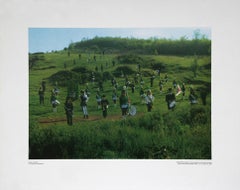
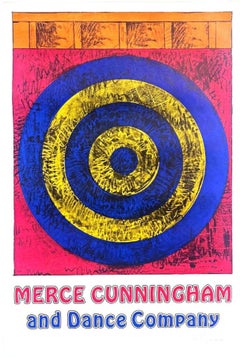
Richard Serra East-West/West-East: A Permanent in the Brouq Nature Reserve, Qatar (Hand Signed by Richard Serra), ca. 2014 Superb provenance: donated by the artist to a major contemporary art organization Very rare offset lithograph (Hand Signed by Richard Serra) Boldly signed on the front in black marker by Richard Serra 24 × 36 inches Unframed Sscarce when hand signed by Richard Serra. This work depicts Serra's iconic permanent installation in the desert of Brouq Qatar: East-West/West-East, which has become a famous landmark in Qatar since its installation in 2014. According to the Jewish-born Richard Serra, he had been visiting Qatar for about 12 years, during which he was introduced to the Chairperson of the Qatari Museums Authority and the sister of the new Emir, Sheikha Mayassa, by the architect of the Museum of Islamic Art, IM Pei. It was Sheikh Mayassathat who urged Serra to build a sculpture in the desert. The artist once said it was the most important thing he had ever done. In 2020 the Serra sculpture was famously vandalized. This hand signed print has superb provenance as it was donated directly by the artist to a major charitable foundation and is accompanied by a documentation from a Foundation as well as a COA from the gallery. Richard Serra biography: Obsession is what it comes down to. It is difficult to think without obsession, and it is impossible to create something without a foundation that is rigorous, incontrovertible, and, in fact, to some degree repetitive. Repetition is the ritual of obsession. Repetition is a way to jumpstart the indecision of beginning. To persevere and to begin over and over again is to continue the obsession with work. Work comes out of work. In order to work you must already be working. —Richard Serra One of the most significant artists of his generation, he has produced large-scale, site-specific sculptures for architectural, urban, and landscape settings spanning the globe, from Iceland to New Zealand. Born in 1938 in San Francisco, Richard Serra lives and works in New York and on the North Fork of Long Island. Serra attended the University of California, Berkeley before transferring to the University of California, Santa Barbara graduating with a BA in English literature; he then studied painting at Yale University, New Haven, Connecticut completing both a BFA and MFA. He began showing with Leo Castelli in 1968, and his first solo exhibition in New York was held at the Leo Castelli Warehouse the following year. His first solo museum exhibition was held at the Pasadena Art Museum, California, in 1970. Serra’s sculptures and drawings have been celebrated with two retrospectives at the Museum of Modern Art, New York, twenty years apart: Richard Serra/Sculpture (1986) and Richard Serra Sculpture: Forty Years (2007). He has had solo exhibitions at the Stedelijk Museum, Amsterdam (1977–78); Kunsthalle Tübingen, Germany (1978); Staatliche Kunsthalle Baden-Baden, Germany (1978); Museum Boijmans Van Beuningen, Rotterdam, Netherlands (1980, 2014, and 2017); Centre Pompidou, Paris (1983–84); Museum Haus Lange, Krefeld, Germany (1985); Louisiana Museum, Humlebæk, Denmark (1986); Westfälisches Landesmuseum für Kunst und Kulturgeschichte, Münster, Germany (1987); Städtische Galerie im Lenbachhaus, Munich (1987); Stedelijk Van Abbemuseum, Eindhoven, Netherlands (1988); Bonnefantenmuseum, Maastricht, Netherlands (1990); Kunsthaus Zürich (1990); CAPC Musée d’Art Contemporain, Bordeaux, France (1990); Museo Nacional Centro de Arte Reina Sofía, Madrid (1992); Kunstsammlung Nordrhein-Westfalen, Düsseldorf, Germany (1992); Dia Center for the Arts, New York (1997); Centro de Arte Hélio Oiticica, Rio de Janeiro (1997–98); Trajan’s Market, Rome (1999–2000); Pulitzer Arts Foundation, St. Louis (2003); and Museo Archeologico Nazionale di Napoli, Naples, Italy (2004). In 2005 The Matter of Time (1994–2005), a series of eight large-scale works, was installed permanently at the Guggenheim Museum Bilbao, Spain. For Monumenta 2008, the major site-specific installation Promenade was shown at the Grand Palais, Paris. Three years later the large-scale, site-specific sculpture 7 was permanently installed opposite the Museum of Islamic Art in Doha, Qatar. A major traveling retrospective dedicated to Serra’s drawings was presented at the Metropolitan Museum of Art, New York, San Francisco Museum of Modern Art, and the Menil Collection, Houston (the organizing venue), from 2011 to 2012. In 2014 the Qatar Museums Authority presented a two-venue retrospective survey of Serra’s work, and East-West/West-East (2014) was permanently installed in the Brouq Nature Reserve, Zekreet, Qatar. In 2017 the Museum Wiesbaden, Germany, presented Richard Serra: Props, Films, Early Works; an overview of Serra’s work in film and video was shown at the Kunstmuseum Basel; and recent drawings were featured at the Museum Boijmans Van Beuningen. Serra has participated in numerous major international exhibitions, including Documenta (1972, 1977, 1982, and 1987), and the Biennale di Venezia (1980, 1984, 2001, and 2013), and his work has been included in many Whitney Annuals and Biennials (1968, 1970, 1973, 1977, 1979, 1981, 1995, and 2006). He is the recipient of the Leone d’Oro for lifetime achievement, Biennale di Venezia, Venice (2001); Orden Pour le Mérite...
Category

2010s Minimalist Art by Medium: Offset

Materials

Lithograph, Offset

Max Ackermann 'Galerie Jahrhunderthalle Hoeschst'

Max Ackermann 'Galerie Jahrhunderthalle Hoeschst'

By Max Ackermann

Located in Brooklyn, NY

Paper Size: 33 x 23.75 inches ( 83.82 x 60.325 cm ) Image Size: 26.5 x 19.75 inches ( 67.31 x 50.165 cm ) Framed: No The original exhibition poster from 1987, issued by a gallery in ...

Category

1980s Modern Art by Medium: Offset

Materials

Offset

Kasse beim Fahrer Exhibition Poster, Offset Print, Contemporary, 1987

Kasse beim Fahrer Exhibition Poster, Offset Print, Contemporary, 1987

Located in Brooklyn, NY

This is an original exhibition poster for Reinhard Mucha's show titled "Kasse beim Fahrer" held at the Kunsthalle Bern in 1987. Reinhard Mucha is a renowned German contemporary artis...

Category

1980s Contemporary Art by Medium: Offset

Materials

Offset

Charles Bell '100 Points When Lit' 1995- Offset Lithograph
Charles Bell '100 Points When Lit' 1995- Offset Lithograph
By Charles Bell

Located in Brooklyn, NY

Paper Size: 8.75 x 7.25 inches ( 22.225 x 18.415 cm ) Image Size: 4.5 x 6.75 inches ( 11.43 x 17.145 cm ) Framed: Yes Condition: A-: Near Mint, very light signs of handling Addition...

Category

1990s Art by Medium: Offset

Materials

Offset

Indian Summer in Nantuckett

Indian Summer in Nantuckett

By Jane Wooster Scott

Located in San Francisco, CA

This artwork titled "Indian Summer in Nantuckett" is an original offset lithograph on wove paper by American artist Jane Wooster Scott, born 1933. It is hand signed and numbered 681/750 in pencil by the artist. The image size is 27 x 20 inches, framed size is 39 x 32.25 inches. It is beautifully framed in a custom wood frame. It is in excellent condition. About the artist. Jane Wooster Scott grew up in the Philadelphia area and moved West following her dream to be a movie star. She quickly learned that goal was not for her, but became the host of a talk show where she interviewed movie stars. She photographs what she sees to recapture them later on canvas. However, few of her paintings are real, existing scenes. They are compositions drawn from her personal imagination. She has been exhibiting her work in Los Angeles and New York and most of her shows have completely sold out on opening night. In the "Guinness Book of Records" as one of the most reproduced artists in America, Jane Wooster Scott began copying work by folk artists such as Grandma Moses and gradually evolved into her own style. A turning point for her career was a joint showing at the Ankrum Gallery in Los Angeles with her comedian friend, Jonathan Winters. It was mostly a business crowd, and she sold 40 paintings in an hour. Her works hang in museums, in public buildings and private homes in Europe, Asia and South America as well as in the United States. She has become legendary for her exceptional scenes of America s celebrations and holidays, Among her collectors are Aaron Spelling, Sylvester Stallone, Charles Bronson, Kenny Rogers, Farah...
Category

Late 20th Century Folk Art Art by Medium: Offset

Materials

Offset

Offset art for sale on 1stDibs.

Find a wide variety of authentic Offset art available on 1stDibs. While artists have worked in this medium across a range of time periods, art made with this material during the 21st Century is especially popular. If you’re looking to add art created with this material to introduce a provocative pop of color and texture to an otherwise neutral space in your home, the works available on 1stDibs include elements of blue, purple, red, yellow and other colors. There are many well-known artists whose body of work includes ceramic sculptures. Popular artists on 1stDibs associated with pieces like this include Takashi Murakami, David Shrigley, Franco Fontana, and Renato Guttuso. Frequently made by artists working in the Pop Art, Contemporary, all of these pieces for sale are unique and many will draw the attention of guests in your home. Not every interior allows for large Offset art, so small editions measuring 0.02 inches across are also available