By Edwin Mieczkowski
Located in Beachwood, OH
Edwin Mieczkowski (American, 1929-2017)
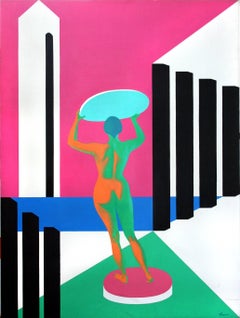
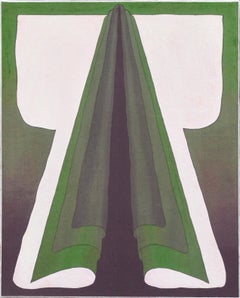
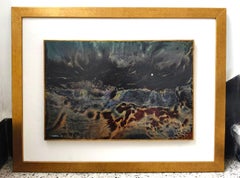
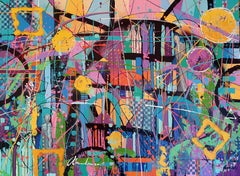
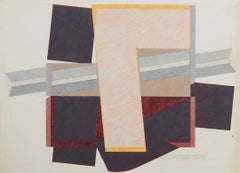
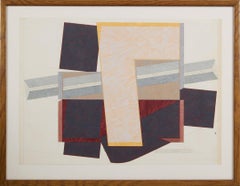
Broken Ice, 1976
Gouache and pencil on paper
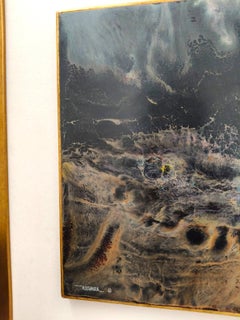
Signed, dated (Feb. 2, 1976) and titled lower right
27.5 x 37.75 inches
35 x 45 inches, framed
Edwin Mieczkowski, born in Pittsburgh, was a leader of geometric and perceptual abstraction during the latter part of the 20th century. Mieczkowski's work first came to prominence in "The Responsive Eye" exhibition, the nation's first major exhibition of perceptual art, held at the Museum of Modern Art in New York in 1965.
Mieczkowski was also featured in the 1964 article in Timemagazine that first used the term "Op Art" to describe paintings that manipulated visual cues in order to reorder and excite viewers' perceptual responses.
With a complex aesthetic that over time has transcended mere tricks of optical art, Mieczkowski has spent nearly four decades producing geometrically paintings, drawings and sculptures, a genre of modern art that is known broadly as perceptual abstraction.
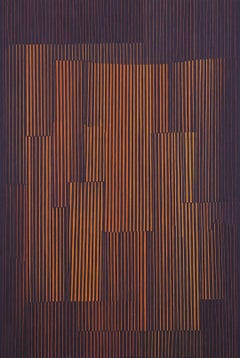
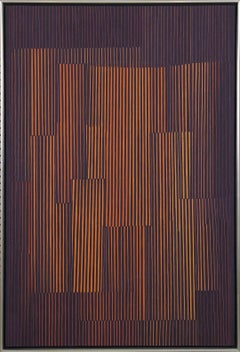
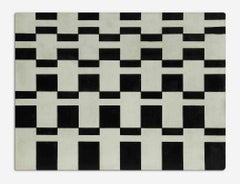
His output of static and dynamic forms create a body of work, still largely intact, that uses visually disorienting, meticulously arranged lines, dazzling kaleidoscopic colors, and alluring juxtapositions of hue and tone, to playfully and seductively present new challenges for the viewer's eyes. The desired result is an optical effect of perpetual motion, harmonics and rhythm. . . .
Along with Frank Hewitt and Ernst Benkert, Mieczkowski was a co-founder in 1959 of the Anonima* group that worked together in Cleveland and New York and declared itself free from the pressures of the art market and the pursuit of personal fame. Members of Anonima often left their works unsigned and vowed to shun the usual art market venues such as commercial galleries, biennials and competitions. Instead, they engaged in a rigorous, self-imposed program of painting exercises to explore the effects of geometry and color on visual perception.
Although Mieczkowski's work hung side-by-side in the MOMA "Responsive Eye" exhibition with such colleagues as Josef Albers, Victor Vasarely, Richard Anuszkiewicz, Morris Louis, Kenneth Noland, Carlos Cruz-Diaz, Ad Reinhardt and Bridget Riley, all of whom went on to considerable fame and fortune, Mieczkowski chose to eschew commercial exhibition and career promotion. Instead, he spent 39 years teaching at the Cleveland Institute of Art and quietly executing a number of public art commissions while independently pursuing his own intuitive explorations in geometric abstraction.
Mieczkowski pursued virtually no commercial sales of his work. Consequently, the body of work he left behind consists of hundreds of paintings, drawings and sculptures only recently viewed...
Category
1970s Op Art Figurative Paintings