By Christian Henri Roullier
Located in Rancho Santa Fe, CA
The Parisian Flower Arranger
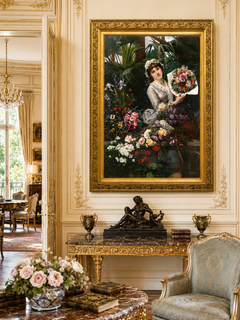
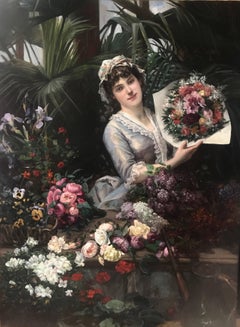
Painted in 1884, Christian-Henri Roullier’s *The Parisian Flower Arranger* is an unusually rich combination of portraiture and still life. Measuring 57 x 42 inches, the large oil on canvas shows a young woman seated in a greenhouse or conservatory, surrounded by flowers and foliage. She holds a newly gathered bouquet in her lap, while her pale dress, lace collar, and carefully rendered features give the scene an unmistakably Parisian elegance.
Much of the painting’s appeal comes from Roullier’s treatment of the flowers themselves. Roses, lilacs, pansies, geraniums, and other blossoms fill nearly every part of the composition. Rather than becoming decorative background, they are painted with enough individuality that each seems to have been closely observed. Reds, purples, yellows, pinks, and greens are set against the softer tones of the woman’s dress and the filtered light of the conservatory.
The setting allows Roullier to play with both natural and controlled light. Sunlight filters through the glass and foliage, touching the flowers, the sitter’s face, and the folds of her gown. Darker passages among the plants give the picture depth and keep the abundance of color from overwhelming the figure. Despite the sheer amount of detail, the composition remains calm and carefully balanced.
There is also something distinctly of its period in the subject. Flower arranging was associated with domestic refinement, taste, and cultivated leisure in late 19th-century France. Roullier takes that familiar theme and gives it considerable scale and importance. The woman is not merely placed among flowers. She appears entirely at home within this cultivated world, surrounded by the materials of her work and pleasure.
The Artist
Christian-Henri Roullier was born in Lyon in 1845, but his life soon took an unusual turn. As an infant, he traveled with his family to San Francisco during the California Gold Rush. The family initially struggled, but their circumstances improved after Roullier’s father found employment at the White House, the prominent San Francisco department store owned by the French-born merchant Raphael Weill.
Roullier eventually returned to France to pursue serious artistic training. In Paris, he studied painting with Jean-Léon Gérôme, one of the best-known academic painters of the period. He also studied sculpture with Emmanuel Frémiet. Roullier continued to work in both painting and sculpture, and the influence of that training can be seen in the solidity of his figures and his careful understanding of form.
His paintings share some of the qualities associated with Gérôme’s academic approach, particularly precise drawing, careful composition, and close attention to surface and detail. Roullier, however, often brought a warmer and more intimate quality to his subjects, particularly when painting portraits, landscapes, and scenes of everyday life.
Roullier exhibited regularly at the Paris Salon from 1878 through 1914. He also maintained strong ties to San Francisco and exhibited with the San Francisco Art Association and at the Mechanics’ Institute in 1883. Among his artistic acquaintances was Jules Tavernier, the French-born painter closely associated with the development of art in California and Hawaii. Roullier painted Tavernier at work in the lively portrait "Tavernier Painting".
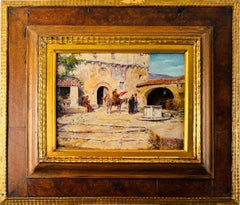
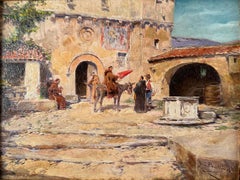
His subject matter was varied. In addition to portraits, he painted rural scenes in France and traveled farther afield, producing colorful views of Tunisia. Across these different subjects, Roullier showed a particular interest in light, atmosphere, and richly observed surroundings.
France and California
When Roullier was not working in Paris, he and his sister Blanche spent time at the family property in Saint-Nizier-sous-Charlieu in the Loire region of France. Blanche Roullier was herself an accomplished pastel artist who exhibited regularly at the French salons and received recognition for her work.
The countryside around Saint-Nizier-sous-Charlieu provided Christian-Henri Roullier with another source of inspiration. His rural paintings often have a quieter character than his formal portraits and elaborate interiors, but they reveal the same careful observation.
Although Roullier spent much of his adult life in France, his early connection to California remained an important part of his biography. His career effectively joined two very different artistic worlds. He was trained in the traditions of the French academy, yet he had grown up in the rapidly changing environment of San Francisco. That combination helps explain the range of his work and perhaps some of its openness to vivid color and strong natural light.
A Major Work
*The Parisian Flower Arranger* brings many of Roullier’s strengths together in a single painting. His academic training is evident in the drawing of the figure, the organization of the composition, and the extraordinary amount of carefully observed detail. At the same time, the picture never feels like a technical exercise. Its real charm comes from the quiet mood Roullier creates.
The sitter, the flowers, and the conservatory all belong to the same world. Nothing feels hurried. The flowers have been gathered and arranged, sunlight enters through the glass, and the young woman pauses within a setting devoted almost entirely to beauty.
Roullier died in Paris on July 25, 1926. Later that year, a retrospective exhibition of his work was held at the Paris Winter...
Category
French School 1880s Interior Paintings


![Pocket Pale Blue Sloes [2023], Baroque Still Life Painting, Small art, Fruit art](https://a.1stdibscdn.com/dani-humberstone-paintings-pocket-pale-blue-sloes-2023-baroque-still-life-painting-small-art-fruit-art-for-sale/a_6323/a_137130821704282745187/1_master.jpg?width=240)
![Pocket Pale Blue Sloes [2023], Baroque Still Life Painting, Small art, Fruit art](https://a.1stdibscdn.com/dani-humberstone-paintings-pocket-pale-blue-sloes-2023-baroque-still-life-painting-small-art-fruit-art-for-sale-picture-2/a_6323/a_137130821704299587444/IMG_3602_master.JPG?width=240)