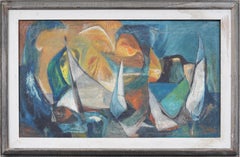
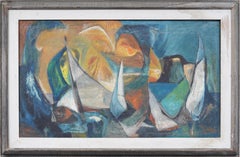
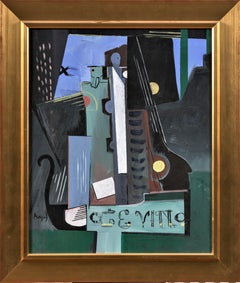
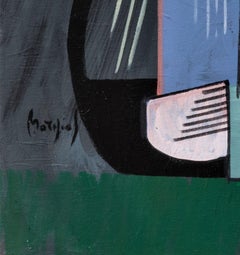
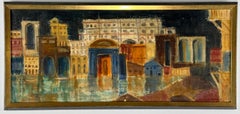
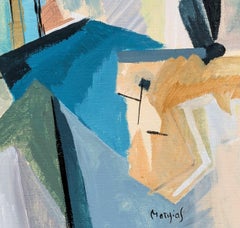
Couple à Aegina (A Couple in Aegina)
Acrylic on Canvas
61 x 50 cm
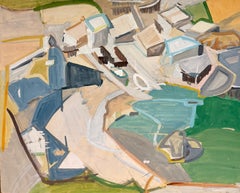
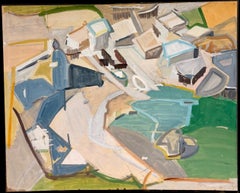
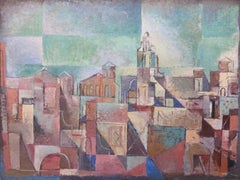
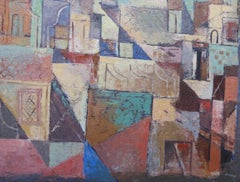
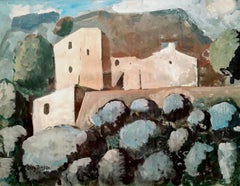
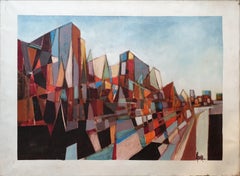
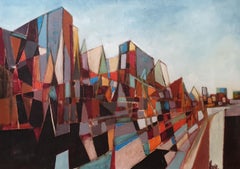
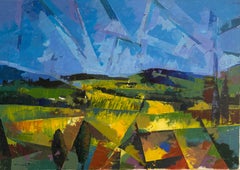
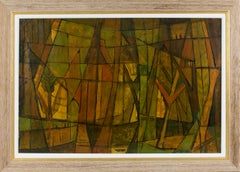
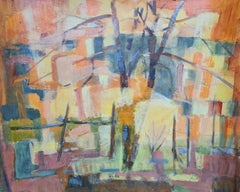
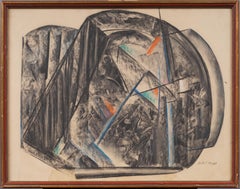
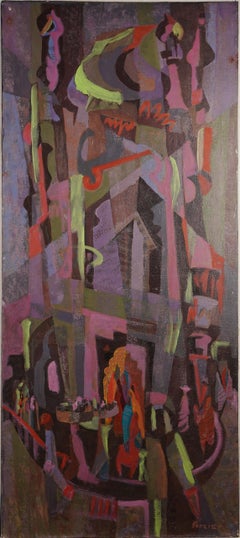
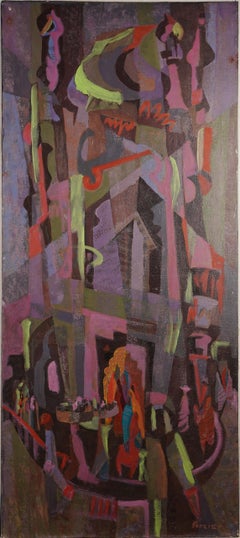
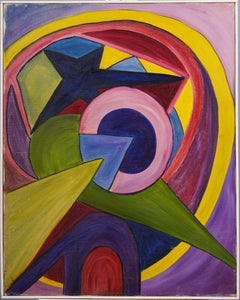
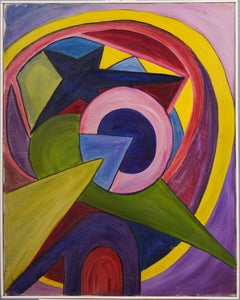
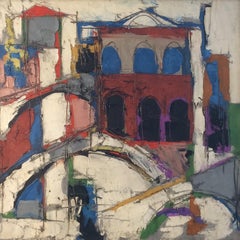
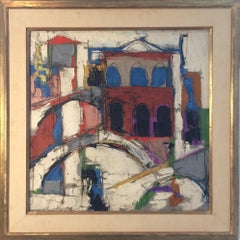
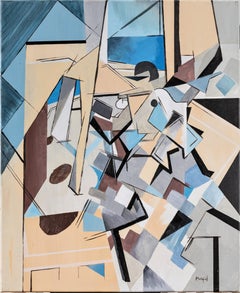
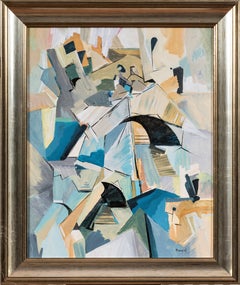
Couple à Aegina presents two intertwined figures assembled within a structured architectural setting inspired by the Greek island of Aegina. Rather than depicting a fixed scene, the composition builds from fragments — bodies, objects, spatial planes — held together through vertical alignment and interlocking geometry, so that figure and environment become genuinely inseparable.
A central elongated form anchors the work, while surrounding elements — suggestive of musical instruments, interior structures, and architectural detail — intersect and layer. The figures remain partially legible, continuously shifting between presence and abstraction as they absorb and release the forms around them.
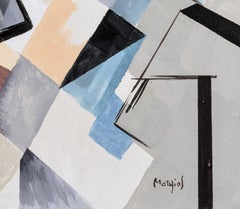
The palette is restrained and deliberate: deep blacks and muted blues form the dominant ground, punctuated by sage greens and lighter neutral passages. Small circular accents and linear elements move across the surface, creating an internal rhythm that draws the eye without dictating a fixed entry point.
This is not a scene captured at a single moment. Working through what he calls a "reverse jigsaw logic" — beginning with a figurative view of reality, then fragmenting and recomposing it — Mathias brings multiple perceptions into one field: variations in viewpoint, shifts in spatial relation, different moments of observation layered together. Like his figurative works more broadly, the human presence here is never isolated; it is always integrated with place, absorbed into the architecture and light of Aegina itself.
Living with the Work:
Before acquiring this piece, consider: at 61 x 50 cm, this is an intimate format — best suited to a space where you will naturally spend time close to it, rather than a large wall viewed from across a room. Does the space you have in mind allow for that?
Does your interior already carry deep blacks, blues or greens, or would this palette introduce a contrast you'd find interesting to live with?
Are you drawn to the human figure as a subject, or does the way the figures here dissolve into their architectural surroundings — becoming part of the place rather than standing apart from it — feel like the more compelling idea?
Collector's Insight
Rooted in the direct lineage of Jean Metzinger — whose disciple Claude Augereau was Mathias's professor at the École Nationale Supérieure des Beaux-Arts in Paris — this work extends the structural logic of European Cubism into a genuinely original proposition. Where Cubism fragmented space, Diachronic Cubism fragments time itself, embedding successive moments of perception within a single composition. The result sits comfortably within the tradition of Gris and Gromaire while belonging to no one but Mathias.
About the Artist
Grégoire Mathias, graduate of the École Nationale Supérieure des Beaux-Arts de Paris, is the pioneer of Diachronic Cubism — an evolution of the cubist tradition that captures not only multiple points in space but multiple moments in time within a single work. His paintings have been exhibited in Paris, New York, Los Angeles, Bordeaux, and Dublin. Since 2020, he has been the official artist of the WFUNA (World Federation of United Nations Associations), designing posters for United Nations Day in Geneva — the first French artist commissioned to do so since Picasso, Chagall, and Miró.
Keywords
Diachronic cubism, Greek island painting...
Category
21st Century and Contemporary Cubist Landscape Paintings