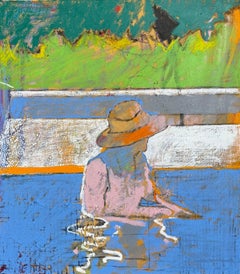
By Hugó Scheiber
Located in Surfside, FL
Hugó Scheiber (Hungarian, 1873–1950)
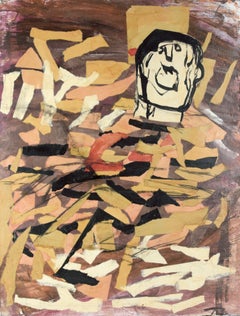
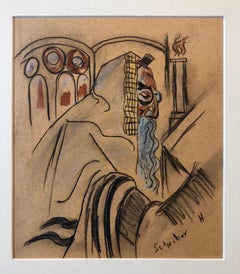
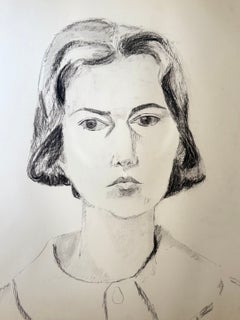
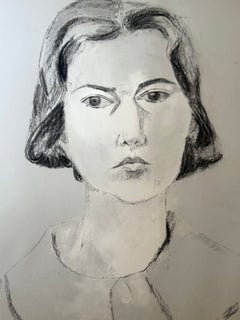
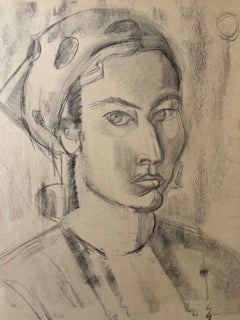
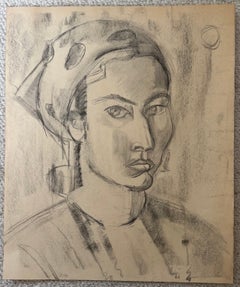
Rabbi at Prayer (Rabbi in Synagogue) wearing tallit and tefillin
Gouache, pastel, and charcoal on paper
15.75 x 14.5 inches (sight)
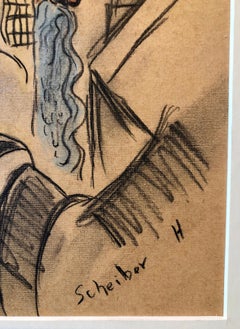
Signed lower right: “Scheiber H”
A deeply moving and masterfully executed work on paper by Hugó Scheiber — one of the most important Hungarian Jewish modernist painters of the twentieth century, championed by Herwarth Walden’s legendary Der Sturm Gallery in Berlin, exhibited through Katherine Dreier’s Société Anonyme in New York alongside Marcel Duchamp and Wassily Kandinsky, and included in the landmark Paris-Berlin 1900–1930 exhibition at the Centre Georges Pompidou.
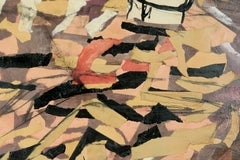
This exceptional work depicts an elderly rabbi in profile, draped in a traditional tallit (prayer shawl) with its characteristic dark stripes, wearing a tefillin (phylactery) on his head, and absorbed in deep prayer or Torah study before an open Torah scroll or prayer book. Behind him, the arched windows of the synagogue interior are rendered in Scheiber’s distinctive stylized manner — the circular and arched stained glass motifs filled with warm russet and grey tones — while to his right a lit candle or lamp flickers, casting the scene in an atmosphere of sacred warmth and quiet devotion. The figure’s full grey-blue beard, rendered in Scheiber’s signature fluid, rhythmic line, flows downward in a cascade of expressive marks that capture both the physical presence of the man and the spiritual weight of the moment.
The work exemplifies everything that makes Scheiber’s Judaica subjects among the most sought-after of his entire output — his ability to combine the emotional intensity of German Expressionism with the decorative elegance of Art Deco, the fluid economy of his line with the richness of his color palette, and his deep, personally felt engagement with the world of Eastern European Jewish religious life. The composition connects Scheiber directly to the great tradition of Jewish subject painters including Marc Chagall — whose depictions of rabbis and Jewish life in the shtetl share Scheiber’s combination of spiritual reverence and modernist formal language — as well as Isidor Kaufmann and Maurycy Gottlieb, the nineteenth century masters of Jewish genre painting whose work Scheiber both absorbed and transformed.
The work is signed in Scheiber’s characteristic hand — “Scheiber H” — lower right, with the “H” monogram that appears on many of his most important works on paper. The warm buff paper ground, the combination of charcoal line with gouache and pastel color accents, and the overall condition are entirely consistent with Scheiber’s mature working method of the 1920s and 1930s — the period of his greatest international recognition and his most sustained engagement with Jewish religious subjects.
Scheiber’s rabbi and synagogue subjects are among the most actively collected works in the entire canon of Jewish art, and appear regularly at Sotheby’s, Christie’s, Bonhams, and specialist auction houses. A rare and important opportunity to acquire a major Judaica work by one of the defining figures of interwar Hungarian Jewish modernism.
Hugó Scheiber (1873–1950)
Hungarian Jewish Modernist Painter German Expressionism Futurism Art Deco Der Sturm Gallery Berlin Société Anonyme Judaica Art Gouache Pastel Tempera
Hugó Scheiber (September 29, 1873 – March 7, 1950) was one of the most important and internationally connected Hungarian Jewish modernist painters of the twentieth century — a largely self-taught master of gouache, pastel, tempera, and oil whose dynamic, color-saturated paintings of urban nightlife, jazz musicians, dancers, acrobats, café scenes, and Jewish subjects placed him at the intersection of German Expressionism, Italian Futurism, and Art Deco, and whose career brought him into direct contact with the most significant figures of the European and American avant-garde. Championed by Herwarth Walden’s legendary Der Sturm Gallery in Berlin, exhibited through Katherine Dreier’s Société Anonyme in New York alongside Marcel Duchamp, Man Ray, and Wassily Kandinsky, and included in the landmark Paris-Berlin 1900–1930 exhibition at the Centre Georges Pompidou, Scheiber is one of the great rediscovered figures of interwar European modernism — and one of the most collectible Jewish artists of the twentieth century.
Early Life: Budapest, Vienna, and the Sign Painter’s Son
Born on September 29, 1873, in Budapest, Hungary, Scheiber came from a working-class Jewish family. At the age of eight he moved with his family to Vienna, where his father worked as a sign painter for the famous Prater Theater — Vienna’s largest entertainment venue — and where the young Scheiber absorbed his earliest visual education in the world of popular entertainment, spectacle, and commercial art that would define his subjects for the rest of his career. The family returned to Budapest in 1898, where Scheiber worked during the day and studied painting in the evenings at the School of Design (also referred to as the Commercial Art School and College of Applied Arts) under Henrik Papp, completing his studies in 1900. He did not graduate, and remained essentially self-taught — a fact that gave his work an instinctive, unacademic energy entirely at odds with the conservative Hungarian art establishment of his era and entirely in sympathy with the spirit of the European avant-garde.
Marinetti, Futurism, and the Modernist Turn
In the 1910s Scheiber’s style began to evolve decisively away from the Impressionist landscapes and still lifes of his early career toward the energetic, stylized world of German Expressionism. In 1915 he met Filippo Tommaso Marinetti — the Italian poet and founder of Futurism, one of the most electrifying figures in the European avant-garde — and the two became close friends. Marinetti invited Scheiber to join the Futurist Movement, and Scheiber’s subsequent work absorbed the Futurists’ celebration of speed, dynamism, modern city life, and the energy of the machine age, combining it with the emotional intensity and expressive distortion of German Expressionism to create a uniquely personal hybrid style. In 1933 Scheiber was invited by Marinetti to participate in the Mostra Nazionale d’Arte Futurista — the great gathering of the Futurists held in Rome — where he was received with great enthusiasm, cementing his place within the international Futurist canon.
Vienna and the Hungarian Avant-Garde
In 1919 Scheiber and his close friend and fellow Hungarian Jewish painter Béla Kádar held an exhibition organized by art critic Max Hevesi at the Hevesy Salon in Vienna — a landmark event for the Hungarian avant-garde and the first exhibition to bring serious attention to Scheiber’s work. The success of the Vienna show was such that the Budapest Art Museum purchased works from it — one of the few institutional recognitions Scheiber would receive in his own country. The Hungarian avant-garde was at this moment divided between two camps: the politically committed Constructivists, led by Lajos Kassák — whom Scheiber painted in a celebrated 1930 portrait — who believed art should serve social revolution; and independent modernists like Scheiber and Kádar who pursued aesthetic and humanist idealism. Scheiber belonged firmly to the latter camp, and it was Kassák who provided a letter of recommendation that would open the most important door of Scheiber’s career: an introduction to Herwarth Walden.
Der Sturm Gallery, Berlin, and the European Avant-Garde
In 1921 Herwarth Walden — founder of Der Sturm, Germany’s leading avant-garde periodical and gallery, and the most powerful champion of the European avant-garde in the Weimar Republic era — discovered Scheiber’s work and became his most important patron and promoter. Walden moved Scheiber to Berlin in 1922, provided him financial support, and began reproducing his work regularly in the pages of Der Sturm magazine alongside the work of Paul Klee, Wassily Kandinsky, Franz Marc, Marc Chagall, and Oskar Kokoschka. Scheiber’s solo exhibitions at the Der Sturm Gallery followed in 1924, 1925, and 1927, and he was included in major group exhibitions at the gallery alongside artists from more than twenty-three countries — placing him at the very center of Weimar-era Berlin’s dynamic international art world.
Scheiber’s move to Berlin coincided with the great exodus of Hungarian artists to the German capital, including László Moholy-Nagy and Sándor Bortnyik — figures who would go on to shape the Bauhaus and international Constructivism. Together, the Hungarian émigrés formed one of the most significant artistic communities in Berlin, and Scheiber was among the most celebrated of them.
Katherine Dreier, the Société Anonyme, and New York
In 1926 another major turning point arrived: Katherine Dreier — the American artist and collector who, with Marcel Duchamp and Man Ray, had founded the Société Anonyme, the first organization in America dedicated to promoting modern art — organized a landmark international exhibition in New York in which Scheiber was included alongside artists from more than twenty-three countries. The Société Anonyme’s mission was to bring the best of the European avant-garde to American audiences, and its roster included Wassily Kandinsky, Paul Klee, Kurt Schwitters, Piet Mondrian, Alexander Archipenko, and Francis Picabia. Scheiber’s inclusion placed him firmly within this constellation of international modernism. Through Dreier’s connections, Scheiber’s work was subsequently exhibited in London (Rehearsal Theatre, Poplar Town Hall), New York (Brooklyn Museum, Anderson Gallery, Little Review), and Rome. Works from the Société Anonyme collection — including Scheiber’s — were later donated to the Yale University Art Gallery, where the Collection of the Société Anonyme exhibition was mounted in 1950.
Artistic Style: Expressionism, Futurism, and Art Deco
Scheiber’s mature style is one of the most distinctive and instantly recognizable in interwar European art. Working primarily in gouache, pastel, tempera, and oil on paper and board, he depicted the cosmopolitan modern world — jazz musicians, dancers, acrobats, singers, musicians, café scenes, cabarets, nightlife, street scenes, horse-drawn carriages, and the energy of the modern city — in a style that combines the emotional intensity of German Expressionism with the dynamism of Futurism and the decorative elegance of Art Deco. His palette is characteristically bold and saturated — deep blues, vivid reds, electric greens, and warm yellows — and his figures are rendered in fluid, rhythmic lines that capture movement and gesture with extraordinary economy and verve. Critics have compared his international Art Deco manner to that of Erté — the celebrated Russian-French artist whose theatrical, stylized figures share Scheiber’s sense of glamour and movement — while his Expressionist intensity connects him to Ernst Ludwig Kirchner, Egon Schiele, and the broader tradition of German and Austrian Expressionism.
Among his most celebrated and collected subjects are his depictions of Jewish religious life — rabbis, synagogue scenes, Jewish musicians, and Shabbat subjects — which represent a deeply felt engagement with the world of Eastern European Jewish culture and place him within the tradition of Jewish artists such as Marc Chagall, Maurycy Gottlieb, and Isidor Kaufmann who made Jewish life and spirituality central subjects of modern art.
Return to Budapest and Late Career
With the rise of Nazism in Germany, the Hungarian artists in Berlin gradually returned home. Béla Kádar left Berlin around 1932, and Scheiber followed in 1934. Back in Budapest, he continued to exhibit and remained remarkably prolific — he was known as an extremely fast-working artist who produced an enormous body of work across his long career. Despite his international recognition, his work remained largely ignored by the conservative Hungarian art establishment throughout his lifetime.
Major Exhibitions
Scheiber’s exhibition record spans the most important venues of European and American modernism: Der Sturm Gallery, Berlin (solo 1924, 1925, 1927; group exhibitions through 1928); Brooklyn Museum, New York; Anderson Gallery, New York; Little Review, New York (all through the Société Anonyme); London (Rehearsal Theatre, Poplar Town Hall); Mostra Nazionale d’Arte Futurista, Rome (1933); The Nell Walden Collection, Kunsthaus Zürich (1945), Kunsthaus Aarau (1957), and Kunstmuseum Bern (1967); Collection of the Société Anonyme, Yale University Art Gallery, New Haven (1950); Hugó Scheiber: A Commemorative Exhibition, Hungarian National Museum, Budapest (1964); Ungarische Avantgarde, Galleria del Levante, Munich (1971); Paris-Berlin 1900–1930, Centre Georges Pompidou, Paris (1978) — one of the landmark exhibitions of twentieth century art history; L’Art en Hongrie 1905–1930, Musée d’Art et l’Industrie, Saint-Etienne (1980) and Musée d’Art Moderne de la Ville de Paris (1981); Ungarische Avantgarde in der Weimarer Republik, Marburg (1986); Futurismo & Futurismi, Palazzo Grassi, Venice (1986), organized by Pontus Hulten; Modernizmus, Eresz & Maklary Gallery, Budapest (2006); Hugó Scheiber & Béla Kádár, Galerie le Minotaure, Paris and Tel Aviv (2007); and A Storm in Europe: Béla Kádar, Hugó Scheiber and Der Sturm in Berlin, Ben Uri Gallery and Museum, London (2003).
Museum Collections
Hugó Scheiber’s paintings and works on paper are held in the permanent collections of the Hungarian National Museum, Budapest; the Janus Pannonius Museum, Pécs; the Kunstmuseum Bern; and museum collections in Vienna and New York, as well as the Yale University Art Gallery through the Collection of the Société Anonyme.
Legacy
Hugó Scheiber died in Budapest on March 7, 1950 — largely unrecognized in his own country despite his extraordinary international career. His rediscovery in the late twentieth century has established him as one of the most significant Jewish modernist painters of the interwar period — a Hungarian-born artist who moved between Vienna, Berlin, and the international art world with remarkable ease and whose work encapsulates the energy, glamour, and tragedy of European Jewish modernism in the years between the wars. His paintings and works on paper appear regularly at Sotheby’s, Christie’s, Bonhams, and specialist auction houses, and are actively collected by institutions and private collectors worldwide, particularly among collectors of Jewish art, Hungarian modernism, German Expressionism, Art Deco, and interwar European painting.
Keywords: Hugo Scheiber, Hugó Scheiber, Hugo Scheiber painting, Hugo Scheiber gouache, Hugo Scheiber pastel, Hungarian Jewish artist, Hungarian modernist painter, Jewish art, Judaica art, Der Sturm Gallery Berlin, Herwarth Walden, Société Anonyme, Katherine Dreier, Béla Kádar, Filippo Tommaso Marinetti, Futurism, German Expressionism, Art Deco, László Moholy-Nagy, Marc Chagall, Erté, interwar European painting, Hungarian avant-garde, Weimar Republic art, Ben Uri Gallery, Centre Georges Pompidou Paris-Berlin, Yale University Art Gallery, Jewish modernism, nightlife painting, jazz painting, café scene painting...
Category
Early 20th Century Modern Charcoal Paintings
MaterialsPaper, Charcoal, Pastel, Watercolor, Gouache