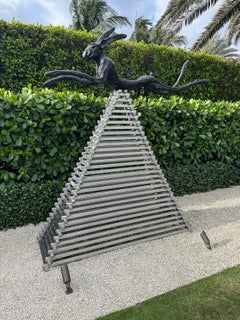
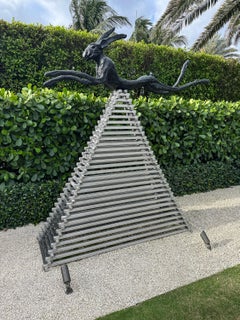
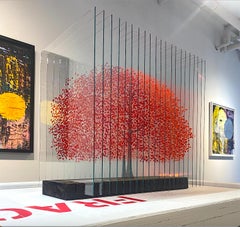
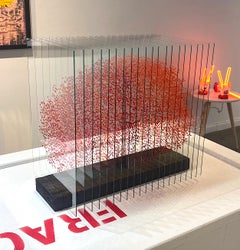
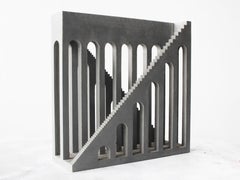
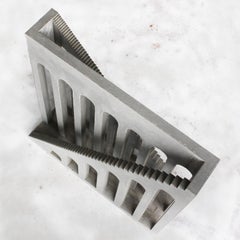
By Randy Shull
Located in Surfside, FL
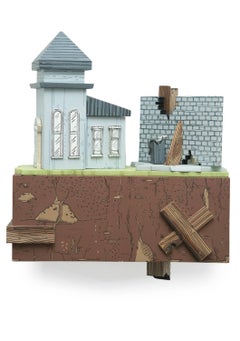
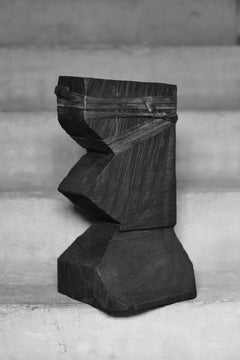
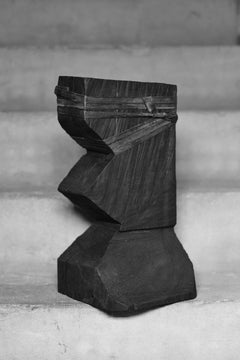
Randy Shull is an artist who works fluidly between a variety of
mediums, including furniture design, spatial design, painting, and
landscape design. He is highly acclaimed for his rich and sensual use
of color and space. Awarded a North Carolina Arts Council Fellowship
in 1994, an NEA Southern Arts Federation grant in 1995, and a master
residency at Oregon School of Arts & Crafts in Portland, Randy has
also had four solo shows in New York in the past decade. His work is
included in a number of important museum collections including The
Brooklyn Museum; The High Museum in Atlanta; The Renwick Museum of
American Art in Washington, D.C.; The Mint Museum of Craft & Design in
Charlotte; Racine Museum of Art; The Gregg Museum of Art & Design, and
Museum of Art and Design in New York. Randy stays involved in the
local community by serving on the board of the Asheville Art Museum.
Randy maintains studios in Asheville, NC and Merida, Mexico.
In 2008 and 2009 Randy’s work was the subject of a twenty-year
retrospective that opened on January 24th at the Gregg Museum of Art &
Design at NC State, and traveled to the San Francisco Museum of Craft
& Design as well as The Bellview Art Museum and The Ogden Museum of
Southern Art. Reviews of the exhibition can be found in the Raleigh
News and Observer and the San Francisco Chronicle.
The craft revival in the 1920s brought a renewed interest in
traditional native crafts and folk art at places like the John C.
Campbell Folk School and Penland School of Crafts. Using pocket
knives, carvers transformed scraps of wood into dolls and toys for
their children. As tourism developed, carving became an important
source of income, and successful carving centers developed in
Cherokee, Asheville, Tryon and Brasstown.
Seaborn Bradley was known for making war clubs, tomahawks and walking
sticks; Will West Long and his son Allen made masks used in native
celebrations; and Hayes Lossiah crafted traditional Cherokee blowguns,
darts, bows and arrows. Goingback Chiltoskey and Amanda Crowe became
influential teachers for the Cherokee community. Eleanor Vance and
Charlotte Yale, coming to N.C. most likely as missionaries,
established Biltmore Estate Industries in Asheville in 1905, initially
focusing their production on carving and later adding weaving. In
1915, the pair moved south of Asheville to establish Tryon Toy-Makers
and Wood-Carvers. In the 1930s, several folk art wood carvers were known in and around Brasstown, home of the John C. Campbell Folk School, including
Floyd Laney, William Julius “W. J.” Martin, who carved traditional
animals, and influential carving teacher Parker Fisher. Other carvers,
like Herman and Mabel Estes, made mostly functional items including
serving platters. “Brasstown Carvers” was established in the 1950s,
known for its small, highly polished animals and nativity scene
figures. Today, the Southern Highlands Craft Guild and Piedmont
Craftsmen give visibility to the finest wood artists in the state. The
aptly named Woody family, now in its seventh generation of crafting
traditional wooden rockers and chairs by hand without nails or glue,
maintains its business in Spruce Pine while the work of high-end
Asheville furniture artists like Randy Shull and Brent Skidmore
appears in venues like the Mint Museum Uptown in Charlotte. Renowned
Saluda woodturner Stoney Lamar creates art with a lathe, and Bynum
outsider artist Clyde Jones invents “critters” with his chainsaw. All
have earned international recognition. A blurring of lines between
craft and visual art also is evident today. Casar resident Bob Trotman...
Category
20th Century Still-life Sculptures