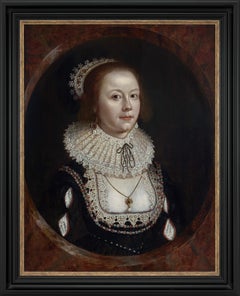
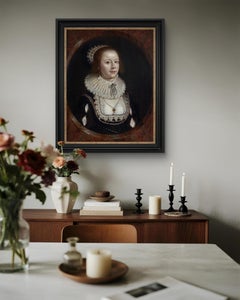
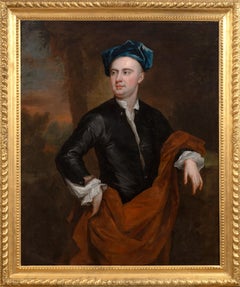
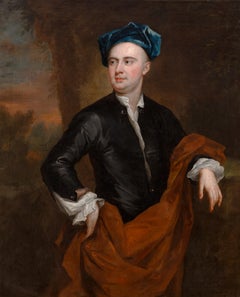
Cornelius Johnson Cornelius Johnson or Cornelis Janssens van Ceulen (Dutch) also Cornelius Jonson van Ceulen, (born 14 October 1593 – died 5 August 1661) was an English painter of portraits of Dutch or Flemish parentage. He was active in England, from at least 1618 to 1643, when he moved to Middelburg in the Netherlands to escape the English Civil War. Johnson painted many portraits of emerging new English gentry. His early portraits were panel paintings with "fictive" oval frames – they appear to have a wooden or marble oval surround, but this is actually painted on to the panel. This trompe-l'œil effect was one of Johnson' favourite devices in the early part of his career. "His figures are usually placed in front of dark, undefined backgrounds with focus on their faces and elaborate costumes that denote their social standing. Cornelius Johnson has been described as "one of the most gifted and prolific portrait painters practising in England during the 1620s and 1630s".
One of his remarkable paintings Portrait of a Woman, 1655-56, is found at Princeton University Art Museum, USA. Following the Netherlandish tradition, he was particularly accurate and detailed in depiction of clothing. As a result, his portraits are especially useful to costume historians. His works can be found in major collections in the UK and overseas as well as in private collections in stately homes in Britain.
Encompassing centuries of change in Europe between 1300 and 1800, from booms of prosperity to bloody revolutions, Old Masters describes a wide range of artists. The informal term was derived from the title of an artist who trained in a guild long enough to become a master, such as Leonardo da Vinci, who studied in a Florence painters’ guild. However, Old Masters paintings, prints and other art is now used to refer to work made by any artist with a high level of skill in painting, drawing, sculpture or printmaking who worked during this era.
The 15th century’s expansive trade and commerce spread culture across borders. A vibrant period of art emerged, bolstered by studies of anatomy and nature that influenced a new visual realism. From Raphael and Michelangelo in the Renaissance to Rembrandt van Rijn and Johannes Vermeer in the Dutch Golden Age, artists expressed emotion, naturalism, color and light in new ways. El Greco and Paolo Veronese were leaders in the dramatic style of Mannerism, while Caravaggio and Peter Paul Rubens demonstrated the movement and meticulous detail of Baroque art.
Historically, most attention was concentrated on male artists, but recent research and exhibitions have elevated the impactful work of women such as Rachel Ruysch and Artemisia Gentileschi. In late-18th-century France, female artists like Adélaïde Labille-Guiard and Élisabeth Vigée Le Brun were prominent names. Nevertheless, access to the academies and guilds was highly restricted for women, and even those able to establish practices were expected to adhere to portraits and still lifes rather than the grand history paintings being created by men.
Find a collection of Old Masters prints, paintings, drawings and watercolors and other art on 1stDibs.