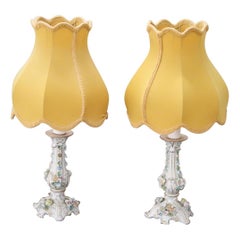
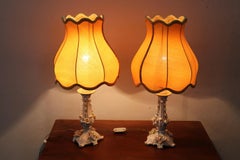
An assortment of capodimonte flower lamps is available at 1stDibs. Each of these unique capodimonte flower lamps was constructed with extraordinary care, often using
ceramic,
porcelain and
metal. There are all kinds of capodimonte flower lamps available, from those produced as long ago as the 19th Century to those made as recently as the 20th Century. Capodimonte flower lamps bearing
Rococo or
Art Nouveau hallmarks are very popular at 1stDibs. Capodimonte flower lamps have been a part of the life’s work for many furniture makers, but those produced by
Capodimonte,
Capo Di Monte and
Giuseppe Pellati are consistently popular.
Capodimonte flower lamps can differ in price owing to various characteristics — the average selling price at 1stDibs is $1,593, while the lowest priced sells for $369 and the highest can go for as much as $34,039.
If success is measured by lasting name recognition, Capodimonte porcelain would seem to be in the same league as such makers as Meissen, Sèvres and Wedgwood. Early examples of Capodimonte lamps — as well as the Italian manufacturer’s celebrated porcelain vases, figurines and sculptures — can be hard to come by, but the best later pieces possess the same over-the-top charm.
The Real Fabbrica (“royal factory”) di Capodimonte hasn’t actually produced porcelain since the early 19th century, when Charles’s son Ferdinand sold it. Although secondary manufacturers have built upon the aesthetic and kept the name alive, some connoisseurs of the royal product feel these pieces should be labeled “in the style of” Capodimonte.
The timeline of royal Capodimonte porcelain is decidedly brief. From beginning to end, its manufacture lasted approximately 75 years. King Charles VII of Naples, who founded the manufactory in 1743, began experimenting with porcelain around 1738, the year he married Maria Amalia of Saxony. No coincidence there. His new bride was the granddaughter of Augustus the Strong, Elector of Saxony and founder of Meissen, the first European hard-paste porcelain manufactory. Her dowry included 17 Meissen table services.
Struck by porcelain fever, Charles built a dedicated facility on top of a hill (capo di monte) overlooking Naples. He financed expeditions to search for the right clay. He hired chemists and artisans to experiment. His earliest successes were small white snuffboxes and vases, although efforts soon progressed to full sets of tableware, decorative objects and stylized figurines of peasants and theatrical personalities.
In 1759, Charles succeeded to the throne of Spain. He moved the manufactory with him — including 40 workers and 4 tons of clay — and continued operations in Madrid. Twelve years later, his son Ferdinand IV, who inherited the throne of Naples, built a new factory there that became known for distinctly rococo designs.
The Napoleonic wars interrupted production, and around 1807, oversight of the royal factories was transferred to a franchisee named Giovanni Poulard-Prad.
Beginning in the mid-18th century, porcelain made by Charles’s factory was stamped with a fleur-de-lis, usually in underglaze blue. Pieces from Ferdinand’s were stamped with a Neapolitan N topped by a crown. When secondary manufacturers began production, they retained this mark, in multiple variations. The value of these later 19th- and 20th-century pieces is determined by the quality, not the Capodimonte porcelain marks.
Find antique and vintage Capodimonte porcelain for sale on 1stDibs.
Antique table lamps became a category of their own once electricity moved light off the wall and onto furniture. The form split quickly: task-driven designs like the Anglepoise on one side, decorative ceramic and glass on the other.
Styles to Know
Base material shapes the light as much as the shade does: ceramic and glass diffuse a softer glow, while brass and metal read more directional. Layer the look with a mid-century modern floor lamp for ambient light, or set a pair on a mid-century modern nightstand for a bedroom.
How to Choose the Right Vintage Table Lamp
Buying individually rather than as a pair allows more flexibility when mixing eras across a room. For those shopping by name rather than by shape, the history of the Anglepoise lamp is worth a read. Each piece comes from a vetted 1stDibs seller, with era, designer and condition detailed, and the 1stDibs Promise stands behind every purchase.